Contractor Stack · Part 30
The Pest Control Contractor Stack
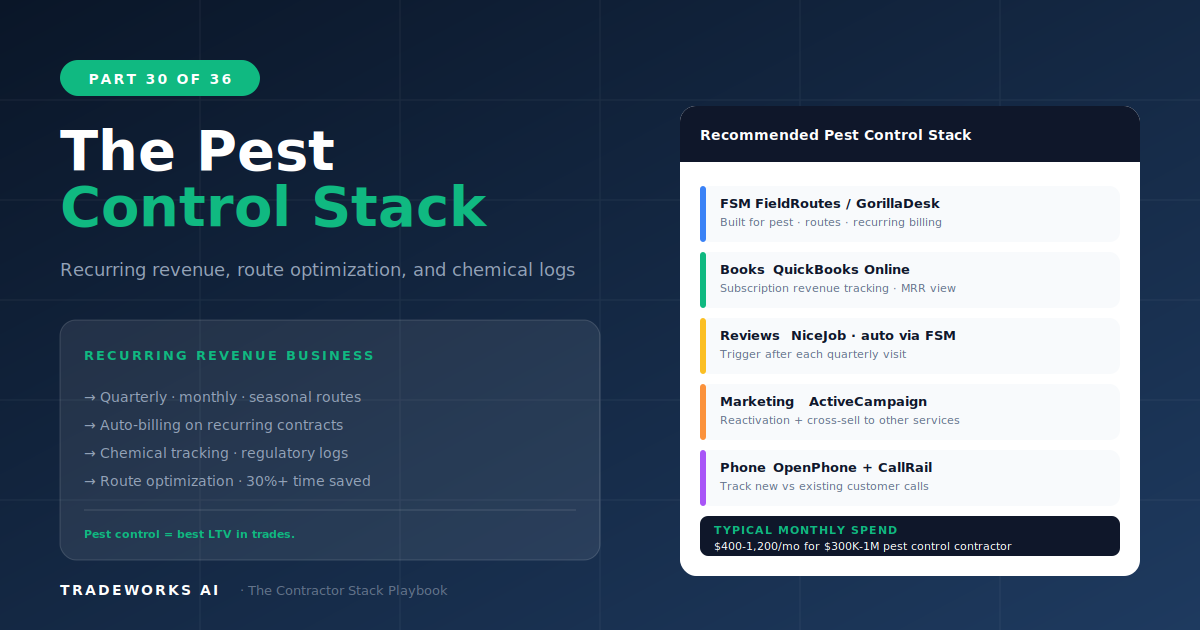
The recommended software stack for a pest control company at Stage 2–3 ($500K–$1.5M revenue) costs $350 to $800 per month and centers on ...
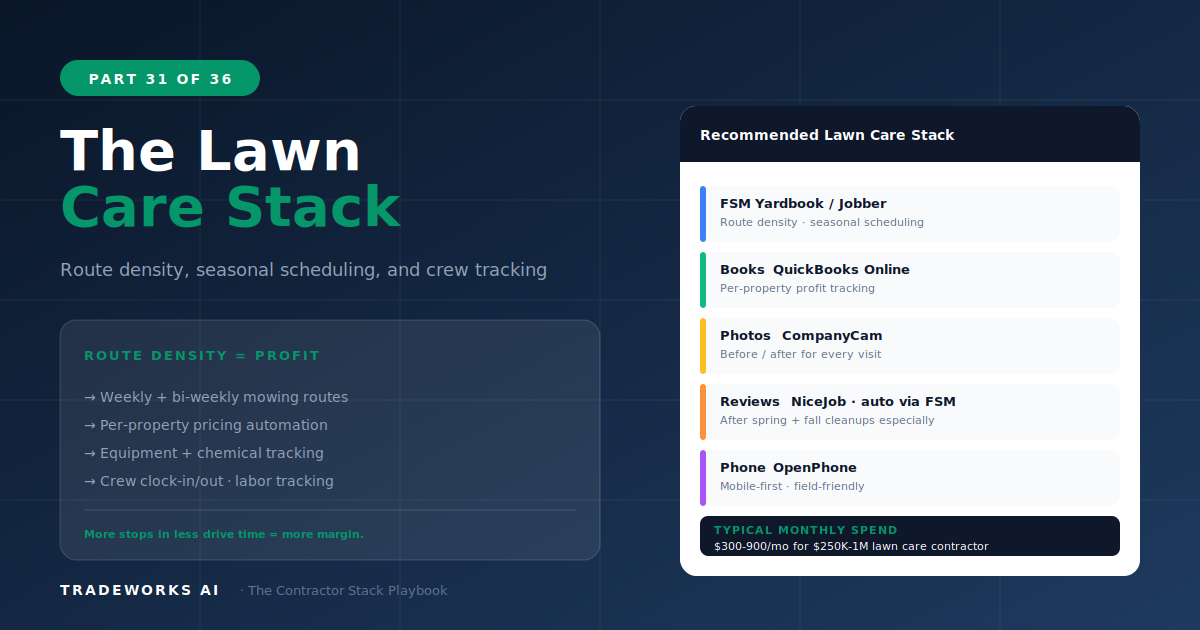
The recommended software stack for a lawn care company at Stage 2–3 ($500K–$1.5M revenue) costs $400 to $1,000 per month and centers on Service Autopilot ($49–$299/month) or Jobber ($149–$249/month) depending on whether the business prioritizes route-based recurring mow contracts or mixed service scheduling. Lawn care shares pest control’s recurring revenue model and route density economics but adds unique requirements: seasonal labor management with summer hiring peaks, service upselling from basic mowing to fertilization, weed control, irrigation, and landscape design, and weather-dependent scheduling that requires daily route adjustments during Florida’s rainy season.
Lawn care sits at the intersection of two stack models seen earlier in this series. Like pest control (Part 30), it is a route-based recurring business where profitability depends on stops per day and route density. Like painting (Part 29), it is a visually demonstrable trade where before/after photos drive marketing. But lawn care adds several unique dimensions:
Multi-service upselling: Most lawn care companies start with basic mowing and expand into fertilization, weed control, aeration, overseeding, irrigation repair, landscape design, hardscaping, and tree/shrub care. Each service addition requires the FSM to track per-property service schedules, pricing tiers, and chemical applications. Service Autopilot handles multi-service management more deeply than general FSMs.
Seasonal labor scaling: Florida lawn care operates year-round but peaks in spring and summer when growth rates surge. Northern markets face extreme seasonality: full crew March–November, skeleton crew December–February. The HR/payroll layer (Part 19) must handle seasonal hiring, W-2 versus 1099 classification, and rapid onboarding. Trainual (Part 18) standardizes crew training for seasonal hires who may have never used a commercial mower.
Weather-dependent daily adjustments: Rain cancels lawn mowing but not fertilization application. The scheduling system must support daily route adjustments, rain-day rescheduling, and customer notification when service is delayed. Service Autopilot’s weather integration and route adjustment tools handle this natively.
Property measurement estimating: Lawn care estimates are driven by property size (lot square footage). LMN and Service Autopilot include measurement-based estimating with overhead and profit margin calculation. Jobber’s general quoting works at Stage 1–2 but requires manual measurement input.
Chemical application tracking: Fertilization and weed control applications require chemical tracking similar to pest control: product, application rate, target, date, technician. Regulatory compliance in many states requires documentation. Service Autopilot tracks this per property.
Jobber is the best starting point for lawn care companies under $500K. The scheduling, invoicing, and client management cover basic mowing operations. At this stage, the business is typically the owner plus 1–2 crew members, handling 30–60 weekly mow accounts. Total: $50–$250/month.
Service Autopilot enters when the business exceeds 100 recurring accounts and route optimization becomes the primary efficiency lever. The platform adds automated recurring billing (critical at scale), route optimization for mow routes, multi-service scheduling (mowing Monday, fertilization Thursday, same property), and chemical application tracking for lawn treatments. NiceJob automates review requests after each mow cycle. ActiveCampaign launches seasonal upsell campaigns: spring fertilization, summer irrigation, fall aeration, winter landscape design.
LMN (Landscape Management Network) becomes relevant for companies adding landscape design and installation alongside maintenance. LMN’s estimating engine calculates material, labor, and overhead costs for landscape projects with more precision than Service Autopilot’s service-focused tools. At Stage 4+, multi-branch management, equipment fleet tracking (Fleetio), and structured seasonal hiring programs (Trainual) round out the enterprise stack.
Lawn care route economics differ from pest control in two ways. First, mow stops average 20–45 minutes versus pest control’s 10–20 minutes, meaning fewer stops per day (8–12 versus 15–18). Second, lawn care routes are more weather-sensitive — a rainy day cancels the entire mow route but not a pest control route. The route density formula adjusts:
Revenue per stop × stops per day × working days (minus rain days) = monthly revenue per crew
Example: $65 avg mow × 10 stops/day × 18 working days (4 rain days) = $11,700/month/crew
With route optimization (12 stops/day): $65 × 12 × 18 = $14,040/month/crew. Difference: $2,340/crew/month.
Using a general FSM past 100 recurring mow accounts when Service Autopilot’s route optimization would save 1–2 hours per day in drive time across the crew.
Manually sending invoices for weekly mow service. At 100+ accounts, manual billing costs $300–$500/month in office labor. Automated billing eliminates this.
Not tracking chemical applications digitally. Regulatory compliance requires documentation. Paper logs get lost. Digital tracking in Service Autopilot or a simple spreadsheet protects the business.
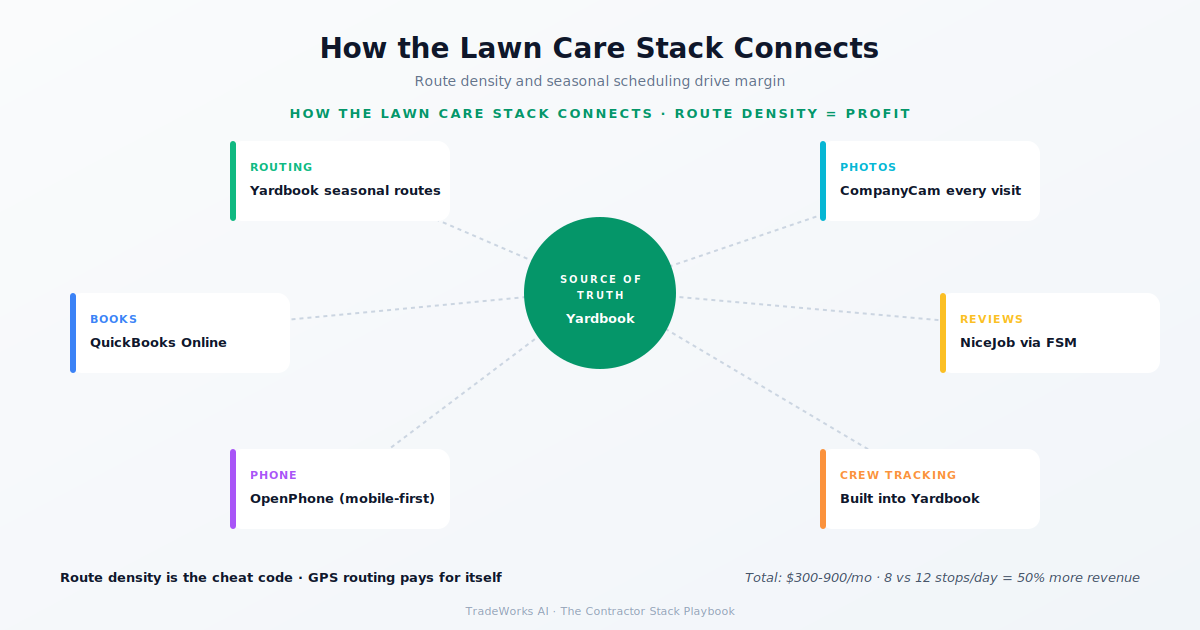
Service Autopilot for lawn care companies with 100+ recurring accounts needing route optimization and automated billing. Jobber for startups and companies under 100 accounts wanting simpler scheduling. LMN for companies adding landscape design and installation services alongside maintenance.
Both are route-based recurring businesses using trade-specific platforms (Service Autopilot for lawn care, PestRoutes for pest control). Key differences: lawn care has longer stop times (20–45 min vs 10–20), more weather disruption, multi-service upselling complexity, and seasonal labor management. The supporting stack (accounting, reviews, email, phone) is identical.
When the maintenance revenue base is stable and the business has $1M+ in recurring revenue, adding landscape design and installation diversifies revenue and increases average customer value. LMN’s estimating engine is purpose-built for this transition. Do not add landscape services before the maintenance base is stable — project-based work without recurring revenue creates cash flow volatility.
Most contractors are paying $400–900 per month for software they barely use, while losing thousands more in hidden costs from manual processes and missed callbacks. Our free audit grades your stack against the maturity model and identifies the highest-ROI changes you can make this quarter.
The recommended software stack for a pest control company at Stage 2–3 ($500K–$1.5M revenue) costs $350 to $800 per month and centers on ...
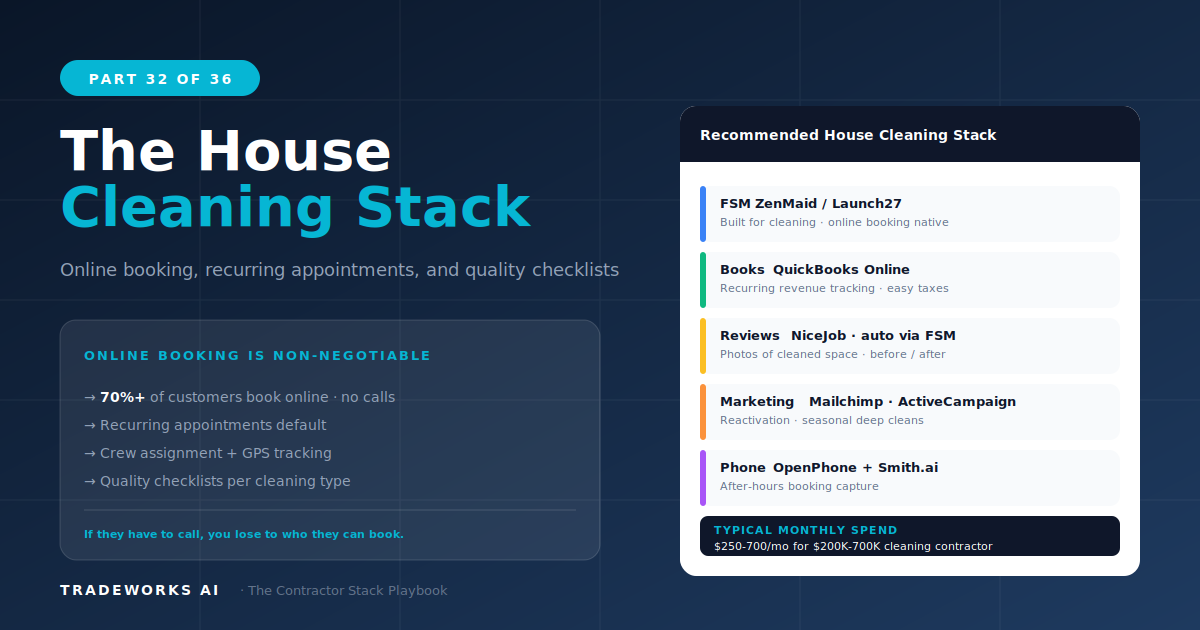
The recommended software stack for a house cleaning company at Stage 2–3 ($300K–$1M revenue) costs $250 to $600 per month and centers on ...