Contractor Stack · Part 28
The Roofing Contractor Stack
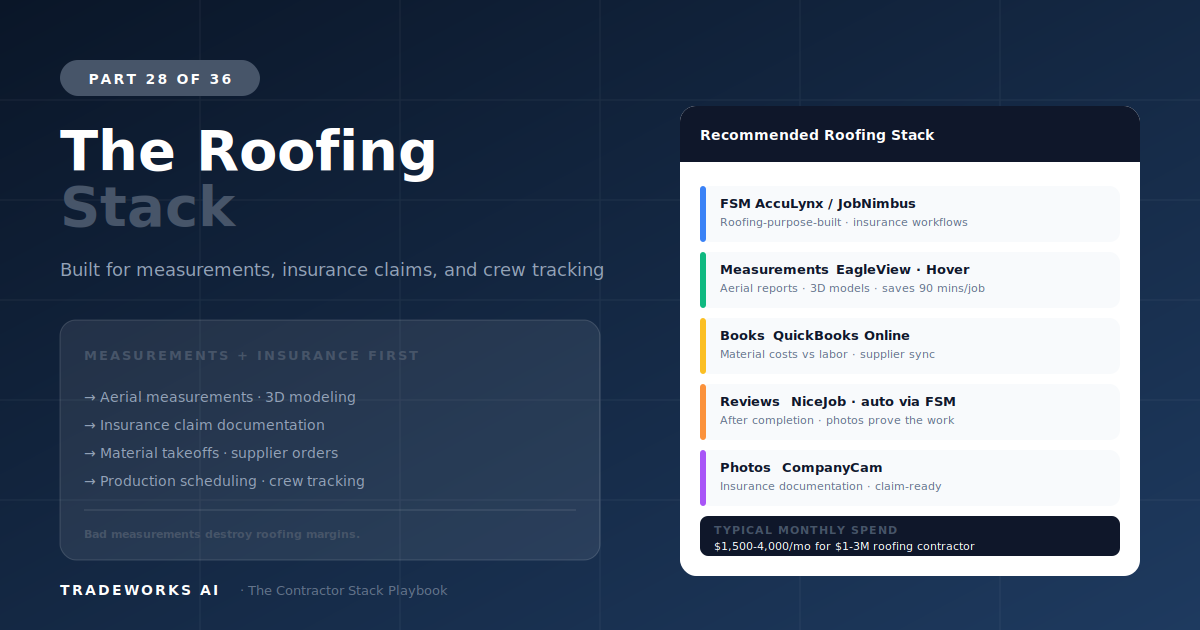
The roofing contractor stack diverges from HVAC, plumbing, and electrical at the most critical layer: the FSM. While those trades follow ...
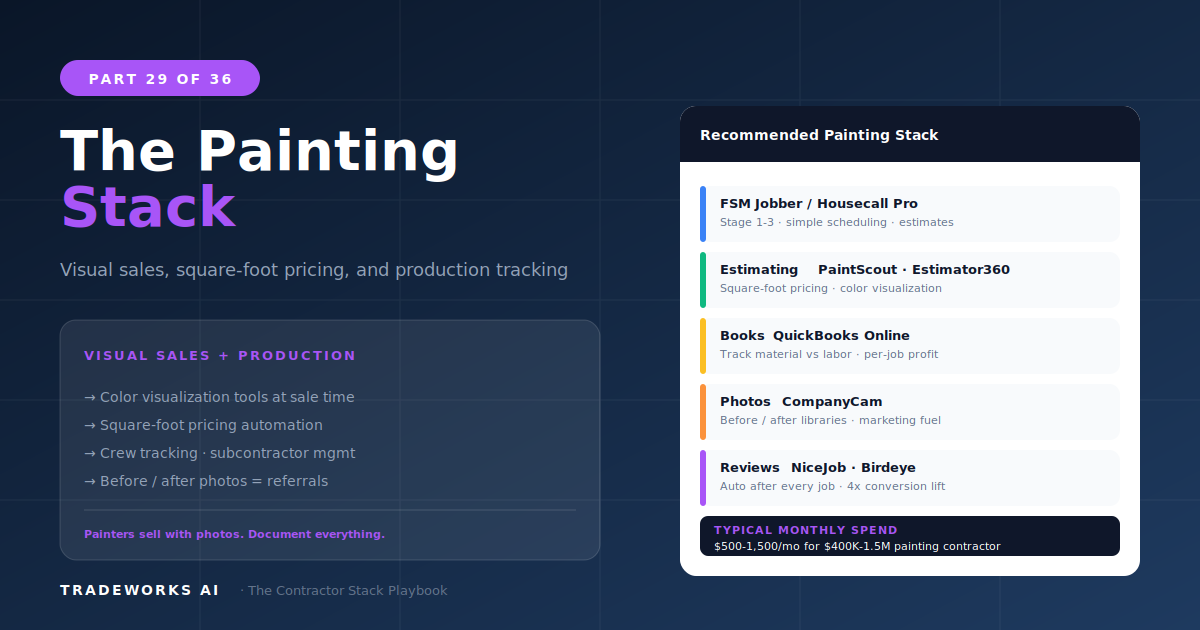
The recommended software stack for a painting contractor at Stage 2–3 ($500K–$1.5M revenue) costs $300 to $700 per month and includes Jobber or Housecall Pro for FSM ($149–$299/month), QuickBooks Online ($60/month), NiceJob ($75/month), ActiveCampaign ($29/month), OpenPhone ($15/user/month), and CompanyCam ($19/user/month). Painting contractors have unique stack priorities: before/after portfolio management is the single most powerful marketing tool in the trade, color consultation and visualization tools influence close rates, estimating by square footage requires measurement-based pricing systems, and the highly visual nature of paint work makes social media content generation easier than any other trade when documented properly.
The painting contractor stack returns to the general FSM progression (Jobber → Housecall Pro) unlike roofing’s divergence to AccuLynx. Painting projects follow a workflow closer to service calls than roofing projects: estimate, schedule, execute over 1–3 days, invoice. General FSMs handle this workflow well. Where painting diverges is in the marketing and documentation layers:
Before/after portfolio: Painting is the most visually transformative trade in home service. A faded, peeling exterior transformed into a fresh, clean finish is the highest-performing social media content in any trade. CompanyCam organizes these photos by project, and NiceJob’s social proof feature automatically converts completed project photos into social media posts. The portfolio IS the marketing strategy for painting contractors.
Color consultation: Homeowners choosing paint colors want to visualize the result before committing. Manufacturer tools (Sherwin-Williams ColorSnap, Benjamin Moore Color Portfolio) and independent apps allow virtual color previews on the actual home photo. While not stack software per se, integrating color consultation into the estimate presentation increases close rates and average ticket (customers choose premium colors when they can see the result).
Square footage estimating: Painting estimates are driven by surface area: walls by square foot, trim by linear foot, ceilings by square foot. PaintScout is a trade-specific estimating platform that calculates pricing from room dimensions and surface counts. At Stage 1–3, Jobber or Housecall Pro’s general quoting with manually calculated square footage works. At Stage 4+, PaintScout’s production rate calculators improve estimate accuracy.
Recurring revenue model: Unlike HVAC maintenance plans, painting’s recurring model is schedule-based: exterior repaints every 5–7 years in Florida (sun and humidity accelerate fading), interior refreshes every 3–5 years for rental properties. ActiveCampaign’s automated sequences can trigger repaint reminders based on the original service date, creating a predictable pipeline of past customers ready for their next project.
Weather dependency: Exterior painting in Florida requires monitoring temperature, humidity, and rain forecasts at the day-of level. Production scheduling must account for weather delays more consistently than interior trades. The FSM’s scheduling should flag exterior jobs for weather review.
Jobber at the lower pricing tier provides clean scheduling, quoting, and invoicing for painting contractors. The critical addition for painting at Stage 1 is photography discipline: even without CompanyCam, every job should be documented with before/after photos using a smartphone. These photos become the marketing portfolio that drives growth. A painter with 50 documented before/after transformations has a more powerful marketing asset than a $5,000/month ad budget.
CompanyCam enters at this stage to formalize photo documentation with GPS tags, timestamps, and project-based organization. NiceJob turns positive reviews into social media posts featuring completed project photos. ActiveCampaign launches two painting-specific campaigns: past-customer repaint reminders (triggered by original service date) and seasonal exterior painting promotions (spring and fall in Florida). This is the stage where the visual portfolio becomes a systematic marketing engine rather than a collection of phone photos.
Larger painting operations need multi-crew scheduling, job costing by project (labor hours vs estimate accuracy), and financing for whole-house exterior projects ($5,000–$15,000). Wisetack or Hearth handles financing. PaintScout adds production-rate estimating that improves margin accuracy for complex projects. Trainual documents prep standards, application techniques, and quality inspection criteria that reduce callbacks from inconsistent crew work.
Paying for social media content creation when CompanyCam + NiceJob automatically generate before/after content from every completed job. Cancel the social media tool; document every job instead.
Paying for a separate portfolio website when CompanyCam’s shareable project galleries serve the same function with automatic updates.
Running Facebook ads without first building a portfolio of 50+ documented before/after transformations. Organic portfolio content outperforms paid ads for painting at Stage 1–2.
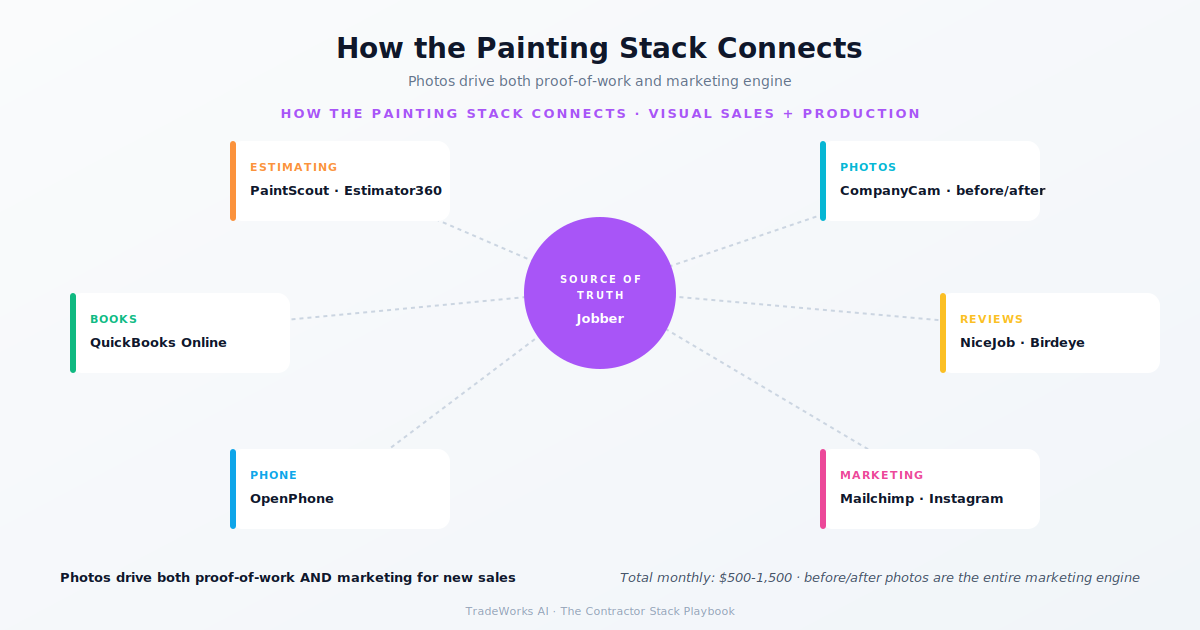
Jobber ($39–$249/month) for FSM at Stage 1–3, upgrading to Housecall Pro when the team grows. The most important non-FSM tool for painters is CompanyCam ($19/user/month) for before/after documentation that becomes the marketing portfolio. Painting is the most visual trade — the portfolio drives growth more than any other software investment.
At Stage 1–3, Jobber or Housecall Pro’s general quoting with manually calculated square footage measurements is sufficient. PaintScout becomes valuable at Stage 4+ when production rate calculations and complex multi-surface estimates justify a dedicated tool. Most painting contractors can grow to $1.5 million without specialized estimating software.
Before/after transformation photos are the highest-performing content in home service social media, and painting produces the most dramatic transformations. Document every job with CompanyCam, enable NiceJob’s social proof auto-posting, and supplement with 2–3 manually curated posts per week showing work in progress, color selection, and crew action shots. The portfolio IS the marketing strategy.
Most contractors are paying $400–900 per month for software they barely use, while losing thousands more in hidden costs from manual processes and missed callbacks. Our free audit grades your stack against the maturity model and identifies the highest-ROI changes you can make this quarter.
The roofing contractor stack diverges from HVAC, plumbing, and electrical at the most critical layer: the FSM. While those trades follow ...
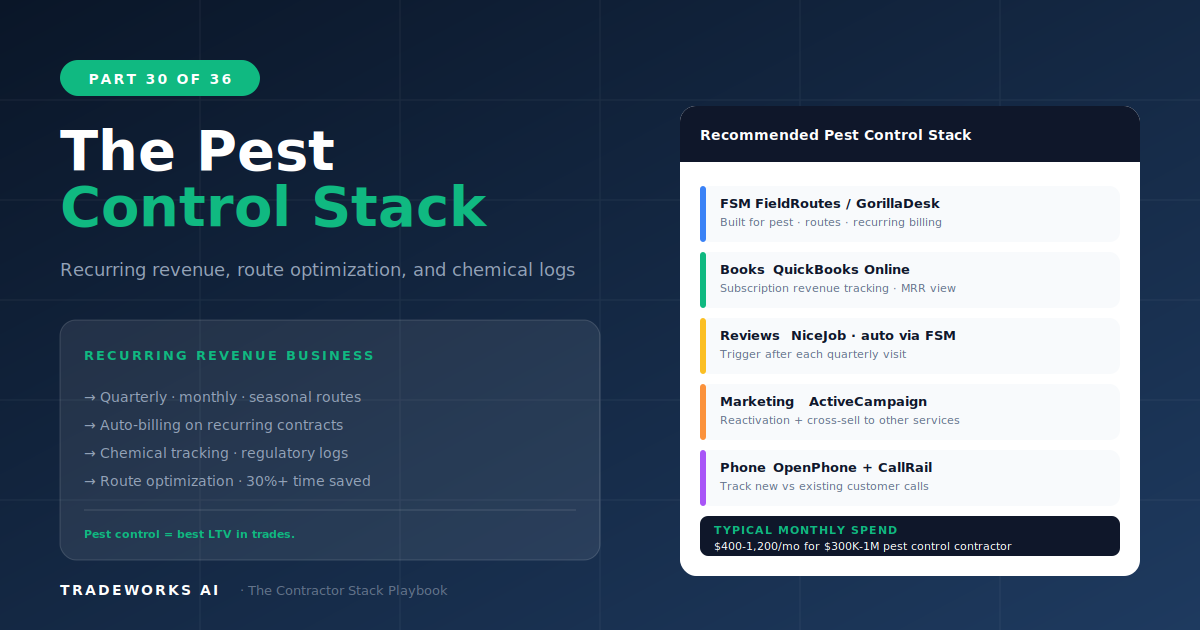
The recommended software stack for a pest control company at Stage 2–3 ($500K–$1.5M revenue) costs $350 to $800 per month and centers on ...