Contractor Stack · Part 9
Phone Systems and VoIP
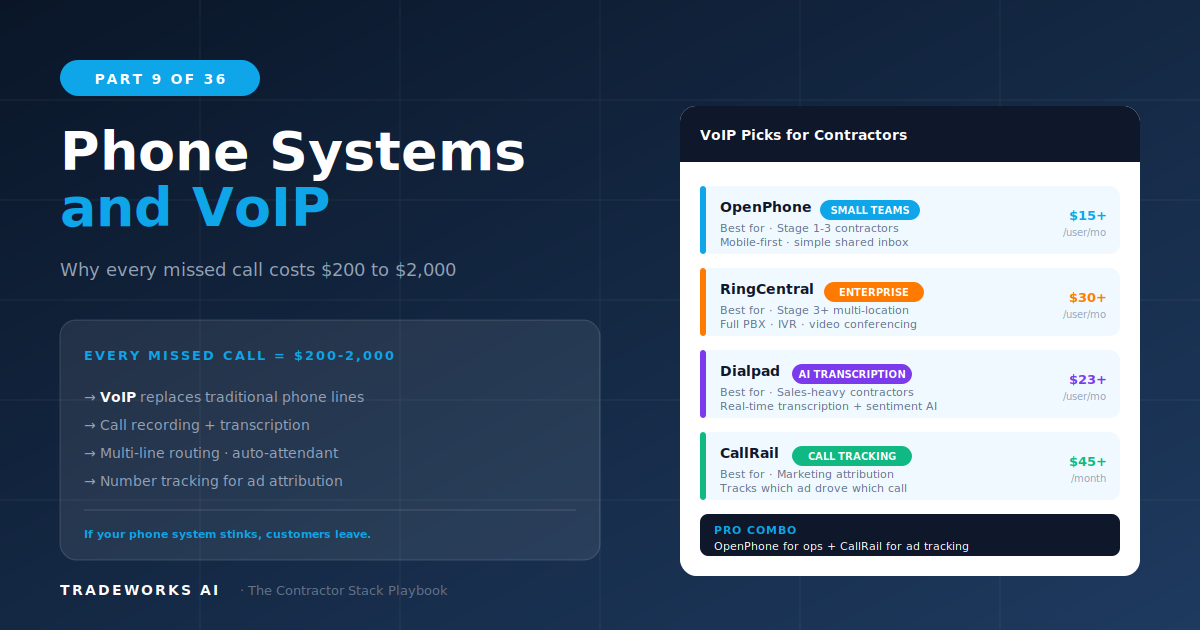
The best phone system for most home service contractors is OpenPhone ($15–$23 per user per month), which delivers a dedicated business nu...
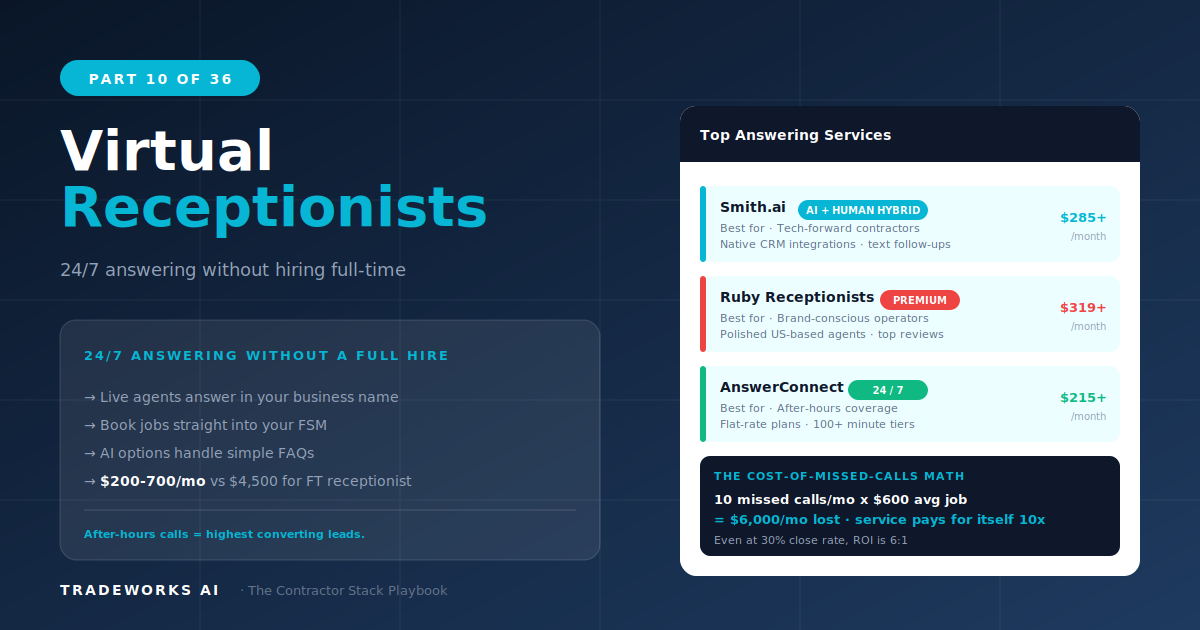
The best virtual receptionist for home service contractors is Ruby ($235–$1,640/month) for premium live call handling, or Smith.ai ($292.50–$1,110/month) for AI-assisted lead qualification with CRM integration. After-hours calls represent the highest-intent leads a contractor receives — a homeowner calling at 10 PM about a broken water heater is not comparison shopping. They are ready to book. A virtual receptionist answers that call live, captures the customer’s information, books the appointment in your scheduling system, and dispatches an on-call technician if needed. The cost per call ranges from $3 to $12 depending on volume and service level, while the average value of an after-hours residential service call is $400 to $2,000.
After-hours calls are fundamentally different from daytime calls. A homeowner calling at 7 AM on a Tuesday is often in research mode — getting estimates, comparing options, asking about availability. A homeowner calling at 10 PM on a Saturday has an emergency. Their AC died in August, their water heater is flooding the garage, or their toilet is overflowing. They are not price shopping. They are booking the first company that answers.
Part 9 covered the speed-to-lead principle: answering within 60 seconds closes at 3 to 5 times the rate of a delayed callback. After hours, this multiplier is even higher because the competitive field narrows dramatically. Most contractors send after-hours calls to voicemail. The contractor who answers live — via a virtual receptionist — captures the lead with near-100% close probability.
The math is straightforward. A virtual receptionist at $300/month handles approximately 50 to 100 calls. If just 3 of those calls convert to service appointments at an average ticket of $500, the service has generated $1,500 in revenue against a $300 cost. That is a 5x return before accounting for customer lifetime value, reviews from emergency service customers, and referrals from grateful homeowners.
Ruby is the premium live receptionist service known for warm, personalized call handling that sounds like an in-house staff member rather than a call center. Receptionists are trained to follow custom call scripts, answer basic service questions, and create the impression that the caller has reached a dedicated office team. For contractors whose brand depends on personal, high-touch customer service, Ruby delivers the most natural caller experience.
The pricing reflects the premium positioning. At $235 for 50 receptionist minutes per month, Ruby’s per-minute cost is higher than competitors. High-volume contractors (200+ calls/month) should calculate per-call cost carefully against alternatives. Integration with CRM and scheduling tools is available but requires Zapier for most contractor platforms.
8-Criteria Score: Trade Fit 4/5, Size 4/5, Integration 3/5, Mobile 3/5, Learning Curve 4/5, Pricing 3/5, Data Ownership 3/5, Support 5/5. Composite: 29/40.
Smith.ai combines live receptionists with AI assistance, creating a hybrid model that handles higher call volumes at lower per-call cost. The AI pre-screens calls, gathers basic information, and routes to a live agent for complex interactions. CRM integration is a core strength — Smith.ai connects natively with HubSpot, Salesforce, and via Zapier with most contractor platforms, automatically creating leads from incoming calls.
For contractors who want lead qualification built into the answering process (asking callers about service type, urgency, property details, and scheduling preferences), Smith.ai’s intake workflow is the most structured in this comparison. The AI-assisted model means consistent data capture even during high-volume periods.
8-Criteria Score: Trade Fit 4/5, Size 4/5, Integration 4/5, Mobile 3/5, Learning Curve 4/5, Pricing 3/5, Data Ownership 4/5, Support 4/5. Composite: 30/40.
AnswerConnect serves high-volume contractors needing 24/7 coverage with fully customizable scripts and overflow handling during peak call times. MAP Communications is the budget option at $47/month for basic after-hours answering with limited features. Nexa specializes in home service businesses with built-in appointment booking and customer intake forms designed for contractor workflows.
For contractors choosing between these three: Nexa’s home service specialization makes it the strongest fit if budget falls between MAP’s basic service and Ruby’s premium tier. AnswerConnect is justified for operations receiving 200+ after-hours calls per month where custom scripting and overflow handling are essential.
The true measure of a virtual receptionist’s value is not the monthly subscription — it is the cost per answered call versus the value of the leads captured.
Ruby: $4.70–$8.20 per call (based on average call length of 2 minutes)
Smith.ai: $5.85–$9.25 per call (blended AI + live agent)
MAP Communications: $2.35–$4.50 per call (basic answering)
Nexa: $4.78–$8.00 per call (with booking)
Compare these costs to the value of one captured emergency call: $400–$2,000 in immediate revenue plus $1,500–$5,000 in customer lifetime value. A 3% conversion rate on after-hours calls makes even premium services profitable.
Part 14 covers AI voice agents (Goodcall, Rosie, Air.ai) that are beginning to compete with human receptionists at lower cost. The current state: AI agents handle basic call routing and information gathering effectively but struggle with complex conversations, emotional callers (common in emergency situations), and nuanced scheduling decisions. For after-hours emergency calls where empathy and judgment matter, human receptionists still outperform AI. For routine daytime overflow, AI agents are increasingly viable. The hybrid approach — AI for initial screening, human handoff for complex calls — is the likely industry standard within 12 to 24 months.
Stage 1–2 (low volume, budget): MAP Communications. Basic after-hours coverage at the lowest cost. Upgrade when call quality and booking become priorities.
Stage 2–3 (growing, service-focused): Ruby or Nexa. Ruby for premium caller experience, Nexa for built-in appointment booking. Both deliver strong ROI from captured after-hours leads.
Stage 3–4 (lead qualification priority): Smith.ai. AI-assisted intake + CRM integration ensures every call becomes a qualified lead in your system automatically.
Stage 4–5 (high volume): AnswerConnect. Custom scripting and overflow handling for 200+ calls/month.
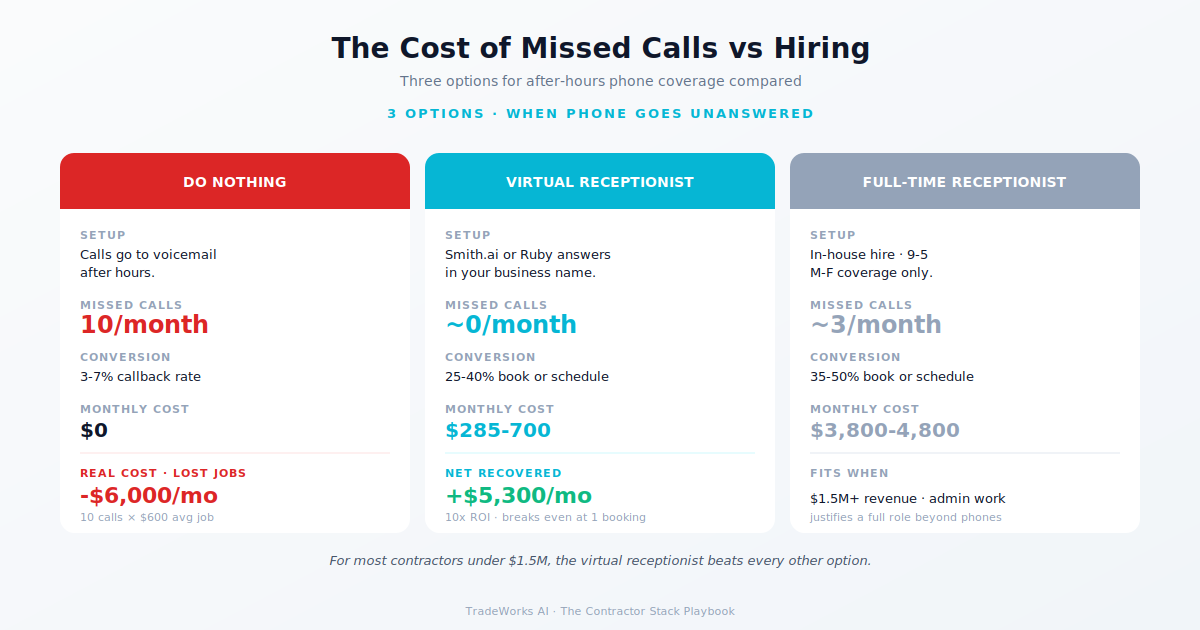
Monthly plans range from $47 (MAP Communications, basic answering) to $1,640+ (Ruby, high-volume premium). Most contractors at Stage 2–3 spend $235–$500/month for 50–150 receptionist minutes, covering after-hours and overflow calls. The cost per captured lead typically falls between $3 and $12, against an average emergency call value of $400–$2,000.
Yes. Nexa offers built-in appointment booking for contractor scheduling systems. Ruby and Smith.ai connect to scheduling tools via Zapier. The booking workflow typically involves the receptionist accessing your available time slots through a web portal and confirming the appointment with the caller in real time.
For after-hours emergency calls where empathy and complex judgment matter, human receptionists outperform AI today. For routine daytime call overflow and basic information gathering, AI agents (Part 14) are increasingly viable at lower cost. The hybrid model — AI for initial screening, human handoff for complex calls — offers the best of both approaches.
Most contractors are paying $400–900 per month for software they barely use, while losing thousands more in hidden costs from manual processes and missed callbacks. Our free audit grades your stack against the maturity model and identifies the highest-ROI changes you can make this quarter.
The best phone system for most home service contractors is OpenPhone ($15–$23 per user per month), which delivers a dedicated business nu...
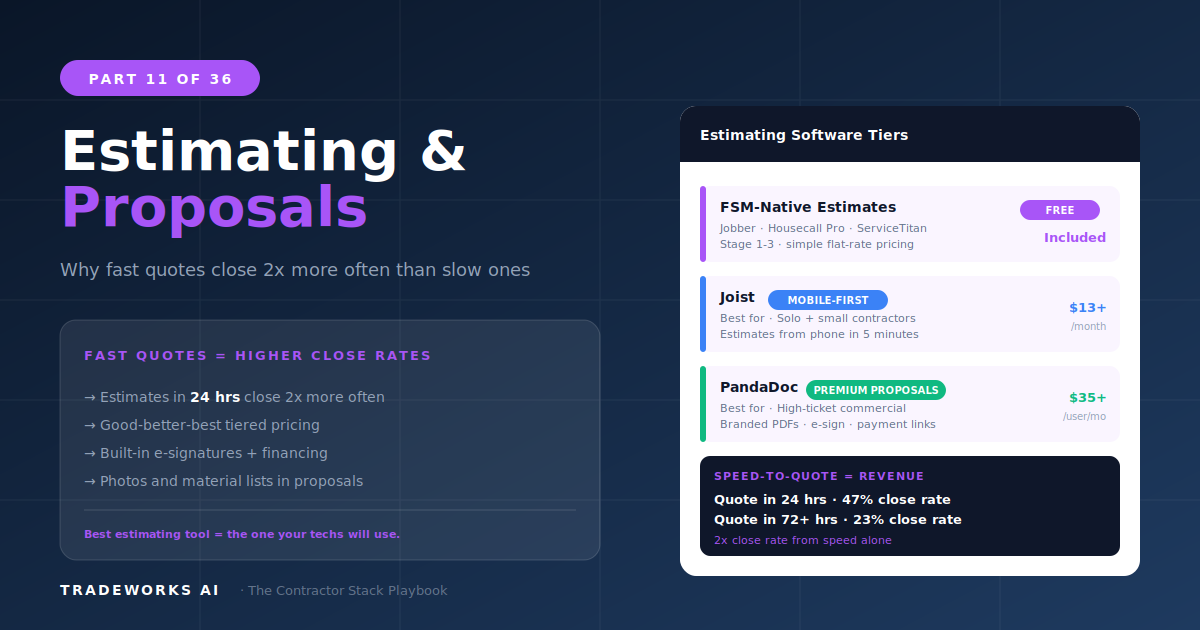
The best estimating software for contractors depends on trade and proposal complexity. For HVAC, plumbing, and electrical contractors usi...