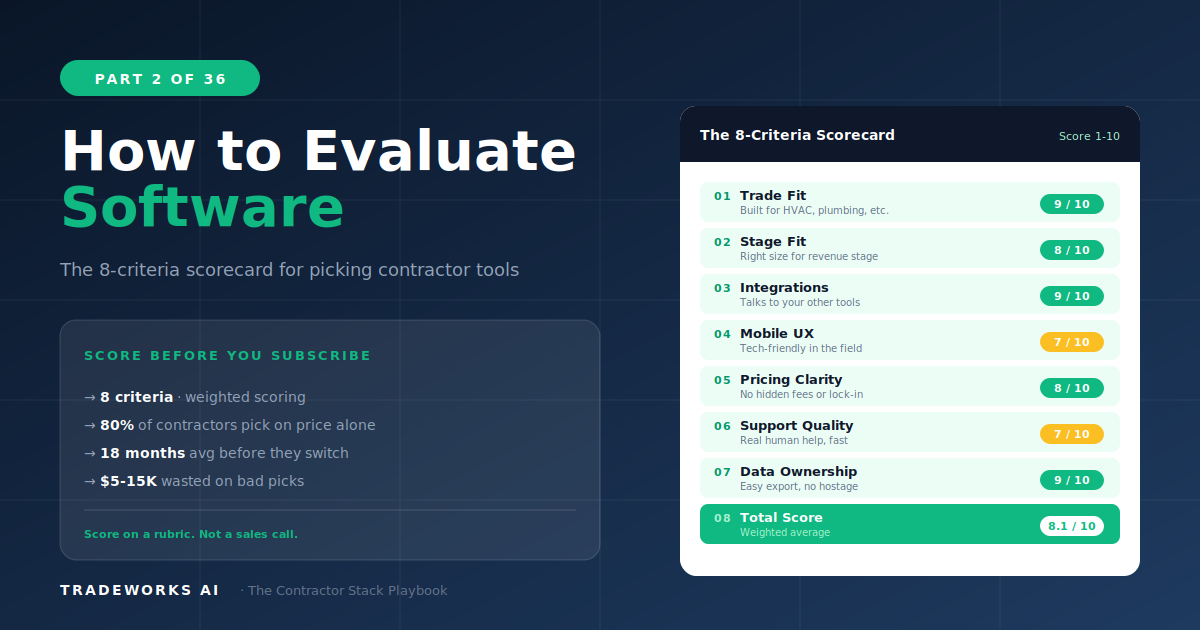
Contractor Stack · Part 2
How to Evaluate Software: The 8-Criteria Framework
The best way to evaluate contractor software is to score each product against eight specific criteria before comparing price: trade fit, ...
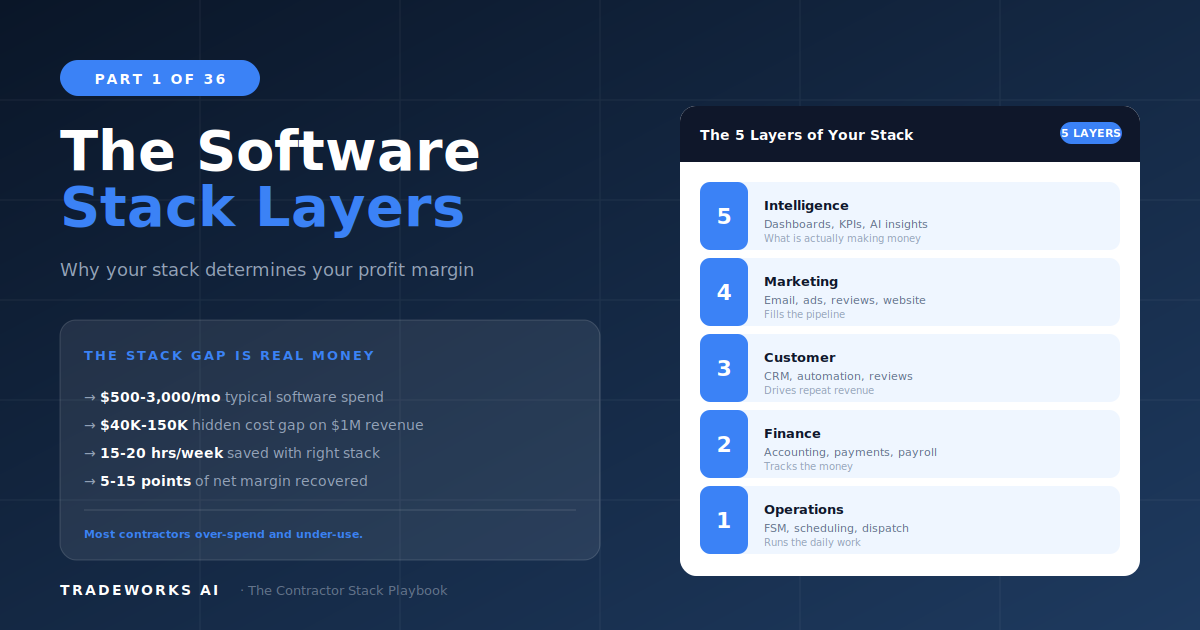
A contractor software stack is the complete set of digital tools a home service business uses to run its operations, finances, customer relationships, marketing, and reporting. Most contractors are spending between $500 and $3,000 per month on software tools they barely use — and losing another $2,000 or more in hidden costs from manual processes, missed appointments, and slow follow-ups that the wrong tools create. The right stack, matched to a contractor’s actual revenue stage and trade, consistently saves 15 to 20 hours per week in administrative labor and adds 5 to 15 percentage points of net profit margin. This guide introduces the five layers every contractor stack contains, the 5-Stage Stack Maturity Model, and why getting your technology right is the single highest-leverage business decision most contractors ignore.
Every contractor has software. The question is whether that software is working for the business or just adding a line item to the credit card statement.
The visible cost of a bad stack is easy to calculate: monthly subscription fees for platforms nobody logs into, duplicate tools that cover the same function, and premium tiers purchased for features the team never activated. A typical contractor running $1 million in annual revenue carries $400 to $900 per month in software subscriptions. That’s not the problem.
The invisible cost is what kills margins. Consider what happens when a contractor operates without the right tools or with tools that don’t talk to each other:
A missed callback turns a $6,000 HVAC install into a lost lead. The homeowner called two other companies while waiting for a return call that never came.
A technician drives 40 minutes to a job site with the wrong part because inventory data lives in a spreadsheet that was updated yesterday — but not synced to the dispatch system.
A five-star review request goes unsent because the CRM doesn’t integrate with the review platform, so the office manager has to remember to send it manually. She forgets 60% of the time.
A $1,200 invoice sits unpaid for 45 days because the payment link was buried in a PDF attachment that the customer never opened. A one-click payment system would have collected it in 48 hours.
A quarterly tax filing takes three days of reconciliation because job costing in the FSM doesn’t match categories in QuickBooks. The bookkeeper charges $150 per hour for the cleanup.
None of these costs show up on a software invoice. They show up in the profit and loss statement as lost revenue, wasted labor, and overhead that should not exist. For a $1 million contractor, the gap between a bad stack and a right-fit stack is typically $40,000 to $150,000 per year in recovered capacity and prevented losses.
A software stack is not one tool. It is the complete ecosystem of digital products a business uses, how they connect, and how data flows between them. For home service contractors, the stack serves five distinct layers of the business. Understanding these layers is the first step toward building a stack that actually works.
Most contractors load up on Layer 1 (operations) because that’s the pain they feel first: scheduling chaos, dispatch confusion, lost paperwork. But the contractors who build real equity and scalable businesses are the ones who invest deliberately in Layers 3 through 5. The customer layer drives repeat revenue. The marketing layer fills the pipeline. The intelligence layer tells you which decisions are actually making money.
A mature stack does not mean an expensive stack. It means every layer has at least one tool that fits, those tools share data instead of creating silos, and the team actually uses them. The most profitable contractors in any trade are not the ones with the most software. They are the ones whose software talks to itself.
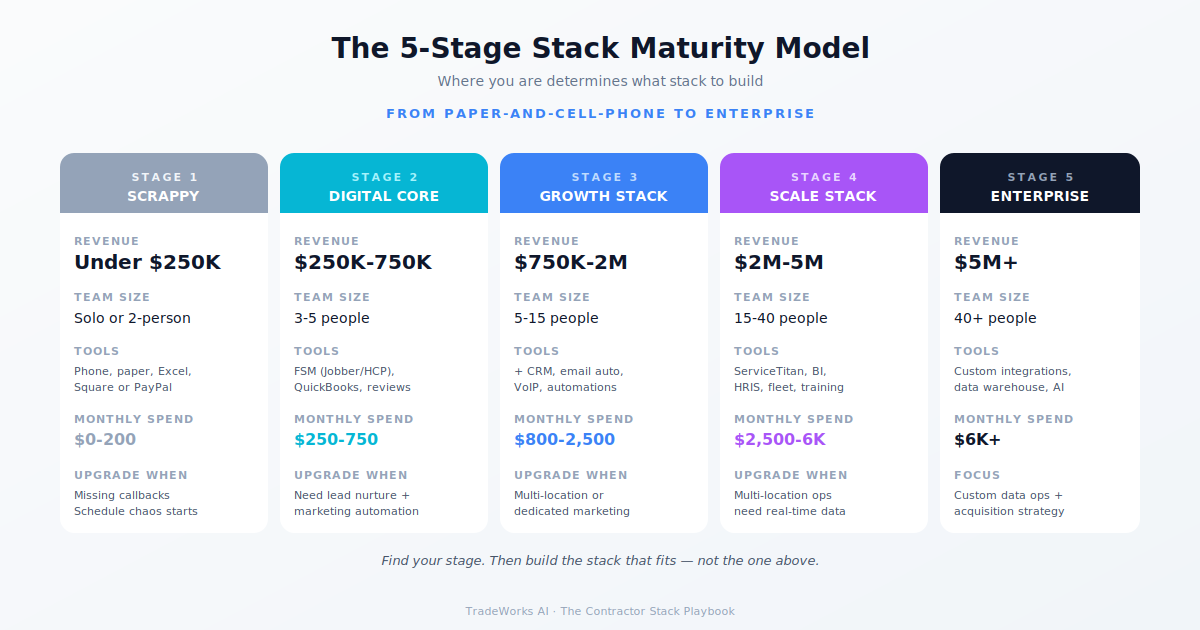
Not every contractor needs ServiceTitan. Not every contractor should be running on paper and a personal cell phone. The right stack depends entirely on where the business sits today and where it is headed in the next 12 to 24 months.
The Stack Maturity Model maps five stages of technology adoption for home service contractors. Each stage has a revenue range, a tool profile, a monthly cost envelope, and a set of upgrade signals that tell you when to move to the next stage.
The model is not prescriptive. A $2 million plumbing company that runs lean with a small team might operate effectively at Stage 3 for years. A $750,000 HVAC company that is growing at 40% per year might need Stage 4 tools now to avoid operational collapse at $1.5 million.
The critical question is not “what stage am I?” but “is my current stage supporting or limiting my growth?” If you are losing jobs because your scheduling system cannot handle volume, you have outgrown your stage. If you are paying $2,000 per month for software features your four-person team has never opened, you are over-staged.
Throughout this series, every software recommendation will reference the maturity stage it fits. Part 2 introduces the 8-Criteria Evaluation Framework that makes the selection process concrete, and Part 3 covers the exact budget math by revenue tier.
This is the most common question contractors ask when they start thinking about their stack: “Should I just get one platform that does everything, or should I pick the best individual tool for each function?”
The honest answer is that neither approach is universally right. The correct answer depends on the business’s maturity stage, team size, and technical tolerance.
Stage 1–2 contractors who need to get digital fast and cannot afford integration complexity.
Solo operators or two-person shops where one login for everything reduces friction.
Businesses that value simplicity over optimization and are not yet at scale where marginal gains matter.
Stage 3+ contractors whose all-in-one platform has weak spots (for example, mediocre CRM inside an otherwise strong FSM).
Businesses that have outgrown their all-in-one’s capacity in a specific function (email marketing, review management, analytics).
Companies with dedicated admin or office staff who can manage integrations via Zapier, Make, or native connections.
The real risk of all-in-one is lock-in. When one platform owns scheduling, dispatching, invoicing, CRM, marketing, and reporting, switching costs become enormous. The real risk of best-of-breed is fragmentation: data lives in six different systems, nothing syncs automatically, and the office manager becomes a human API.
Part 15 of this series is a full deep dive on GoHighLevel — the most popular all-in-one platform in the contractor space right now — evaluated against a best-of-breed stack at equivalent capability. Part 16 covers the automation and integration tools (Zapier, Make) that make best-of-breed stacks functional without manual data transfers.
Before buying new software, every contractor should audit what they already own. The most common finding in a stack audit is not missing tools — it is unused features in tools the business is already paying for.
The Underutilization Audit is a structured review of every software subscription against actual usage. Here is the process:
Pull every recurring software charge from the last 90 days. Bank statements and credit card records catch tools that auto-renewed without anyone noticing.
For each tool, identify: Who logs in? How often? Which features are active? Which features are available but untouched?
Categorize each tool: Essential (used daily, no alternative), Underutilized (paying for premium but using basic features), Redundant (another tool covers the same function), Abandoned (nobody has logged in for 30+ days).
Calculate the monthly cost of Underutilized, Redundant, and Abandoned tools combined. This is the immediate savings opportunity.
In TradeWorks AI’s experience auditing contractor software stacks, the average home service business is carrying $150 to $400 per month in Redundant or Abandoned software. That is $1,800 to $4,800 per year freed up by canceling tools that are not producing value. But the larger number is usually in the Underutilized category: contractors paying for ServiceTitan Pro but only using basic scheduling, or paying for ActiveCampaign but never building an automation sequence.
Part 35 of this series features a live Contractor Stack Teardown — a real contractor’s software spend audited on camera with specific recommendations and projected savings.
This article is Part 1 of a 40-part series covering every category of software a home service contractor touches. The series is organized into five phases:
Phase 1: Foundations (Parts 1–3). How to think about your stack, evaluate software, and set a budget.
Phase 2: Category Deep Dives (Parts 4–24). Individual product reviews and comparisons for FSM, CRM, accounting, reviews, email marketing, phone systems, AI tools, estimating, payments, financing, automation, and more.
Phase 3: Trade-Specific Stacks (Parts 25–32). Recommended stacks for HVAC, plumbing, electrical, roofing, painting, pest control, lawn care, and house cleaning at every maturity stage.
Phase 4: Live Application (Parts 33–35). Building a stack from zero, migrating between platforms, and a live teardown of a real contractor’s software spend.
Phase 5: Strategy and Finale (Parts 36–40). Integration architecture, switching playbooks, the agency vs. DIY decision, annual optimization, and the master decision matrix covering all trades and stages.
Every part uses the same 8-Criteria Evaluation Framework introduced in Part 2, provides specific pricing breakdowns, names real products with real opinions, and ends with a “Cancel This” action item — one thing the contractor can do that week to improve their stack immediately.
This series has no affiliate links and no sponsored product placements. TradeWorks AI does not receive referral fees from any software vendor reviewed in The Contractor Stack. Every recommendation is based on hands-on experience deploying these tools for real contractor clients.
A contractor software stack is the complete collection of digital tools a home service business uses across operations, finances, customer management, marketing, and business intelligence. It includes field service management platforms, accounting software, CRM systems, review tools, email marketing, and any automation or AI tools. The stack is not just the individual products but how they connect and share data.
A healthy software budget for a home service contractor is typically 1 to 3 percent of annual revenue. For a $500,000 company, that is $400 to $1,250 per month. For a $2 million company, $1,600 to $5,000 per month. Part 3 of this series breaks down the exact math by revenue tier, including ROI expectations for each category of tool.
It depends on your business size and complexity. Stage 1–2 contractors (under $750,000 revenue) often benefit from an all-in-one platform for simplicity. Stage 3+ contractors usually outgrow all-in-one limitations in at least one function and benefit from dedicated tools connected via integrations. Part 15 provides a head-to-head comparison of GoHighLevel versus a best-of-breed stack at equivalent capability.
Buying based on price alone. Eighty percent of contractors who choose software by picking the cheapest option end up switching within 18 months, losing data, retraining their team, and spending more total than if they had selected the right-fit tool from the start. The second biggest mistake is buying software for features they do not need yet, paying premium prices for capability their team will not use until 12 to 24 months later.
Three signals indicate it is time to move to the next maturity stage: you are losing leads because your current tools cannot handle volume, your team is creating manual workarounds for functions the platform should automate, or you are spending more time managing your software than using it. The 5-Stage Stack Maturity Model in this article maps the revenue ranges and upgrade triggers for each transition.
Most contractors are paying $400–900 per month for software they barely use, while losing thousands more in hidden costs from manual processes and missed callbacks. Our free audit grades your stack against the maturity model and identifies the highest-ROI changes you can make this quarter.
The best way to evaluate contractor software is to score each product against eight specific criteria before comparing price: trade fit, ...
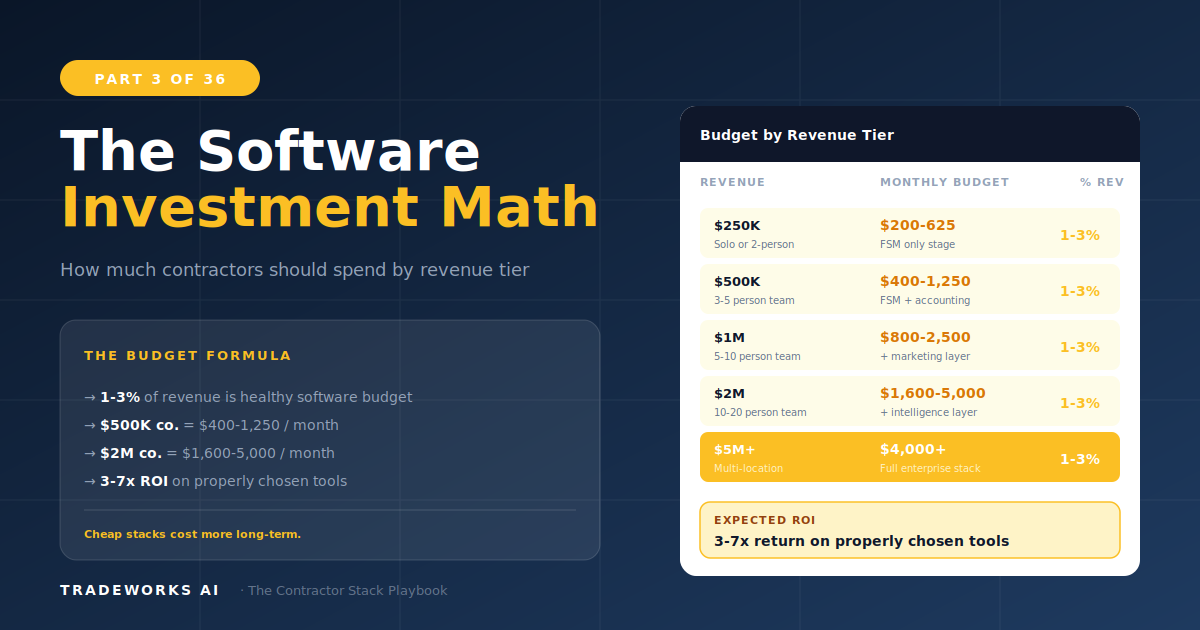
A home service contractor should spend between 1 and 3 percent of annual revenue on software tools. For a $500,000 company, that means $3...