Contractor Stack · Part 31
The Lawn Care Contractor Stack
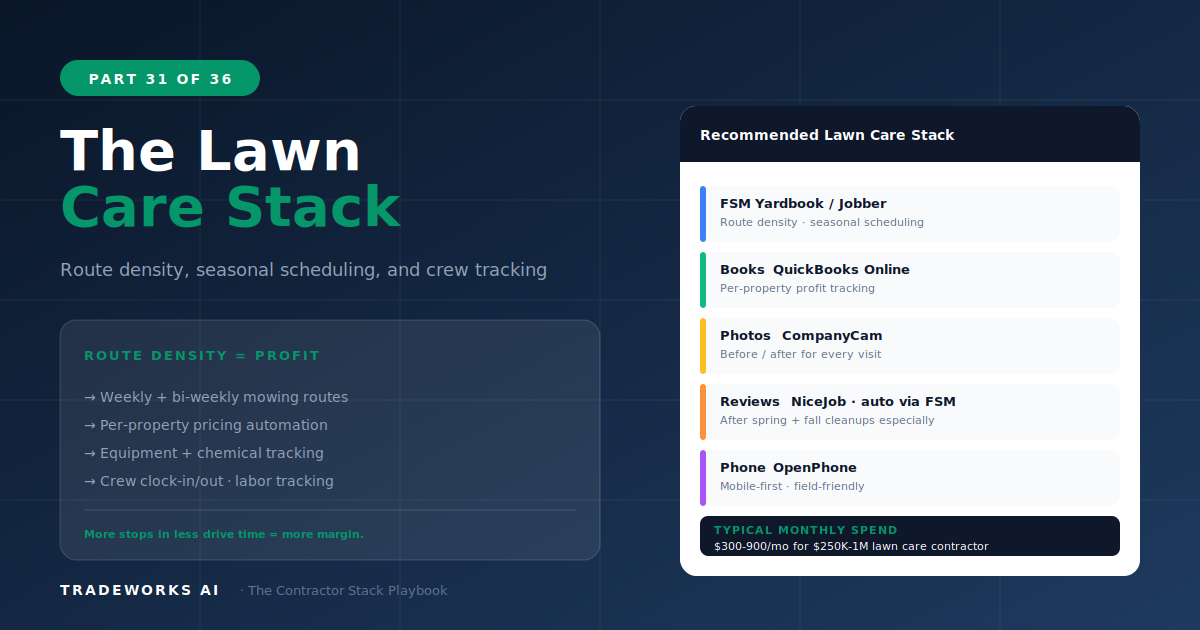
The recommended software stack for a lawn care company at Stage 2–3 ($500K–$1.5M revenue) costs $400 to $1,000 per month and centers on S...
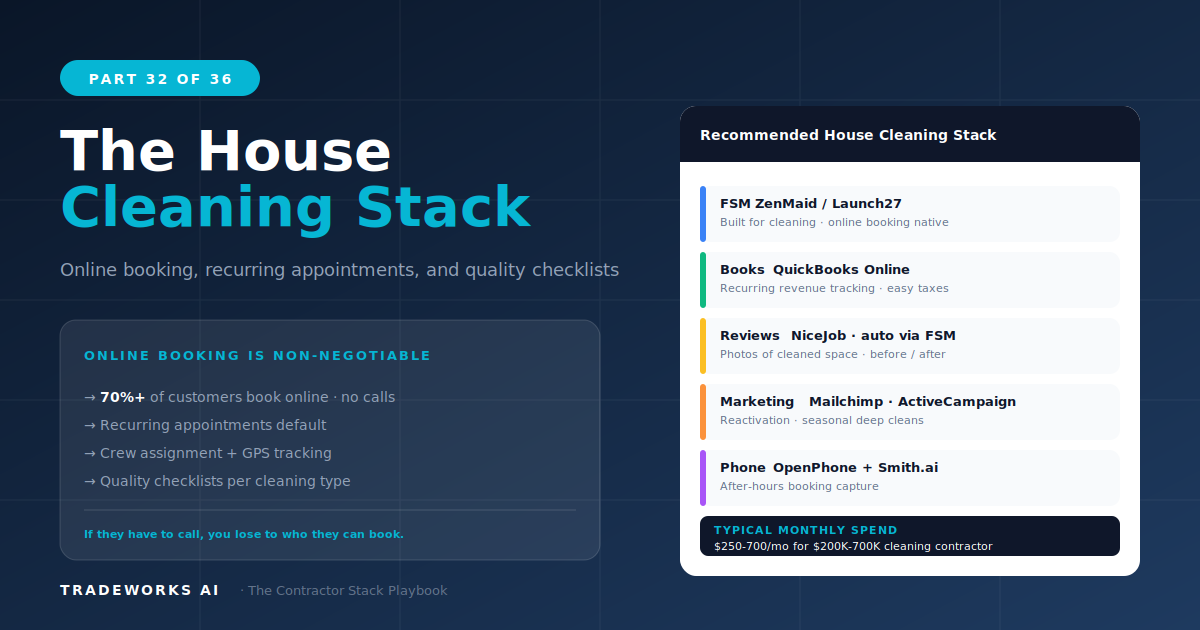
The recommended software stack for a house cleaning company at Stage 2–3 ($300K–$1M revenue) costs $250 to $600 per month and centers on ZenMaid ($99–$199/month) for cleaning-specific scheduling and automation or Housecall Pro ($149–$299/month) for a broader FSM with cleaning-friendly features. House cleaning is the most recurring-revenue-dependent trade in this series, with 70 to 90 percent of revenue from weekly, biweekly, and monthly cleaning contracts. The stack must automate online booking with instant quoting (ResponsiBid at $99/month eliminates phone-based estimates), manage multi-team daily schedules across dozens of homes, track quality through digital checklists, and reduce customer churn through automated communication and satisfaction follow-ups.
House cleaning has the highest recurring revenue percentage of any trade in this series. A mature cleaning company generates 70 to 90 percent of revenue from recurring contracts — higher even than pest control (60–80%). This extreme dependency on recurring revenue means customer retention is the single most important metric, and churn management drives more profitability than new customer acquisition at Stage 2 and above.
Online booking with instant quotes: Cleaning customers expect to book online without a phone call. ResponsiBid (Part 11) provides automated quoting based on property details: the customer answers questions about home size, number of bedrooms/bathrooms, pet ownership, and cleaning frequency, then receives an instant price. This eliminates the site visit bottleneck that limits growth for phone-based cleaning companies.
Multi-team daily scheduling: A cleaning company with 8 to 12 teams schedules 15 to 30 homes per day. Each team needs an optimized route, arrival time windows communicated to customers, and real-time schedule adjustments for cancellations and add-ons. ZenMaid is purpose-built for this workflow. General FSMs handle it but with more manual configuration.
Quality checklists: Cleaning quality consistency is the primary churn driver. When Team A cleans to standard but Team B misses the guest bathroom, the customer cancels. Digital checklists (room-by-room completion with photo verification) standardize quality across all teams. ZenMaid and Housecall Pro support digital checklists with varying depth.
Airbnb and short-term rental turnover: Short-term rental cleaning (turnover cleans between guests) is a growing revenue segment with unique scheduling requirements: variable timing based on guest check-in/check-out, higher frequency than residential recurring, and integration with property management platforms like Guesty, Hostaway, or Airbnb direct. The cleaning FSM must support this scheduling flexibility.
Customer churn management: With 70–90% recurring revenue, a 5% monthly churn rate means replacing 60% of the customer base annually. Reducing churn from 5% to 3% at 200 customers saves 48 customers per year — at $150 average monthly value per customer, that is $7,200/month in retained recurring revenue. ActiveCampaign’s post-service satisfaction surveys and automated re-engagement sequences directly address churn.
ZenMaid or Launch27 at entry pricing provides cleaning-specific scheduling with customer notifications, team assignment, and basic invoicing. Jobber is an alternative for cleaning companies that also handle other services (deep cleaning, post-construction, commercial). QuickBooks handles accounting. At this stage, the owner is likely cleaning alongside 1–2 team members. Total: $30–$200/month.
ResponsiBid eliminates phone-based quoting by generating instant online estimates. This is transformative for cleaning companies: instead of returning calls and scheduling site visits, new customers receive an immediate price and can book online. NiceJob automates review requests after every clean (biweekly cleans = biweekly review opportunities per customer). ActiveCampaign handles satisfaction surveys, referral requests, and seasonal deep clean promotions.
At $1M+, cleaning companies manage 8–15 teams across dozens of daily homes. Quality consistency becomes the primary challenge: digital checklists, post-clean photo verification, and customer satisfaction tracking prevent the quality degradation that drives churn at scale. Trainual documents cleaning standards for every room type, every surface, and every special instruction. The hiring pipeline for cleaning technicians must be systematized because turnover in cleaning is higher than most trades.
Churn is the silent revenue killer for cleaning companies. The math:
200 recurring customers at $150 average monthly value = $30,000/month recurring revenue
5% monthly churn = 10 customers lost per month = $1,500/month lost
3% monthly churn = 6 customers lost per month = $900/month lost
Reducing churn by 2 percentage points saves $600/month = $7,200/year in retained revenue
Churn reduction costs nearly nothing: a post-clean satisfaction text (automated via Zapier + ActiveCampaign), quality checklists to prevent service failures, and a save-offer automation that triggers when a customer requests cancellation. These three automations can shift churn by 1–3 percentage points.
Manually quoting every new customer by phone or site visit. ResponsiBid at $99/month generates instant online quotes and eliminates the bottleneck. Your phone should be for bookings, not estimates.
Not tracking customer churn monthly. If you do not know your churn rate, you do not know if growth is real. Track it in ZenMaid or a spreadsheet. Target below 3% monthly.
Skipping post-clean quality verification. One missed bathroom cancels a 2-year customer. Digital checklists with photo completion take 3 minutes per clean and prevent the quality failures that drive churn.
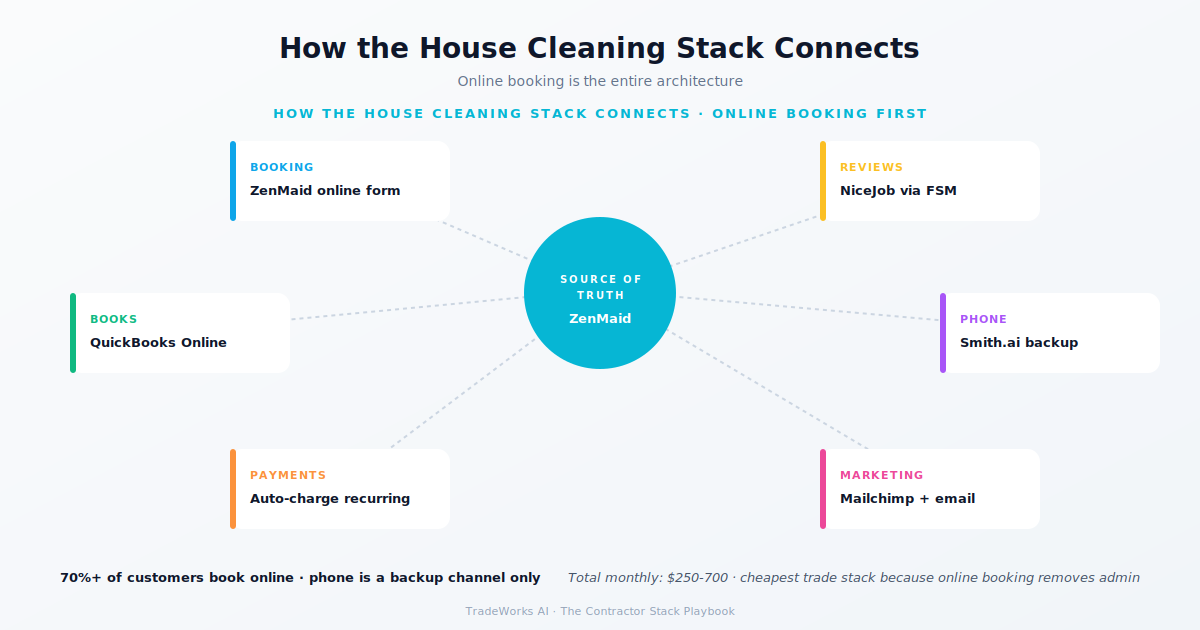
ZenMaid for cleaning-specific scheduling and automation at Stage 1–4. Housecall Pro for cleaning companies that want broader FSM features with marketing tools. ResponsiBid for instant online quoting that eliminates phone-based estimates. The cleaning stack is lower cost than HVAC or plumbing because ticket sizes and complexity are lower.
Three automated interventions: post-clean satisfaction text asking for a 1–5 rating (scores below 4 trigger a manager callback), quality checklists with photo verification on every clean, and a save-offer automation when a customer requests cancellation (discount on next clean or service upgrade). Together, these reduce monthly churn by 1–3 percentage points.
Yes, with caution. Airbnb turnover cleans are higher frequency and higher margin than residential recurring cleans, but scheduling is variable and dependent on guest booking patterns. Add turnover cleans when your residential recurring base is stable and you have scheduling capacity. Do not build the business primarily on short-term rental cleaning — platform policy changes or rental regulations can eliminate the revenue overnight.
Most contractors are paying $400–900 per month for software they barely use, while losing thousands more in hidden costs from manual processes and missed callbacks. Our free audit grades your stack against the maturity model and identifies the highest-ROI changes you can make this quarter.
The recommended software stack for a lawn care company at Stage 2–3 ($500K–$1.5M revenue) costs $400 to $1,000 per month and centers on S...
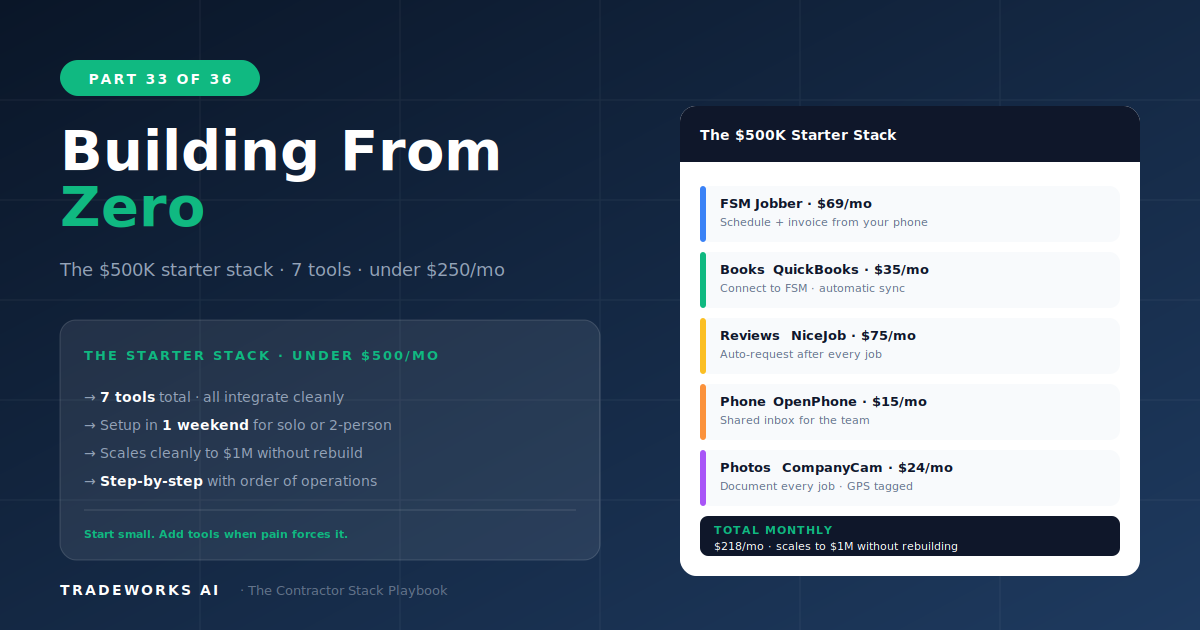
A complete software stack for a startup or small contractor generating up to $500,000 in annual revenue can be assembled in 5 days for $1...