Contractor Stack · Part 25
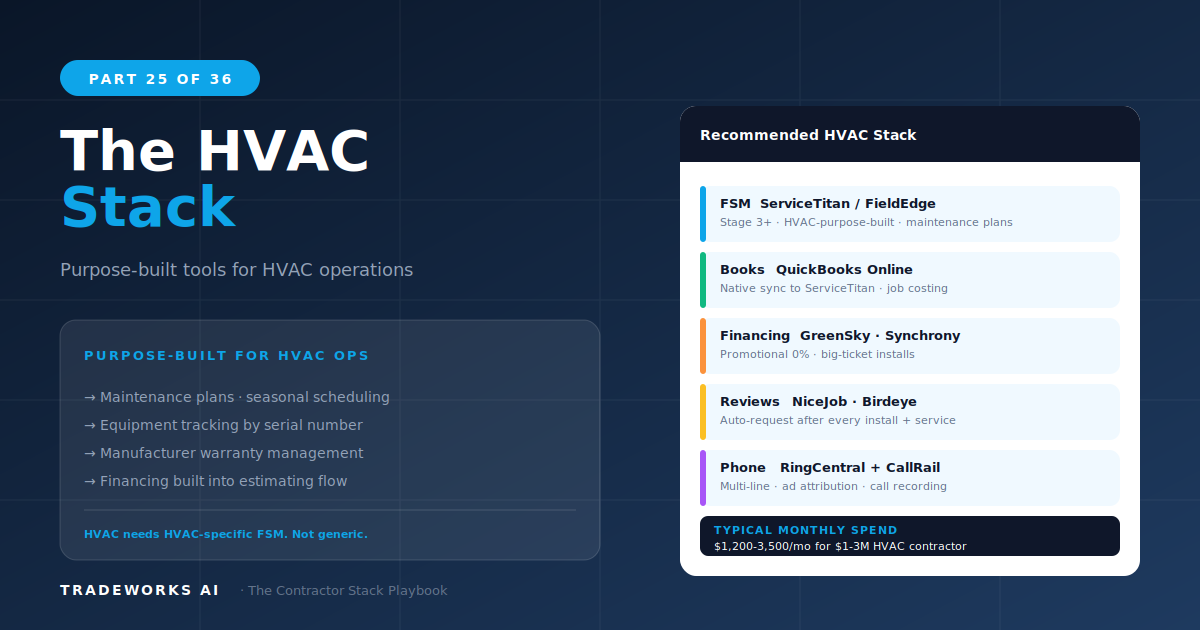
The HVAC Contractor Stack
The recommended software stack for an HVAC contractor at Stage 2–3 ($500K–$2M revenue) costs $400 to $900 per month and includes Housecal...
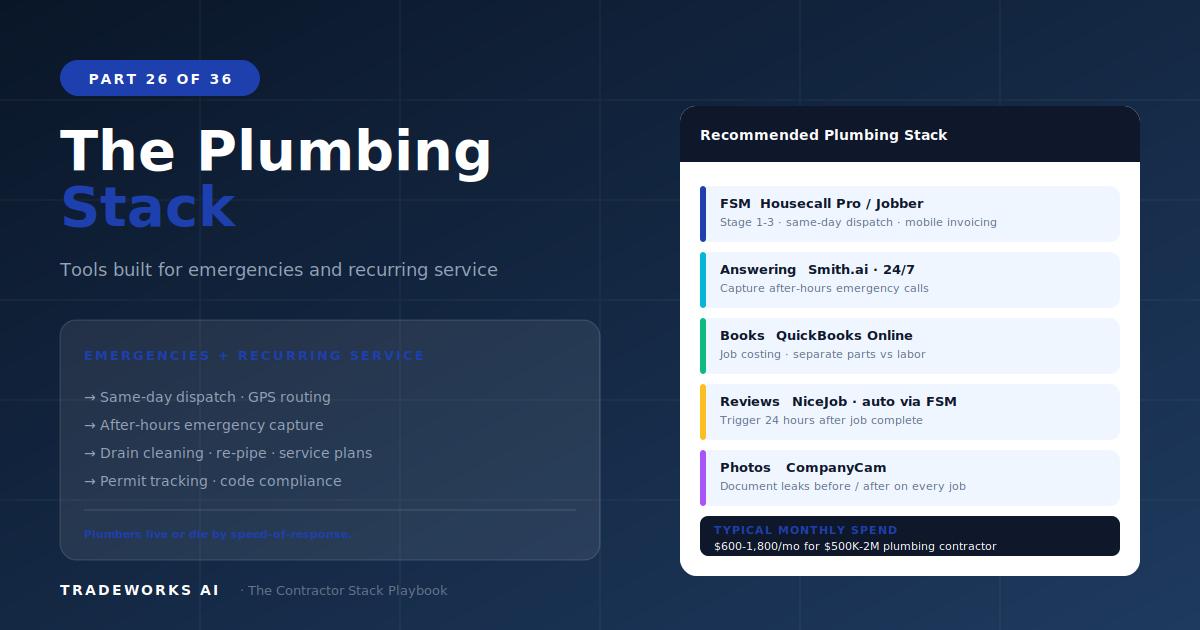
The recommended software stack for a plumbing contractor at Stage 2–3 ($500K–$2M revenue) costs $400 to $850 per month and includes Housecall Pro for FSM ($149–$299/month), QuickBooks Online ($60/month), NiceJob ($100/month), ActiveCampaign ($49/month), and OpenPhone ($15/user/month). Plumbing contractors have unique stack requirements: emergency call handling for after-hours flooding and sewer backups, drain maintenance plan tracking for recurring revenue, sewer camera documentation integrated with estimates, and water heater replacement pricebooks with Good/Better/Best presentation. This guide maps the complete plumbing stack at every maturity stage with HVAC comparisons where the stacks diverge.
The plumbing stack shares much of its structure with the HVAC stack from Part 25 — both trades need FSM, accounting, reviews, email, and phone systems. But several plumbing-specific requirements create divergence points:
Emergency call priority: Plumbing emergencies (burst pipes, sewer backups, gas leaks) are among the most time-sensitive calls in home service. A homeowner with water flooding their kitchen will call three companies and book the first one that answers. After-hours answering (Part 10) and AI voice agents (Part 14) are higher priority for plumbing than many other trades because the emergency conversion window is measured in minutes, not hours.
Drain maintenance plans: Recurring drain cleaning and hydro-jetting plans are the plumbing equivalent of HVAC maintenance agreements. The FSM must track plan status, schedule recurring service, automate renewal reminders, and attribute recurring revenue separately. ActiveCampaign’s email automation handles renewal sequences (Email Playbook Part 8).
Sewer camera documentation: Sewer camera inspections generate video and photo documentation that must be stored, organized by property, and presented to customers alongside repair estimates. CompanyCam (Part 17) handles photo documentation. Video storage requires either FSM-native media management or cloud storage with property-indexed organization.
Water heater and repipe estimates: Tank vs tankless water heater replacements and whole-house repipe projects are the plumbing equivalent of HVAC system replacements — $3,000 to $15,000+ projects that benefit from Good/Better/Best tiered presentation (Part 11) and customer financing (Part 13).
Well water and water quality: In Florida and rural markets, well water testing, water softener installation, and water quality solutions represent a growing revenue segment. The FSM should track water test results by property and trigger follow-up recommendations based on results.
The plumbing startup stack mirrors the HVAC Stage 1–2 recommendation: Jobber for FSM, QuickBooks for accounting, Google Workspace for email and documents. The difference is urgency: plumbing contractors should add a business phone system (OpenPhone at $15/user) earlier than other trades because emergency call capture is a primary revenue driver from day one. A missed midnight sewer backup call is a $1,500 to $5,000 lost opportunity. Total: $100–$350/month.
Housecall Pro provides the mid-market FSM with automated review requests and flat-rate team pricing. NiceJob amplifies review velocity for local ranking. ActiveCampaign launches drain maintenance plan promotions and seasonal campaigns (spring pipe inspections, winter freeze prevention in northern markets, hurricane prep in Florida). OpenPhone’s shared inbox ensures emergency calls reach someone on the team 24/7.
The plumbing-specific “Cancel This” at this stage: paying for a separate CRM when Housecall Pro’s built-in customer tracking plus ActiveCampaign’s CRM module cover the same function. One customer database, not three.
ServiceTitan enters the plumbing stack at $2M+ for the same reasons as HVAC: pricebook management (water heater options presented as Good/Better/Best), membership tracking (drain maintenance plans), and marketing attribution. CompanyCam becomes essential for sewer camera documentation — organizing inspection photos and videos by property address for future reference and customer communication. Wisetack handles on-site financing for repipe and water heater replacement projects. At Stage 4–5, AI dispatching and predictive tools optimize technician routing and emergency prioritization.
Emergency call infrastructure is higher priority for plumbing — add business phone and after-hours answering earlier.
Video documentation (sewer cameras) adds a media management requirement that HVAC does not have at the same intensity.
Drain maintenance plans use the same software as HVAC maintenance agreements but require different email sequences and renewal timing (typically annual vs biannual).
Water quality testing and treatment is a unique plumbing revenue segment with no HVAC equivalent — track test results in the FSM for follow-up marketing.
The FSM selection is identical: Jobber → Housecall Pro → ServiceTitan is the same progression for both trades.
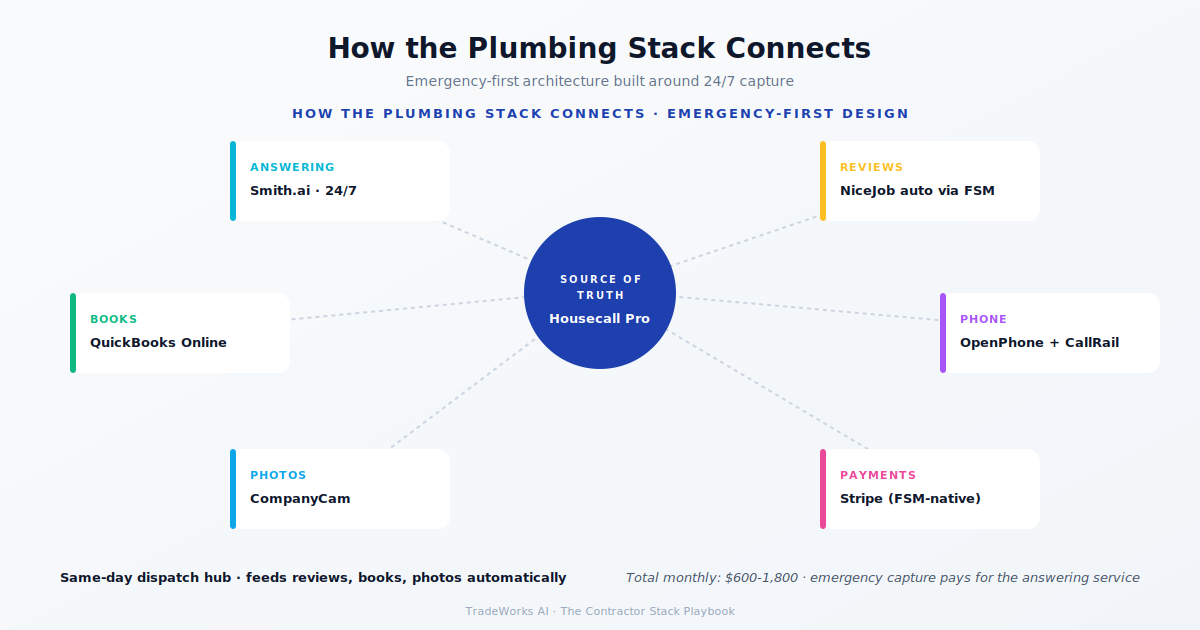
Jobber ($49–$149/month) for FSM plus QuickBooks ($30/month) plus OpenPhone ($15/user/month) for a total of $100–$200/month. Add NiceJob ($75+/month) for review automation as the first growth tool. The business phone is higher priority for plumbing than most trades because emergency call capture directly drives revenue.
At $2 million or more with 8+ technicians, yes — particularly if the business offers water heater replacements and repipe services where Good/Better/Best pricebook presentation increases average ticket. Below $2 million, Housecall Pro provides better value at flat-rate pricing. The evaluation framework from Part 2 and budget math from Part 3 apply to plumbing identically to HVAC.
Emergency call handling is more critical (plumbing emergencies are more time-sensitive), video documentation for sewer cameras adds media management needs, and drain maintenance plans require different email sequence timing than HVAC agreements. The core FSM progression (Jobber to Housecall Pro to ServiceTitan) and supporting tools (QuickBooks, NiceJob, ActiveCampaign) are identical.
Most contractors are paying $400–900 per month for software they barely use, while losing thousands more in hidden costs from manual processes and missed callbacks. Our free audit grades your stack against the maturity model and identifies the highest-ROI changes you can make this quarter.
The recommended software stack for an HVAC contractor at Stage 2–3 ($500K–$2M revenue) costs $400 to $900 per month and includes Housecal...
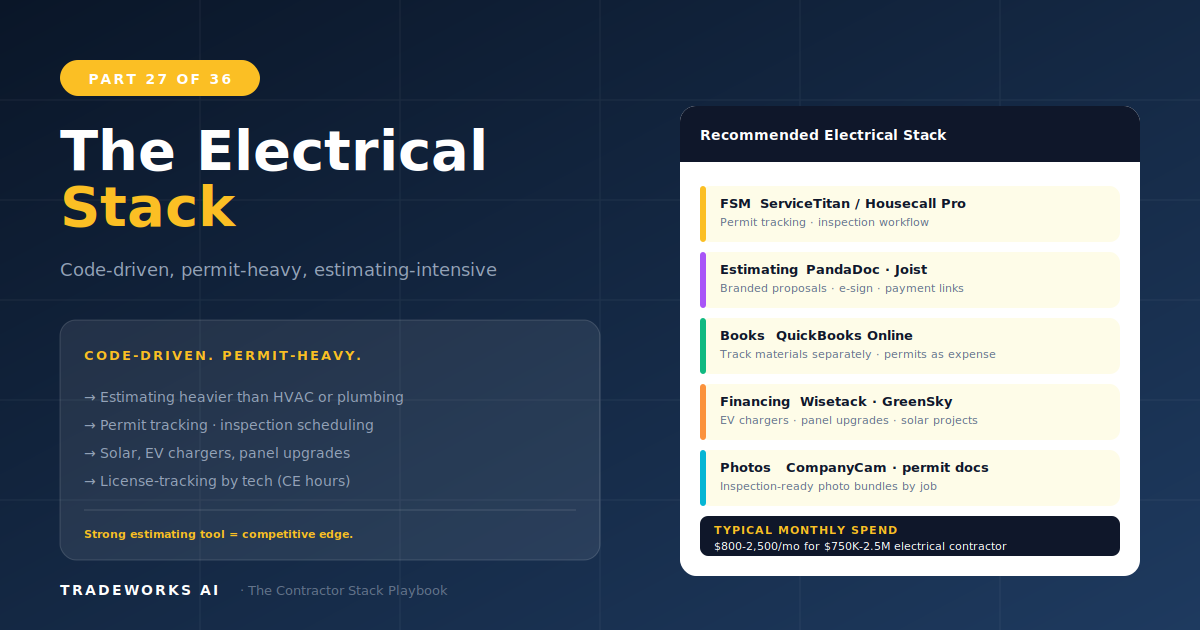
The recommended software stack for an electrical contractor at Stage 2–3 ($500K–$2M revenue) costs $400 to $900 per month and follows the...