Contractor Stack · Part 3
The Software Investment Math
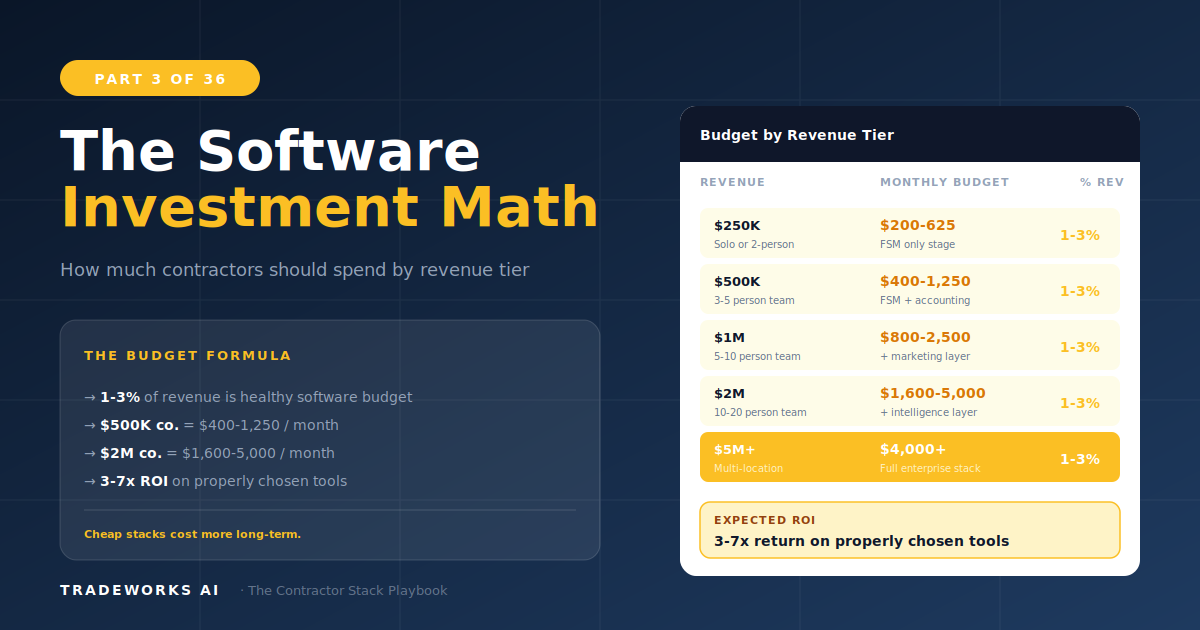
A home service contractor should spend between 1 and 3 percent of annual revenue on software tools. For a $500,000 company, that means $3...
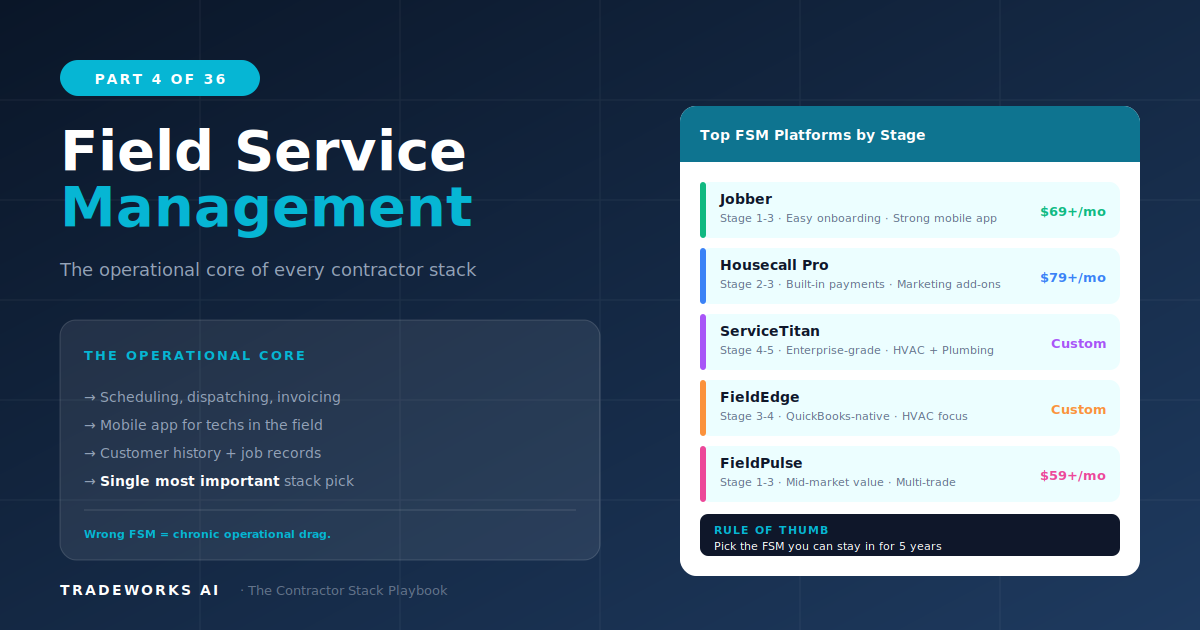
The best field service management software for contractors in 2026 depends on trade, team size, and revenue stage. For HVAC, plumbing, and electrical contractors above $2 million, ServiceTitan offers the deepest trade-specific feature set at $245 to $500 per technician per month. For contractors between $500,000 and $2 million, Housecall Pro ($79–$299/month) delivers the strongest balance of simplicity and marketing tools. For startups and small teams under $500,000, Jobber ($39–$249/month) provides the fastest time to productivity with the highest-rated mobile app. This guide compares seven FSM platforms across the 8-Criteria Evaluation Framework, with specific pricing, mobile ratings, integration depth, and best-fit recommendations by maturity stage.
Your field service management platform is the operational backbone of your business. Scheduling, dispatching, job tracking, invoicing, customer records, and technician communication all run through this single system. Every other tool in your stack either connects to your FSM or creates a data silo that costs you time and accuracy.
An FSM that fits well accelerates everything: faster dispatch means more jobs per day, mobile invoicing means faster payment collection, automated follow-ups mean fewer dropped leads, and integrated reporting means you can actually see which services, technicians, and marketing channels are profitable. An FSM that fits poorly creates friction at every step, and that friction compounds across every technician, every day.
This is also the most expensive software decision. FSM pricing ranges from $39 per month for basic platforms to $500 per technician per month for enterprise solutions. A 10-technician HVAC company on ServiceTitan is spending $2,500 to $5,000 per month on FSM alone. That investment needs to return measurable value in dispatch efficiency, revenue per technician, and operational visibility.
Each platform below is evaluated against the 8-Criteria Framework from Part 2. Scores reflect hands-on deployment experience, not marketing claims.
ServiceTitan is the enterprise standard for residential HVAC, plumbing, and electrical contractors. The platform offers the deepest trade-specific features of any FSM: pricebook management with Good/Better/Best presentation, membership program tracking, marketing attribution with call tracking, dispatch board with technician GPS, and a full reporting suite.
The cost reflects the capability. At $245 to $500 per technician per month, ServiceTitan is priced for Stage 3–5 contractors generating $2 million or more. Below that revenue threshold, the per-technician cost consumes too large a share of the software budget (see Part 3). Implementation typically takes 30 to 60 days with a dedicated onboarding team.
8-Criteria Score: Trade Fit 5/5, Size 4/5 (large only), Integration 4/5, Mobile 4/5, Learning Curve 2/5, Pricing 2/5, Data Ownership 3/5, Support 4/5. Composite: 28/40.
Housecall Pro targets the mid-market: contractors with 3 to 20 technicians who want a clean interface, solid mobile experience, and built-in marketing features. The platform includes online booking, automated review requests, a customer notification system, and basic CRM functionality. Postcard marketing and financing integration are standout features not found in most competitors.
At $79 to $299 per month (flat rate, not per-technician for most tiers), Housecall Pro delivers strong value for Stage 2–3 contractors. The flat-rate model is particularly advantageous for growing teams: adding a fifth technician does not double your FSM cost the way per-technician pricing does.
8-Criteria Score: Trade Fit 4/5, Size 4/5, Integration 3/5, Mobile 5/5, Learning Curve 4/5, Pricing 4/5, Data Ownership 3/5, Support 3/5. Composite: 30/40.
Jobber is the best entry point for contractors transitioning from paper to digital. The interface is the cleanest in the category, the mobile app has the highest ratings on both app stores, and most teams are productive within a few days of setup. Quoting, scheduling, invoicing, and payment collection work smoothly at small scale.
Jobber’s limitations emerge at Stage 3: the reporting suite lacks the depth that $1 million+ operations need, the CRM functionality is basic, and trade-specific features (pricebooks, membership tracking) are minimal. Jobber is the right tool for Stage 1–2 and a stepping stone, not a destination, for growing contractors.
8-Criteria Score: Trade Fit 3/5, Size 3/5 (small teams), Integration 3/5, Mobile 5/5, Learning Curve 5/5, Pricing 5/5, Data Ownership 4/5, Support 4/5. Composite: 32/40 for Stage 1–2; 24/40 for Stage 3+.
FieldEdge’s strongest differentiator is its deep QuickBooks integration — the tightest two-way sync in the FSM category. For contractors whose bookkeeper or accountant lives in QuickBooks and demands accurate, real-time data flow, FieldEdge eliminates the reconciliation headaches that other platforms create. Trade-specific features for HVAC, plumbing, and electrical are solid if not as deep as ServiceTitan’s.
The quote-based pricing model is a red flag under the Part 2 framework (Criterion 6). Without published rates, cost varies by negotiation, and existing customers report pricing increases at renewal that were not transparent at signing.
8-Criteria Score: Trade Fit 4/5, Size 3/5, Integration 5/5 (QuickBooks), Mobile 3/5, Learning Curve 3/5, Pricing 2/5, Data Ownership 3/5, Support 3/5. Composite: 26/40.
Service Fusion appeals to budget-conscious contractors who need GPS fleet tracking and flat-rate pricing without enterprise costs. The platform covers core FSM functions — scheduling, dispatch, estimates, invoicing — with built-in GPS tracking at no additional cost. At $225 to $575 per month flat rate, it positions between Jobber and Housecall Pro in total cost.
The mobile experience lags behind Housecall Pro and Jobber, and the interface design feels dated compared to newer entrants. For contractors who prioritize fleet visibility and cost control over UI polish, it is a functional choice.
8-Criteria Score: Trade Fit 3/5, Size 3/5, Integration 3/5, Mobile 3/5, Learning Curve 3/5, Pricing 4/5, Data Ownership 3/5, Support 3/5. Composite: 25/40.
Workiz stands out for contractors whose business runs on phone calls. Built-in VoIP, call tracking, call recording, and an integrated phone system make it the strongest option for call-heavy service businesses — particularly locksmith, garage door, and appliance repair operations where speed-to-lead from incoming calls drives revenue.
For traditional HVAC/plumbing/electrical contractors, the trade-specific features are less developed than ServiceTitan or Housecall Pro. But for call-driven businesses at Stage 2–3, the phone integration alone can justify the platform.
8-Criteria Score: Trade Fit 3/5 (trade-dependent), Size 3/5, Integration 4/5 (phone), Mobile 4/5, Learning Curve 4/5, Pricing 3/5, Data Ownership 3/5, Support 3/5. Composite: 27/40.
Successware is the legacy platform choice for HVAC and plumbing contractors with complex pricebook requirements. The flat-rate pricebook system is the most granular in the category, and the platform has deep roots in the HVAC industry dating back decades. Acquired by private equity in recent years, the platform has modernized its interface but still feels heavier than newer competitors.
Quote-based pricing and a steeper learning curve make Successware a Stage 3–5 option for established operations with dedicated office staff who can manage the complexity.
8-Criteria Score: Trade Fit 4/5, Size 3/5, Integration 3/5, Mobile 3/5, Learning Curve 2/5, Pricing 2/5, Data Ownership 3/5, Support 3/5. Composite: 23/40.
Stage 1–2 (Under $750K): Jobber. Fastest setup, lowest cost, highest mobile ratings. Upgrade when reporting and trade-specific features become limiting.
Stage 2–3 ($500K–$2M): Housecall Pro. Best balance of capability, marketing features, and flat-rate pricing. Strong mobile app keeps field teams productive.
Stage 3–4 ($2M–$5M, trades): ServiceTitan. Justified when revenue supports the per-technician cost and the team needs pricebooks, membership tracking, and marketing attribution.
Stage 3–4 (QuickBooks-dependent): FieldEdge. If your bookkeeper demands real-time QuickBooks sync and will not accept anything less, FieldEdge is the integration leader.
Call-heavy businesses: Workiz. If incoming phone calls are your primary lead source and speed-to-lead is your competitive advantage, the integrated phone system is worth the trade-off in trade-specific features.
FSM is the category with the most aggressive sales practices in the contractor software industry. Watch for these patterns:
Multi-year contracts with steep early termination fees. Always negotiate a 90-day out clause or start month-to-month.
Per-technician pricing that scales faster than your revenue. Calculate total cost at current team size AND at projected team size in 12 months.
Implementation fees that rival three months of subscription cost. Negotiate implementation into the contract or use the vendor’s self-serve onboarding.
Feature announcements for capabilities that do not exist yet. Only evaluate what works today, not what the roadmap promises.
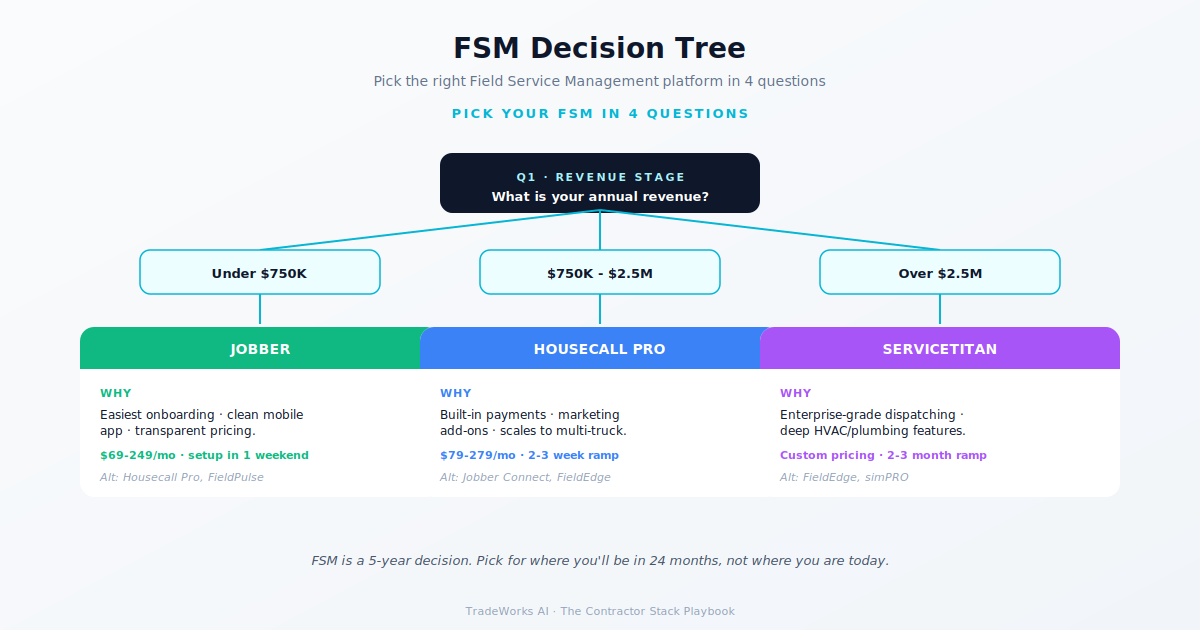
For HVAC contractors under $750,000 in revenue, Jobber provides the fastest path from paper to digital with minimal learning curve. At $500,000 to $1.5 million, Housecall Pro adds marketing tools and a stronger feature set without per-technician pricing. ServiceTitan becomes justified above $2 million when the HVAC-specific pricebook, membership tracking, and reporting depth deliver ROI that exceeds the per-technician cost.
At $2 million or more in revenue with 8 or more technicians, typically yes — if the team commits to using the full platform. The most common failure mode is paying ServiceTitan prices while only using scheduling and dispatch, which is a Stage 2 use case at a Stage 4 price. Run the 8-Criteria Framework from Part 2 and the budget math from Part 3 before signing.
You can, but it requires planning. Most platforms offer CSV export for customer data, job history, and invoices. The critical step is running both systems in parallel for 30 to 60 days to verify data integrity. Part 37 covers the complete switching playbook including data migration, parallel running, and team retraining.
Yes. Your FSM is the hub of your stack. Every other tool — CRM, accounting, review management, email marketing — needs to integrate with your FSM. Pick the FSM first, then select supporting tools that connect natively. Choosing a CRM first and then finding an FSM that integrates with it is backwards and limits your options.
Most contractors are paying $400–900 per month for software they barely use, while losing thousands more in hidden costs from manual processes and missed callbacks. Our free audit grades your stack against the maturity model and identifies the highest-ROI changes you can make this quarter.
A home service contractor should spend between 1 and 3 percent of annual revenue on software tools. For a $500,000 company, that means $3...
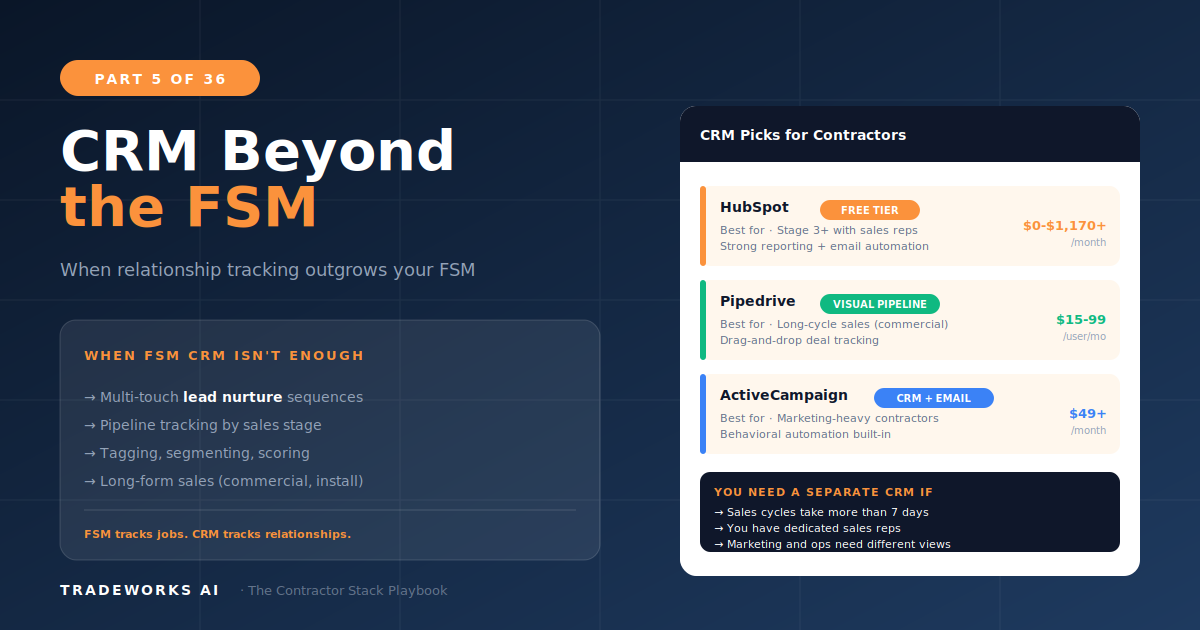
Most contractors do not need a separate CRM. The customer management features built into modern FSM platforms like ServiceTitan, Housecal...