Contractor Stack · Part 24
Referral Programs and Customer Loyalty
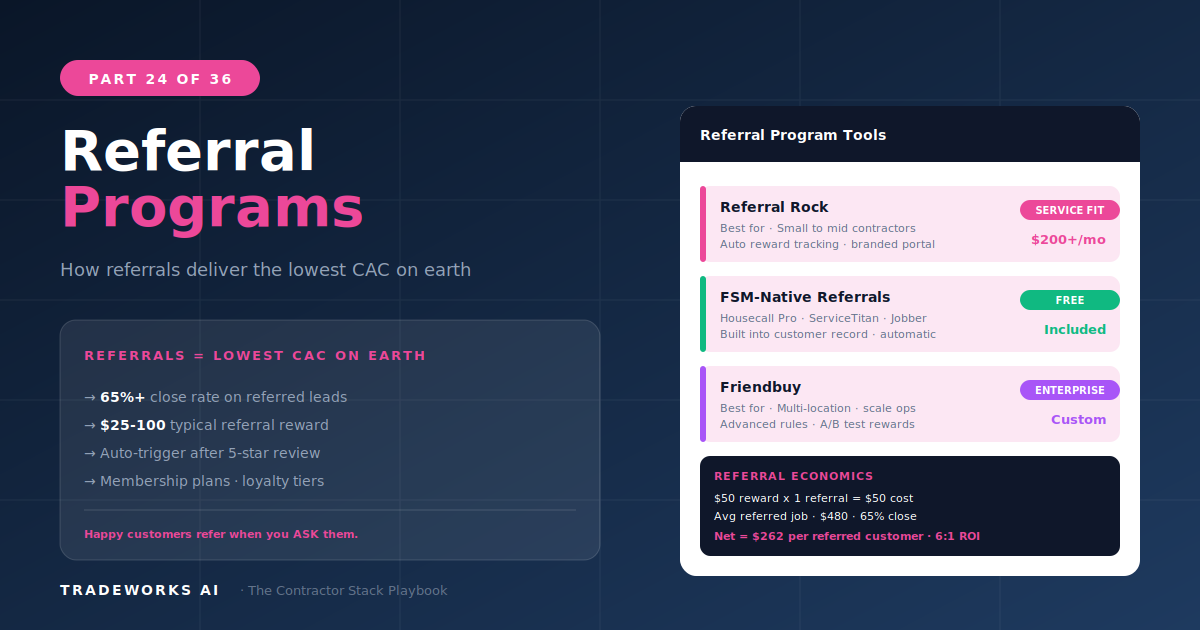
The best referral program software for contractors integrating with an existing review workflow is NiceJob (referral features included wi...
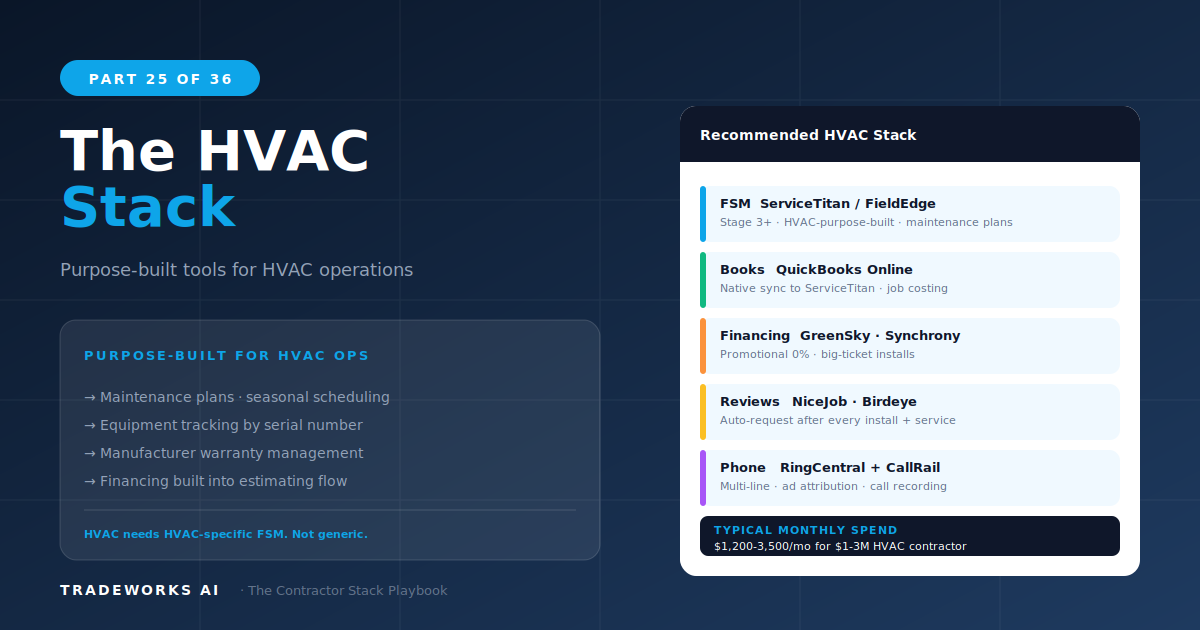
The recommended software stack for an HVAC contractor at Stage 2–3 ($500K–$2M revenue) costs $400 to $900 per month and includes Housecall Pro for FSM ($149–$299/month), QuickBooks Online for accounting ($60/month), NiceJob for review management ($100/month), ActiveCampaign for email marketing ($49/month), and OpenPhone for business phone ($15/user/month). At Stage 3–4 ($2M–$5M), ServiceTitan replaces Housecall Pro as the FSM at $245 to $500 per technician, adding pricebook management with Good/Better/Best presentation, membership plan tracking, and marketing attribution. This guide maps the complete HVAC stack at every maturity stage with specific products, monthly costs, upgrade signals, and the HVAC-specific considerations that make this trade’s stack unique.
HVAC contractors have stack requirements that general field service businesses do not. Understanding these trade-specific needs determines which products fit and which create expensive workarounds.
Pricebook management: HVAC technicians need field-accessible pricebooks with Good/Better/Best presentation for equipment replacements. A 15-year-old condenser replacement presented as three options (14 SEER basic, 16 SEER mid-range, 20 SEER premium with variable speed) increases average ticket by 20–35%. ServiceTitan’s pricebook is purpose-built for this. Housecall Pro and Jobber offer basic quoting that works at smaller scale.
Maintenance agreement tracking: Recurring maintenance plans (biannual tune-ups, priority scheduling, discount on repairs) are the primary retention tool for HVAC contractors. The FSM must track agreement status, automate renewal reminders, schedule seasonal visits, and report on plan revenue separately from service revenue. ServiceTitan handles this natively. Other FSMs require workarounds or CRM automation (Part 5).
Seasonal demand peaks: HVAC revenue in Florida and southern markets concentrates heavily in May through September (cooling) with a secondary peak in November through January (heating in northern markets). The stack must handle 3–5x call volume spikes without dropping leads. Virtual receptionists (Part 10), AI voice agents (Part 14), and overflow call routing (Part 9) become critical during peak season.
Customer financing dependency: HVAC system replacements range from $5,000 to $20,000+, making financing essential for close rates. Wisetack or Hearth (Part 13) must integrate with the estimate workflow so technicians can present monthly payments alongside the total price during the on-site visit.
EPA certification tracking: Technicians handling refrigerant must maintain EPA 608 certification. The training and SOP platform (Part 18) should track certification expiration dates alongside contractor licenses (Part 21).
The priority at this stage is eliminating paper and personal phone operations. Jobber provides the fastest path from paper to digital with mobile scheduling, dispatch, invoicing, and online payment collection. QuickBooks Simple Start handles basic accounting with Jobber integration. Google Workspace provides professional email and document storage. Homebase’s free tier adds GPS time tracking for field technicians.
At this stage, skip review software, email marketing, and CRM. Focus entirely on operational efficiency. When every job is scheduled digitally, invoiced from the field, and paid online, the business is ready to invest in growth tools. Total monthly cost: $100 to $350.
The jump from Stage 2 to Stage 3 is where most HVAC contractors either accelerate or plateau. Housecall Pro replaces Jobber as the FSM, adding marketing features (automated review requests, postcard marketing) and flat-rate pricing that scales better with growing teams. NiceJob automates review collection and social proof marketing (Part 7). ActiveCampaign launches the Re-Revenue Framework email sequences (Part 8): maintenance plan promotions, seasonal tune-up campaigns, and dormant customer reactivation. OpenPhone provides a dedicated business line with call recording and shared inbox.
The “Cancel This” callout for HVAC at this stage: any software that duplicates a function already covered. If Housecall Pro’s built-in review requests are working, do not add a separate review tool yet. If ActiveCampaign’s CRM is sufficient, do not add HubSpot. One tool per function until you outgrow it.
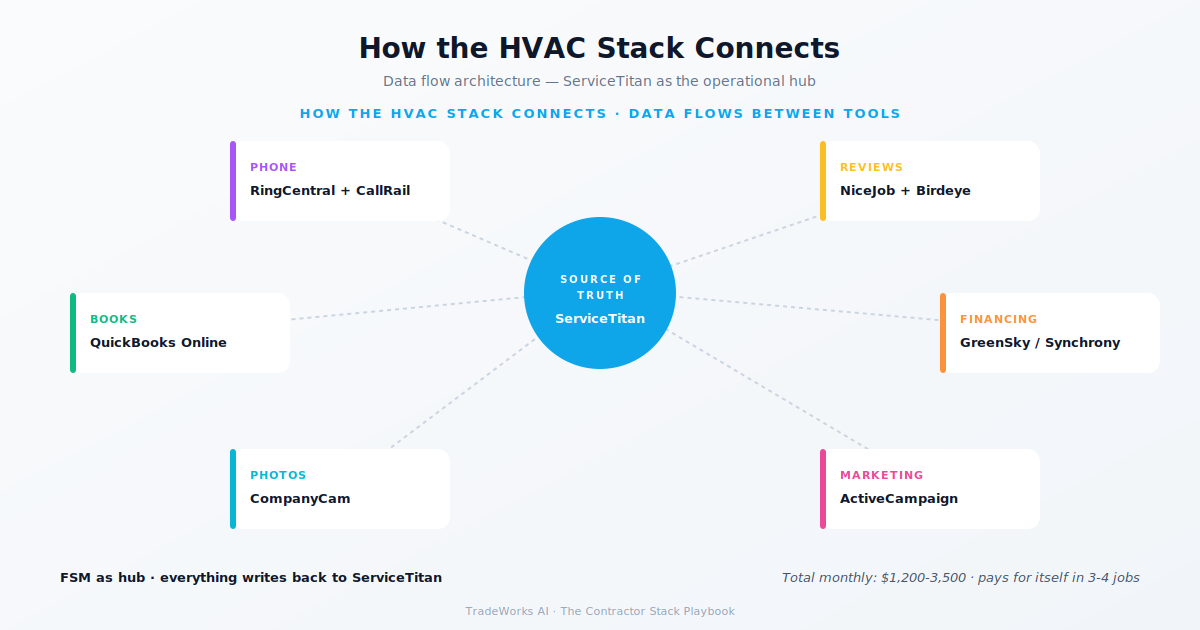
ServiceTitan enters the stack when revenue justifies the per-technician cost. The HVAC-specific pricebook with Good/Better/Best presentation, membership plan tracking, marketing attribution with call tracking, and the dispatch board with technician performance scoring drive measurable revenue per technician improvement. Wisetack integrates with ServiceTitan for on-site financing during the estimate conversation. CompanyCam documents every job (Part 17). Zapier connects ServiceTitan to ActiveCampaign, NiceJob, and QuickBooks for automated workflows (Part 16).
This is also the stage where the HVAC contractor should evaluate whether to keep Housecall Pro’s marketing features or rely on ServiceTitan’s built-in marketing tools. ServiceTitan’s marketing module includes call tracking and attribution but is less user-friendly for day-to-day campaign management than dedicated tools.
Titan Intelligence adds AI-powered dispatching, revenue prediction, and demand forecasting. Goodcall or another AI voice agent (Part 14) handles after-hours calls that exceed virtual receptionist capacity. Hearth or a multi-lender financing platform maximizes approval rates on large-ticket replacements. Fleetio manages the vehicle fleet (Part 20). Trainual structures technician onboarding and SOP compliance (Part 18). RingCentral provides enterprise phone with IVR and call center queues for the dispatch team.
Beyond the general contractor stack categories, HVAC contractors should be aware of several trade-specific tools:
Manual J / Load Calculation Software: Wrightsoft, CoolCalc, or ACCA-approved tools for proper system sizing. Not an FSM function — a separate engineering tool used during replacement estimates.
Refrigerant Tracking: EPA requires tracking refrigerant purchases, usage, and recovery. Some FSMs track this; others require a separate log. Verify your FSM handles refrigerant tracking before adding a separate system.
Equipment Warranty Registration: Most manufacturers require online registration within 60 to 90 days of installation. Build this into your SOP (Part 18) to prevent warranty voidance from missed registration deadlines.
Run this audit on your current HVAC stack to identify immediate savings:
Paying for ServiceTitan but only using scheduling and dispatch? You are at Stage 2 cost with Stage 2 usage. Either commit to implementing the full platform or downgrade to Housecall Pro and save $200–$400/month per technician.
Paying for a separate CRM when your FSM’s customer tracking covers your needs? Cancel the CRM and reallocate to review management or email marketing (higher ROI categories).
Paying for multiple review platforms? One is sufficient. NiceJob covers collection + social proof marketing. Cancel overlapping tools.
Paying for marketing automation you have not built sequences in? If ActiveCampaign has been running for 6 months with zero automations active, either commit to building the Re-Revenue Framework sequences this month or downgrade to the free tier of Mailchimp until you are ready.
For HVAC companies under $750,000 in revenue: Jobber ($49–$149/month) for FSM plus QuickBooks Simple Start ($30/month). Total stack: $100–$350/month. Focus on operational efficiency before adding marketing tools. Upgrade to Housecall Pro when you need review automation and flat-rate team pricing.
When revenue exceeds $2 million, the team has 8 or more technicians, and the business needs pricebook management, membership tracking, and marketing attribution. Below this threshold, the per-technician cost ($245–$500/month) consumes too much of the software budget. Run the 8-Criteria Framework (Part 2) and budget math (Part 3) before committing.
Following the 1–3% of revenue rule from Part 3: a $1 million HVAC company should budget $600 to $1,500/month. A $3 million company: $1,800 to $4,500/month. The stage-specific stack recommendations in this article fall within these ranges at each revenue tier.
Most contractors are paying $400–900 per month for software they barely use, while losing thousands more in hidden costs from manual processes and missed callbacks. Our free audit grades your stack against the maturity model and identifies the highest-ROI changes you can make this quarter.
The best referral program software for contractors integrating with an existing review workflow is NiceJob (referral features included wi...
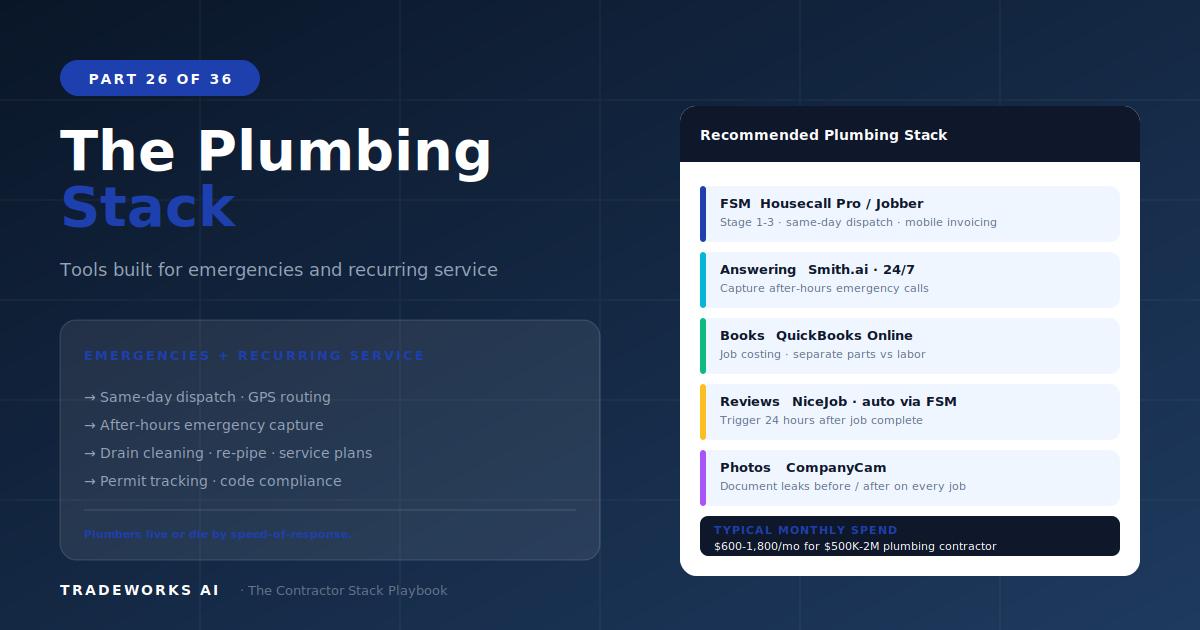
The recommended software stack for a plumbing contractor at Stage 2–3 ($500K–$2M revenue) costs $400 to $850 per month and includes House...