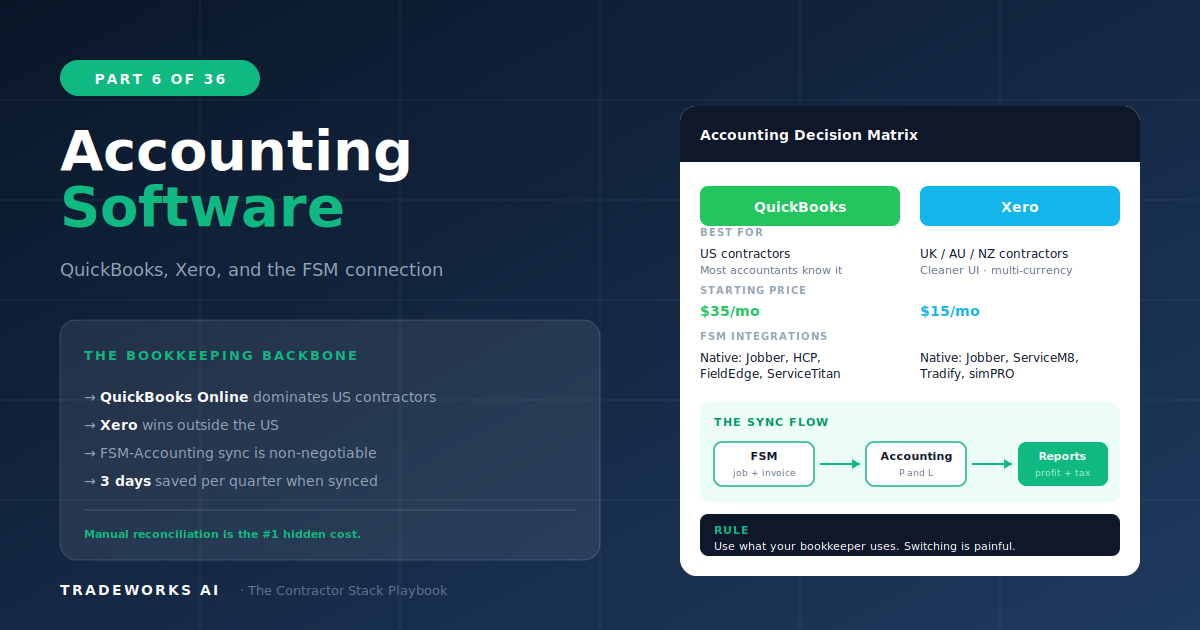
Contractor Stack · Part 6
Accounting — QuickBooks, Xero, and the FSM Connection
The best accounting software for home service contractors is QuickBooks Online, and the reason is not the software itself — it is the int...
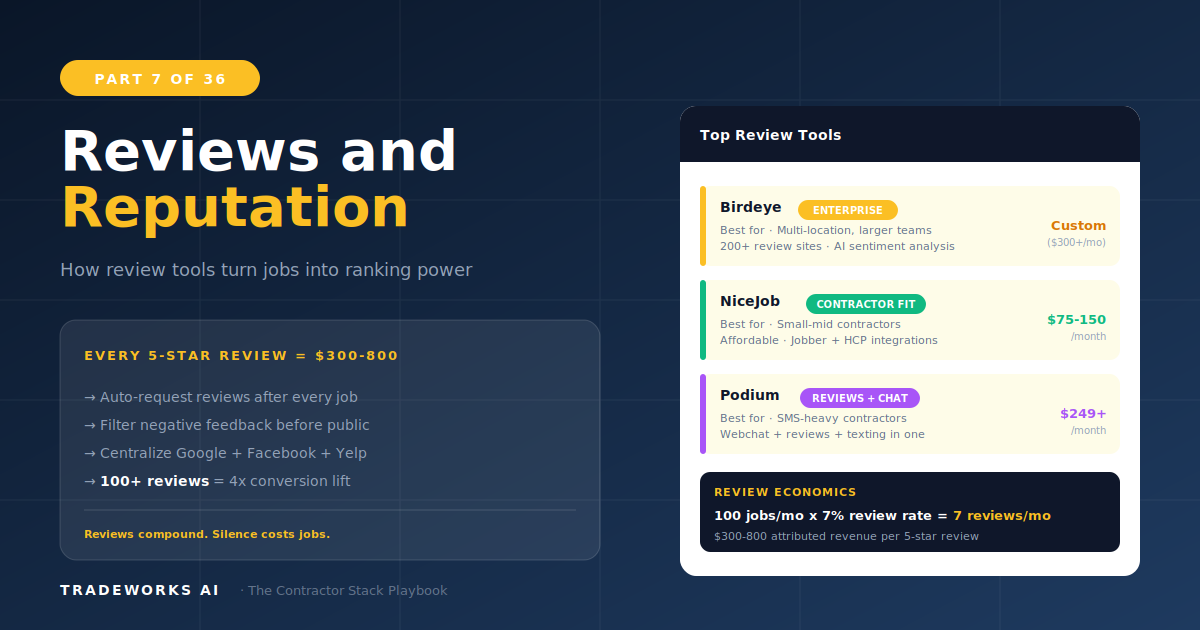
The best review management software for contractors automates the request process so every completed job triggers a review invitation without relying on your team’s memory. NiceJob ($75–$200/month) is the strongest option for Stage 2–4 contractors because it combines automated review requests with social proof marketing — turning new reviews into branded social media posts automatically. Birdeye ($299–$499/month) is the enterprise choice for multi-location contractors needing listings management and review monitoring at scale. Podium ($289–$599/month) wins for businesses that prioritize text-based customer communication and want payment collection integrated with the review workflow. Review velocity — how many new reviews you generate per week — is the single strongest signal for local search ranking improvement, making this one of the highest-ROI software categories in the contractor stack.
Review management software delivers 5 to 15 times its monthly cost in attributed leads. The mechanism is straightforward: more reviews at higher velocity improve your position in Google’s local pack, and higher local pack position drives more calls, clicks, and direction requests. A contractor generating 3 new Google reviews per week will typically see measurable local ranking improvement within 60 to 90 days.
The math works because the cost of acquiring a review through automation is essentially zero once the system is configured. A $100/month review platform that generates 12 additional reviews per month has a per-review cost of $8.33. A single new customer acquired through improved local search ranking is worth $500 to $5,000 in first-job revenue, plus lifetime value. The ROI ratio makes review management one of the easiest software investments to justify.
Yet most contractors handle reviews manually. The office manager remembers to send a review request after some jobs, forgets after others, and never sends follow-ups. The result: inconsistent review velocity, missed opportunities from satisfied customers who would have reviewed if asked, and a competitor down the road who automated the process six months ago and now has 150 more Google reviews.
NiceJob is built specifically for home service contractors and delivers the best combination of automated review collection and social proof marketing in this price range. The platform triggers review requests via email and SMS after job completion (integrated with your FSM), follows up automatically with non-responders, and converts new reviews into branded social media posts that publish to your Facebook and Instagram feeds.
The social proof marketing feature is NiceJob’s key differentiator. Most review platforms stop at collection. NiceJob turns each review into a marketing asset by creating shareable graphics with the review text, star rating, and your brand design. For contractors who struggle to produce consistent social media content, this feature alone can justify the subscription.
FSM integration is strong: NiceJob connects natively with Jobber, Housecall Pro, and ServiceTitan, plus via Zapier with most other platforms. The trigger is typically job completion status change, which means the request goes out at the moment of highest customer satisfaction.
8-Criteria Score: Trade Fit 5/5, Size 4/5, Integration 4/5, Mobile 3/5, Learning Curve 4/5, Pricing 4/5, Data Ownership 3/5, Support 4/5. Composite: 31/40.
Birdeye is the enterprise review and reputation management platform for contractors operating multiple locations or managing a high volume of customer interactions. Beyond review collection, Birdeye offers listings management (ensuring your NAP data is consistent across 50+ directories), review monitoring across all platforms, competitive benchmarking, and customer survey tools.
At $299 to $499 per month, Birdeye is priced for Stage 3–5 contractors whose online reputation directly impacts revenue at scale. For a single-location contractor under $1 million, the price-to-value ratio favors NiceJob or GatherUp. For a multi-location operation managing 200+ reviews per month across Google, Facebook, Yelp, and industry-specific platforms, Birdeye’s monitoring and management depth is unmatched.
8-Criteria Score: Trade Fit 4/5, Size 3/5 (large), Integration 4/5, Mobile 4/5, Learning Curve 3/5, Pricing 2/5, Data Ownership 3/5, Support 4/5. Composite: 27/40.
Podium approaches reputation management from a different angle: text-first customer communication. The platform’s core strength is converting all customer interactions — review requests, appointment confirmations, payment collection, and general communication — into text message conversations managed from a single inbox. For contractors whose customers prefer text over email (increasingly common across all demographics), Podium’s approach captures more responses.
The review request conversion rate via text message is typically 15 to 25 percent higher than email-only platforms. When a customer receives a text with a direct link to leave a Google review, the friction is minimal: tap, rate, write, submit. The payment integration is a bonus — sending a text-to-pay link alongside a review request in the same conversation thread.
8-Criteria Score: Trade Fit 4/5, Size 3/5, Integration 4/5, Mobile 4/5, Learning Curve 3/5, Pricing 2/5, Data Ownership 3/5, Support 3/5. Composite: 26/40.
GatherUp and Grade.us serve overlapping but distinct niches. GatherUp’s strength is white-label reporting for agencies managing multiple contractor clients — if TradeWorks AI or another agency manages your reviews, GatherUp is likely what they use behind the scenes. Grade.us offers the most granular control over review site routing: directing happy customers to Google, filtering less-than-5-star respondents to a private feedback form, and distributing review requests across multiple platforms to build broad coverage.
Both integrate primarily via Zapier rather than native FSM connections, which adds a step to the automation setup. For contractors managing their own reviews without agency support, NiceJob’s native FSM integrations and simpler setup make it the better direct choice.
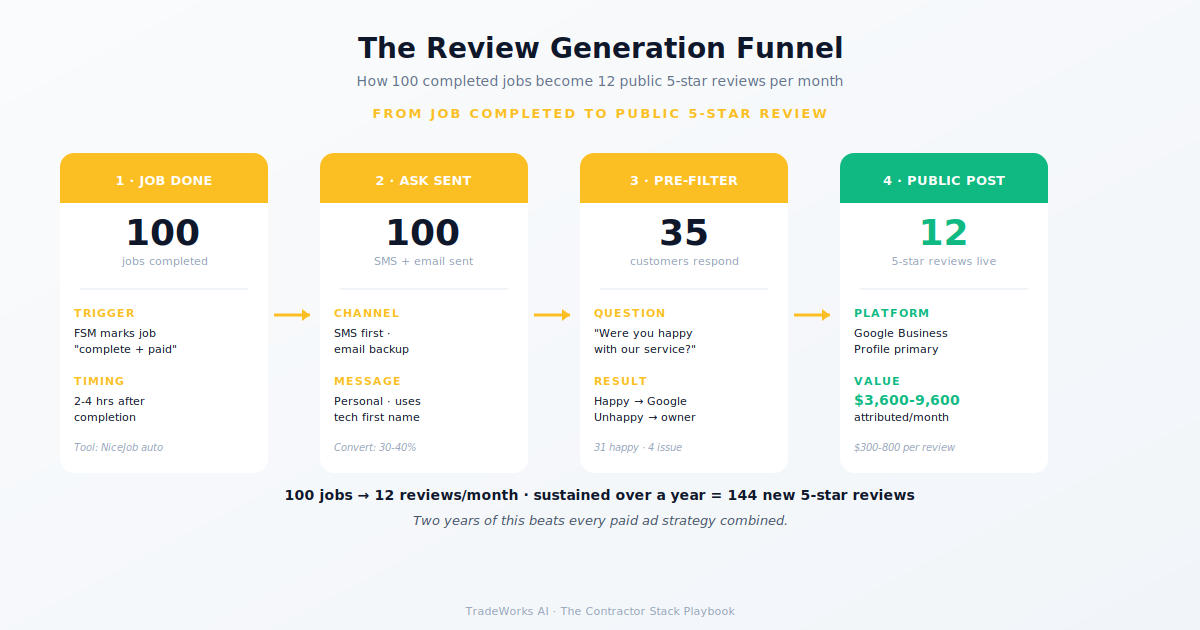
Review velocity is the rate at which you generate new reviews over time. Google’s local search algorithm weights recent reviews more heavily than old ones. A contractor with 50 reviews but no new reviews in 90 days will rank below a competitor with 30 reviews who adds 2 to 3 per week.
The formula for sustainable review velocity:
Jobs completed per week × review request rate × response rate = weekly review velocity
Example: 25 jobs/week × 100% request rate (automated) × 15% response rate = 3.75 new reviews/week
At 3–4 new Google reviews per week, most single-location contractors will see local pack improvement within 60–90 days.
The automation is what makes this sustainable. Manual review requests achieve 30 to 50 percent request rates because the office manager forgets or gets busy. Automated platforms achieve 95 to 100 percent request rates because every completed job triggers the workflow without human intervention.
Collecting reviews is half the equation. Responding to reviews — every single one, positive and negative — signals to Google that the business actively manages its online presence and values customer feedback. The Email Playbook Part 9 and Facebook Playbook Part 10 cover review response templates and crisis protocols in detail.
Positive reviews: Respond within 24 hours. Thank by name, reference the specific service, reinforce the relationship. Never use the same template twice in a row — Google’s algorithm can detect templated responses.
Negative reviews: Respond within 4 hours during business hours. Acknowledge the concern, apologize for the experience (not the fault), offer to resolve via phone or direct message, and take the conversation offline. Never argue in the public thread.
Fake or malicious reviews: Report to the platform with documentation. Post a measured, factual response for future readers. Do not engage in back-and-forth.
Stage 1–2 (Under $750K): FSM-native review requests if available. If not, NiceJob at the starter tier. The ROI justifies even a small budget allocation.
Stage 2–4 ($750K–$5M, single location): NiceJob. Automated collection + social proof marketing at the strongest price-to-value ratio. Connects to your FSM natively.
Stage 3–5 (multi-location or high volume): Birdeye. Justified when managing reviews across multiple locations, platforms, and hundreds of customer interactions monthly.
Text-first businesses: Podium. If your customer base responds better to text than email, Podium’s 15–25% higher conversion rate is worth the premium pricing.
There is no absolute number, but competitive positioning typically requires matching or exceeding the review count of the top 3 local pack results in your market. More important than total count is velocity: 2 to 4 new reviews per week consistently outperforms a one-time push to get 50 reviews that then goes dormant. Focus on sustainable velocity, not a target number.
Yes. Google explicitly permits businesses to ask customers for reviews. You cannot offer incentives (discounts, gifts) in exchange for reviews, and you cannot ask only happy customers to review (review gating violates Google’s policies). The platforms reviewed in this article send requests to every customer automatically, which maintains compliance.
No legitimate review software can remove negative reviews. Platforms can help you respond faster, flag potentially fake reviews for platform investigation, and route unhappy customers to private feedback before they post publicly. But once a genuine negative review is posted, the only response is a professional, empathetic public reply and an offline resolution effort.
At $75 to $300 per month, review management platforms typically deliver 5 to 15 times their cost in attributed lead value. The attribution comes from improved local search ranking, higher click-through rates on profiles with more reviews, and increased close rates when prospects see strong social proof. One additional lead per month from improved review presence pays for the software multiple times over.
Most contractors are paying $400–900 per month for software they barely use, while losing thousands more in hidden costs from manual processes and missed callbacks. Our free audit grades your stack against the maturity model and identifies the highest-ROI changes you can make this quarter.
The best accounting software for home service contractors is QuickBooks Online, and the reason is not the software itself — it is the int...
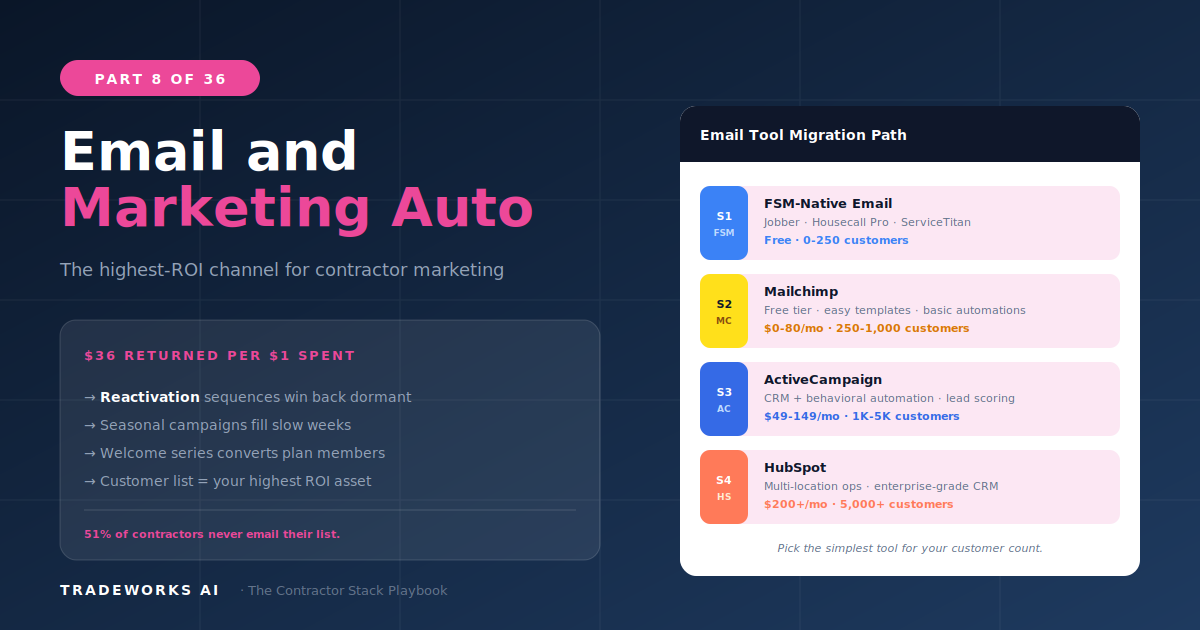
The best email marketing software for home service contractors is ActiveCampaign ($29–$259/month), which delivers the most powerful autom...