Contractor Stack · Part 26
The Plumbing Contractor Stack
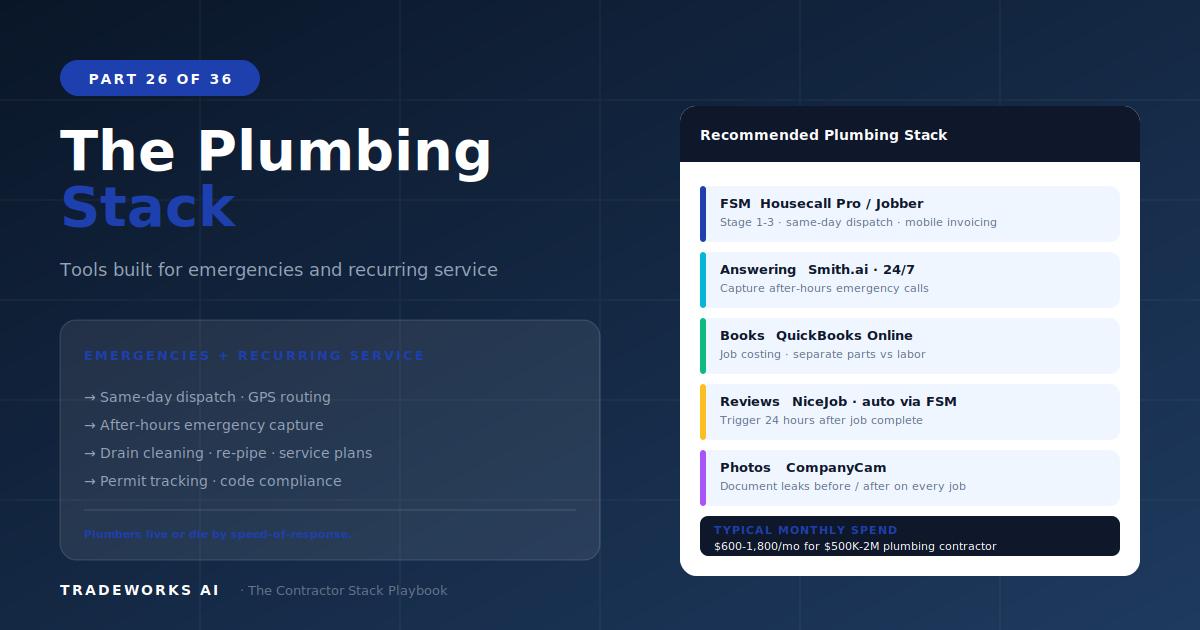
The recommended software stack for a plumbing contractor at Stage 2–3 ($500K–$2M revenue) costs $400 to $850 per month and includes House...
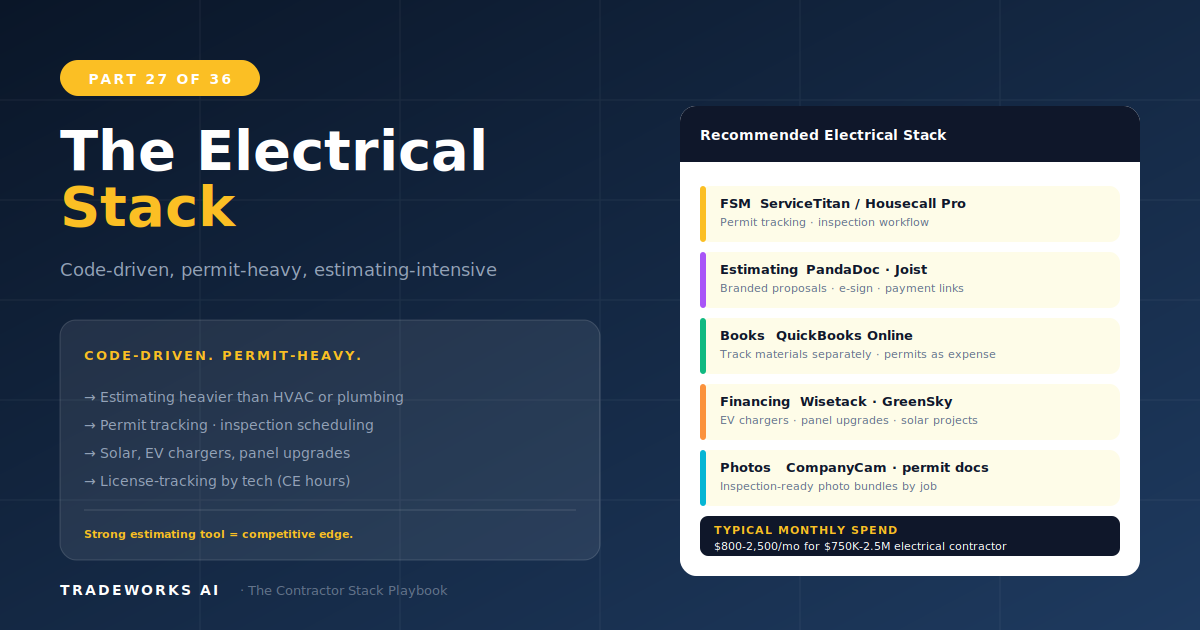
The recommended software stack for an electrical contractor at Stage 2–3 ($500K–$2M revenue) costs $400 to $900 per month and follows the same core structure as the HVAC and plumbing stacks: Housecall Pro for FSM ($149–$299/month), QuickBooks Online ($60/month), NiceJob ($100/month), ActiveCampaign ($49/month), and OpenPhone ($15/user/month). Electrical contractors have unique stack requirements: panel upgrade and EV charger installation estimates with Good/Better/Best tiered pricing, permit tracking and inspection scheduling integration, code compliance photo documentation, and generator installation proposals with financing. This guide maps the complete electrical stack at every maturity stage and highlights where it diverges from HVAC and plumbing.
The electrical contractor stack shares its core infrastructure with HVAC and plumbing — the FSM progression from Jobber to Housecall Pro to ServiceTitan is identical, and the supporting tools (accounting, reviews, email, phone) are the same products. But electrical work has trade-specific requirements that shape how those tools are configured and which additional capabilities matter:
Panel upgrade and EV charger estimates: Panel upgrades ($1,500–$4,000) and EV charger installations ($500–$2,500) are the primary high-ticket residential services driving electrical contractor growth. Both benefit from Good/Better/Best tiered presentation (Part 11): a 100-amp to 200-amp panel upgrade presented as basic upgrade, upgrade with whole-house surge protection, and upgrade with surge protection plus dedicated EV circuit. Financing integration (Part 13) is essential for panel upgrades approaching the $3,000–$4,000 range.
Permit tracking and inspection scheduling: Electrical work requires permits and inspections more consistently than HVAC or plumbing service calls. The FSM must track permit status per job, schedule inspection dates, and alert technicians when permits are pending inspection. ServiceTitan handles this at Stage 3+. At Stage 1–2, a Google Calendar-based permit tracker alongside the FSM covers the requirement.
Code compliance documentation: Electrical code compliance (NEC updates, GFCI/AFCI requirements, arc fault protection) creates documentation requirements that CompanyCam (Part 17) addresses: before/after photos of panels, wire routing, device installation, and grounding connections provide proof of code-compliant work that protects the contractor during inspections and customer disputes.
Safety protocol emphasis: Electrical work carries the highest personal safety risk of any trade in this series. Lockout/tagout procedures, arc flash protection, and voltage verification protocols must be documented in SOPs (Part 18) and trained via Trainual or Loom. The training platform is not optional for electrical contractors — it is a safety requirement.
Generator installations: Whole-house generator installations ($5,000–$15,000+) with automatic transfer switches are a growing revenue segment, particularly in Florida and other storm-prone markets. These projects require detailed estimates with equipment options, financing presentation, and permit tracking — all functions the stack must support at Stage 3+.
Commercial vs residential split: Electrical contractors often serve both residential and commercial markets earlier than HVAC or plumbing companies. Commercial work (tenant improvements, new construction rough-in, parking lot lighting) requires different estimating, invoicing, and project tracking than residential service calls. ServiceTitan or a dedicated project management layer becomes important earlier for dual-market electricians.
The electrical startup stack matches HVAC and plumbing: Jobber for FSM, QuickBooks for accounting, Google Workspace for email. The electrical-specific addition is a permit tracking system — even a simple Google Sheet tracking permit number, job address, submission date, inspection date, and status prevents the most common compliance failure for small electrical contractors. Safety SOPs should be documented from day one using Loom’s free tier, even before investing in a formal training platform. Total: $100–$350/month.
Housecall Pro replaces Jobber with marketing features and flat-rate team pricing. NiceJob automates review collection — particularly important for electrical contractors because homeowners rarely think to review electrical work unless prompted (unlike the visible result of a new AC or bathroom renovation). ActiveCampaign launches panel upgrade marketing campaigns, EV charger promotions, and seasonal electrical safety content. CompanyCam begins documenting every panel, circuit, and installation for code compliance evidence.
The electrical-specific “Cancel This” at this stage: paying for a commercial project management tool when 90% of your work is residential service calls. Manage the occasional commercial project in your FSM until commercial revenue justifies a dedicated tool.
ServiceTitan enters the electrical stack at $2M+ for pricebook management (panel upgrade options with Good/Better/Best), permit tracking within the job workflow, and marketing attribution. Wisetack handles on-site financing for panel upgrades and generator installations. Trainual becomes critical for safety protocol documentation and apprentice training programs — electrical apprentice onboarding has regulatory requirements that mandate structured training documentation. At Stage 4–5, AI dispatching optimizes technician routing for mixed residential and commercial schedules.
Permit tracking is higher priority for electrical — nearly every project requires a permit, versus select projects for HVAC and plumbing.
Safety training documentation is non-negotiable for electrical due to arc flash, lockout/tagout, and voltage verification risks. Invest in Trainual or SweetProcess earlier than HVAC/plumbing.
EV charger installations are a unique growth segment with no HVAC/plumbing equivalent — marketing campaigns should target this segment specifically through ActiveCampaign.
Commercial work enters the revenue mix earlier for electricians, potentially requiring project management alongside FSM at Stage 3.
Review solicitation requires more intentional effort — electrical work is less visible to homeowners than HVAC or plumbing, making NiceJob’s automated requests more important.
The core FSM progression (Jobber → Housecall Pro → ServiceTitan) is identical across all three trades.
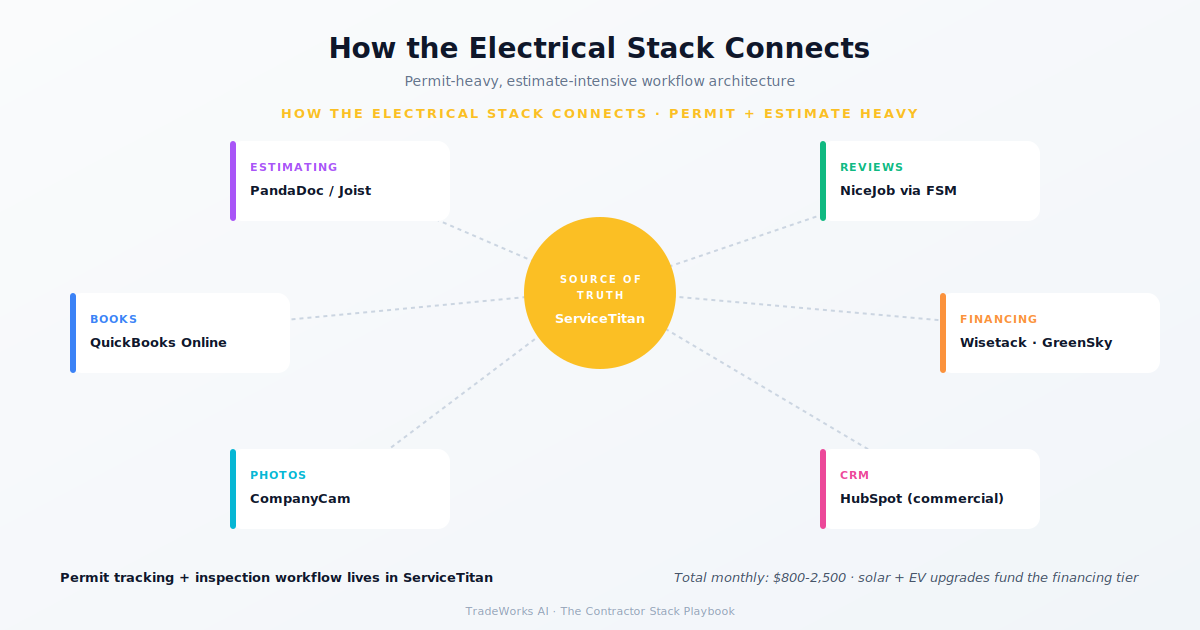
Jobber ($49–$149/month) for FSM plus QuickBooks ($30/month) plus a permit tracking spreadsheet. Add CompanyCam ($19/user/month) for code compliance documentation as soon as you have a second technician. Safety SOPs via Loom (free) from day one. Total starting stack: $100–$250/month.
The core stack (FSM, accounting, reviews, email, phone) uses the same products. The differences are in configuration and priority: permit tracking is more critical for electrical, safety training documentation is mandatory, EV charger and panel upgrade marketing campaigns are trade-specific, and commercial project management may be needed earlier. The software is the same; the workflows are different.
At Stage 1–2, a Google Sheet tracking permit number, address, dates, and status is sufficient. At Stage 3+, ServiceTitan’s job workflow includes permit tracking within the job record. The key requirement: someone on the team is responsible for checking permit status daily and scheduling inspections proactively. An expired or missed permit holds up the project and damages the customer relationship.
Yes. EV charger installations are a growing residential segment with high search volume, predictable scope (making online estimating feasible), and repeat referral potential (EV owners talk to other EV owners). A dedicated service page on your website (Part 23) targeting “EV charger installation [city]” plus ActiveCampaign campaigns to existing customers drives this segment with minimal additional cost.
Most contractors are paying $400–900 per month for software they barely use, while losing thousands more in hidden costs from manual processes and missed callbacks. Our free audit grades your stack against the maturity model and identifies the highest-ROI changes you can make this quarter.
The recommended software stack for a plumbing contractor at Stage 2–3 ($500K–$2M revenue) costs $400 to $850 per month and includes House...
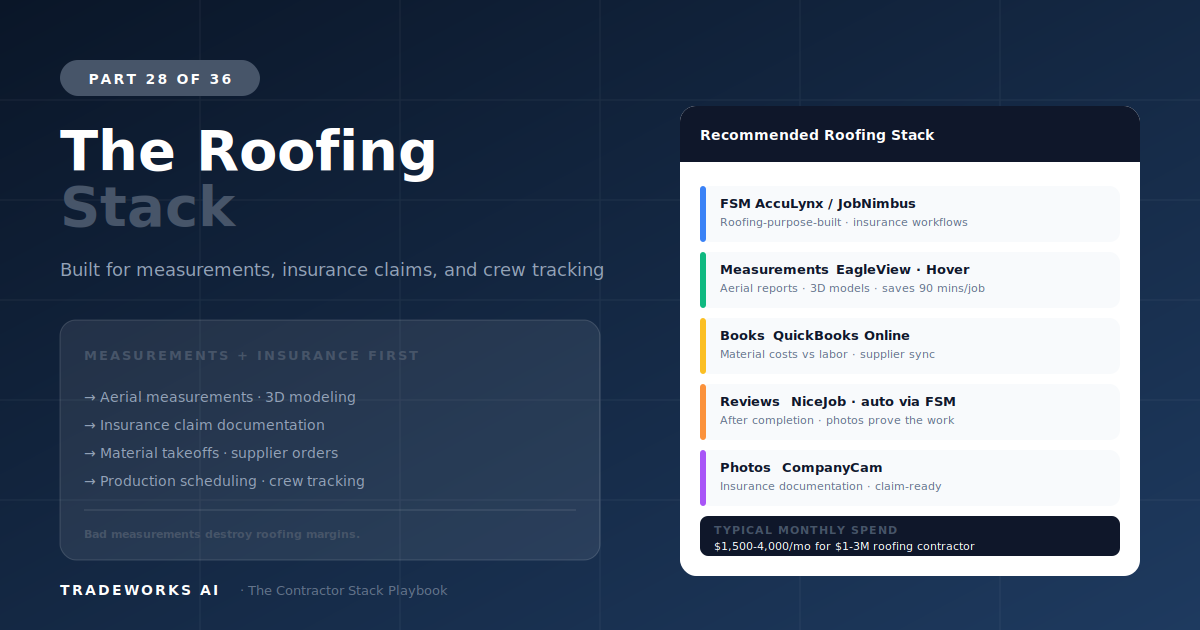
The roofing contractor stack diverges from HVAC, plumbing, and electrical at the most critical layer: the FSM. While those trades follow ...