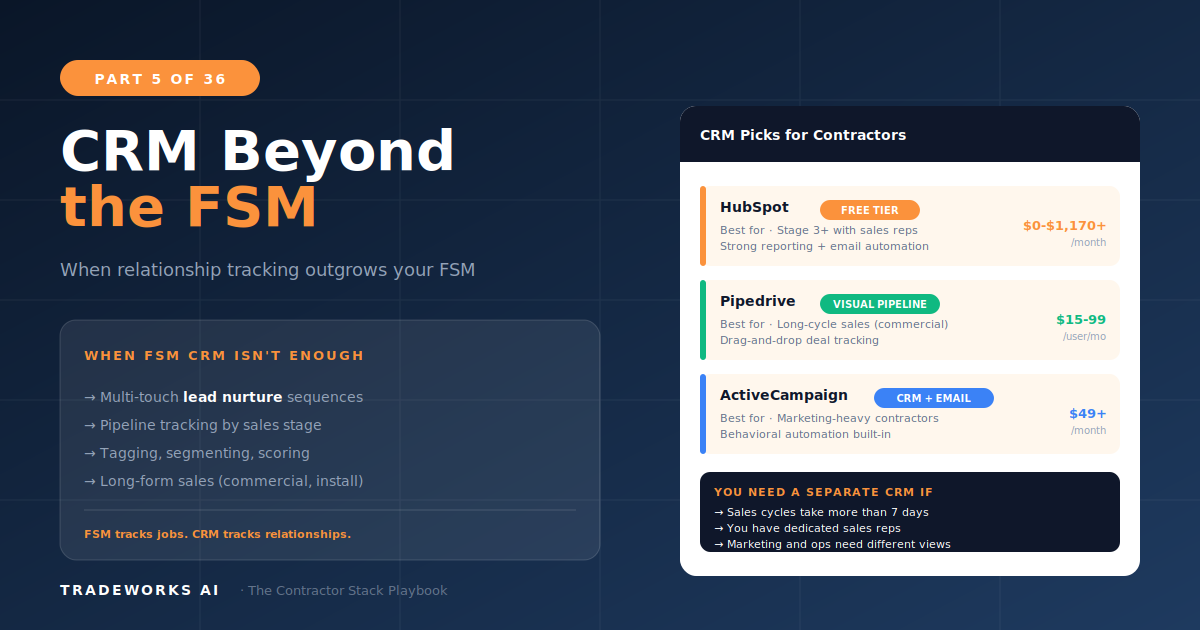
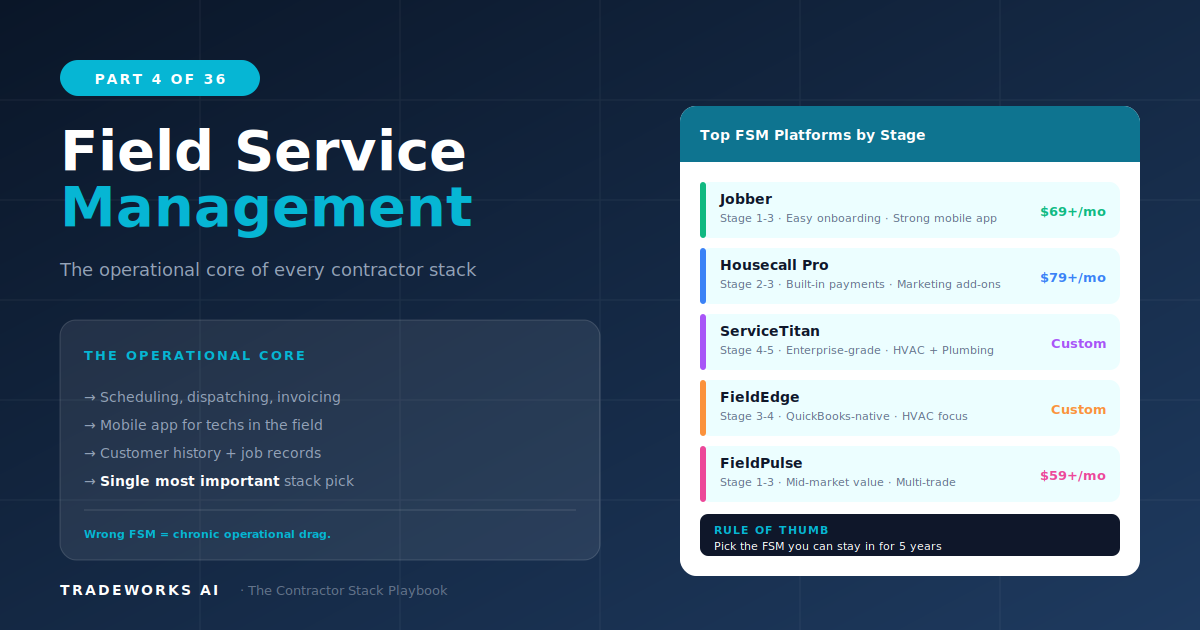
Most contractors do not need a separate CRM. The customer management features built into modern FSM platforms like ServiceTitan, Housecall Pro, and Jobber handle contact records, job history, and basic follow-up for the majority of Stage 1–3 businesses. A dedicated CRM becomes necessary when the contractor’s growth depends on managing relationships that the FSM was never designed to track: long-term commercial accounts, multi-touch sales pipelines, reactivation campaigns, referral programs, and marketing automation sequences. The leading CRM options for contractors in 2026 are ActiveCampaign ($29–$259/month, strongest email-CRM hybrid), HubSpot (free to $1,200+/month, best for dedicated sales teams), and GoHighLevel ($97–$497/month, best all-in-one alternative).
The Question Most Contractors Get Wrong
The question is not “which CRM should I buy?” It is “do I need a CRM at all?”
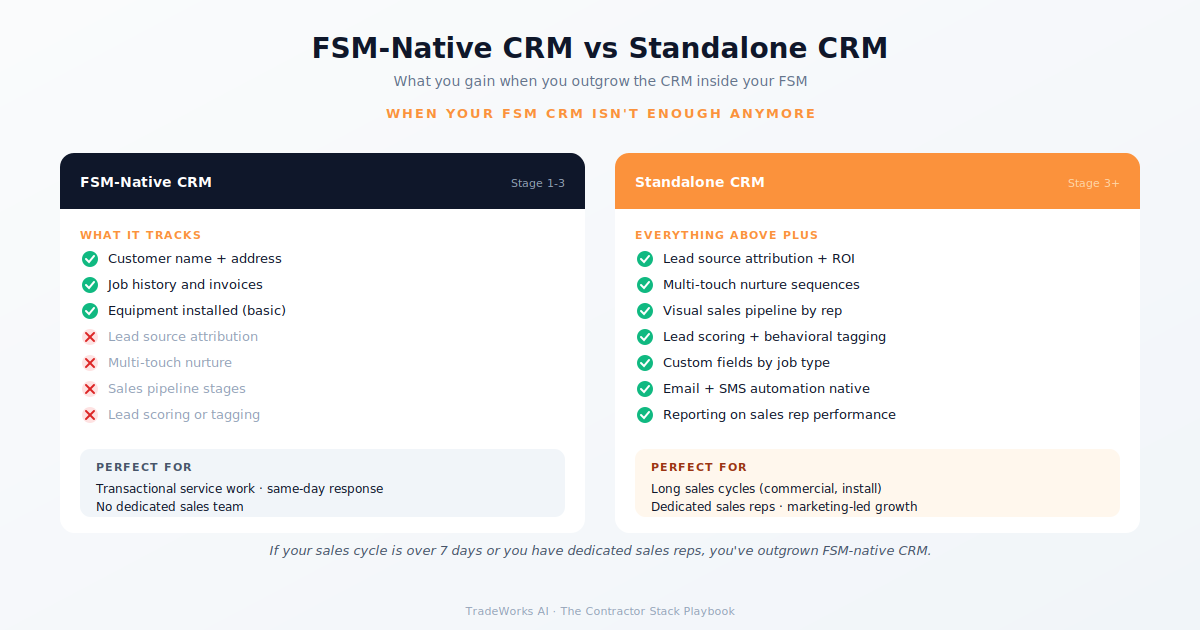
Every FSM reviewed in Part 4 includes customer management functionality: contact records, job history, communication logs, and some level of follow-up tracking. For a Stage 1–2 contractor with 50 to 200 active customers, this built-in CRM is sufficient. Adding a separate CRM at this stage creates data duplication, integration complexity, and administrative overhead that exceeds any benefit.
The dedicated CRM decision becomes relevant when you need capabilities your FSM does not provide. Here are the five signals that indicate it is time:
Marketing automation: You need to send automated email sequences based on customer behavior — maintenance reminders, seasonal promotions, reactivation campaigns for dormant customers. Most FSMs offer basic email but not multi-step automation. ActiveCampaign excels here (see Email Playbook Part 4 for the detailed recommendation).
Multi-touch sales pipeline: You are pursuing commercial accounts or large residential projects that require multiple touchpoints over weeks or months before closing. FSMs track jobs, not sales stages. HubSpot and Salesforce are built for pipeline management.
Referral tracking: You want to systematically track which customers refer new business, attribute revenue to referral sources, and automate referral reward programs. Most FSMs have no referral attribution.
Customer segmentation: You want to group customers by service type, property value, lifetime spend, or last service date and communicate differently with each segment. FSMs offer basic filtering but not dynamic segmentation.
Multi-channel communication: You need to manage customer conversations across email, SMS, voicemail drops, and social media from a single dashboard. GoHighLevel is the strongest option here.
The CRM Comparison
ActiveCampaign
ActiveCampaign is the strongest CRM-plus-email-marketing hybrid for contractors. The platform combines contact management, deal tracking, and the most powerful email automation builder in this price range. For contractors whose primary CRM need is customer communication — maintenance reminders, seasonal campaigns, review requests, reactivation sequences — ActiveCampaign delivers CRM and email marketing in a single subscription.
The Email Marketing Playbook (Part 4) recommends ActiveCampaign as the primary platform for contractor email marketing. When you add the CRM module, you eliminate the need for a separate email tool and a separate CRM, reducing both cost and integration complexity.
8-Criteria Score: Trade Fit 3/5, Size 4/5, Integration 4/5, Mobile 3/5, Learning Curve 3/5, Pricing 4/5, Data Ownership 4/5, Support 3/5. Composite: 28/40.
HubSpot
HubSpot is the most powerful CRM in this comparison — and the most likely to be overkill for contractors under $2 million. The free tier provides solid contact management and basic deal tracking. The paid tiers ($50–$1,200+/month) add marketing automation, advanced reporting, custom workflows, and sales pipeline management that rival enterprise platforms.
HubSpot makes sense for Stage 3–5 contractors with dedicated office or sales staff who will use the platform daily. A single dispatcher doubling as the CRM administrator will not extract enough value from HubSpot’s advanced features to justify the paid tier pricing.
8-Criteria Score: Trade Fit 2/5, Size 3/5, Integration 5/5, Mobile 4/5, Learning Curve 2/5, Pricing 3/5, Data Ownership 4/5, Support 4/5. Composite: 27/40.
GoHighLevel
GoHighLevel is the all-in-one platform that combines CRM, email marketing, SMS, reputation management, funnel building, website hosting, and appointment booking in a single subscription. For contractors who want to consolidate multiple tools into one platform, GoHighLevel can replace a separate CRM, email tool, review tool, and website builder.
The trade-off is depth versus breadth. GoHighLevel’s CRM is competent but not as powerful as HubSpot’s. Its email automation is functional but not as refined as ActiveCampaign’s. Its review management works but lacks the sophistication of dedicated platforms like NiceJob or Birdeye. Part 15 provides the full deep dive on when GoHighLevel makes sense versus a best-of-breed stack.
8-Criteria Score: Trade Fit 3/5, Size 3/5, Integration 3/5, Mobile 3/5, Learning Curve 3/5, Pricing 4/5, Data Ownership 3/5, Support 3/5. Composite: 25/40.
Salesforce Essentials
Salesforce is enterprise CRM that has been scaled down for small business. For contractors managing complex commercial sales pipelines — multi-property facility management, government contracts, or commercial HVAC service agreements — Salesforce provides pipeline management and reporting that no other option in this comparison can match.
For residential contractors, Salesforce is almost always overkill. The learning curve is steep, the customization requirements are significant, and the per-user pricing scales quickly with team size. Unless your business has a dedicated sales team managing complex B2B relationships, skip Salesforce and choose ActiveCampaign or HubSpot.
8-Criteria Score: Trade Fit 2/5, Size 2/5, Integration 5/5, Mobile 4/5, Learning Curve 1/5, Pricing 2/5, Data Ownership 4/5, Support 3/5. Composite: 23/40.
FSM-Native CRM (Staying Put)
The right answer for many contractors is to stay with their FSM’s built-in CRM and invest the CRM budget elsewhere. If your primary need is tracking customer contact information, job history, and basic notes, your FSM already does this. Adding a separate CRM for capabilities you will not use in the next 12 months is a classic over-staging mistake.
Use the 5 signals from the beginning of this article as your decision filter. If none of them apply, your FSM’s CRM is sufficient. Revisit the decision annually.
The Integration Question
When you add a dedicated CRM, the most critical requirement is bidirectional data flow with your FSM. Customer records, job completion data, and communication history must sync automatically. Manual data entry between two systems is worse than having one system with limited features.
ActiveCampaign integrates with most FSMs via Zapier or Make. HubSpot has native integrations with ServiceTitan and pre-built Zapier connections for Housecall Pro and Jobber. GoHighLevel integrates via Zapier with most platforms. Salesforce requires custom configuration for FSM integration, which adds implementation cost.
Part 16 covers the full automation and integration layer, including specific workflows for connecting CRM to FSM, email to CRM, and review management to CRM.
Best-Fit Recommendations
Stage 1–2 (Under $750K): Stay with FSM-native CRM. Invest the CRM budget in review management (Part 7) or email marketing (Part 8) instead.
Stage 2–3 ($750K–$2M, communication-focused): ActiveCampaign. Get CRM + email marketing in one platform. Connects to your FSM via Zapier.
Stage 3–4 ($2M+, sales-team): HubSpot. Justified when you have dedicated staff managing customer relationships as their primary function.
Stage 2–4 (tool consolidation): GoHighLevel. Best if you want to eliminate 3–4 separate subscriptions with a single all-in-one platform. Accept the depth trade-off.
Stage 4–5 (commercial/enterprise): Salesforce Essentials. Only for complex B2B sales pipelines that no other option in this comparison can handle.
Most contractors at Stage 1–2 do not need a separate CRM — their FSM’s built-in customer management is sufficient. A dedicated CRM becomes valuable when the business needs marketing automation, multi-touch sales pipelines, customer segmentation, or referral tracking that the FSM does not provide. The five signals in this article help determine when the switch is justified.
What is the best CRM for HVAC contractors?
For HVAC contractors focused on customer communication and retention, ActiveCampaign offers the best combination of CRM and email marketing automation at $29 to $259 per month. For larger HVAC operations with dedicated sales staff managing commercial accounts, HubSpot provides deeper pipeline management. If consolidating multiple tools is the priority, GoHighLevel replaces CRM, email, SMS, and review management in one platform.
Should I pick CRM or email marketing first?
ActiveCampaign eliminates this choice by combining both. If you are evaluating separate tools, pick email marketing first — the revenue impact of automated maintenance reminders and reactivation campaigns is immediate and measurable, while CRM benefits often take 6 to 12 months to compound.
How does CRM connect to my FSM?
Most CRM-to-FSM integrations run through Zapier or Make (Part 16). The typical workflow: when a job is completed in the FSM, Zapier automatically updates the customer record in the CRM, triggers a review request sequence, and adds the customer to a maintenance reminder campaign. This eliminates manual data entry and ensures no customer falls through the cracks.
Free Audit
Is Your Software Stack Helping You or Hurting Your Margin?
Most contractors are paying $400–900 per month for software they barely use, while losing thousands more in hidden costs from manual processes and missed callbacks. Our free audit grades your stack against the maturity model and identifies the highest-ROI changes you can make this quarter.