Contractor Stack · Part 22
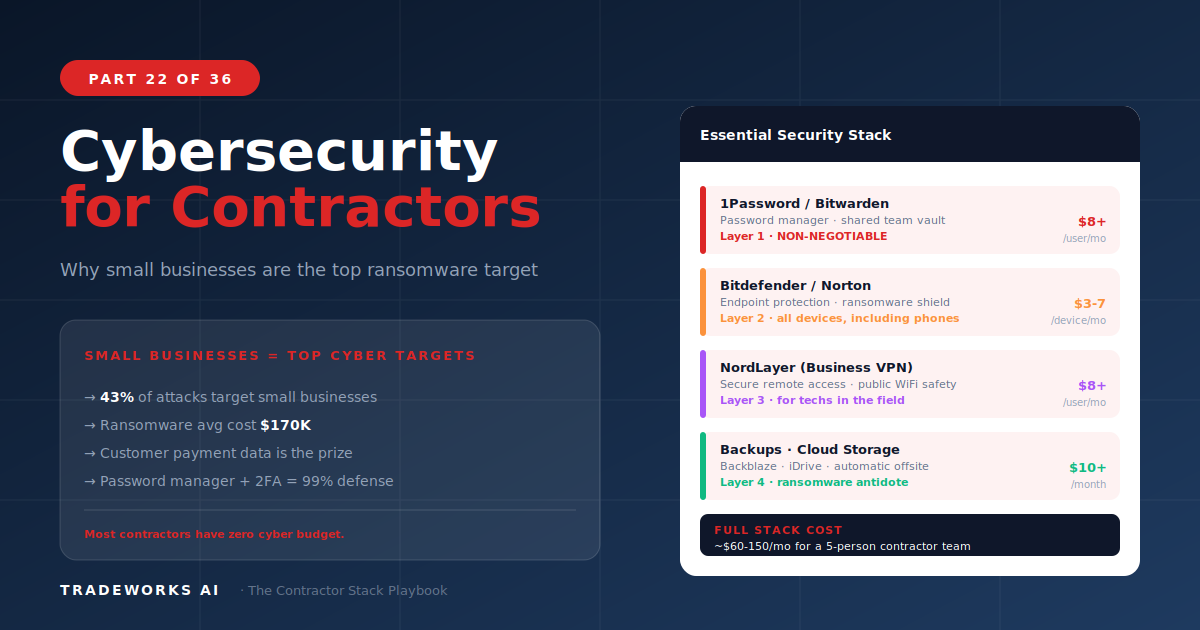
Cybersecurity for Contractors
A complete cybersecurity stack for contractors costs approximately $50 per month and protects against threats that cost unprotected small...
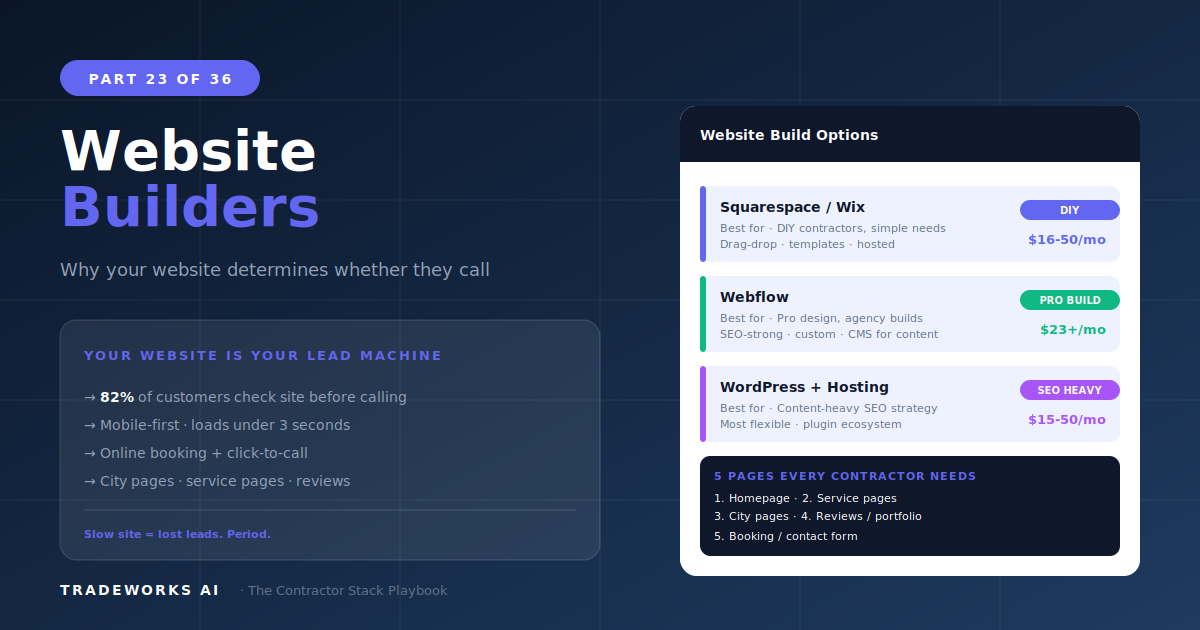
The best website platform for home service contractors who want maximum lead generation and SEO capability is WordPress ($10–$50/month hosting) with a contractor-specific theme like flavor themes from contractor-focused developers. WordPress delivers unmatched SEO flexibility, unlimited content publishing for blog and service pages, and a plugin ecosystem that adds any functionality the business needs. For contractors who prioritize design simplicity over SEO depth, Squarespace ($16–$49/month) offers the most visually polished templates with minimal technical effort. The critical standard for any contractor website: mobile-first design with click-to-call, page load under 3 seconds, and at least one conversion element (phone number, booking form, or chat widget) visible without scrolling on every page.
A contractor website does one of two things: it generates leads by converting visitors into phone calls, form submissions, and bookings, or it sits as a static digital business card that confirms the company exists. Most contractor websites are business cards. They have a homepage, an about page, a services page, and a contact page. They load slowly on mobile. The phone number is buried in the footer. There is no booking form. The content has not been updated since the site launched.
A website that generates leads has specific conversion elements engineered into every page: a click-to-call phone number in the header that follows the user as they scroll, a booking or contact form above the fold on the homepage, service pages for every individual service targeting specific search queries, a Google reviews widget showing recent 5-star reviews, and a service area page optimized for local SEO. The platform you choose determines how easily you can build and maintain these elements.
WordPress powers over 40 percent of all websites on the internet, and for contractors, its dominance in SEO capability is the primary advantage. WordPress sites can be optimized at every level: custom title tags and meta descriptions per page, schema markup for local business and FAQ, unlimited blog content publishing for long-tail keyword targeting, and plugin-based speed optimization that achieves sub-3-second load times.
The trade-off is complexity. WordPress is not drag-and-drop in the way Squarespace or Wix are. Building a high-performing contractor website on WordPress requires either a web developer, a contractor-specific theme with pre-built templates, or a marketing agency (like TradeWorks AI) that specializes in contractor WordPress sites. The initial investment is higher, but the SEO and conversion ceiling is dramatically higher than any alternative.
For contractors who view their website as a lead generation engine — not just an online presence — WordPress is the platform that scales with that ambition. Every blog post, service page, and location page adds a new entry point from search.
8-Criteria Score: Trade Fit 4/5, Size 5/5, Integration 5/5, Mobile 4/5 (theme-dependent), Learning Curve 2/5, Pricing 4/5, Data Ownership 5/5, Support 3/5. Composite: 32/40.
Squarespace is the design-first website builder. The templates are the most visually polished in this comparison, and the built-in design system ensures that even non-designers produce clean, professional-looking sites. For contractors whose primary need is a beautiful online presence with basic SEO capability, Squarespace delivers the best aesthetics-to-effort ratio.
SEO on Squarespace is good but not WordPress-level. Basic optimization (title tags, meta descriptions, alt text, sitemap) is straightforward. Advanced optimization (custom schema, granular speed tuning, complex internal linking) is limited by the platform’s closed architecture. For contractors at Stage 1–3 whose website primarily validates the business for referral and social media traffic rather than generating organic search leads, Squarespace is sufficient.
8-Criteria Score: Trade Fit 3/5, Size 3/5, Integration 3/5, Mobile 5/5, Learning Curve 4/5, Pricing 3/5, Data Ownership 3/5, Support 3/5. Composite: 27/40.
Wix offers the most intuitive drag-and-drop builder with an AI-powered site generator that creates an initial site from business information in minutes. For a contractor who needs a website today and has zero technical skills, Wix is the fastest path to an online presence. SEO is moderate — better than GoDaddy, not as flexible as WordPress.
GoDaddy’s website builder is the most basic option in this comparison. It produces functional but generic sites with limited customization and minimal SEO capability. It exists as a starting point for Stage 1 contractors who have never had a website. Upgrade to Squarespace or WordPress as soon as the business can support it.
GoHighLevel’s website and funnel builder was evaluated in Part 15. It produces functional landing pages and basic websites within the GHL ecosystem. For contractors already on GoHighLevel, using the built-in site builder avoids an additional subscription. For anyone else, WordPress or Squarespace produce dramatically better websites.
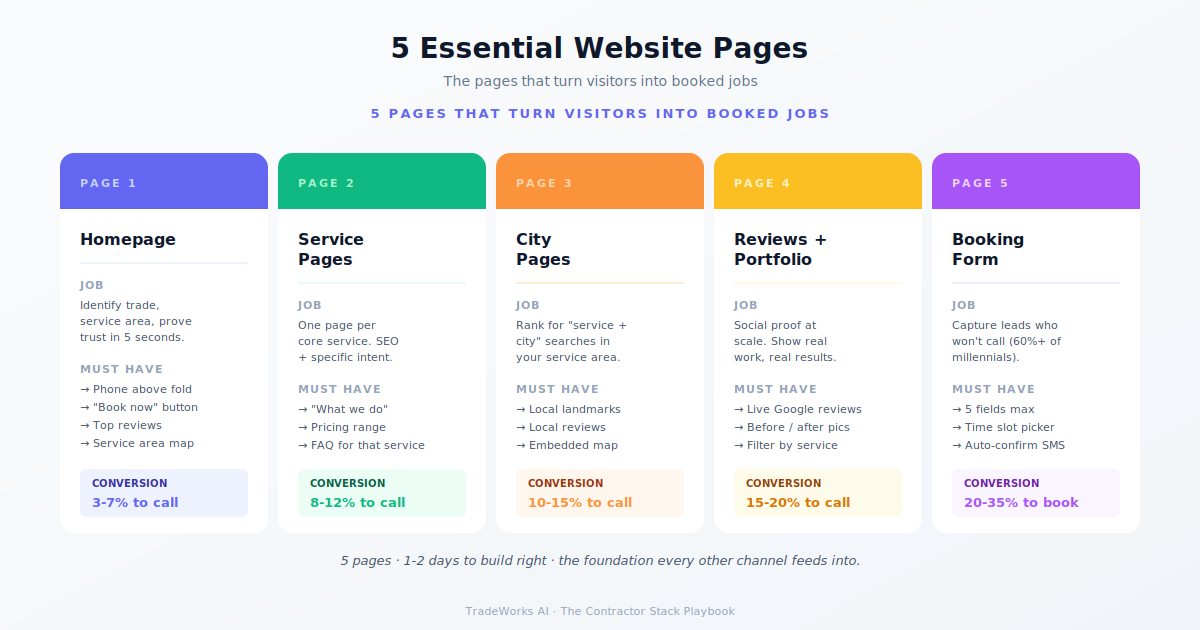
Click-to-call phone number in header, visible on every page, sticky on mobile scroll
Booking or contact form above the fold on the homepage (visible without scrolling)
Google reviews widget showing recent 5-star reviews with total count and average rating
Individual service pages (not one services page) for each service offered, targeting specific search queries
Service area page with embedded map listing all cities and neighborhoods served
Trust signals: license numbers, insurance badge, years in business, certifications, BBB accreditation
Speed: page load under 3 seconds on mobile. Every second above 3 loses 20% of visitors.
Stage 1 (need a website today): Wix or GoDaddy. Get online immediately. Plan to upgrade within 12 months.
Stage 1–3 (design priority): Squarespace. Beautiful templates, minimal technical effort, good-enough SEO for businesses that get most leads from referrals and social media.
Stage 2–5 (SEO and lead generation): WordPress. The only platform that scales with a serious content strategy. Pair with a contractor-specific theme or hire a web developer/agency.
Already on GoHighLevel: Use GHL’s site builder only if website investment is not a priority and you are consolidating tools. For any SEO-serious contractor, WordPress is the separate investment worth making.
WordPress with a contractor-focused theme for HVAC contractors serious about SEO and lead generation. Squarespace for HVAC contractors who want a polished online presence with minimal technical effort. The choice depends on whether the website is a lead generation engine (WordPress) or a digital business card (Squarespace).
DIY: $10 to $50 per month for hosting and platform. Professional build: $2,500 to $8,000 one-time for a custom contractor WordPress site. Agency-managed: $500 to $2,000 per month including SEO, content, and ongoing optimization. Match the investment to how much revenue the website needs to generate. A site that brings in 5 leads per month at $500 average ticket justifies $500/month in investment.
If you want organic search traffic, yes. Every blog post targeting a specific search query (like “how long does an AC unit last in Florida”) creates a new entry point from Google. Contractors who publish 2 to 4 blog posts per month see measurable organic traffic growth within 6 to 12 months. WordPress is the strongest platform for blog-driven content strategy.
Most contractors are paying $400–900 per month for software they barely use, while losing thousands more in hidden costs from manual processes and missed callbacks. Our free audit grades your stack against the maturity model and identifies the highest-ROI changes you can make this quarter.
A complete cybersecurity stack for contractors costs approximately $50 per month and protects against threats that cost unprotected small...
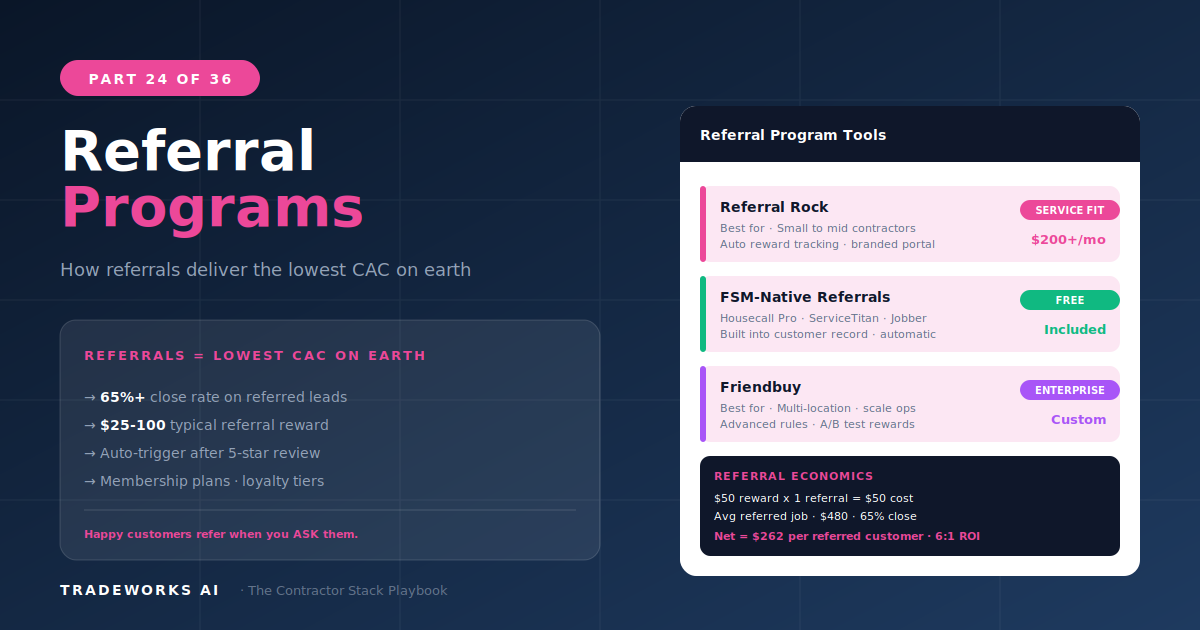
The best referral program software for contractors integrating with an existing review workflow is NiceJob (referral features included wi...