Contractor Stack · Part 17
Photo Documentation and Visual Reporting
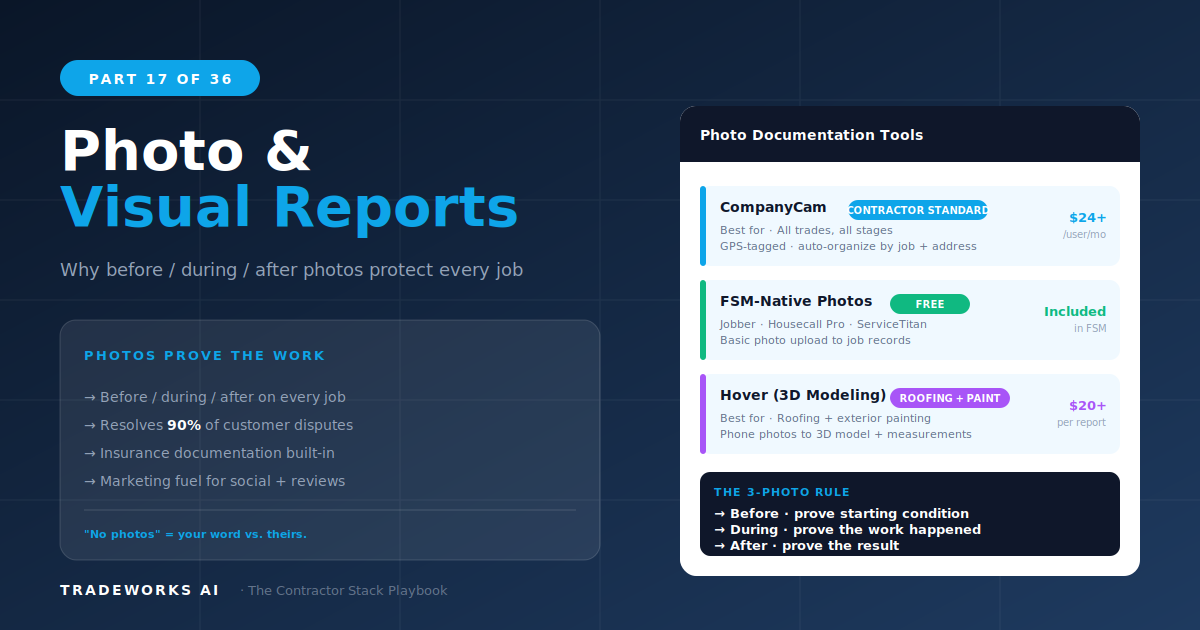
The best photo documentation software for contractors is CompanyCam ($19–$29 per user per month), which provides GPS-tagged, time-stamped...
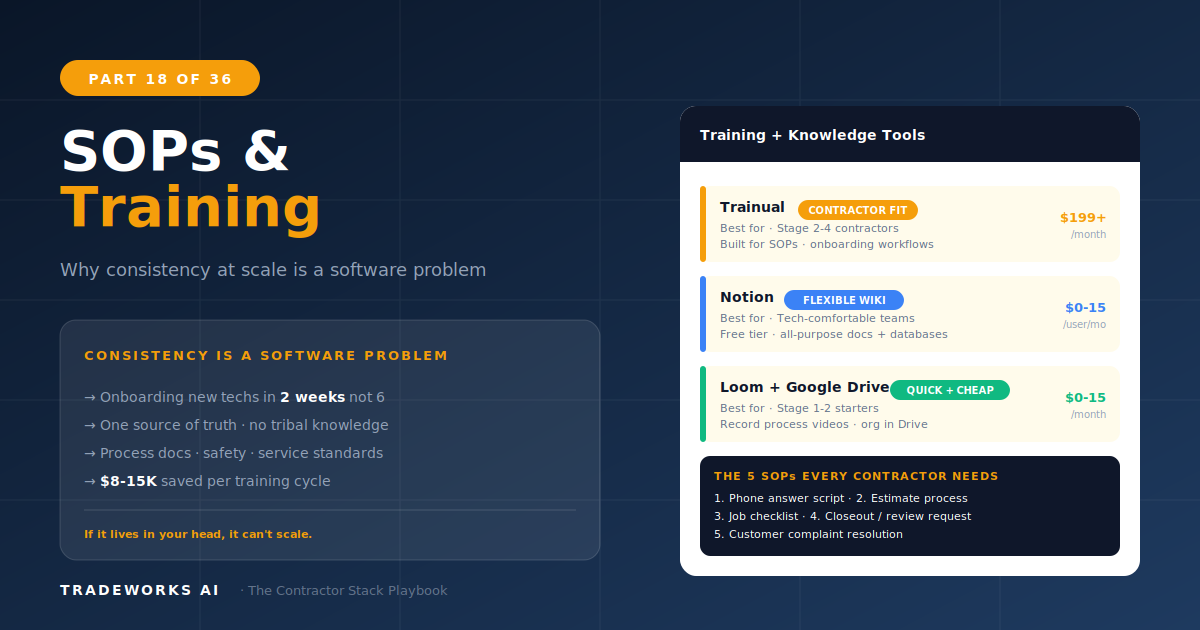
The best training and SOP platform for growing contractor teams is Trainual ($249–$499/month) for structured onboarding playbooks with completion tracking, or SweetProcess ($99/month) for clean, searchable step-by-step SOPs without the training management overhead. Standard operating procedures reduce callbacks by 20 to 40 percent, cut new technician onboarding time from 8 to 12 weeks to 3 to 4 weeks, and protect the business from knowledge loss when senior technicians leave. For contractors not ready for dedicated SOP software, Loom (free–$12.50/user/month) plus Google Workspace ($7–$18/user/month) provides a functional training system at minimal cost. This guide compares five platforms and identifies the 10 SOPs every contractor needs documented first.
Most contractors think of standard operating procedures as corporate overhead — documentation that large companies create because they have compliance departments and nothing better to do. This perception costs them money every week.
A callback costs 3 to 5 times a first visit. The technician drives back, spends time diagnosing what went wrong, corrects the issue, and the company absorbs the labor cost, fuel, and opportunity cost of the slot that callback occupied. A callback caused by inconsistent procedures — a step skipped, a test not performed, a connection not verified — is entirely preventable. An SOP that every technician follows eliminates the variation that creates callbacks.
The math on callback reduction alone justifies SOP investment. A contractor completing 100 jobs per month with a 12 percent callback rate experiences 12 callbacks. If SOPs reduce callbacks by 30 percent (a conservative estimate from contractors who implement them), that is 3.6 fewer callbacks per month. At an average callback cost of $250 (technician time, fuel, lost opportunity), the monthly savings is $900. Against even the most expensive SOP platform (Trainual at $499/month), the ROI is positive in the first month.
Trainual is the most complete training and knowledge management platform for growing contractor teams. The platform structures all company knowledge into organized subjects: each trade procedure, company policy, customer service standard, and software workflow becomes a documented, assignable training module. When a new technician starts, Trainual assigns them a role-specific training path and tracks completion.
Trainual’s value compounds with team size. For a 3-person crew, documented SOPs in Google Docs may suffice. For a team of 8 to 20 technicians with regular new hires, Trainual’s structured training paths, completion tracking, and role-based assignments reduce onboarding time from 8 to 12 weeks of ride-alongs to 3 to 4 weeks of structured learning supplemented by ride-alongs. The senior technicians spend less time training and more time producing revenue.
At $249 to $499 per month, Trainual is priced for Stage 3–5 contractors who hire regularly and need scalable onboarding. Below that threshold, the feature depth exceeds the need.
8-Criteria Score: Trade Fit 3/5, Size 3/5 (growing teams), Integration 3/5, Mobile 4/5, Learning Curve 3/5, Pricing 2/5, Data Ownership 3/5, Support 4/5. Composite: 25/40.
SweetProcess focuses specifically on step-by-step procedure documentation. Every SOP is a numbered sequence of steps with images, videos, and decision points. The interface is deliberately simple: create a process, add steps, assign to team members. No training path management, no completion tracking, no role-based assignments. Just clean, searchable SOPs.
For contractors whose primary need is documentation rather than training management, SweetProcess at $99 per month delivers the core value at 60 to 80 percent lower cost than Trainual. The team can look up any procedure on their phone in the field. When a technician encounters an unfamiliar situation, they search for the relevant SOP and follow the steps.
8-Criteria Score: Trade Fit 3/5, Size 4/5, Integration 2/5, Mobile 4/5, Learning Curve 5/5, Pricing 4/5, Data Ownership 3/5, Support 3/5. Composite: 28/40.
For contractors at Stage 1–2 or those not ready for dedicated SOP software, Loom plus Google Workspace provides a functional training system at minimal cost. Record a Loom video of every standard procedure: how to use the FSM, how to conduct a system inspection, how to present an estimate, how to handle a customer complaint. Store the videos in a shared Google Drive folder organized by category. Create a Google Doc index that links to each video.
This approach lacks the structure, search, and tracking of Trainual or SweetProcess. But for a team of 3 to 5, it captures institutional knowledge that would otherwise live only in senior technicians’ heads. A 5-minute Loom video of the lead technician demonstrating the proper compressor check procedure is worth more than any written manual because the new hire sees exactly how it is done.
Notion is the flexible middle ground: a wiki-style platform that can be configured as a knowledge base, SOP library, training tracker, or all three. The learning curve is moderate — Notion is powerful but requires setup effort. For tech-comfortable contractors or office managers who enjoy building systems, Notion at $10/user/month offers the most customizable approach.
The risk with Notion is that flexibility becomes complexity. Without a clear structure imposed from the start, Notion workspaces tend to grow organically into disorganized information dumps. If you choose Notion, invest the initial time to build a clean template structure before adding content.
Start with these ten procedures. They cover the highest-frequency, highest-impact processes that drive callback rates, customer satisfaction, and team consistency:
1. System/Property Inspection Protocol: Step-by-step inspection checklist specific to your trade. Ensures nothing is missed.
2. Estimate Presentation Process: How to present Good/Better/Best options (Part 11), present financing (Part 13), and handle objections.
3. Customer Communication Standards: Phone greeting, on-site introduction, explaining findings, delivering bad news, requesting reviews.
4. Job Site Arrival and Departure: Vehicle parking, shoe covers/floor protection, property walk-through, customer sign-off, cleanup, photo documentation.
5. FSM Workflow: How to use the scheduling platform: accepting jobs, updating status, creating invoices, collecting payment, adding notes.
6. Emergency Call Handling: Triage protocol for after-hours calls. What qualifies as emergency dispatch versus next-business-day scheduling.
7. Callback/Warranty Return Process: How to handle a callback: diagnosis, documentation, resolution, root-cause tracking.
8. Safety Protocol: PPE requirements, electrical lockout/tagout, confined space, heat illness prevention, customer property protection.
9. Parts/Inventory Management: How to request parts, stock the truck, log inventory usage, handle returns.
10. New Hire Onboarding Checklist: Day 1 through Week 4 schedule. Paperwork, software access, training sequence, ride-along schedule, first solo job criteria.
Stage 1–2 (1–5 people): Loom + Google Workspace. Record procedures as Loom videos, organize in Google Drive. Total cost: $7–$25/user/month.
Stage 2–3 (documentation priority): SweetProcess at $99/month. Clean, searchable SOPs without training management complexity. Best value for SOP-specific needs.
Stage 2–4 (tech-comfortable teams): Notion at $10/user/month. Flexible wiki that scales with the business. Requires initial structure investment.
Stage 3–5 (regular hiring, structured onboarding): Trainual. Justified when new hires arrive frequently enough that structured, trackable training paths save senior technician time.
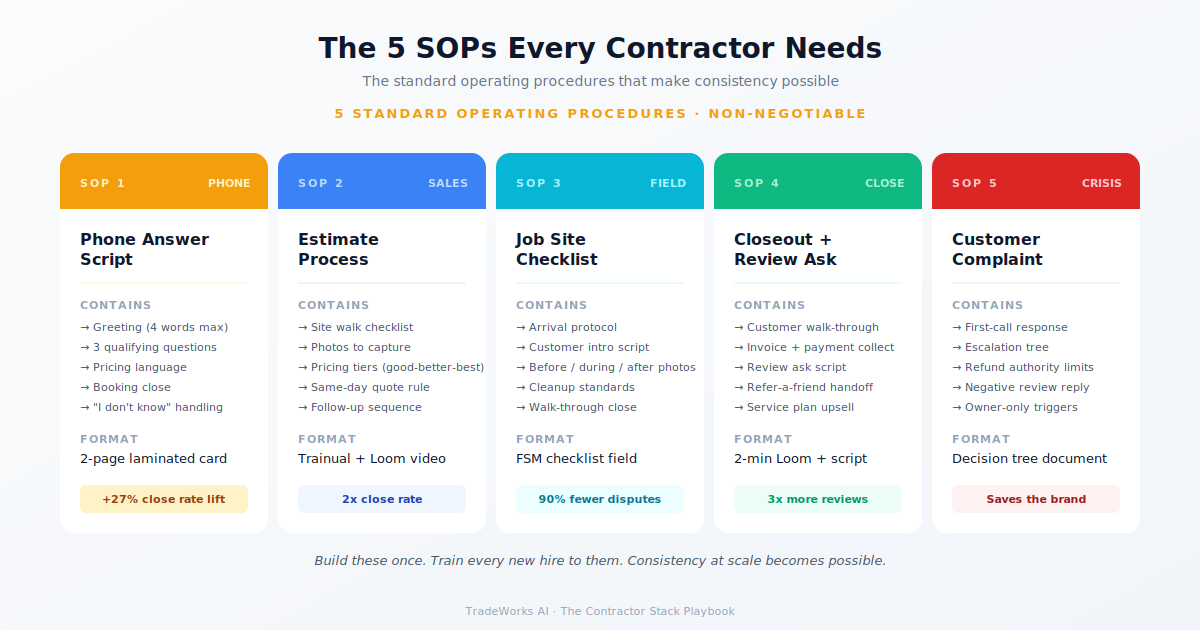
Callbacks caused by inconsistent procedures — a test skipped, a connection not verified, a filter not checked — are eliminated when every technician follows the same documented steps. Contractors who implement SOPs for their top 10 procedures typically see callback reductions of 20 to 40 percent within 90 days.
Start with one SOP per week. The most efficient method: have your best technician perform the procedure while someone records a Loom video and takes notes. Then convert the video into a written step-by-step SOP. Budget 1 to 2 hours per procedure. The 10 essential SOPs take approximately 10 to 20 hours total spread over 5 to 10 weeks.
Both. Loom videos capture nuance that written steps miss — hand positioning, tool technique, visual indicators. Written SOPs provide a quick reference checklist that technicians can scan in the field. The ideal SOP includes a written step-by-step procedure with an embedded Loom video demonstrating each critical step.
Most contractors are paying $400–900 per month for software they barely use, while losing thousands more in hidden costs from manual processes and missed callbacks. Our free audit grades your stack against the maturity model and identifies the highest-ROI changes you can make this quarter.
The best photo documentation software for contractors is CompanyCam ($19–$29 per user per month), which provides GPS-tagged, time-stamped...
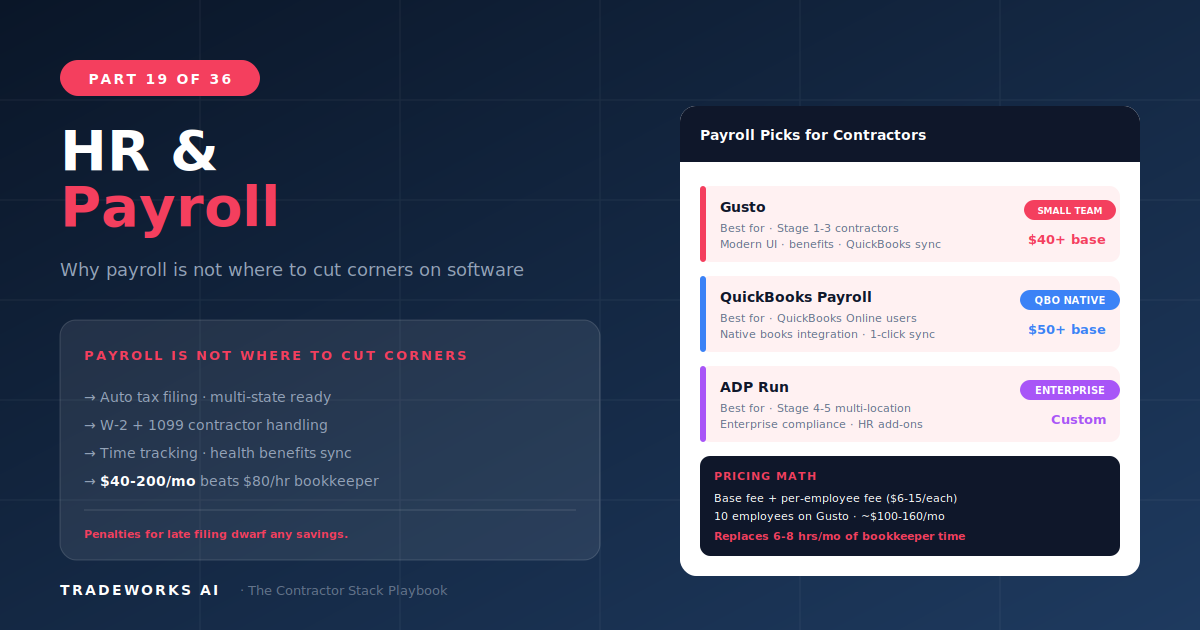
The best payroll software for home service contractors is Gusto ($40 base plus $6 per person per month), which delivers modern, intuitive...