Contractor Stack · Part 23
Website Builders for Contractors
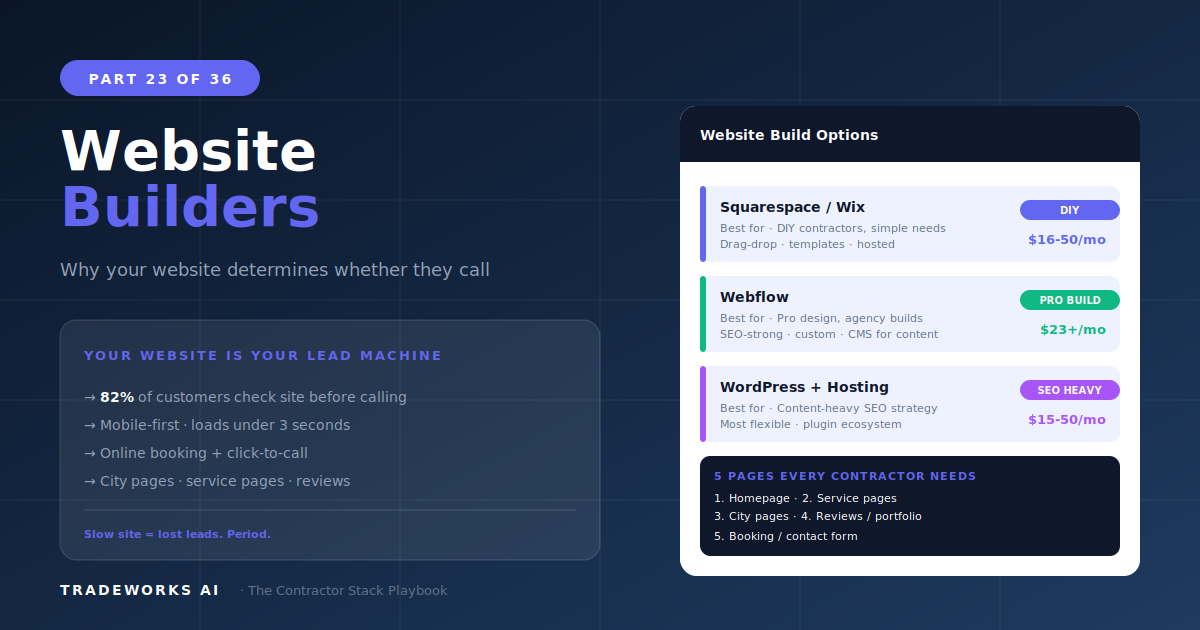
The best website platform for home service contractors who want maximum lead generation and SEO capability is WordPress ($10–$50/month ho...
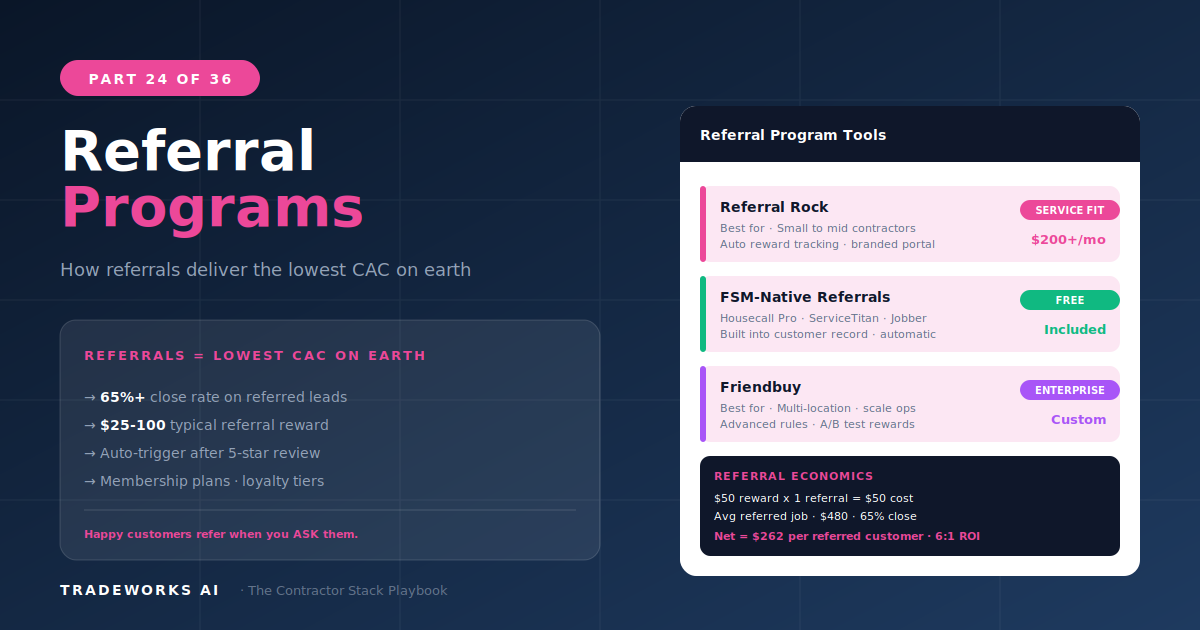
The best referral program software for contractors integrating with an existing review workflow is NiceJob (referral features included with the $75+/month review platform from Part 7). Referred customers close at 2 to 4 times the rate of cold leads, spend 15 to 25 percent more per job, and cost zero dollars in advertising to acquire. Despite this, most contractors run no formal referral program — they rely on organic word of mouth and hope satisfied customers mention them to neighbors. A structured referral program with automated requests, tracking, and rewards transforms passive word of mouth into a predictable lead generation channel. The Email Marketing Playbook Part 8 covers the Referral Engine email sequence that connects to the software platforms evaluated here.
Referral leads are the most valuable leads in any contractor’s pipeline, and the data consistently supports this across every home service trade. Understanding why requires examining three metrics: close rate, average ticket, and acquisition cost.
Referred customers close at 2 to 4 times the rate of leads from advertising, Google search, or social media. The reason is trust transfer: when a neighbor says “Call this company, they did a great job on my AC,” the new customer arrives with pre-built trust. They are not comparison shopping five companies — they are calling the one company their friend recommended. The sales conversation starts from “when can you come” rather than “what are your qualifications.”
Referred customers spend 15 to 25 percent more per job. They are less price-sensitive because the recommendation carried implicit endorsement of the company’s value. A homeowner who found the contractor through a Google ad will compare the estimate against two competitors. A homeowner who was referred by a trusted friend is comparing the estimate against their friend’s positive experience — a much more favorable comparison.
Acquisition cost for referral leads is effectively zero. No advertising spend, no lead generation platform fee, no cost-per-click. The only cost is the referral reward, which is paid after the referred customer completes service — meaning you pay for the lead only after collecting revenue from it. Compare this to Google Ads at $30 to $100 per click for HVAC keywords or Facebook ads at $15 to $50 per lead, and the economics are overwhelming.
If referral leads are this valuable, why do most contractors run no formal program? Three reasons:
No system: The contractor relies on customers to refer organically. Some do, most forget. Without a prompt at the right moment, even delighted customers do not think to refer their contractor to friends.
No tracking: Without tracking, the contractor does not know which customers referred, who was referred, whether the referral converted, or what the revenue was worth. This makes it impossible to reward referrers or measure the program’s ROI.
No reward: Even contractors who ask for referrals rarely offer a structured incentive. A “we appreciate referrals” line on the invoice is not a program. A $50 credit toward the next service, delivered automatically when the referred customer books — that is a program.
The Email Marketing Playbook Part 8 introduces the Referral Engine — a 3-email automated sequence that requests referrals at the moment of highest customer satisfaction (immediately after a positive review), explains the reward, and makes referring as simple as sharing a link. The software platforms in this part automate the tracking and reward fulfillment that make the Referral Engine operational.
NiceJob’s referral feature integrates directly with its review workflow from Part 7. After a customer leaves a positive review, NiceJob automatically triggers a referral request — asking the customer to share the experience with friends and family. The timing is optimal: the customer just expressed satisfaction publicly by leaving a review, and the referral request arrives while that positive emotion is active.
The referral tracking is built into the NiceJob dashboard alongside review metrics. Contractors can see which customers referred, who was referred, and whether the referral converted to a booked job. For contractors already using NiceJob for review management, adding the referral feature requires zero additional cost or software — it is included in the existing subscription.
The limitation is simplicity: NiceJob’s referral features are basic compared to dedicated referral platforms. If you need multi-tier rewards (different incentives for different service levels), partner referral tracking (real estate agents, property managers), or advanced referral analytics, a dedicated platform like Referral Rock provides deeper functionality.
8-Criteria Score (referral-specific): Trade Fit 4/5, Size 4/5, Integration 5/5 (with NiceJob), Mobile 3/5, Learning Curve 5/5, Pricing 5/5 (included), Data Ownership 3/5, Support 4/5. Composite: 33/40.
Referral Rock is the dedicated referral program platform for contractors who want a full-featured program: custom referral landing pages, multi-channel sharing (email, text, social media), automated reward fulfillment, multi-tier incentive structures, and detailed analytics showing referral funnel performance. At $200 to $800 per month, it is significantly more expensive than NiceJob’s included feature.
Referral Rock makes sense for Stage 3–5 contractors who generate 20+ referral leads per month and need program management at scale. For a contractor whose referral program generates $50,000 or more in annual revenue, the $200 to $800 per month investment is justified by the tracking and optimization capability. For most Stage 2–3 contractors, NiceJob’s simpler referral feature is sufficient.
8-Criteria Score: Trade Fit 3/5, Size 3/5 (large programs), Integration 3/5, Mobile 4/5, Learning Curve 3/5, Pricing 2/5, Data Ownership 4/5, Support 3/5. Composite: 25/40.
Jobber includes basic referral tracking within its FSM. Contractors can generate referral links, track which customers shared them, and see when referred leads book service. The feature is simple but functional for Stage 1–3 contractors who want referral tracking without additional software cost.
A manual referral system — tracking referrals in a spreadsheet and fulfilling rewards by hand — works for solo operators handling 2 to 3 referrals per month. The overhead of managing the program becomes unsustainable above 5 referrals per month, at which point software automation pays for itself in administrative time saved.
A referral program has three components: the ask, the reward, and the tracking. Get all three right and referrals become a predictable monthly lead source.
When and how you ask determines whether customers participate. The optimal moment is immediately after a positive experience — specifically, right after a customer leaves a 5-star review. NiceJob automates this timing. For manual or email-based programs, the Referral Engine sequence from Email Playbook Part 8 provides the template.
The ask must be specific: “Do you know anyone who might need [specific service] this season?” outperforms “Refer us to your friends” because it prompts the customer to think of a specific person rather than the abstract concept of referral.
Effective referral rewards for contractors:
$25–$50 service credit toward the referrer’s next maintenance or repair
$50–$100 Visa gift card (tangible, universally valued, easy to fulfill)
Dual reward: $25 for the referrer AND $25 off the referred customer’s first service (incentivizes both sides)
Tiered rewards: $25 for first referral, $50 for second, $100 for third (rewards repeat referrers who become brand ambassadors)
Avoid percentage-based rewards (“10% off your next service”) because the value is vague and the customer cannot visualize what they are earning. A specific dollar amount or gift card is more motivating.
Every referral program needs to answer four questions: who referred, who was referred, did they convert, and what was the revenue? Without this data, you cannot measure ROI, optimize the program, or reward referrers accurately. NiceJob, Referral Rock, and Jobber all provide this tracking automatically. Manual systems require disciplined spreadsheet maintenance that most contractors abandon within 60 days.
Stage 1–2 (starting out): Manual system (spreadsheet) or Jobber built-in referrals. Keep it simple: ask after every job, track in a spreadsheet, fulfill rewards manually.
Stage 2–4 (NiceJob users): NiceJob referrals (33/40). Already included. Automated post-review referral request. Zero additional cost. The primary recommendation.
Stage 3–5 (high-volume program): Referral Rock. Justified when generating 20+ referrals/month and needing multi-tier rewards, partner tracking, and program analytics.
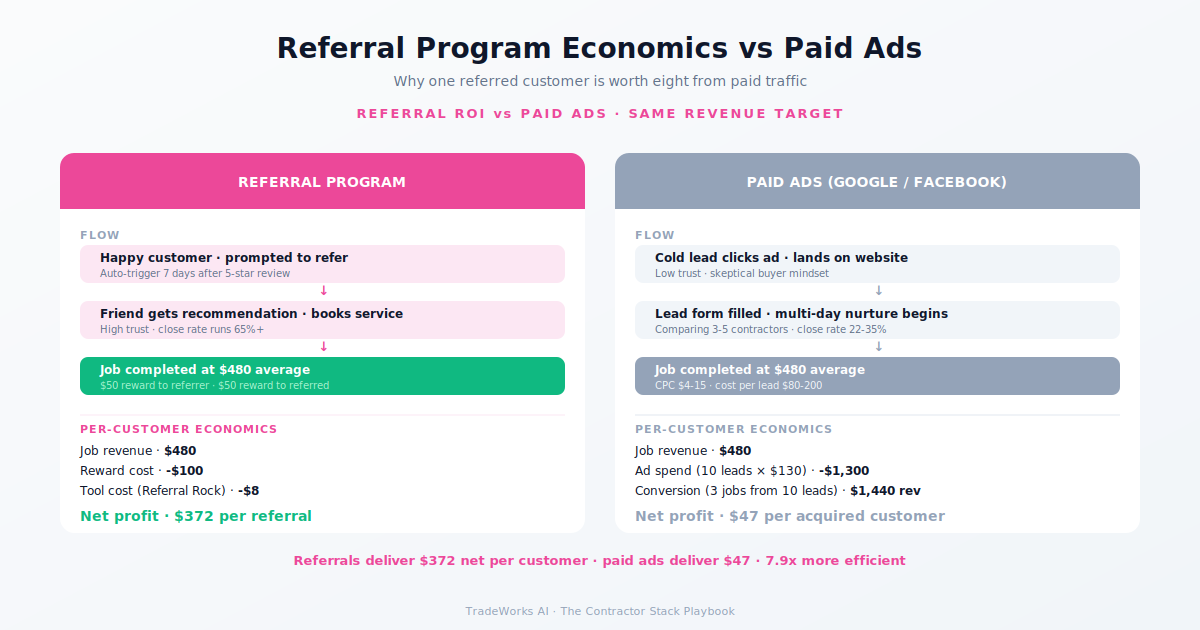
A $25 to $50 service credit or gift card is the sweet spot for residential contractors. The reward needs to be meaningful enough to motivate but not so high that it cuts into job profitability. On a $500 average ticket with a $50 referral reward, the acquisition cost is 10 percent — compared to 20 to 40 percent for paid advertising leads. Tiered rewards ($25, $50, $100 for successive referrals) encourage repeat referrals from your best advocates.
Immediately after a positive experience. The highest-conversion moment is right after a customer leaves a 5-star review — they have just publicly expressed satisfaction and are primed to share. NiceJob automates this timing. For manual programs, ask at the completion of every job with a follow-up email or text within 24 hours.
Referral programs typically deliver 5 to 15 times their cost in attributed revenue. A contractor paying $50 per referral reward who generates 5 referred customers per month at $500 average ticket produces $2,500 in monthly revenue from $250 in rewards — a 10x return. Because referred customers also have higher lifetime value and lower churn than advertising-acquired customers, the long-term ROI is even higher.
Manual tracking works for 1 to 3 referrals per month. Above that volume, the administrative burden of spreadsheet tracking and manual reward fulfillment causes the program to fail within 60 days. NiceJob’s referral feature (included with review management at $75+/month) provides automated tracking at no additional cost for contractors already managing reviews.
Most contractors are paying $400–900 per month for software they barely use, while losing thousands more in hidden costs from manual processes and missed callbacks. Our free audit grades your stack against the maturity model and identifies the highest-ROI changes you can make this quarter.
The best website platform for home service contractors who want maximum lead generation and SEO capability is WordPress ($10–$50/month ho...
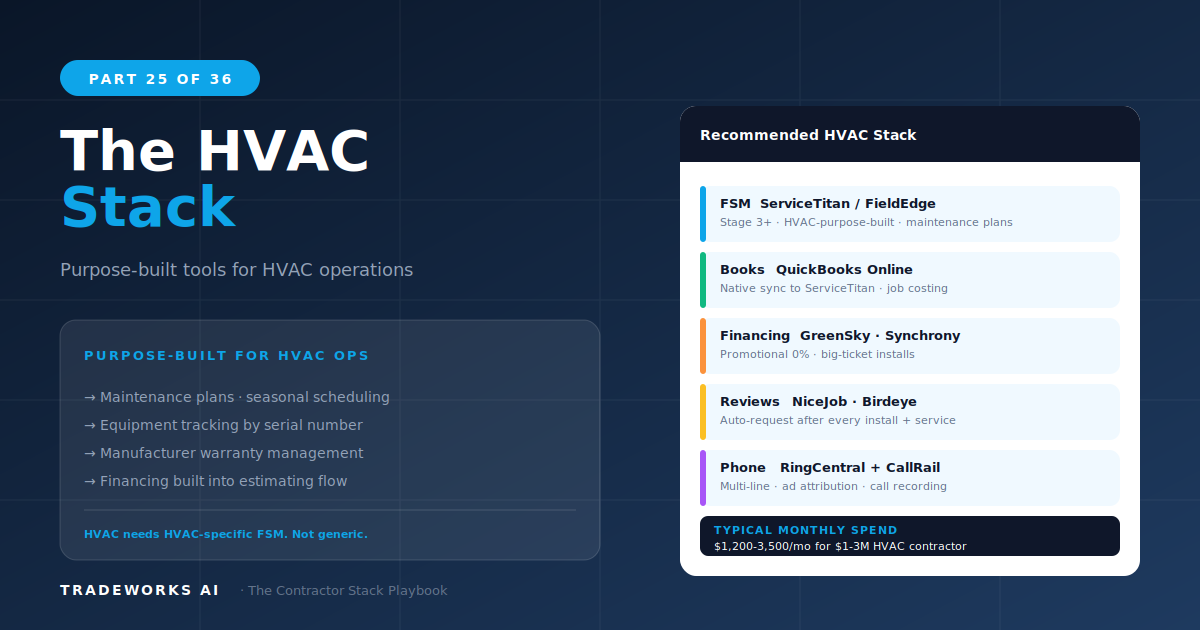
The recommended software stack for an HVAC contractor at Stage 2–3 ($500K–$2M revenue) costs $400 to $900 per month and includes Housecal...