Contractor Stack · Part 8
Email Marketing and Marketing Automation
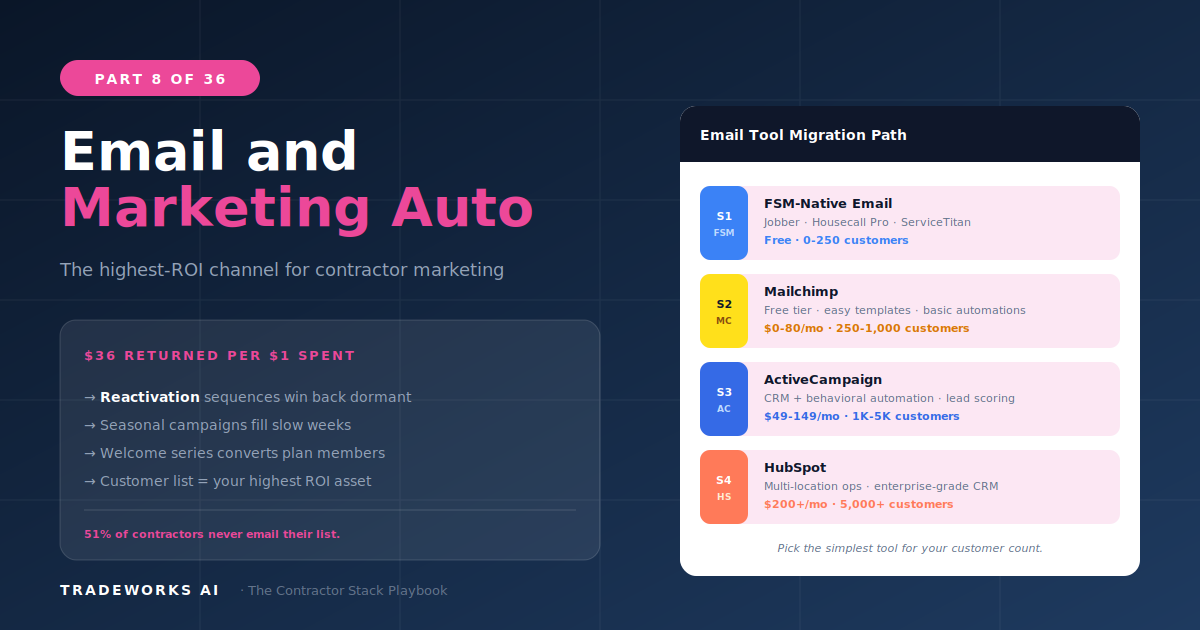
The best email marketing software for home service contractors is ActiveCampaign ($29–$259/month), which delivers the most powerful autom...
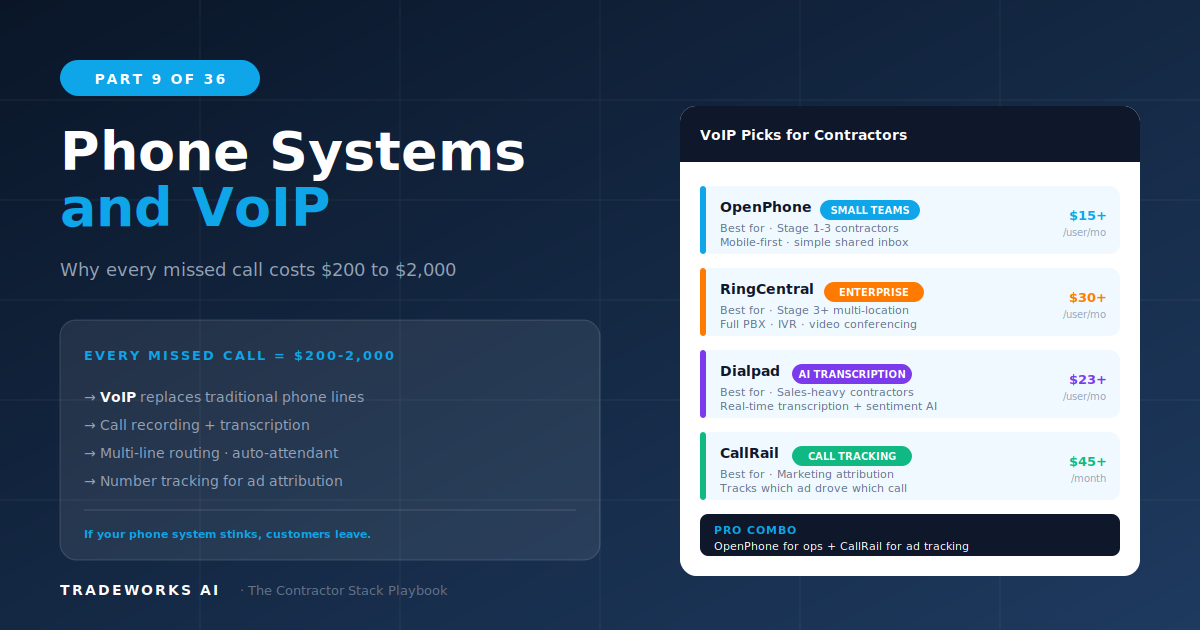
The best phone system for most home service contractors is OpenPhone ($15–$23 per user per month), which delivers a dedicated business number, call recording on all tiers, shared phone inbox for team collaboration, and a modern mobile app that separates business and personal calls on a single device. For solo operators needing only a basic business number, Grasshopper ($14–$55/month) provides the simplest call forwarding solution. For multi-location operations needing full PBX features, video conferencing, and team messaging, RingCentral ($20–$45/user/month) is the enterprise standard. Every missed call is a lost lead — contractors who answer within 60 seconds close at 3 to 5 times the rate of those who call back hours later.
The phone is still the primary lead source for home service contractors. Despite online booking, chat widgets, and contact forms, 60 to 70 percent of residential service leads arrive as phone calls. The conversion math on those calls is unforgiving: industry data shows that contractors who answer or return calls within 60 seconds close at 3 to 5 times the rate of those who respond after an hour or more.
A missed call during business hours is a lead that called your competitor while your phone rang. A missed call after hours is a lead that called your competitor the next morning. The Email Playbook Part 10 covers the speed-to-lead framework in detail, and the Facebook Playbook Part 5 addresses click-to-call conversion from social media ads. The phone system is the infrastructure that makes speed-to-lead possible.
Most contractors operate on a personal cell phone or a single landline. Both create the same failure mode: one phone, one person, limited availability. When the owner is on a roof, in an attic, or driving to a job site, the phone goes to voicemail. The customer hangs up and calls the next company on the list. A proper business phone system solves this with call routing, simultaneous ring, team-based call handling, and after-hours management.
OpenPhone is the strongest fit for Stage 1–3 contractors who want a modern business phone system without enterprise complexity. The platform provides a dedicated business number that runs through a mobile app, keeping business and personal calls separate on the same device. Call recording is included on all tiers — critical for dispute resolution, training, and quality control.
The shared inbox feature is OpenPhone’s standout for small teams: multiple team members can see and respond to calls and texts from the same business number. When a customer calls and the first person is unavailable, the call routes to the next team member automatically. After-hours calls can be forwarded to a voicemail with a text-back auto-response, maintaining speed-to-lead even outside business hours.
At $15 to $23 per user per month, OpenPhone is the most cost-effective dedicated business phone system in this comparison. Integration with CRM and FSM platforms is available via Zapier.
8-Criteria Score: Trade Fit 4/5, Size 4/5, Integration 3/5, Mobile 5/5, Learning Curve 5/5, Pricing 5/5, Data Ownership 3/5, Support 3/5. Composite: 32/40.
Grasshopper is a virtual phone system that adds a business number to your existing personal phone. Calls to the business number are forwarded to your cell phone, and outgoing calls through the Grasshopper app display the business number as caller ID. It is call forwarding with a professional wrapper — nothing more, nothing less.
For solo operators at Stage 1 who need a business number today at the lowest possible cost, Grasshopper works. The limitation is that Grasshopper does not offer call recording, has no shared inbox, and limited team routing. As soon as you add a second person who needs to handle calls, Grasshopper’s single-user architecture becomes a bottleneck.
8-Criteria Score: Trade Fit 2/5, Size 2/5, Integration 1/5, Mobile 4/5, Learning Curve 5/5, Pricing 4/5, Data Ownership 2/5, Support 2/5. Composite: 22/40.
RingCentral is the enterprise VoIP platform for contractors who need a full-featured business communication system: multi-line phone, video conferencing, team messaging, call center queues, IVR (interactive voice response) menus, and detailed call analytics. For a 20+ person operation with multiple locations, a dedicated dispatch center, and customer service staff, RingCentral provides the telephony infrastructure that smaller platforms cannot match.
For contractors under 10 employees, RingCentral is overkill. The feature depth creates configuration complexity, per-user pricing adds up quickly for small teams, and most of the advanced features (call center queues, IVR trees, video conferencing) go unused. The 8-Criteria Framework’s business size criterion penalizes RingCentral for small contractors because the product is not designed for them.
8-Criteria Score: Trade Fit 3/5, Size 3/5 (large), Integration 4/5, Mobile 4/5, Learning Curve 2/5, Pricing 3/5, Data Ownership 4/5, Support 4/5. Composite: 27/40.
Vonage and 8x8 serve the enterprise contractor market with API-level customization (Vonage) and international/contact center capabilities (8x8). Both are Stage 3–5 options for large operations with dedicated IT or telephony management. Neither is cost-effective or appropriately sized for contractors under $2 million.
Google Voice is the free starting point: a free business number with basic voicemail and call forwarding. It lacks call recording, shared inbox, and team routing, but for a Stage 1 solo operator with zero budget, it provides a business number that is not a personal cell phone. Upgrade to OpenPhone when the business can support $15/month per user.
Phone calls are the hardest marketing channel to attribute. A customer calls your business number — did they find you on Google, Facebook, a yard sign, or a referral? Without call tracking, the answer is a guess.
Dedicated call tracking numbers (different numbers on your website, Google Business Profile, Facebook page, and print materials) allow you to attribute each call to its marketing source. Several platforms in this comparison offer call tracking natively or via integration:
ServiceTitan includes call tracking as a core feature (integrated with FSM data for full attribution).
Workiz (Part 4) has built-in call tracking with source attribution.
CallRail is a dedicated call tracking platform that integrates with most phone systems and FSMs via Zapier.
Call tracking transforms your marketing budget from guesswork to data-driven allocation. Part 38 (Agency vs. DIY) covers how agencies like TradeWorks AI use call tracking data to optimize client marketing spend.
Stage 1 (zero budget): Google Voice. Free business number. Upgrade when you need call recording or team routing.
Stage 1–2 (solo operator): Grasshopper. Simple call forwarding with a professional business number. Upgrade when you add a second team member.
Stage 2–3 (small team): OpenPhone. Best value, call recording, shared inbox, modern mobile app. The primary recommendation for most contractors.
Stage 3–5 (multi-location/enterprise): RingCentral. Full PBX, IVR, call center features. Justified when team size and call volume require enterprise telephony.
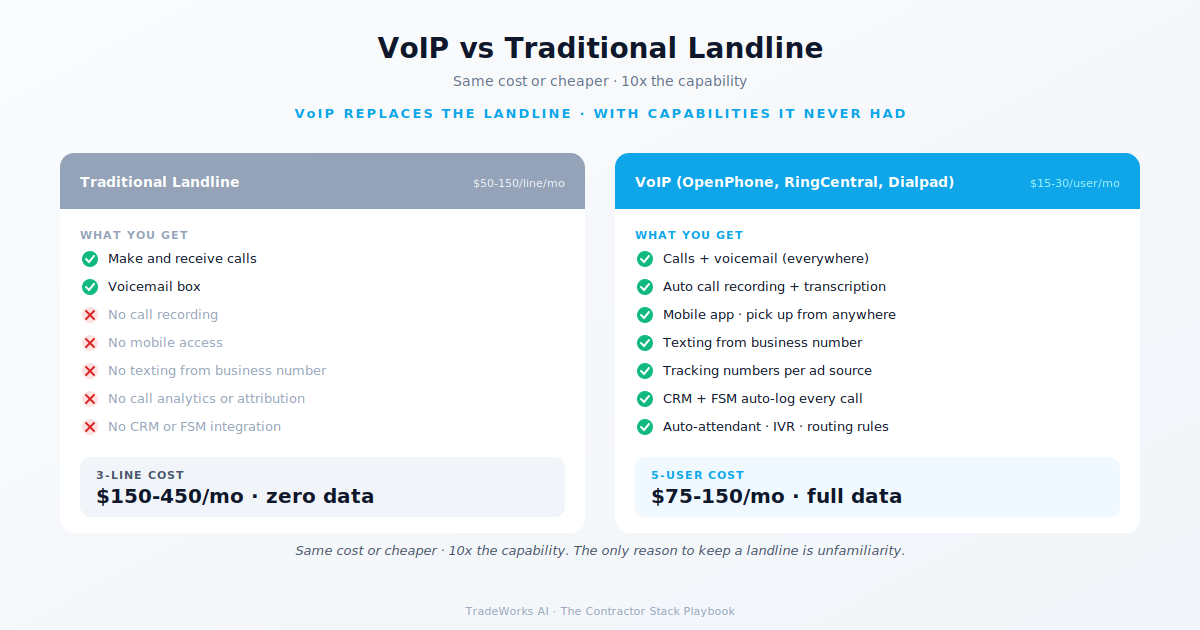
No. A personal cell phone blends business and personal communication, makes it impossible to track call metrics, provides no call recording for dispute resolution, and cannot route calls to other team members when you are unavailable. At $15/month, a dedicated business phone system is one of the highest-value investments in the stack.
Yes. Call recording protects the business in customer disputes, provides training material for new staff, and enables quality monitoring of customer interactions. In most U.S. states, one-party consent allows recording as long as the business is a party to the call. Some states require two-party consent — check your state’s laws and include a recording disclosure in your greeting if required.
OpenPhone for plumbing contractors under $2 million. The shared inbox ensures incoming emergency calls reach someone on the team even during service calls. Call recording documents customer-reported symptoms before the technician arrives. At $15/user/month for a 3-person team, the total cost is $45/month — less than one missed emergency call is worth.
The primary integration points are CRM and FSM. When a call comes in, the phone system can create a lead in your CRM, log the call in your FSM, and trigger a follow-up sequence in your email platform. These connections typically run through Zapier or native integrations. Part 16 covers the full automation layer including phone-to-CRM workflows.
Most contractors are paying $400–900 per month for software they barely use, while losing thousands more in hidden costs from manual processes and missed callbacks. Our free audit grades your stack against the maturity model and identifies the highest-ROI changes you can make this quarter.
The best email marketing software for home service contractors is ActiveCampaign ($29–$259/month), which delivers the most powerful autom...
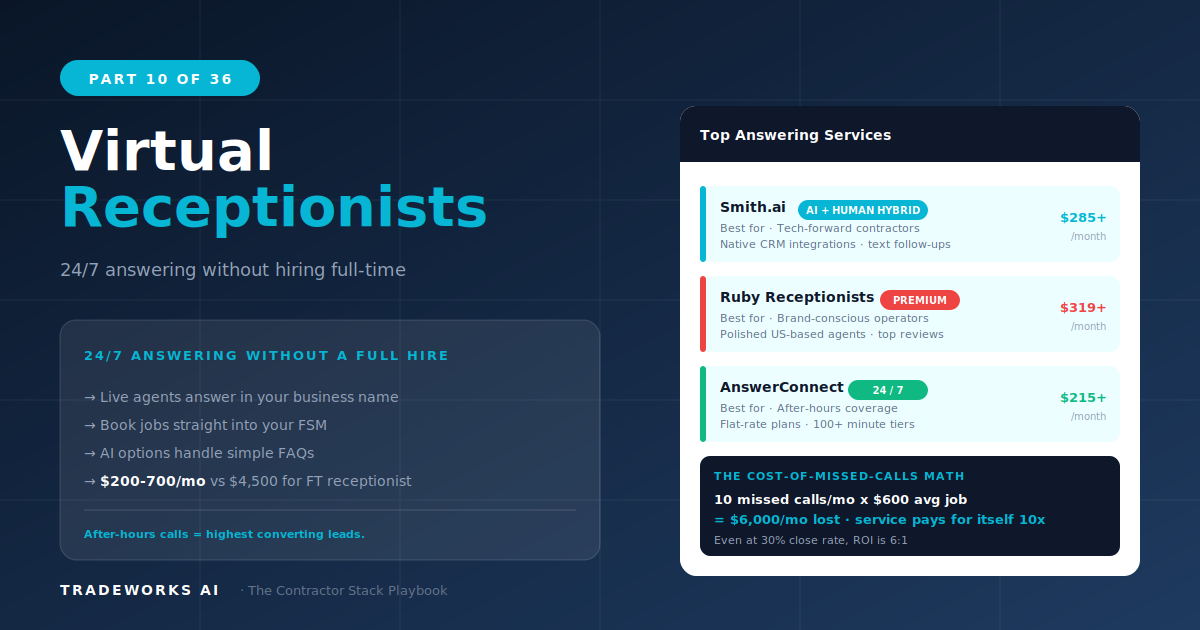
The best virtual receptionist for home service contractors is Ruby ($235–$1,640/month) for premium live call handling, or Smith.ai ($292....