
Contractor Stack · Part 15
GoHighLevel — The All-in-One Deep Dive
GoHighLevel ($97–$497/month) is an all-in-one platform that combines CRM, email marketing, SMS, reputation management, funnel/website bui...
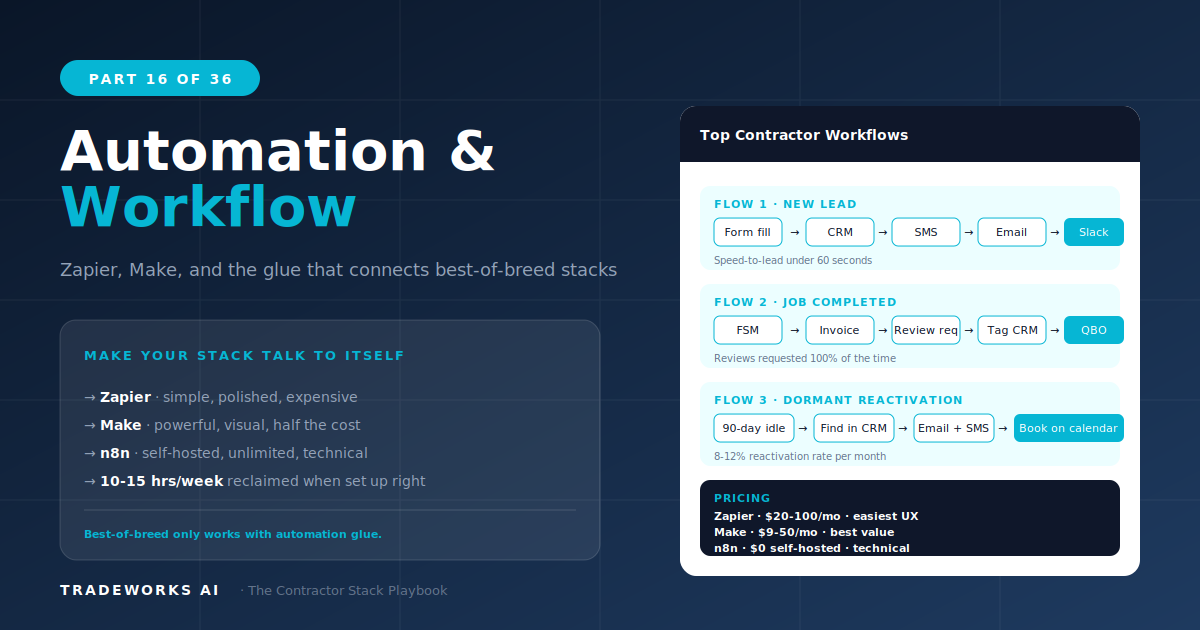
The best automation platform for contractors is Zapier (Free–$599/month), which connects more contractor software tools than any alternative and requires no technical knowledge to set up. Automation is the integration layer that makes a best-of-breed software stack function as a unified system: when a job is completed in your FSM, Zapier automatically triggers a review request in NiceJob, adds the customer to a maintenance plan sequence in ActiveCampaign, updates the contact record in your CRM, and logs the completed job in a Google Sheet for reporting. Without automation, these connections require manual data entry — and manual data entry is where leads fall through cracks, reviews go unsent, and follow-ups get forgotten.
Throughout this series, every category part has referenced integration: FSM to accounting (Part 6), FSM to CRM (Part 5), FSM to review management (Part 7), FSM to email marketing (Part 8). The question is always the same: how does data move between these tools?
There are three answers. Native integration means the tools connect directly with a built-in sync (FieldEdge to QuickBooks, for example). API integration means a developer builds a custom connection. Automation platforms like Zapier and Make sit in the middle: they connect tools that do not have native integrations without requiring custom development. For most contractors, automation platforms are the practical answer because they are cheaper than custom development and more flexible than native-only integrations.
The ROI of automation is measured in eliminated manual tasks. Every time your office manager copies a customer’s name from the FSM to the CRM, manually sends a review request email, or re-enters an invoice in QuickBooks that already exists in the FSM, that is time automation eliminates permanently. At 5 to 10 hours per week of manual data transfer for a typical $1 million contractor, automation at $20 to $100 per month replaces $1,000 to $2,000 per month in administrative labor.
Zapier is the default recommendation for contractors because it has the largest library of app connections (7,000+ apps), the simplest interface for non-technical users, and the broadest FSM support. ServiceTitan, Housecall Pro, Jobber, Workiz, and most CRM, email, and review platforms connect through Zapier with pre-built templates.
Zapier’s free tier allows 5 single-step workflows (called Zaps) with 100 tasks per month. Most contractors need the Starter ($19.99/month) or Professional ($49/month) tiers for multi-step workflows and higher task volumes. The per-task pricing model means costs scale with volume — a contractor triggering 500 automations per month pays more than one triggering 100.
8-Criteria Score: Trade Fit 4/5, Size 5/5, Integration 5/5, Mobile 3/5, Learning Curve 4/5, Pricing 3/5, Data Ownership 3/5, Support 3/5. Composite: 30/40.
Make is more powerful than Zapier for complex workflows with conditional branching, loops, and error handling. The visual workflow builder shows the entire automation as a connected diagram, making it easier to design multi-step processes with decision points. Pricing is based on operations rather than tasks, and the free tier is more generous than Zapier’s (1,000 operations/month).
Make’s trade-off is complexity. Setting up a simple two-step automation (FSM job complete → send review request) takes longer in Make than Zapier because Make exposes more configuration options. For contractors or office managers without technical inclination, Zapier’s simpler interface is the better starting point. For agencies managing automations for multiple clients, Make’s power and lower per-operation cost often justify the learning curve.
8-Criteria Score: Trade Fit 3/5, Size 4/5, Integration 4/5, Mobile 3/5, Learning Curve 2/5, Pricing 4/5, Data Ownership 3/5, Support 3/5. Composite: 26/40.
N8N is the self-hosted open-source option: unlimited workflows, no per-task fees, full data control. The trade-off is that self-hosting requires technical infrastructure (a server, maintenance, updates). For agencies like TradeWorks AI or tech-savvy contractors with IT resources, N8N offers the best long-term economics at scale. For contractors without technical staff, it is impractical.
Pabbly Connect is the budget alternative to Zapier: fixed monthly pricing ($25–$79) with unlimited workflows and generous task limits. App support is narrower than Zapier but covers most popular contractor tools. For budget-conscious contractors who need more than Zapier’s free tier but want predictable costs, Pabbly is worth evaluating.
Regardless of platform, these five workflows form the automation foundation for any contractor stack:
1. Job Complete → Review Request: When job status changes to “complete” in your FSM, trigger a review request in NiceJob, Birdeye, or your email platform. This is the single highest-value automation — it fixes the review velocity problem (Part 7) permanently.
2. New Customer → CRM + Welcome Sequence: When a new customer is created in your FSM, add them to your CRM (ActiveCampaign, HubSpot) and trigger a 3-email welcome sequence (Part 8’s email framework).
3. Estimate Sent → Follow-Up Sequence: When an estimate is sent, start a follow-up automation: text message at 2 hours, email at 24 hours, phone call reminder at 48 hours. This increases close rates by 15–20% (Part 11).
4. Invoice Paid → Accounting Sync: When payment is recorded in the FSM, sync the transaction to QuickBooks or Xero automatically (Part 6). Eliminates manual reconciliation.
5. No Activity 12 Months → Reactivation: When a customer’s last service date exceeds 12 months, trigger a reactivation email sequence (Part 8’s dormant customer workflow).
Start with Automation #1 (Job Complete → Review Request). It is the simplest to set up and delivers the fastest measurable ROI. Here is the process:
Sign up for Zapier’s free tier.
Create a new Zap. Trigger: your FSM (Housecall Pro, Jobber, etc.) → “Job status changed to Complete.”
Action: your review platform (NiceJob, email platform) → “Send review request to customer.”
Map the fields: customer name, email, phone from the FSM to the review platform.
Test with a real completed job. Verify the review request arrives.
Turn on and monitor for one week. Check that every completed job triggers a request.
Total setup time: 15 to 30 minutes. Impact: permanent, automated review requests on 100% of completed jobs. This single automation replaces the most common manual task failure in contractor operations.
Stage 2–4 (most contractors): Zapier. Start with the free tier. Build the 5 essential automations. Upgrade to paid when task volume exceeds 100/month.
Stage 3–5 (complex workflows): Make. Justified when automations require conditional logic, loops, or multi-branch decision trees that Zapier handles clumsily.
Stage 2–4 (fixed budget): Pabbly Connect. Predictable pricing with unlimited workflows. Verify your specific tools are supported before committing.
Stage 4–5 (agency/self-host): N8N. Best economics at scale with full control. Requires technical infrastructure.
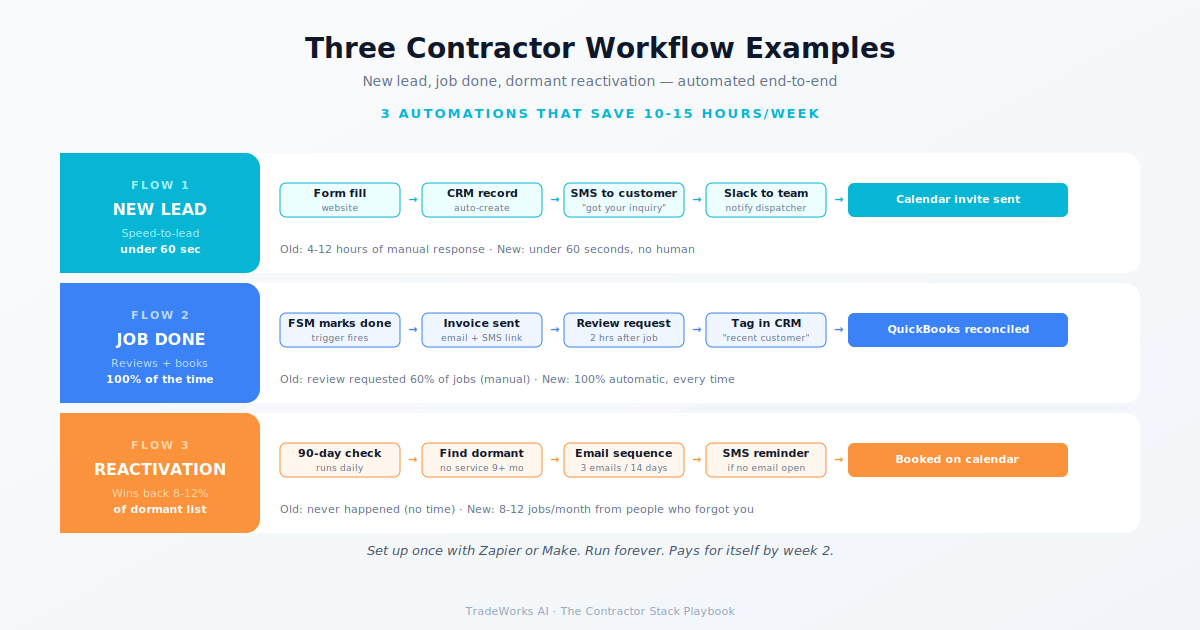
Zapier is an automation platform that connects software tools so data flows between them automatically. Contractors need it because their stack typically includes 5 to 10 tools (FSM, CRM, accounting, email, reviews) that do not natively share data. Without Zapier, someone manually transfers information between systems. With Zapier, completed jobs automatically trigger review requests, new customers automatically enter the CRM, and payments automatically sync to accounting.
The free tier (5 workflows, 100 tasks/month) covers basic needs. Most contractors need the Starter tier at $19.99/month (20 workflows, 750 tasks) or Professional at $49/month (unlimited workflows, 2,000 tasks). At $20 to $50/month, Zapier replaces 5 to 10 hours of weekly manual data entry worth $500 to $1,000 in administrative labor.
Zapier for simplicity and the widest app support. Make for complex multi-branch workflows and lower per-operation cost at high volume. Most contractors should start with Zapier — the learning curve is significantly shorter. Evaluate Make when your automations become complex enough that Zapier’s linear workflow model feels limiting.
Most contractors are paying $400–900 per month for software they barely use, while losing thousands more in hidden costs from manual processes and missed callbacks. Our free audit grades your stack against the maturity model and identifies the highest-ROI changes you can make this quarter.
GoHighLevel ($97–$497/month) is an all-in-one platform that combines CRM, email marketing, SMS, reputation management, funnel/website bui...
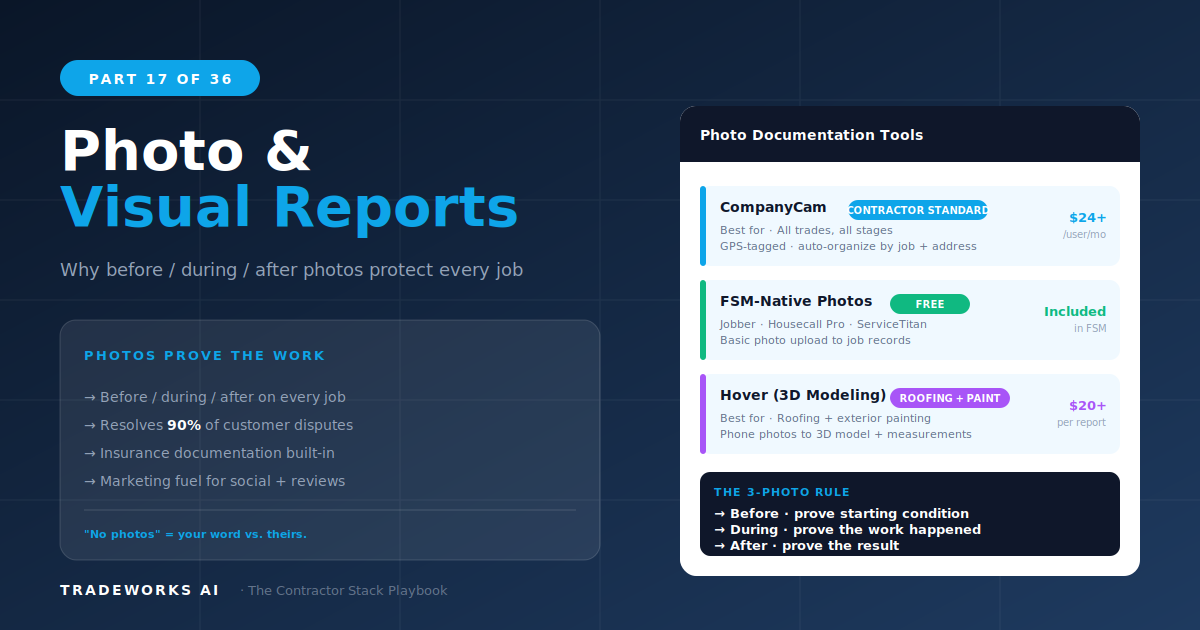
The best photo documentation software for contractors is CompanyCam ($19–$29 per user per month), which provides GPS-tagged, time-stamped...