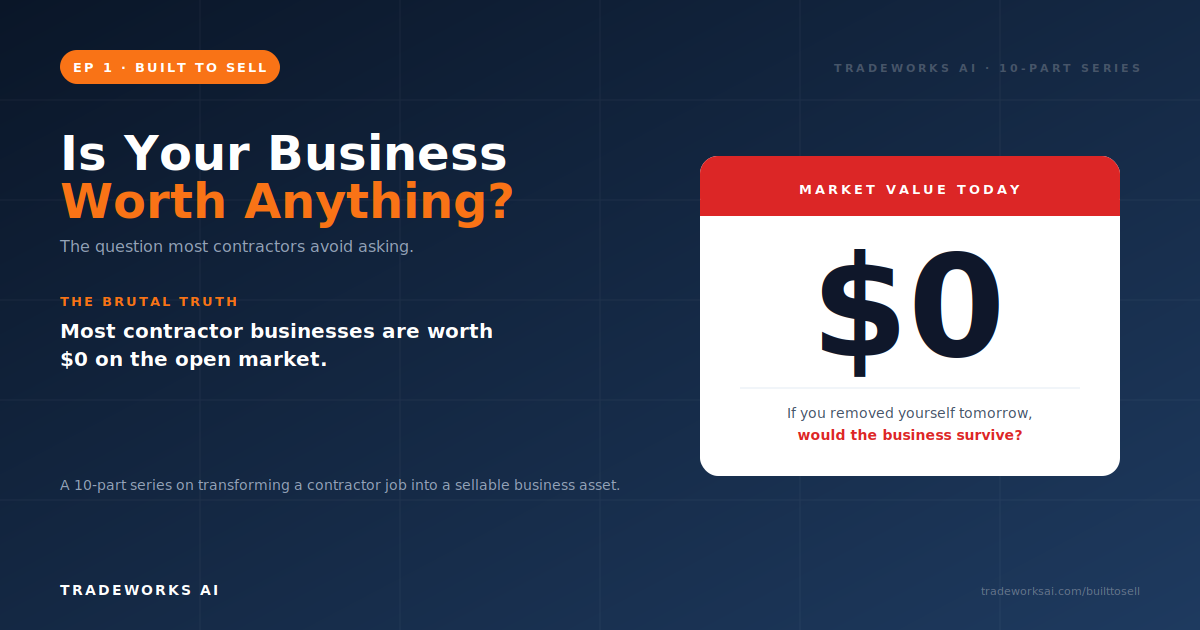
Built to Sell · Part 1
Is Your Contractor Business Worth Anything?
Continue the Built to Sell series with Part 1 of 10.
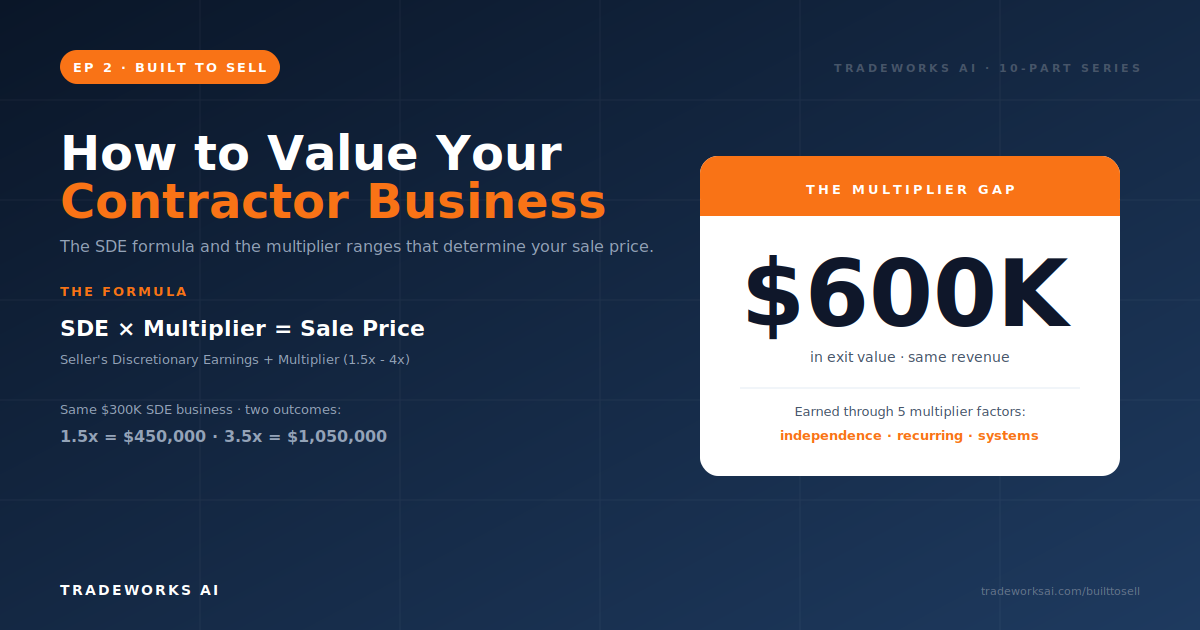
Contractor businesses are valued using Seller’s Discretionary Earnings (SDE) multiplied by an industry multiple. SDE equals net profit plus owner salary plus owner benefits plus one-time expenses plus non-essential expenses that a new owner would not incur. The industry multiple for contractor businesses ranges from 1.5x to 4x SDE depending on trade, size, owner dependency, recurring revenue, and documentation quality. HVAC companies with maintenance plan revenue typically receive higher multiples (2.5x to 4x) than project-based trades like roofing (1.5x to 2.5x). A contractor business with $300,000 SDE and a 3x multiple would be valued at approximately $900,000. The multiple is not fixed—it is earned through building the five pillars of sellability: owner independence, recurring revenue, documented systems, clean financials, and customer diversification.
SDE is the standard metric for valuing small businesses including contractor companies. It represents the total economic benefit available to a single owner-operator. The formula starts with net profit from your tax return, then adds back the owner’s salary and benefits, one-time or non-recurring expenses, and discretionary expenses that a new owner might not incur (personal vehicle through the business, family members on payroll who do not work, owner’s personal insurance through the company). SDE answers the question: how much money does this business actually generate for its owner?
The multiplier reflects the risk and attractiveness of the business. A business that is highly dependent on the owner, has no recurring revenue, and has messy financials might receive a 1.5x multiple. A business with documented systems, a management team, maintenance plan revenue, and three years of clean financials might receive a 3.5x or 4x multiple. On a $300,000 SDE, the difference between 1.5x and 3.5x is the difference between a $450,000 sale and a $1,050,000 sale. The multiple is not assigned by an appraiser reading a formula. It is earned by how you build the business.
HVAC companies typically receive the highest multiples in the home service sector (2.5x to 4x SDE) because they have natural recurring revenue through maintenance plans and seasonal demand that creates predictable cash flow. Plumbing companies range from 2x to 3.5x depending on the mix of emergency calls versus planned work. Electrical contractors range from 2x to 3x. Roofing companies typically receive lower multiples (1.5x to 2.5x) because the work is heavily project-based with less recurring revenue. Painting and cleaning companies range from 1.5x to 2.5x. These ranges are not fixed—a roofing company with strong recurring inspection contracts and documented systems can exceed a poorly run HVAC company’s multiple.
Five factors reliably increase the multiplier a buyer will pay. Owner independence: the business operates without the owner’s daily involvement. Recurring revenue: maintenance plans, service contracts, and subscription models that generate predictable monthly income. Documented systems: an operations manual, SOPs, and training materials that allow a buyer to understand and replicate operations. Clean financials: three years of professionally prepared financial statements with clear job costing and separated personal expenses. Customer diversification: no single customer or referral source represents more than 15% of revenue. Each factor adds 0.25x to 0.5x to the multiple. A business with all five can command the top of its trade’s range.
Owner dependency is the primary multiple killer. If the owner is the lead technician, sole estimator, and primary customer relationship, the buyer knows the revenue will decline after the sale. Concentration risk (one large customer or referral partner representing more than 20% of revenue) reduces the multiple because losing that relationship crashes the business. Messy or incomplete financial records make buyers assume the worst about profitability. Deferred maintenance on equipment signals hidden costs. Legal issues, unresolved complaints, or regulatory problems create liability that reduces value.
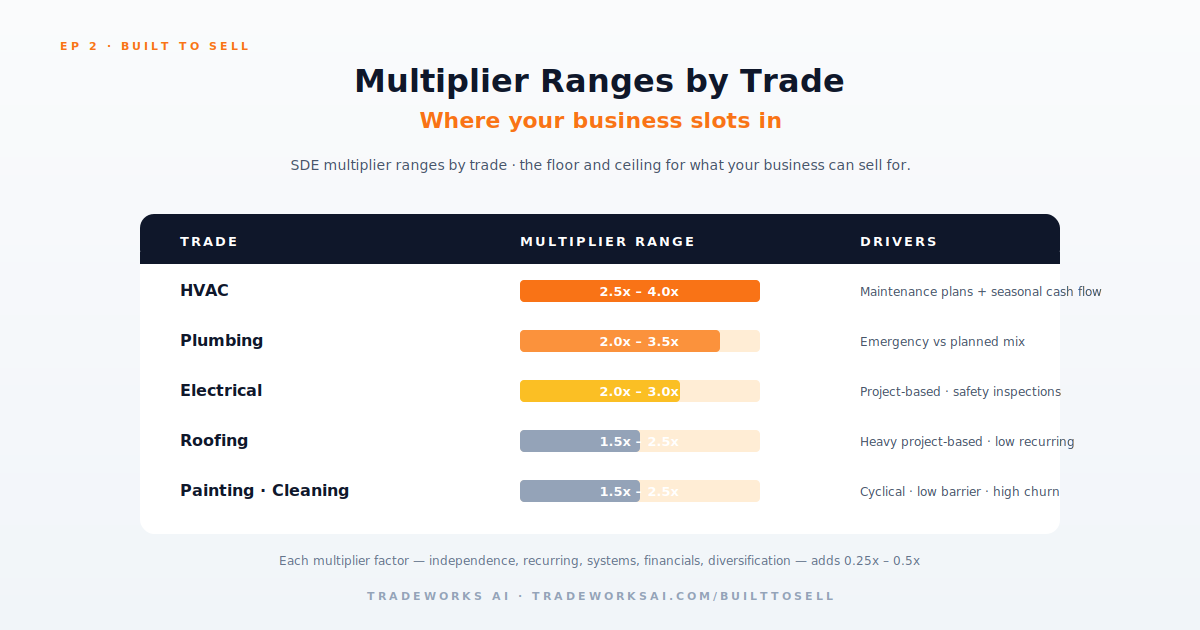
HVAC businesses typically sell for 2.5x to 4x Seller’s Discretionary Earnings. An HVAC company with $400,000 SDE and strong maintenance plan revenue might sell for $1 million to $1.6 million.
Plumbing businesses typically sell for 2x to 3.5x SDE. The multiple depends on the mix of emergency versus scheduled work, owner dependency, and whether the company has service agreements.
SDE adds back the owner’s salary and benefits; EBITDA does not. SDE is the standard for small businesses where the owner is active. EBITDA is used for larger businesses with professional management teams.
Most owners assume their business is worth more than the market would pay. The Sellability Audit grades your business against the five pillars of value — owner independence, recurring revenue, documented systems, clean financials, and customer diversification — and gives you a realistic valuation range plus the highest-leverage actions to lift your multiple.
Continue the Built to Sell series with Part 1 of 10.

Continue the Built to Sell series with Part 3 of 10.