Built to Sell · Part 5
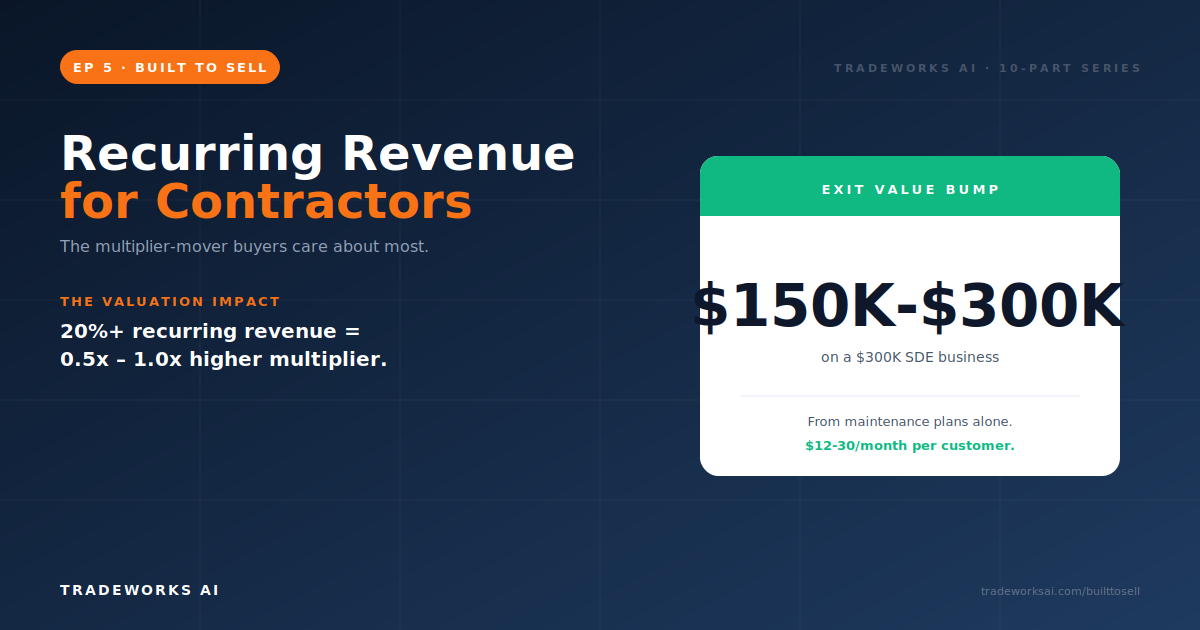
Recurring Revenue & Maintenance Plans
Continue the Built to Sell series with Part 5 of 10.
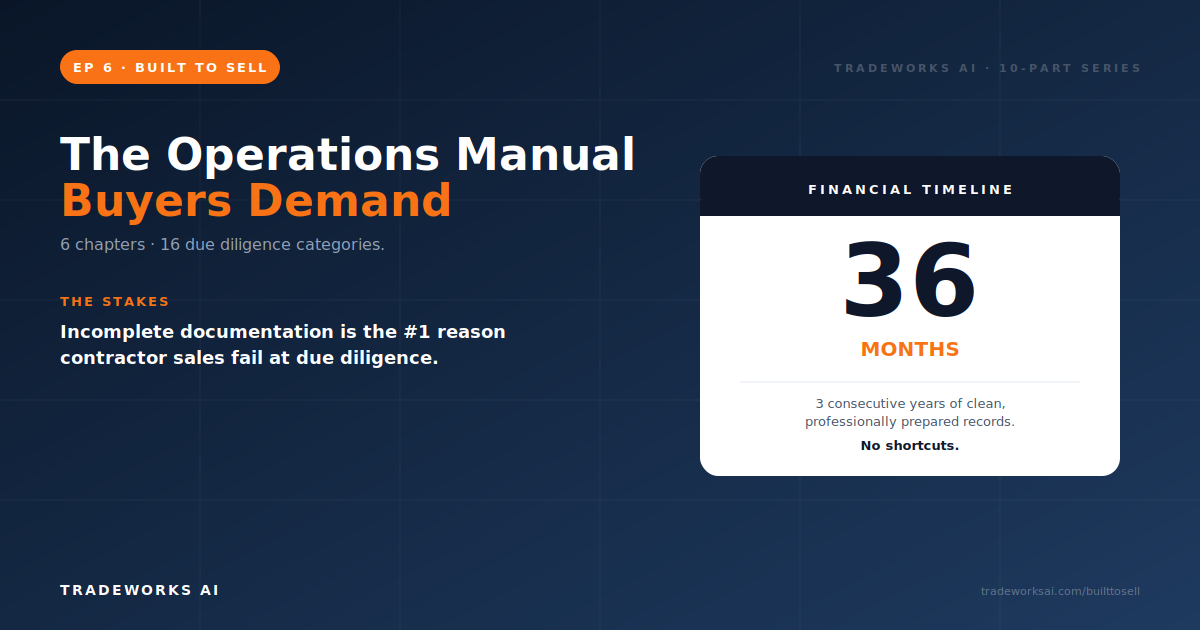
Contractor business documentation for sale preparation requires two deliverables: a complete operations manual and three years of buyer-ready financial records. The operations manual contains six chapters: business overview (entity structure, licenses, insurance), daily operations (dispatch, scheduling, quality control SOPs), software stack (every tool with login credentials and configurations), sales and marketing (lead sources, pricing, customer acquisition), HR and compliance (employee handbook, safety protocols, training procedures), and financial processes (invoicing, collections, job costing, budgeting). Financial preparation follows a 36-month timeline: months 1–2 separate personal from business expenses, months 3–6 enable job costing and monthly reconciliation, months 7–12 complete the first clean year, months 13–36 maintain for three consecutive buyer-ready years. The due diligence checklist covers 16 document categories.
A buyer’s accountant sends a due diligence document request within the first week of serious discussions. The list covers 16 categories across financials, operations, legal, and marketing. If producing this documentation would take two months of scrambling through shoeboxes and memory, you are not ready to sell. Incomplete or disorganized documentation is the most common reason contractor business sales fail at the due diligence stage. The documentation does not just prove your business is profitable—it proves your business is transferable.
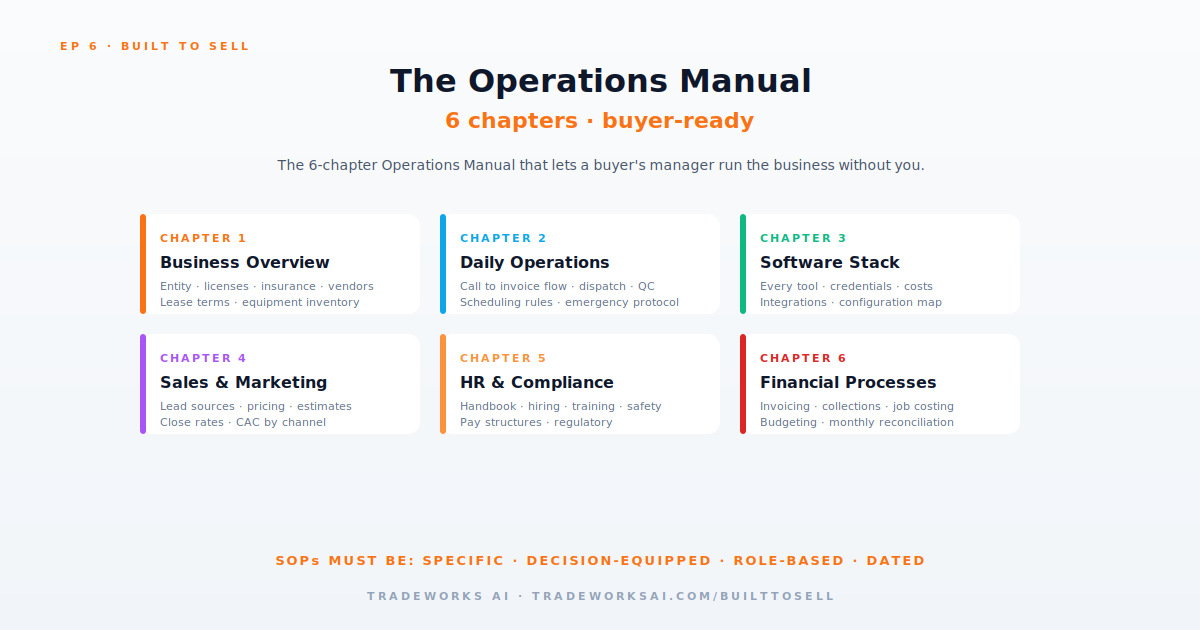
The operations manual is the document that allows a buyer or their manager to run the business without you. It has six chapters. Chapter 1: Business Overview—entity structure, ownership, licenses, insurance policies, key vendor relationships, lease terms, equipment inventory. Chapter 2: Daily Operations—how a service call flows from phone ring to invoice, dispatch procedures, scheduling rules, quality control checkpoints, emergency protocols. Chapter 3: Software Stack—every tool the business uses with login credentials, configuration notes, subscription costs, and the integration map from your Contractor Stack. Chapter 4: Sales and Marketing—lead sources, marketing channels, pricing structure, estimate templates, close rates, customer acquisition cost by channel. Chapter 5: HR and Compliance—employee handbook, hiring process, training procedures, safety protocols, compliance requirements, pay structures. Chapter 6: Financial Processes—invoicing procedures, collections process, job costing methodology, budgeting, monthly reconciliation, tax preparation workflow.
Each SOP in the operations manual must meet four buyer-ready criteria. First, specific enough that someone unfamiliar with the business can follow it without asking questions. If a step says handle the customer complaint, it fails. If it says acknowledge the concern, apologize, offer a specific resolution within 24 hours, and document the resolution in the CRM, it passes. Second, includes decision points—what to do when the standard process does not apply. Third, role-based rather than name-based—the dispatcher does X rather than Sarah does X. Fourth, dated with a quarterly review schedule showing the documentation is maintained.
Buyers require three consecutive years of clean financial records. If you start today, you will have buyer-ready financials in 36 months. Months 1–2: separate all personal expenses from business accounts. No personal purchases on the business credit card. Months 3–6: enable job costing in your accounting software so you can track profitability by service type, technician, and marketing source. Begin monthly reconciliation. Months 7–12: complete your first full year of clean, professionally prepared financial statements. Months 13–36: maintain the standard. Three full years of clean books, consistent methodology, and professional preparation. The three-year requirement exists because buyers want to see trends, not snapshots.
Create a Due Diligence Folder today. You will not need it for months or years. But when the accountant sends the request, you send back a link. Five categories: Financial Records (3 years of P&L, balance sheets, tax returns, bank statements, accounts receivable aging, debt schedule). Operational Documents (operations manual, employee handbook, vendor contracts, equipment inventory, vehicle titles). Legal and Compliance (business entity documents, licenses, insurance policies, permits, pending litigation if any). Marketing and Customers (customer database, marketing spend by channel, website analytics, social media accounts, customer contracts). Software Stack (subscription list, integration documentation, data export capabilities).
Once the financial infrastructure is in place, track six metrics monthly. Revenue trend year over year. Gross margin by service type. Overhead ratio. Net profit margin (target 15–25%). Recurring revenue percentage. Cash position in days of operating expenses (target 60–90 days). This dashboard serves double duty: it gives you operational intelligence today and becomes buyer-facing evidence of financial discipline during due diligence.
The documentation itself can be created in 2–4 months of focused work. Financial preparation requires 36 months for three years of clean records. Start both simultaneously.
Yes. Professionally prepared financial statements (reviewed or compiled by a CPA) carry significantly more weight with buyers than self-prepared books. The cost is $2,000–$5,000 annually and is the most cost-effective investment in exit preparation.
Most owners assume their business is worth more than the market would pay. The Sellability Audit grades your business against the five pillars of value — owner independence, recurring revenue, documented systems, clean financials, and customer diversification — and gives you a realistic valuation range plus the highest-leverage actions to lift your multiple.
Continue the Built to Sell series with Part 5 of 10.
Continue the Built to Sell series with Part 7 of 10.