Built to Sell · Part 2
How to Value a Contractor Business: SDE & Multiples
Continue the Built to Sell series with Part 2 of 10.
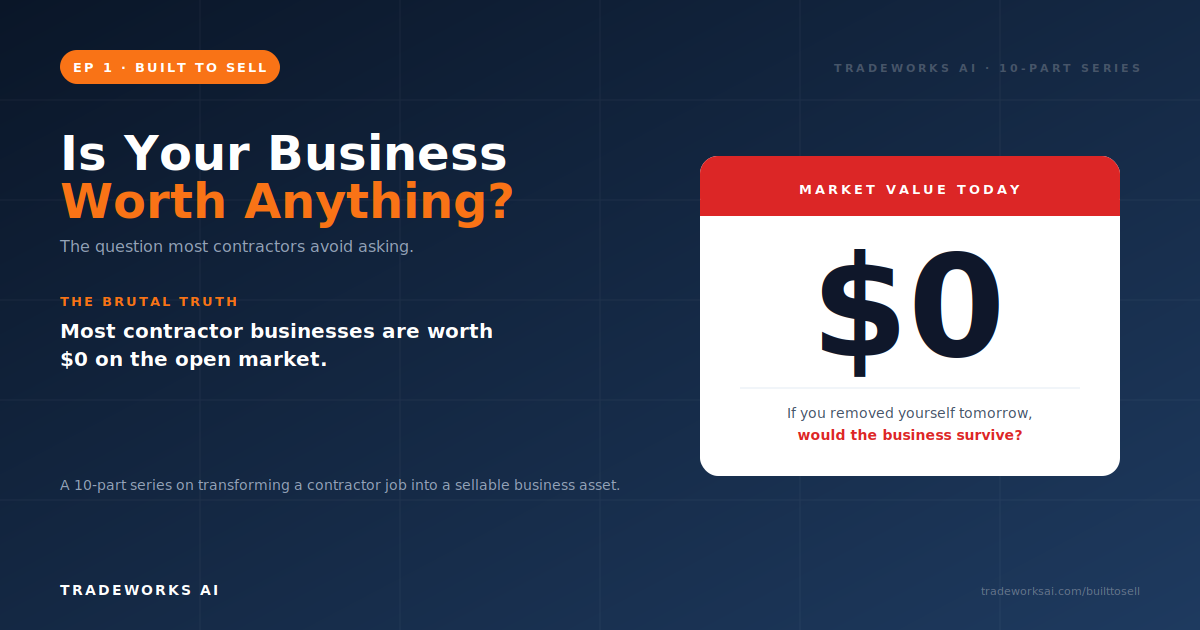
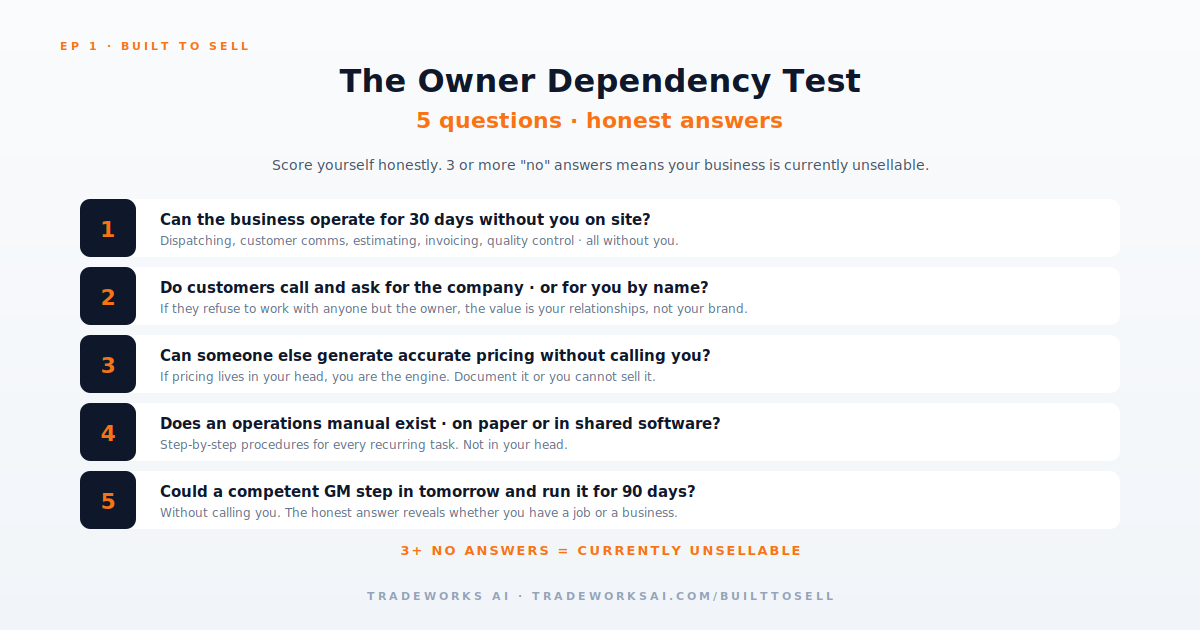
Most contractor businesses are worth zero on the open market because they are entirely dependent on the owner. When the owner is the lead technician, the primary salesperson, the estimator, and the only person who knows how the business operates, there is nothing for a buyer to purchase except the owner’s labor—and the owner is leaving. The Owner Dependency Test asks five questions: Can the business operate for 30 days without you? Do customers request you by name? Are you the only person who knows the pricing? Is there a documented operations manual? Could a competent manager step in tomorrow? If you answered no to three or more, your business is currently a job that depends on you showing up, not a transferable asset someone would pay for.
You built a million-dollar contractor business. You have trucks, equipment, employees, a customer list, and a reputation in your community. You work 50-60 hours a week. You have not taken a real vacation in years. And your business is worth zero dollars on the open market. This is not a hypothetical scenario. It is the reality for the majority of contractor businesses. The reason is not revenue, not reputation, and not the quality of your work. The reason is owner dependency. If you removed yourself from the business tomorrow, would it continue to operate? Would it continue to generate revenue? Would it continue to serve customers at the same level? For most contractors, the honest answer is no.
Five questions determine whether your business is an asset or a job. First: can the business operate for 30 days without you on site? This means dispatching, customer communication, estimating, invoicing, and quality control all happen without your direct involvement. Second: do customers call and ask for you by name? If customers refuse to work with anyone except the owner, the business’s value is the owner’s personal relationships—not the company’s brand. Third: are you the only person who knows the pricing? If your pricing lives in your head and nobody else can generate an accurate estimate, you are the pricing engine. Fourth: does a documented operations manual exist? Not in your head. On paper or in a shared system. Step-by-step procedures for every recurring task. Fifth: could a competent general manager step in tomorrow and run the business for 90 days without calling you? Score yourself honestly. Three or more no answers means your business is currently unsellable.
A buyer evaluating a contractor business asks one fundamental question: will this business continue to generate revenue after the current owner leaves? If the answer is no, the business has no transferable value. The buyer would be paying for a revenue stream that disappears when the seller walks out the door. This is why contractors with $2 million in annual revenue sometimes discover their business has the same market value as their trucks and equipment. The revenue is real. The profit is real. But both depend entirely on one person continuing to show up.
A Job vs. A Business
A job requires you to show up. If you stop showing up, income stops. A business generates value independent of any single person. The distinction is not about size or revenue. A solo plumber earning $250,000 has a job. A plumbing company with three technicians, a dispatcher, documented processes, recurring revenue from maintenance plans, and a brand identity has a business. Both might generate the same revenue. One is worth $0 at exit. The other might sell for $500,000 to $1,000,000. The difference is not what the company earns. It is how the company earns it.
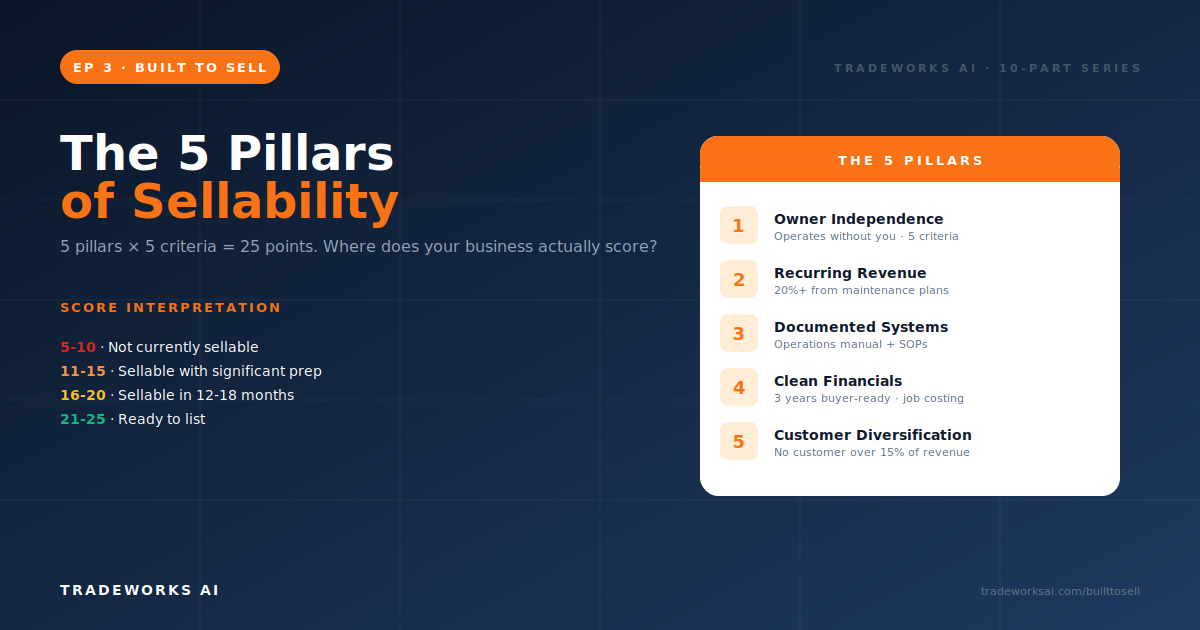
This series covers the complete transformation from owner-dependent job to sellable business asset. The five pillars of sellability are: owner independence (the business operates without you), recurring revenue (predictable income that transfers with the business), documented systems (operations manual, SOPs, training procedures), clean financials (three years of buyer-ready financial records), and customer diversification (no single customer or referral source represents more than 15% of revenue). Each pillar gets a dedicated part. The result is not just a business worth selling. It is a business worth owning—one that gives you freedom whether you choose to sell or not.
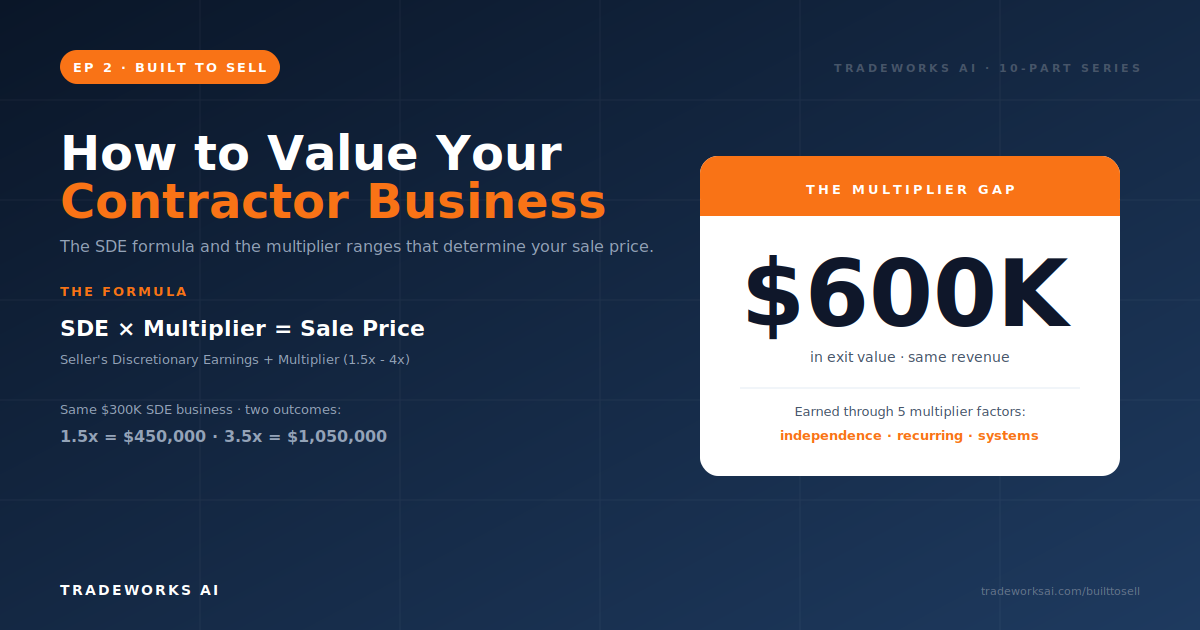
Contractor businesses typically sell for 2 to 4 times seller’s discretionary earnings (SDE). A business with $300,000 SDE might sell for $600,000 to $1.2 million. However, businesses that fail the Owner Dependency Test often sell for asset value only—trucks and equipment—regardless of revenue.
A solo contractor business is extremely difficult to sell because the entire value depends on one person’s labor. Building a team, documenting processes, and creating recurring revenue streams are prerequisites for a sellable business.
The typical timeline is 2 to 3 years. Building owner independence, establishing recurring revenue, documenting systems, and producing clean financial records each require sustained effort over multiple quarters.
Most owners assume their business is worth more than the market would pay. The Sellability Audit grades your business against the five pillars of value — owner independence, recurring revenue, documented systems, clean financials, and customer diversification — and gives you a realistic valuation range plus the highest-leverage actions to lift your multiple.
Continue the Built to Sell series with Part 2 of 10.
Continue the Built to Sell series with Part 3 of 10.