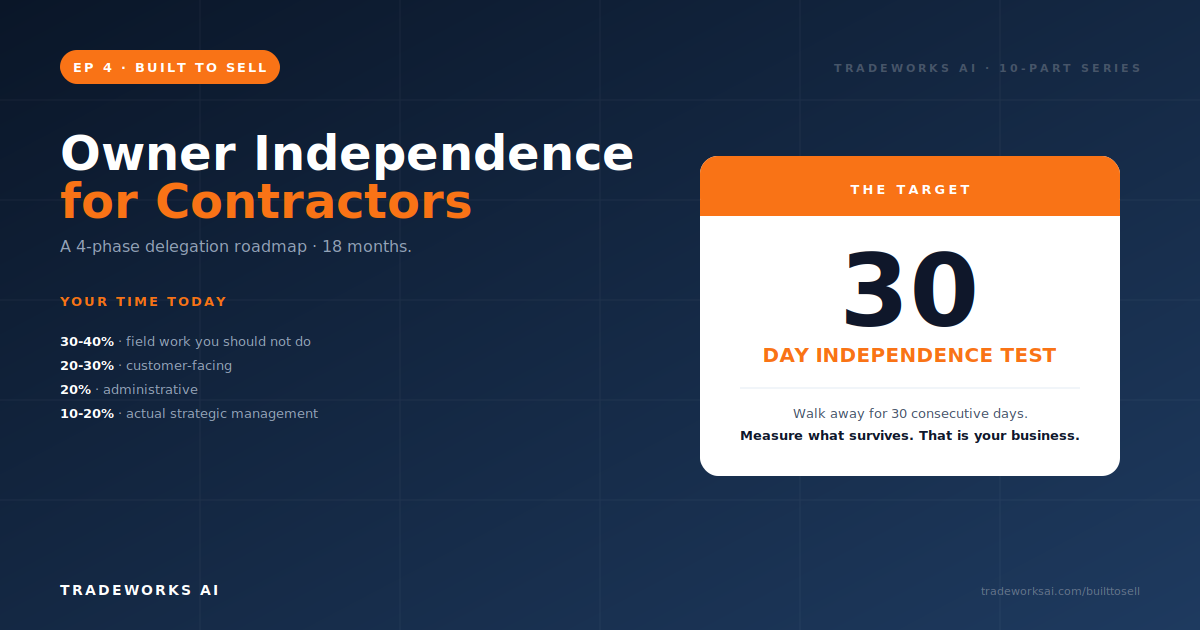
Built to Sell · Part 4
Owner Independence: A Business That Runs Without You
Continue the Built to Sell series with Part 4 of 10.
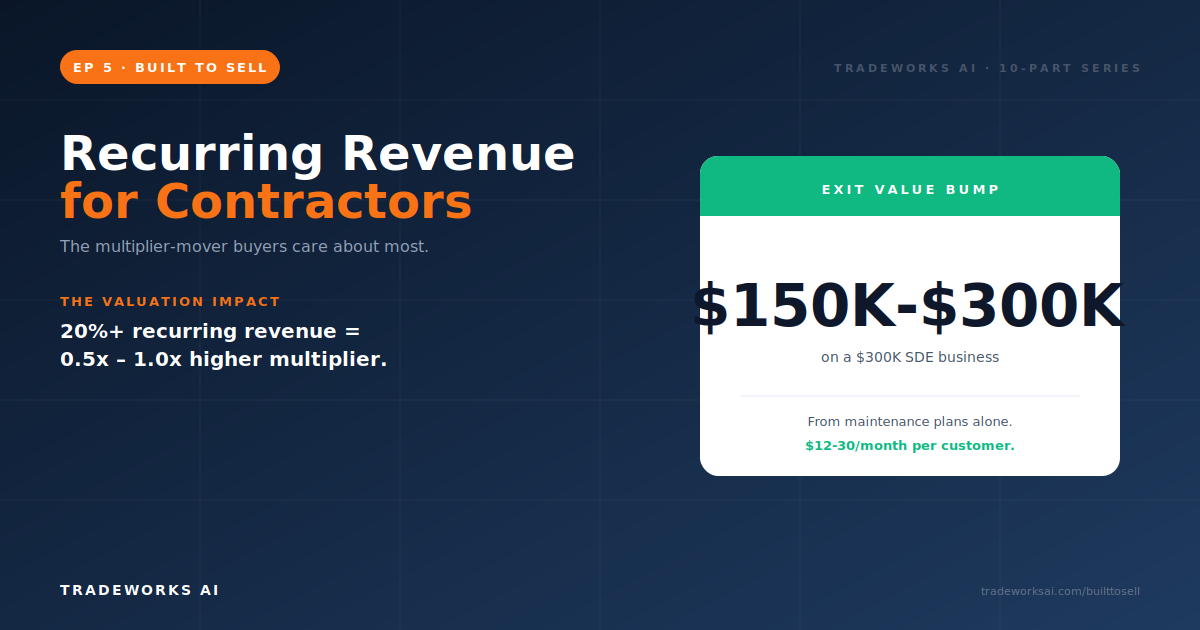
Recurring revenue for contractors comes primarily from maintenance plans and service agreements. A well-structured maintenance plan includes 1–2 annual inspections or tune-ups, priority scheduling during peak season, a discount on repairs (typically 10–15%), and no overtime or after-hours charges. Pricing ranges from $12 to $30 per month depending on trade and included services. The conversion pathway moves one-time customers to plan members through a 3-email post-service sequence. The Stickiness Ladder increases retention: Year 1 is the basic plan, Year 2 adds perks (extended warranty coverage, annual credits), Year 3 adds premium benefits (priority same-day service, loyalty pricing). Recurring revenue directly increases business valuation—a business with 20% or more recurring revenue typically receives a 0.5x to 1.0x higher multiplier than a comparable business with none.
When a buyer evaluates a contractor business, the first question after profitability is: how predictable is the revenue? A business that starts every month at zero and depends entirely on new calls has higher risk than a business that starts every month with a base of contracted, recurring income. This predictability reduces buyer risk, and reduced risk means a higher multiplier. The data is clear: contractor businesses with 20% or more of revenue from maintenance plans and service agreements consistently receive multipliers 0.5x to 1.0x higher than comparable businesses without recurring revenue. On $300,000 SDE, that difference is $150,000 to $300,000 in exit value.
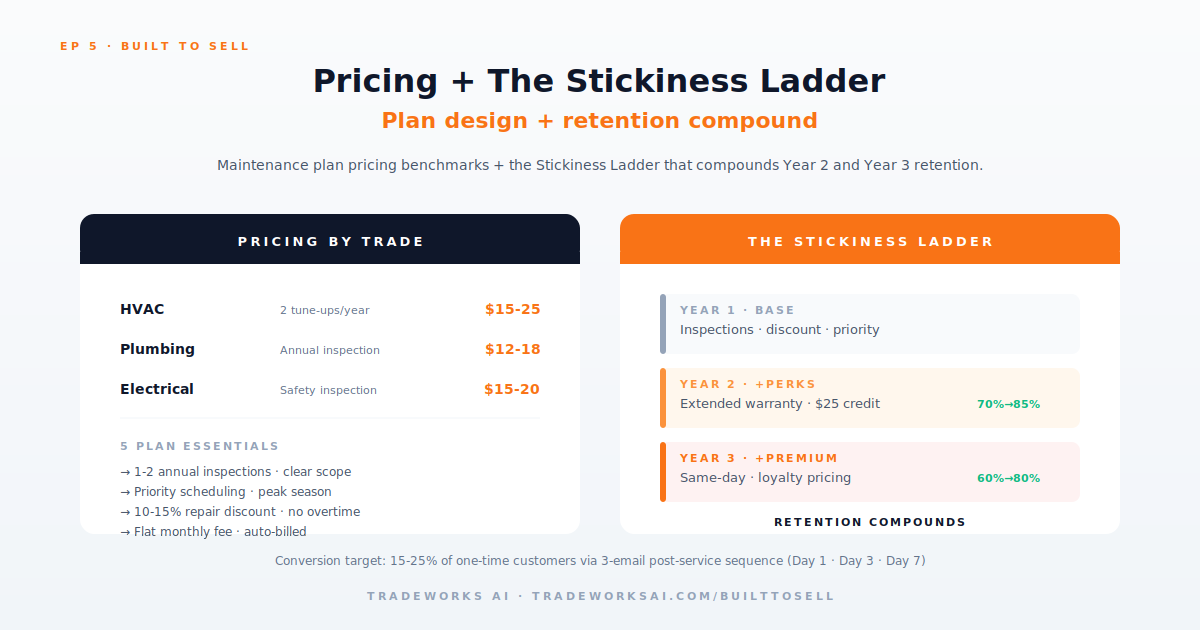
The most successful contractor maintenance plans share five characteristics. First, clear deliverables: 1–2 annual inspections or tune-ups with a specific scope of work documented and communicated. Second, tangible benefits: priority scheduling during peak season (a customer with a plan gets served before a customer without), a discount on repairs, and no overtime or after-hours charges. Third, simple pricing: a flat monthly fee billed automatically. No annual lump sums, no complicated tier structures. Fourth, easy enrollment: 60-second signup process, digital or in-person. Fifth, automatic renewal: plans renew unless the customer actively cancels. The pricing sweet spot for most trades is $12 to $30 per month. HVAC plans with two tune-ups typically fall at $15 to $25 per month. Plumbing inspection plans at $12 to $18. Electrical safety inspections at $15 to $20.
The highest-conversion pathway to maintenance plan enrollment is a post-service email sequence sent to one-time customers within 48 hours of job completion. Email 1 (Day 1): thank you for choosing us, plus a description of what a maintenance plan prevents (the problems you just fixed recurring). Email 2 (Day 3): the financial case—show the math comparing the plan cost to the average emergency repair cost. A $19/month plan costs $228/year. One emergency call costs $300 to $800. Email 3 (Day 7): urgency and social proof—mention how many active plan members you have, include a testimonial, and offer a limited-time enrollment bonus. Target conversion rate: 15–25% of one-time customers who receive the sequence.
Customer retention on maintenance plans typically drops in months 10–14 if the plan does not evolve. The Stickiness Ladder adds value at each annual renewal to reward loyalty and reduce churn. Year 1: the base plan as described above. Year 2: add extended warranty coverage on major components and a $25 annual service credit. Year 3: add premium same-day priority service and loyalty pricing (an additional 5% discount on all work). The Stickiness Ladder increases Year 2 retention from a typical 70% to 85%, and Year 3 retention from 60% to 80%. Each retained customer is compounding recurring revenue that directly increases business value.
Track four metrics monthly. Active plan count: the total number of customers currently enrolled. Monthly Recurring Revenue (MRR): active plans multiplied by average monthly fee. Churn rate: the percentage of plans cancelled each month (target under 3%). New enrollments: the number of new plans added monthly. The goal is for recurring revenue to represent 20% or more of total revenue within 18–24 months of launching the program. For an HVAC company doing $1 million in annual revenue, that means $200,000 or more from maintenance plans—approximately 800 to 1,000 active plans at $20 per month.
Target 10–15% of total customers within the first year. For an HVAC company serving 3,000 unique customers annually, that means 300–450 active plans. Scale to 20–25% by Year 3.
Year 1 retention should target 75–80%. Year 2 with Stickiness Ladder improvements should target 85%. Year 3+ should target 80% or higher. Industry average without a retention strategy is 60–65%.
Businesses with 20% or more recurring revenue typically receive a 0.5x to 1.0x higher SDE multiple. On $300,000 SDE, this translates to $150,000 to $300,000 in additional exit value.
Most owners assume their business is worth more than the market would pay. The Sellability Audit grades your business against the five pillars of value — owner independence, recurring revenue, documented systems, clean financials, and customer diversification — and gives you a realistic valuation range plus the highest-leverage actions to lift your multiple.
Continue the Built to Sell series with Part 4 of 10.
Continue the Built to Sell series with Part 6 of 10.