
Built to Sell · Part 6
Documentation: Operations Manuals & Financial Records
Continue the Built to Sell series with Part 6 of 10.
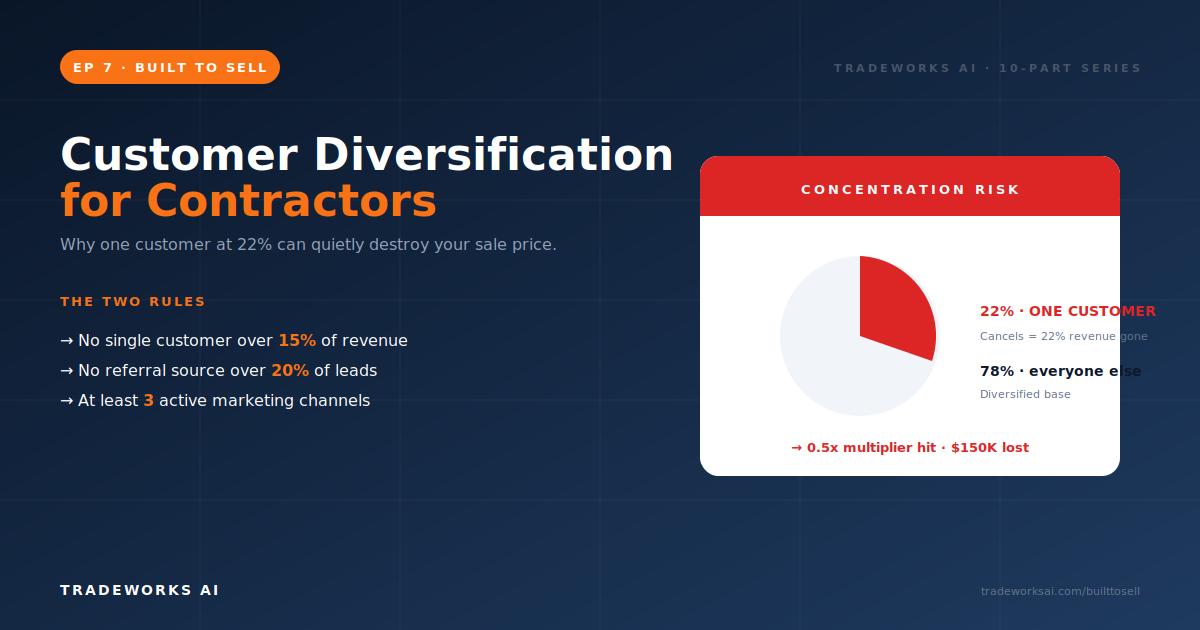
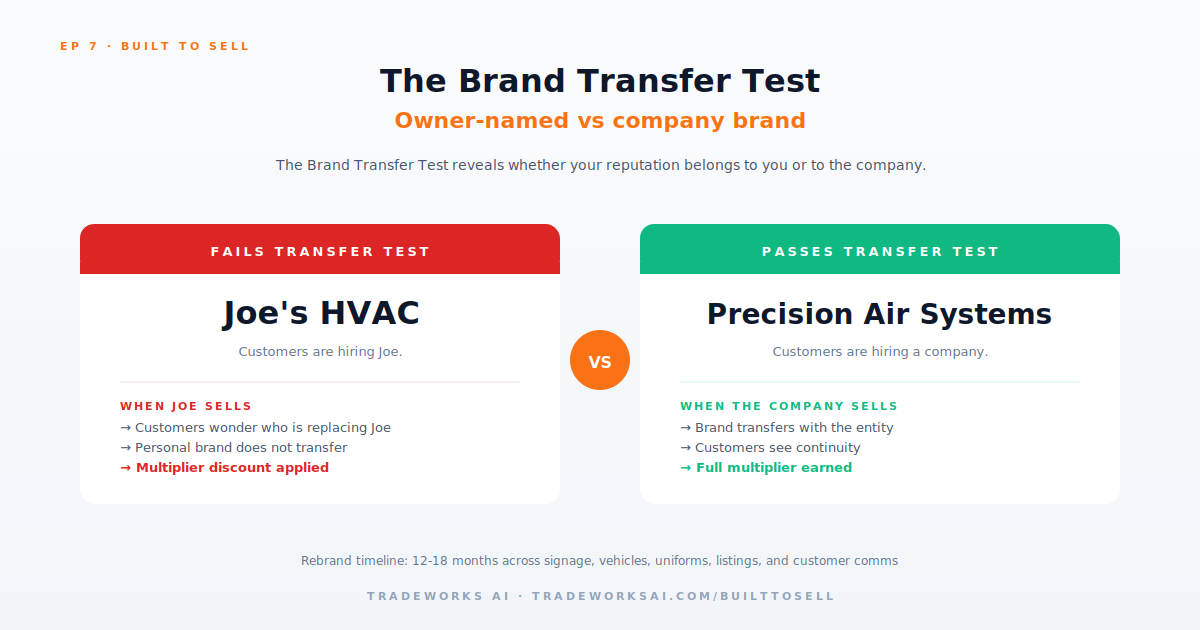
Customer diversification for contractor businesses requires that no single customer represents more than 15% of annual revenue and no single referral source exceeds 20% of annual leads. The Revenue Concentration Audit identifies risk by calculating each customer’s and referral source’s percentage of total revenue. Red flags appear when any customer exceeds 15%, any referral partner exceeds 20%, or the business depends on fewer than 3 active marketing channels. The Brand Transfer Test evaluates whether the business’s reputation is attached to the company name or the owner’s personal name. A business called Joe’s HVAC has lower transferable brand value than Precision Air Systems. Diversification strategies include growing the total customer base so large customers become a smaller percentage, adding marketing channels, developing multiple service segments, and transitioning the brand identity from owner-centric to company-centric.
Imagine your largest commercial customer represents 22% of your annual revenue. They cancel. Your revenue drops by 22% overnight. Now imagine you are selling the business and the buyer’s accountant discovers this concentration. The buyer sees a bomb—a single relationship that could collapse 22% of the revenue they are paying for. That single data point can reduce your multiplier by 0.5x or more. On $300,000 SDE, that is $150,000 in lost exit value from one line in a spreadsheet. Customer concentration is the risk buyers fear most after owner dependency.
Pull your revenue by customer for the past 12 months. Calculate each customer’s percentage of total revenue. Flag any customer above 15%. Pull your lead sources and calculate each referral partner’s percentage of total leads. Flag any source above 20%. Count your active marketing channels—flag if fewer than 3. This audit takes 30 minutes with a CRM or accounting export and reveals concentration risk immediately. Most contractors discover 1–2 customers or referral sources above the threshold.
A business named after the owner has lower transferable brand value than a business with a company brand. Joe’s HVAC tells customers they are hiring Joe. When Joe sells, customers wonder who they are hiring now. Precision Air Systems tells customers they are hiring a company. When the company sells, the brand transfers with it. If your business carries your personal name, consider a rebrand as part of your exit preparation. This is a 12–18 month process involving signage, vehicles, uniforms, online listings, and customer communication.
The solution to customer concentration is not losing big customers. It is growing enough smaller customers that the big ones become a smaller percentage. Target 3 or more active marketing channels each generating 15–30% of leads. Develop multiple service segments (residential and light commercial, or maintenance and new installation). Build the brand around the company rather than the owner. The diversification timeline is 12–18 months to meaningfully shift concentration ratios.
Any single customer exceeding 15% of annual revenue creates concentration risk that reduces business value. Buyers heavily discount businesses where losing one customer would significantly impact profitability.
If the business carries the owner’s personal name, rebranding to a company name increases transferable brand value. Allow 12–18 months for the transition across all customer touchpoints.
Most owners assume their business is worth more than the market would pay. The Sellability Audit grades your business against the five pillars of value — owner independence, recurring revenue, documented systems, clean financials, and customer diversification — and gives you a realistic valuation range plus the highest-leverage actions to lift your multiple.
Continue the Built to Sell series with Part 6 of 10.

Continue the Built to Sell series with Part 8 of 10.