Built to Sell · Part 8
Who Buys Contractor Businesses: Buyer Types & Motivations
Continue the Built to Sell series with Part 8 of 10.
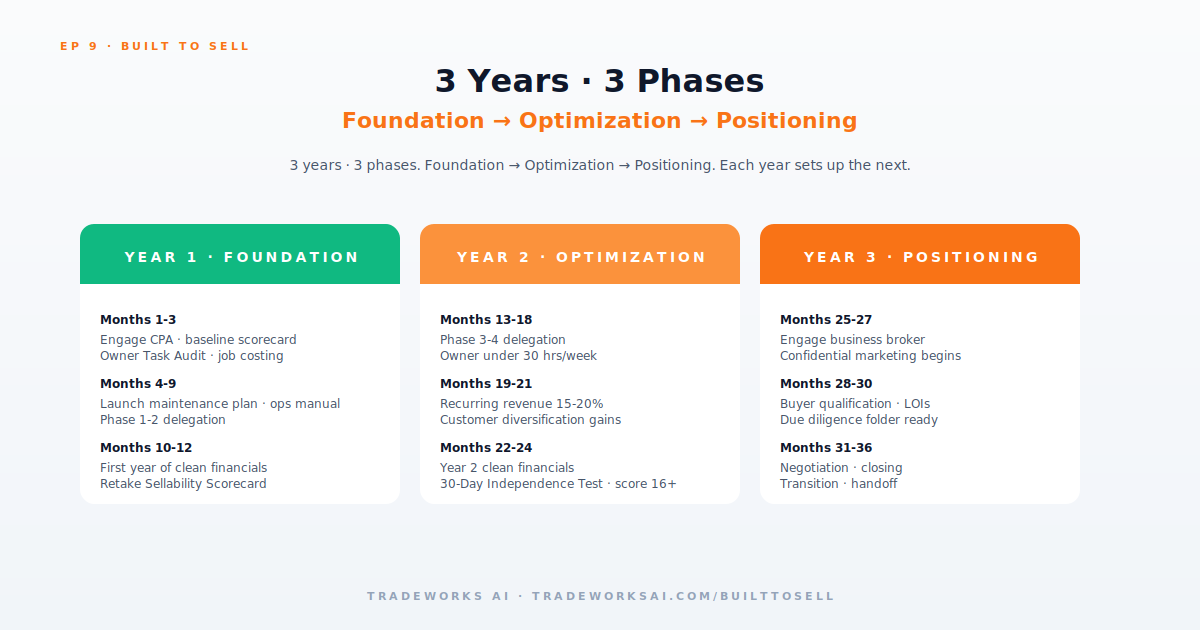
The 3-Year Runway for selling a contractor business follows a structured timeline. Year 1 focuses on foundation: assembling the professional team (CPA, attorney, business broker), beginning financial clean-up, conducting the Owner Task Audit, starting delegation, launching a maintenance plan program, and creating the operations manual. Year 2 focuses on optimization: achieving owner independence, growing recurring revenue to 20%+ of total, completing the second year of clean financials, diversifying the customer base, and strengthening the management team. Year 3 focuses on positioning: completing the third year of clean financials, refining the Sellability Scorecard to 20+, preparing the due diligence folder, engaging the broker, and beginning buyer conversations. The runway cannot be shortened significantly—financial records require three years and owner independence requires 12–18 months.
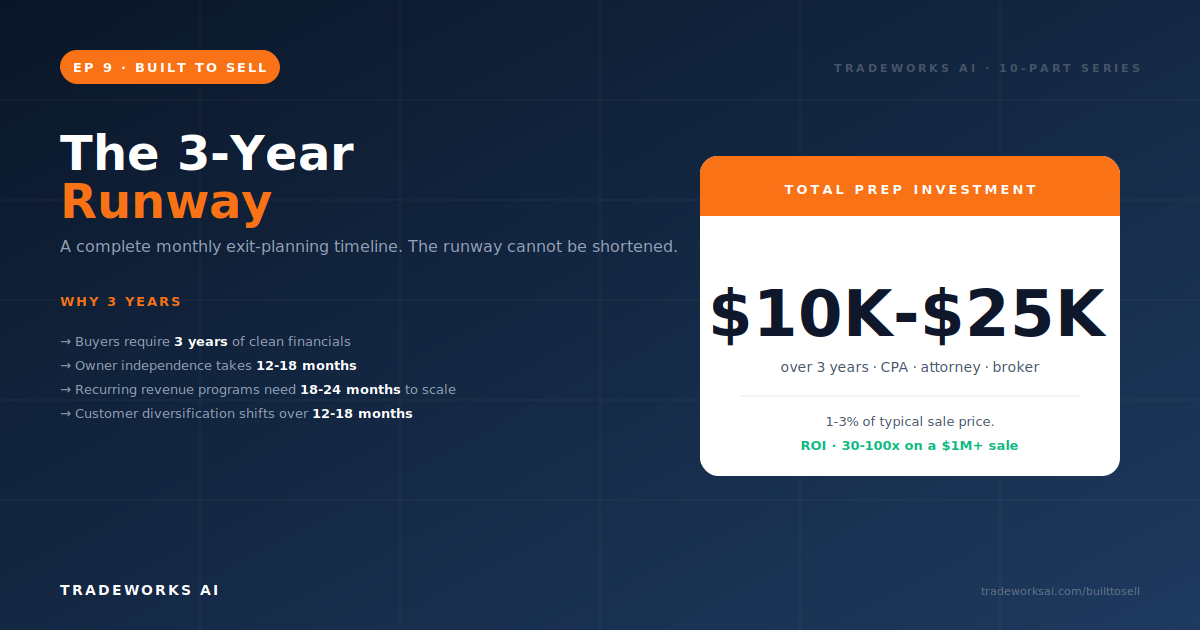
The three-year timeline is not arbitrary. Buyers require three years of financial records to identify trends, not just snapshots. Owner independence requires 12 to 18 months to achieve through the four-phase delegation sequence. Recurring revenue programs need 18 to 24 months to reach meaningful scale. Customer diversification shifts over 12 to 18 months. And the emotional preparation—deciding whether to actually sell—benefits from a measured, deliberate timeline rather than a reactive decision under pressure.
Month 1: Take the Owner Dependency Test and Sellability Scorecard from Part 3. Baseline your starting position. Engage a CPA for financial preparation. Month 2: Begin separating personal expenses from business. Start the Owner Task Audit from Part 4. Month 3: Enable job costing. Begin Phase 1 of delegation (field work). Start designing the maintenance plan from Part 5. Month 4–6: Launch the maintenance plan. Begin the operations manual from Part 6. Continue delegation into Phase 2. Month 7–9: Conduct the Revenue Concentration Audit from Part 7. Begin diversification efforts. Month 10–12: Complete Year 1 of clean financials. Assess delegation progress. Retake the Sellability Scorecard and measure improvement.
Month 13–15: Phase 3 delegation (administrative functions). Grow maintenance plan enrollment. Continue monthly financial reconciliation. Month 16–18: Phase 4 delegation begins (management hire or promotion). Target: owner working less than 30 hours per week in operations. Month 19–21: Recurring revenue should approach 15–20% of total. Customer diversification should show measurable improvement. The operations manual should be substantially complete. Month 22–24: Complete Year 2 of clean financials. The 30-Day Independence Test from Part 4. Retake the Sellability Scorecard—target 16+ by end of Year 2.
Month 25–27: Engage a business broker. Begin confidential marketing. Prepare the due diligence folder from Part 6. Month 28–30: Broker identifies and qualifies potential buyers from Part 8’s buyer type framework. Preliminary conversations begin. Month 31–33: Letters of intent, due diligence, negotiations. The documentation and financial preparation from the previous 30 months reduces friction and accelerates this phase. Month 34–36: Closing, transition, and handoff. The operations manual, trained management team, and documented systems make the transition smooth for the buyer, employees, and customers.
Assemble the team in Year 1. CPA: $2,000 to $5,000 annually for prepared financials. Attorney: $5,000 to $15,000 for the transaction (engaged in Year 3). Business broker: 8 to 12% commission on sale price (engaged in Year 3). Financial advisor: optional but recommended for tax planning on the proceeds. Total preparation cost over three years: $10,000 to $25,000—typically 1 to 3% of the eventual sale price.
If your financials are already clean, your business operates independently, and you have recurring revenue, the timeline can compress to 12–18 months. The three-year runway is for businesses starting from a typical owner-dependent position.
Broker commissions typically range from 8–12% of the final sale price. On a $1 million sale, expect $80,000 to $120,000 in broker fees.
Most owners assume their business is worth more than the market would pay. The Sellability Audit grades your business against the five pillars of value — owner independence, recurring revenue, documented systems, clean financials, and customer diversification — and gives you a realistic valuation range plus the highest-leverage actions to lift your multiple.
Continue the Built to Sell series with Part 8 of 10.
Continue the Built to Sell series with Part 10 of 10.