Built to Sell · Part 2
How to Value a Contractor Business: SDE & Multiples
Continue the Built to Sell series with Part 2 of 10.
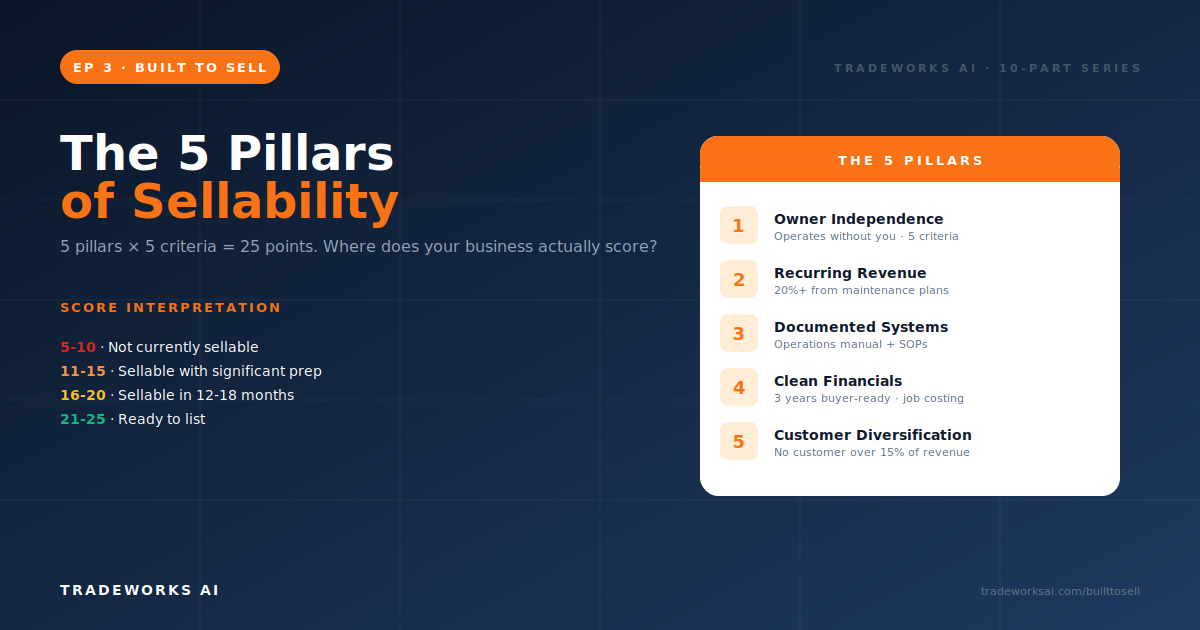
The five pillars of a sellable contractor business are: owner independence (the business operates without the owner’s daily involvement), recurring revenue (predictable income from maintenance plans and service contracts), documented systems (operations manual, SOPs, and training procedures), clean financials (three years of professionally prepared financial statements with job costing), and customer diversification (no single customer or referral source exceeds 15% of revenue). The Sellability Scorecard rates each pillar on 5 criteria for a total of 25 points. Scores of 5–10 indicate the business is not currently sellable. Scores of 11–15 indicate sellable with significant preparation. Scores of 16–20 indicate sellable within 12–18 months. Scores of 21–25 indicate the business is ready to list.
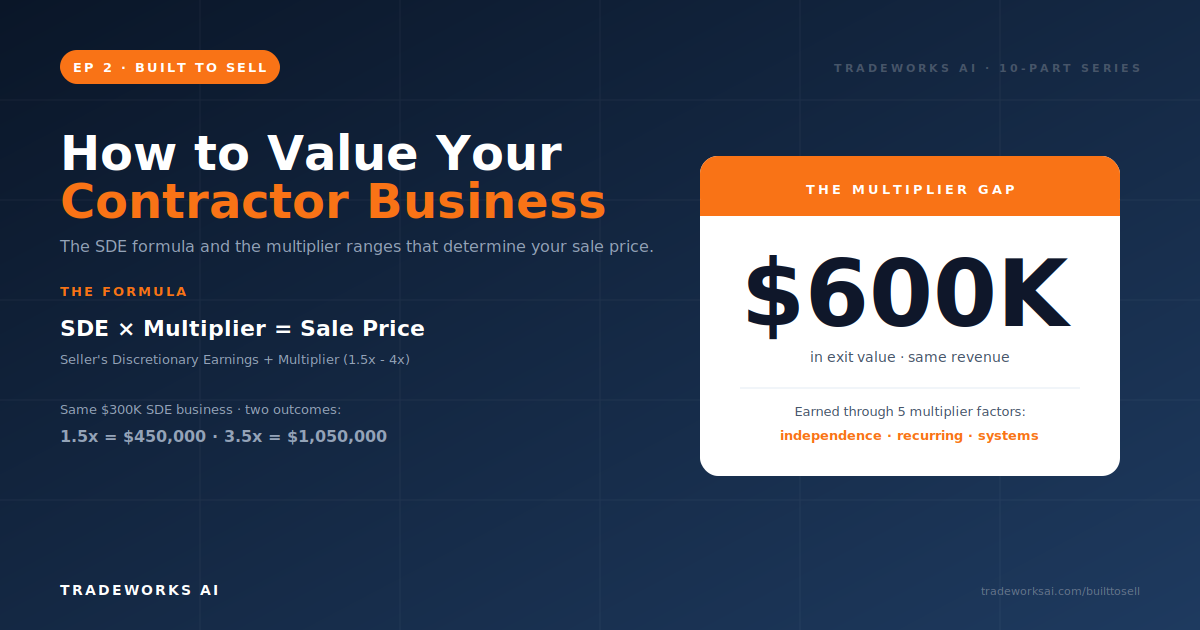
After Part 1 established that most contractor businesses are worth $0 due to owner dependency, and Part 2 provided the SDE valuation formula, this part introduces the complete framework for building sellability. The five pillars are not abstract concepts—each one directly influences the multiplier a buyer will pay. A business scoring 5/25 on the Sellability Scorecard might receive a 1.5x multiple. A business scoring 22/25 might receive 3.5x or higher. On $300,000 SDE, that difference is $600,000 in exit value. Each pillar gets a dedicated part later in the series (Parts 4–7). This article provides the overview framework and scoring system.
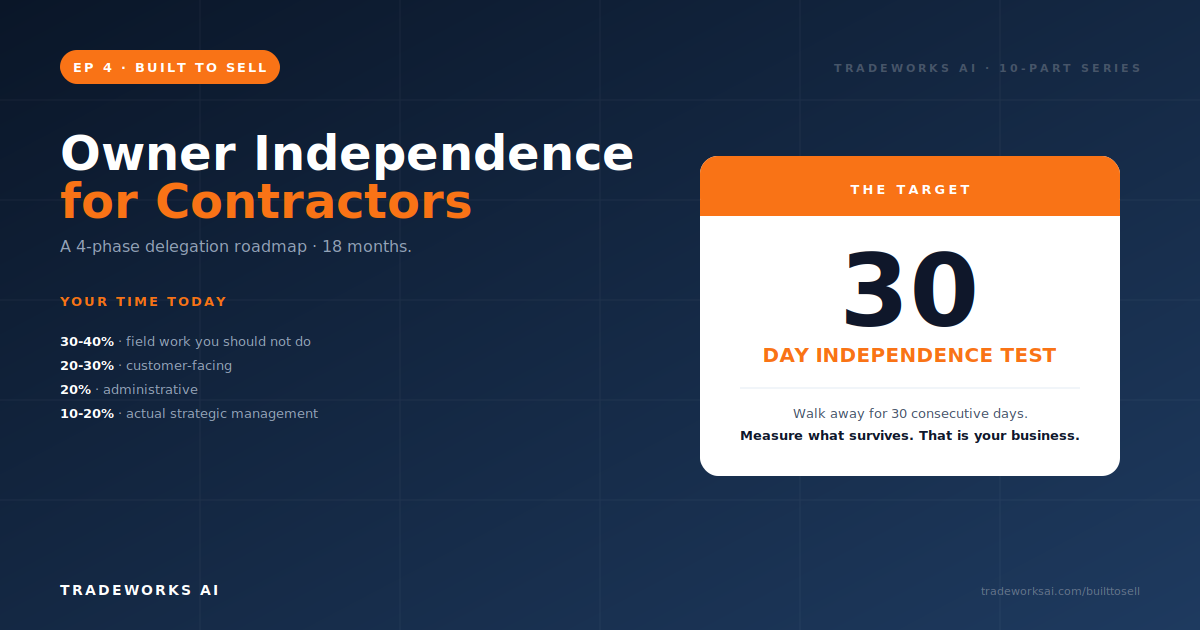
Five criteria scored yes/no. Can the business operate for 30 days without the owner present? Is there a manager or lead technician who handles daily operations? Do customers identify with the company brand rather than the owner’s name? Can someone other than the owner produce estimates and close sales? Does the owner work fewer than 40 hours per week in operations? Each yes is 1 point. A perfect score on Pillar 1 means the owner is working on the business, not in it. Part 4 covers the complete Owner Independence roadmap.
Five criteria. Does the business have active maintenance plans or service contracts? Do recurring revenue streams represent 20% or more of total revenue? Is the customer retention rate on recurring plans above 80%? Are recurring revenue customers acquired through systematic marketing (not just ad hoc offers)? Is the recurring revenue growing year over year? Recurring revenue is the single most powerful factor in increasing a contractor business’s multiple because it provides the buyer with predictable post-sale income. Part 5 covers the complete recurring revenue strategy.
Five criteria. Does a written operations manual exist covering all core business processes? Are SOPs documented for daily operations (dispatch, scheduling, invoicing, quality control)? Is there a training program for new employees that does not require the owner to conduct it? Are customer-facing processes standardized (how calls are answered, how estimates are presented, how follow-ups are conducted)? Is the documentation current (reviewed and updated within the last 12 months)? Part 6 covers systems documentation and due diligence preparation.
Five criteria. Are three years of financial statements available and professionally prepared? Is job costing active (can you determine profit by job type, technician, and marketing source)? Is the owner’s compensation clearly separated from business expenses? Can a P&L be produced within 24 hours of request? Is the business current on all tax filings and regulatory requirements? Buyers and their accountants scrutinize financials more than any other pillar. Messy books are the most common deal-killer in contractor business sales.
Five criteria. Does any single customer represent less than 15% of annual revenue? Does any single referral source represent less than 20% of annual leads? Does the business serve multiple customer segments or service types? Are there three or more active marketing channels generating leads? Is the brand attached to the company name rather than the owner’s personal name? Customer concentration is the risk that buyers fear most after owner dependency. Part 7 covers diversification strategy.
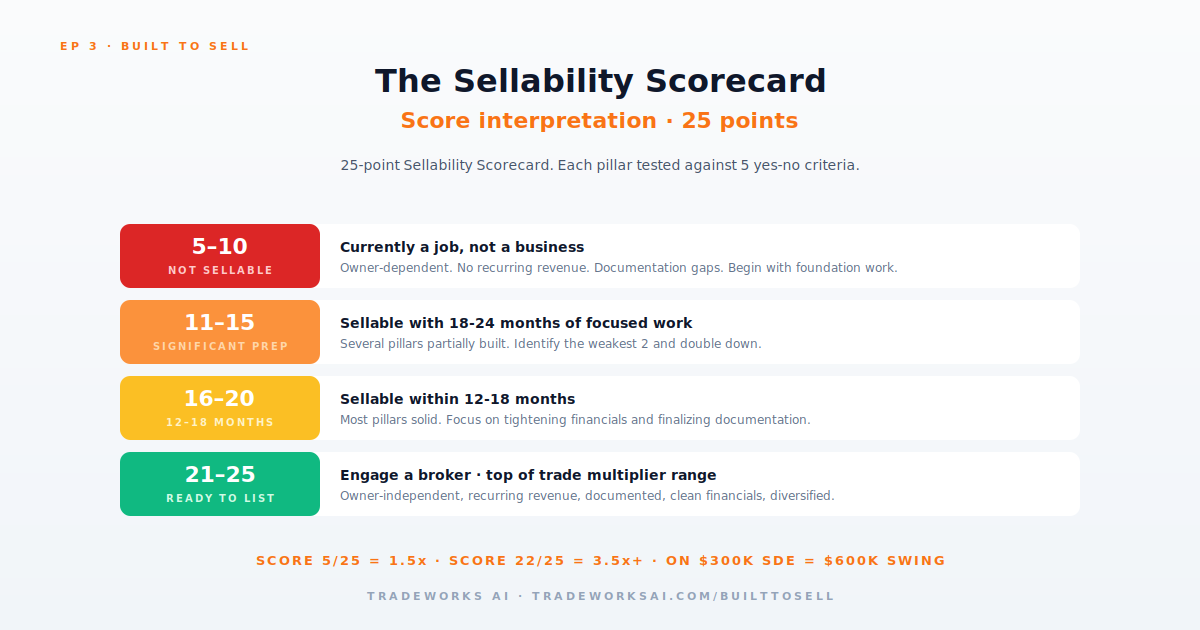
Total the yes answers across all five pillars for a score out of 25. Score 5–10: the business is not currently sellable—significant structural work is needed. Score 11–15: the business is sellable but requires 18–24 months of preparation to achieve a fair multiple. Score 16–20: the business is sellable within 12–18 months and will attract qualified buyers. Score 21–25: the business is ready to list and will command a premium multiple. Most contractors score between 8 and 14 on their first assessment. The goal of this series is to move that score toward 20+.
Owner independence. Without it, the other four pillars are irrelevant—a buyer cannot purchase a business that stops functioning when the seller leaves.
Most contractors can improve their score by 5–8 points within 12–18 months with focused effort on the weakest pillars. Moving from 10 to 18 typically takes 2–3 years.
Most owners assume their business is worth more than the market would pay. The Sellability Audit grades your business against the five pillars of value — owner independence, recurring revenue, documented systems, clean financials, and customer diversification — and gives you a realistic valuation range plus the highest-leverage actions to lift your multiple.
Continue the Built to Sell series with Part 2 of 10.
Continue the Built to Sell series with Part 4 of 10.