
Built to Sell · Part 3
The 5 Pillars of a Sellable Contractor Business
Continue the Built to Sell series with Part 3 of 10.
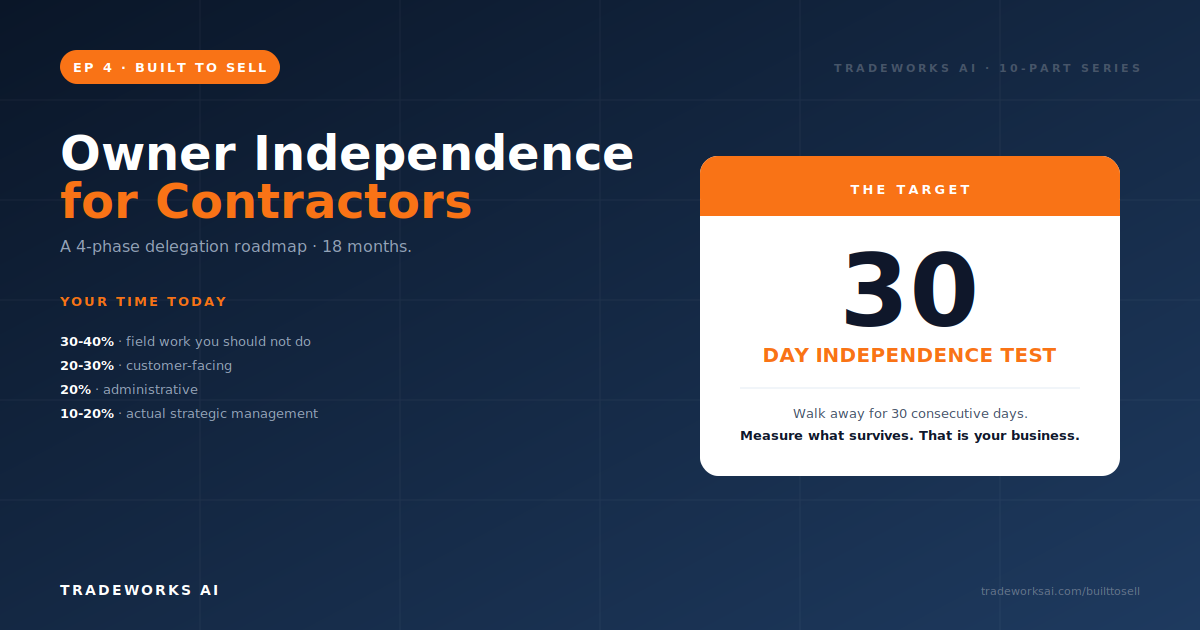
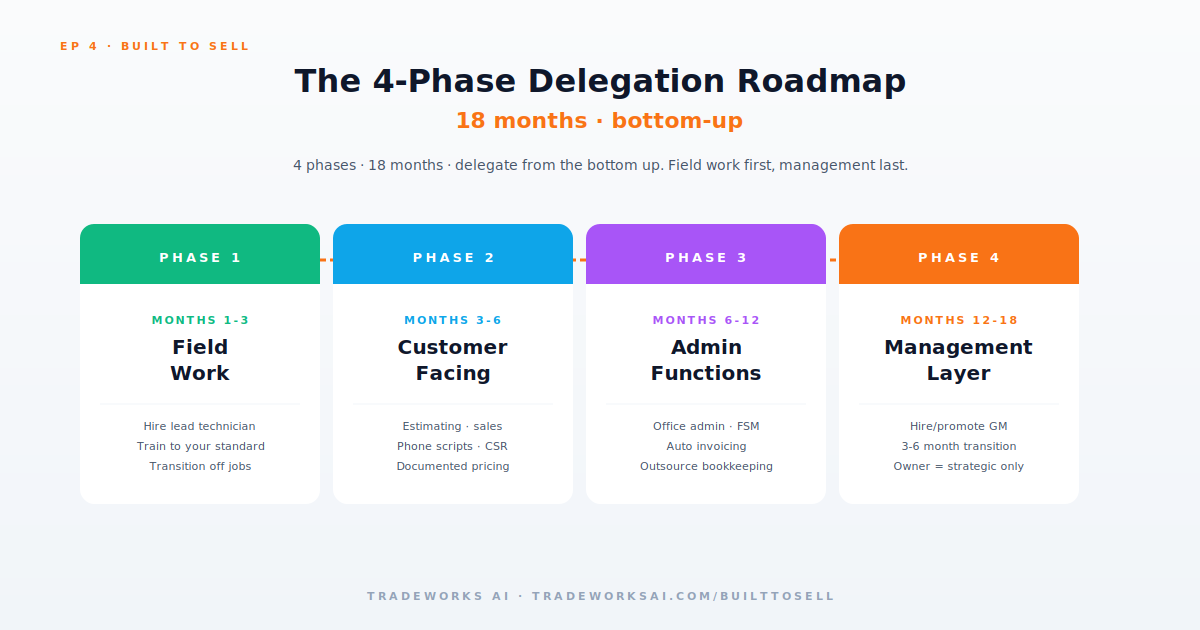
Building owner independence in a contractor business requires a systematic delegation process across four phases. Phase 1 (months 1–3): delegate field work by hiring and training a lead technician. Phase 2 (months 3–6): delegate customer-facing tasks including estimating, sales, and customer communication. Phase 3 (months 6–12): delegate administrative functions including scheduling, dispatching, invoicing, and bookkeeping. Phase 4 (months 12–18): delegate management by installing a general manager or operations manager. The Owner Task Audit is the starting tool: list every task you perform in a typical week, categorize each as field work, customer-facing, administrative, or management, then begin delegating from the bottom up. The 30-Day Independence Test is the validation: take 30 consecutive days completely away from the business and measure what happens.
Before you can delegate, you need to know what you actually do. For one full week, document every task you perform and the time it takes. Most contractor owners discover they spend 30–40% of their time on field work they should not be doing, 20–30% on customer-facing activities that could be systematized, 20% on administrative tasks that should be automated or assigned, and 10–20% on actual management and strategic decisions. The goal is to shift 100% of your time into the last category. Everything else gets delegated, automated, or eliminated.
The first and most common owner dependency is the owner working as the lead technician. If you are still running service calls, installations, or repairs, this is where you start. Hire a lead technician who can perform at your quality standard. Train them using documented SOPs (Part 6 covers documentation). Accompany them on the first 10–20 jobs, then transition to quality inspections only, then to spot checks, then to callback review only. The emotional challenge is trusting someone else with your customers. The practical requirement is accepting that a well-trained technician performing at 90% of your skill level is worth more to the business than you performing at 100% while being unavailable for everything else.
Once field work is delegated, the next dependency is usually customer-facing activities: answering calls, presenting estimates, closing sales, and managing customer relationships. Systematize the estimate process with standardized pricing (Part 5 of Category 8 covers pricing). Create scripts for common customer interactions. Train a customer service representative or office manager to handle inbound calls. The pricing conversation is the hardest to delegate because most contractor owners believe nobody can sell like they can. Document your sales approach, train someone, and measure closing rates. A trained salesperson closing at 40% is more valuable than the owner closing at 60% while being unavailable for strategic work.
Scheduling, dispatching, invoicing, bookkeeping, payroll, vendor management. These tasks consume 15–20 hours per week for most contractor owners and contribute zero to the business’s strategic value. Hire a part-time or full-time office administrator. Implement field service management software (Contractor Stack Part 4 covers FSM selection). Automate invoicing and payment collection. Outsource bookkeeping to a professional. Every hour freed from administrative work is an hour available for growth, team development, or stepping away entirely.
The final phase is the hardest: installing a general manager or operations manager who runs the business day-to-day. This person handles hiring, performance management, customer escalations, quality control, and financial oversight. Finding the right person is critical—they need operational competence, leadership ability, and the trust of your team. Consider promoting from within (your lead technician or office manager may be ready) or hiring externally. Either way, the transition takes 3–6 months of shadowing, graduated responsibility, and feedback loops.
When you believe the business can operate without you, test it. Take 30 consecutive days completely away from operations. No phone calls about daily issues. No dispatching decisions. No customer conversations. You can review financial reports weekly, but operational decisions stay with your team. The results tell you everything: if revenue holds steady and customer satisfaction remains consistent, you have achieved owner independence. If revenue drops or quality declines, identify the specific failure points and address them before testing again.
The typical timeline is 12 to 18 months from the first hire to a successful 30-day independence test. The pace depends on starting position—a solo operator takes longer than a business with 3–4 employees.
Start with Phase 1 (a lead technician) and Phase 3 (a part-time administrator). These two hires free 30–40 hours per week and are affordable at Stage 2. The management hire comes at Stage 3 when revenue supports a $50,000–$70,000 salary.
Most owners assume their business is worth more than the market would pay. The Sellability Audit grades your business against the five pillars of value — owner independence, recurring revenue, documented systems, clean financials, and customer diversification — and gives you a realistic valuation range plus the highest-leverage actions to lift your multiple.
Continue the Built to Sell series with Part 3 of 10.

Continue the Built to Sell series with Part 5 of 10.