
Marketing & Psychology · Part 5
Authority for Contractors: Why the Expert Commands $229 and the Vendor Competes at $89
Continue the Marketing & Psychology series with Part 5 of 15.
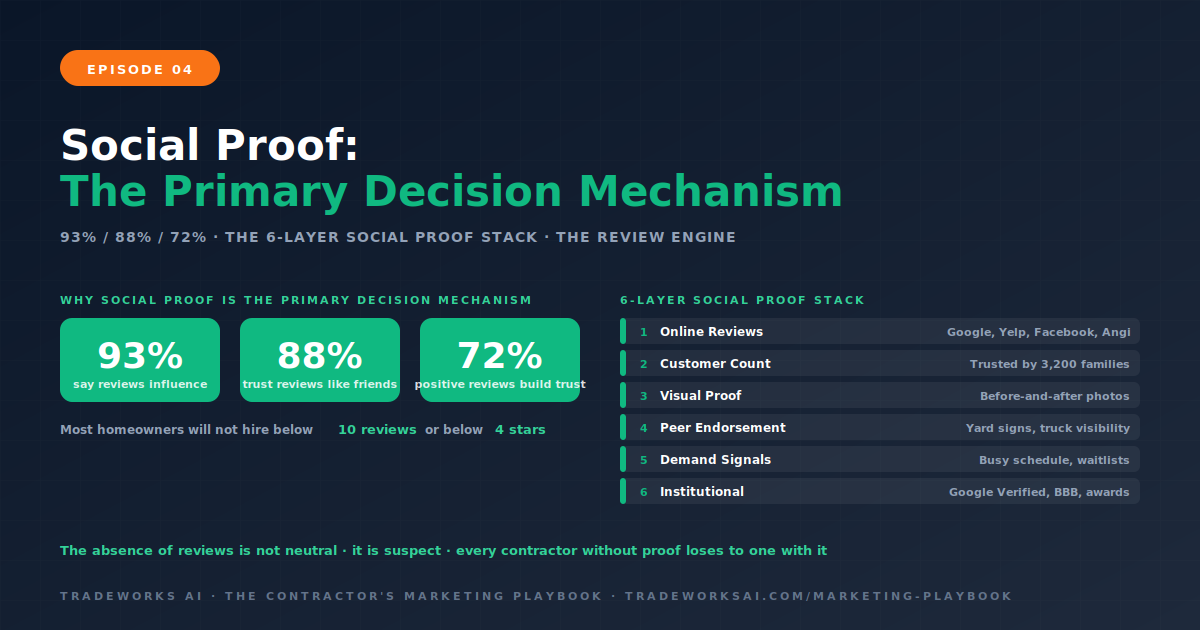
Social proof for contractors is the most powerful influence principle because homeowners cannot evaluate the service before purchasing it. 93% of consumers say online reviews influence their decisions. 88% trust online reviews as much as personal recommendations. Most homeowners will not hire a contractor with fewer than 10 reviews or a rating below 4 stars. Social proof extends beyond reviews: truck count as proof of demand (3 branded trucks in a neighborhood signals popularity), customer count messaging (trusted by 3,200 Tampa families), yard signs as peer endorsement, before-and-after photos as visual proof, and active social media as validation of a real, operating business. The absence of social proof is itself negative social proof—a contractor with zero reviews is not neutral, they are suspect. The Social Proof Stack builds 6 layers of proof that compound each other.
Of the seven Cialdini principles, Social Proof is the most powerful for contractors for one reason: homeowners cannot evaluate the quality of the service before they buy it. A homeowner hiring an HVAC contractor cannot test the repair before paying. They cannot sample the plumbing work before committing. The service is invisible until it is delivered. When people cannot evaluate a product or service themselves, they rely on the evaluations of others. That is social proof—the psychological tendency to look to others’ actions and opinions to determine correct behavior, especially under uncertainty. For contractors, uncertainty is the entire buying experience. The homeowner is uncertain about the problem, uncertain about the solution, uncertain about the price, and uncertain about the contractor. Social proof is the mechanism that resolves all of that uncertainty at once.
The data on reviews for contractors is unambiguous. 93% of consumers say online reviews influence their purchase decisions. 92% read online reviews before making a hiring decision. 88% trust online reviews as much as personal recommendations from friends and family. 72% say positive reviews make them trust a local business more. 69% of consumers seek opinions before choosing a service. Most homeowners will not hire a contractor with fewer than 10 reviews or a rating below 4 stars. Businesses with more than 50 reviews see measurably higher conversion rates. Reviews are not a marketing tactic to implement when you have time. They are the primary mechanism by which homeowners evaluate and select contractors. A contractor without reviews is not neutral. They are suspect—because the absence of social proof is itself negative social proof. If no one is saying anything about you, the homeowner’s brain interprets that as a warning sign.
Reviews are the foundation, but social proof for contractors has 6 distinct layers that compound each other.
Most contractors get reviews accidentally—the homeowner who was so impressed they left one voluntarily, or the angry customer who left one without being asked. A Social Proof strategy requires a review engine: a systematic process that generates reviews consistently. The review engine has 4 components. First, the ask: every completed job gets a review request within 24 hours via text message with a direct link to your Google Business Profile. Text outperforms email by 3 to 5 times for review response rates. Second, the timing: ask when satisfaction is highest—immediately after the tech confirms the system is working, not 3 days later when the homeowner has moved on to the next task. Third, the response: respond to every review (positive and negative) within 24 to 48 hours. Responses show potential customers that the business is active, engaged, and accountable. Fourth, the display: feature reviews on your website, landing pages, social media, and estimates. Reviews do not help if they only exist on Google.
In the 45-Minute Decision Map from Episode 1, social proof operates at the Evaluate stage (minutes 15 to 25). The homeowner scans 3 to 5 contractor profiles in 10 minutes using rapid heuristic shortcuts. The review count, star rating, and review recency are the primary shortcuts. A contractor with 340 reviews at 4.8 stars is evaluated differently than a contractor with 8 reviews at 5.0 stars—the first has volume proof, the second does not, even though the second has a higher rating. In Episode 2’s Two Brains framework, reviews serve both systems. The star rating is a System 1 signal—processed instantly as a visual pattern (4.8 stars = trustworthy). The written review text is System 2 evidence—it provides rational justification for the emotional impression. In Episode 3’s Trust Equation, reviews build Credibility (others confirm your expertise) and reduce Self-Orientation perception (the homeowner who writes that the tech was honest and did not upsell is providing evidence of low self-orientation from a third party, which is far more powerful than the contractor claiming it themselves).
There is a version of social proof that works against contractors. Messaging that highlights negative behavior inadvertently normalizes it. Do not complain publicly about no-shows or difficult customers—it signals that your business attracts those problems. Do not post about how hard it is to find good employees—it signals staffing problems. Do not focus on how many competitors do bad work—it signals the industry is unreliable and you might be too. Social proof works in both directions. Positive proof attracts. Negative proof repels. Every piece of public content is either building or eroding social proof. There is no neutral.
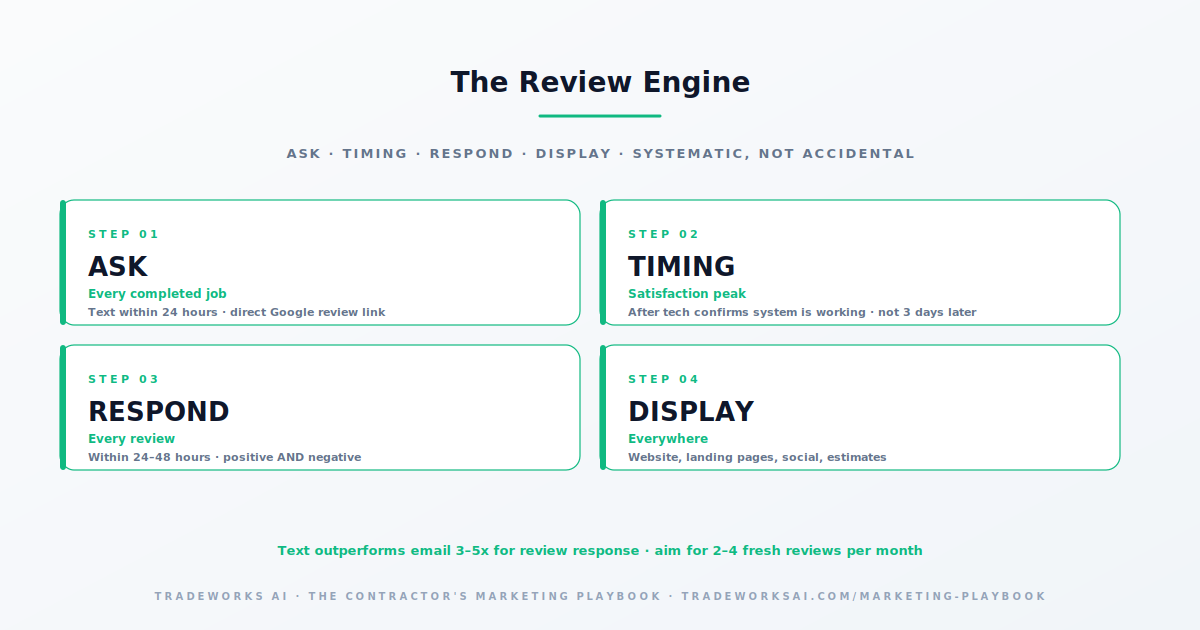
Minimum 10 reviews to be considered, but 50 or more significantly improves conversion rates. Aim for a steady stream of recent reviews (2 to 4 per month) rather than a burst followed by silence. Recency signals current quality.
Text message with a direct Google review link sent within 24 hours of job completion. Ask when satisfaction is highest—immediately after the tech confirms the system is working. Text outperforms email by 3 to 5 times for review response rates.
Always. Respond within 24 to 48 hours. Acknowledge the concern, apologize for the experience, offer to resolve via phone or direct message. The response is not for the angry reviewer. It is for the hundreds of potential customers who will read that review and judge your professionalism by how you handled it.
Content that inadvertently normalizes negative behavior. Complaining about no-shows, posting about staffing problems, or highlighting industry failures signals problems associated with your brand. Social proof works in both directions—every piece of public content either builds or erodes it.
Tactics change every quarter. Psychology has not changed in 50,000 years. The Influence Audit grades your marketing across the 7 principles — Reciprocity, Commitment, Liking, Social Proof, Authority, Scarcity, and Unity — and identifies the one principle that, when activated, lifts every other channel you run.
Continue the Marketing & Psychology series with Part 5 of 15.
Continue the Marketing & Psychology series with Part 6 of 15.