Marketing & Psychology · Part 3
The Trust Equation for Contractors: Four Variables, One Denominator That Destroys Everything
Continue the Marketing & Psychology series with Part 3 of 15.
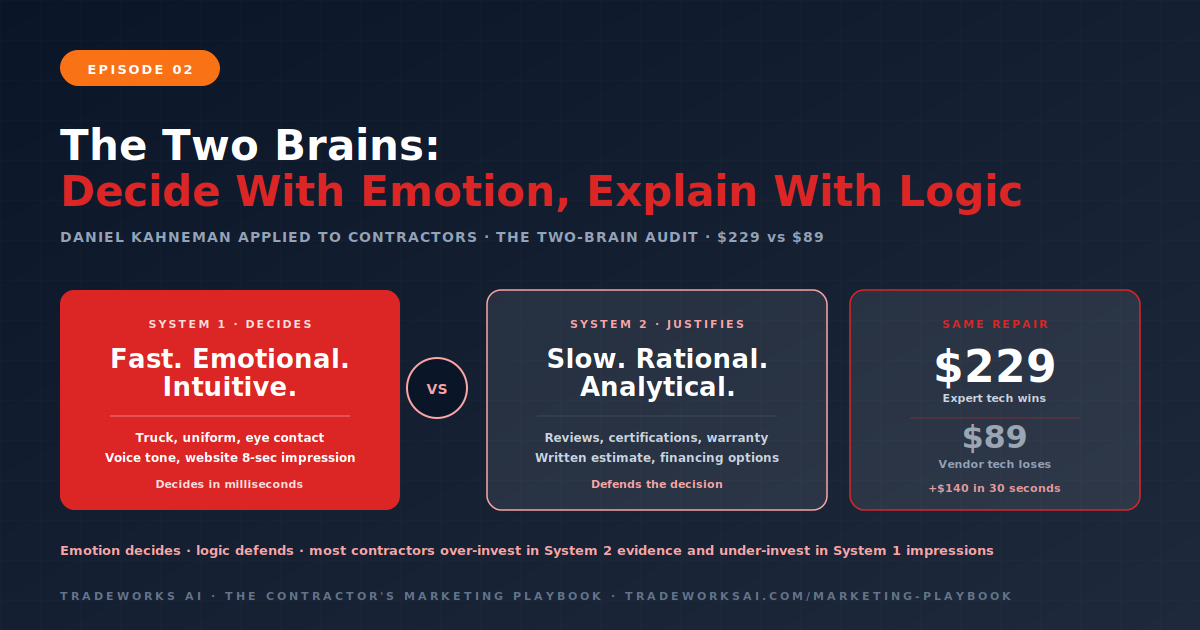
Homeowners decide with System 1 (fast, automatic, emotional, intuitive) and explain with System 2 (slow, deliberate, rational, analytical). This is Daniel Kahneman’s dual-process framework applied to contractor marketing. The tech’s uniform, the truck’s appearance, the voice on the phone, the website’s first impression, the tech’s eye contact at the door—these are not details. These are the decision. System 1 processes them in milliseconds and produces a gut feeling: I trust this person, or I do not. Certifications, license numbers, written estimates, and price comparisons do not win the job. They prevent buyer’s remorse—they give System 2 the rational evidence it needs to justify the emotional decision System 1 already made. The Two-Brain Audit evaluates every contractor touchpoint as either a System 1 trigger (wins the decision) or a System 2 justifier (prevents the regret).
Ask any homeowner why they chose their contractor and they will give you a System 2 answer. They had the best reviews. They were licensed and insured. The estimate was reasonable. The warranty was good. These are rational explanations. They are real and they matter. But they are not why the homeowner chose the contractor. The homeowner chose the contractor because of a feeling. The tech showed up in a clean truck, wearing a uniform, and looked the homeowner in the eye. The voice on the phone was confident and warm. The website felt professional and trustworthy in the 8 seconds before the homeowner decided to call. The decision was made in seconds by System 1—the fast, intuitive, emotional brain. Then System 2—the slow, rational, analytical brain—assembled the evidence to justify what System 1 already decided.
System 1 is fast, automatic, and runs constantly. It processes patterns, emotions, and impressions without conscious effort. It decides whether someone is trustworthy in milliseconds—before a word is spoken. For contractors, System 1 operates at every touchpoint where the homeowner forms an impression.
None of these touchpoints involve the homeowner consciously evaluating credentials. They are processed automatically by System 1 and produce a feeling: trust or distrust, confidence or doubt, comfort or anxiety. Most of the time, the homeowner cannot articulate why they feel this way. They just know.
System 2 is slow, deliberate, and requires effort. It handles logic, analysis, and comparison. It activates when the homeowner needs to justify the decision—to themselves, to a spouse, or to anyone who asks why they chose this contractor. System 2 does not make the decision. It defends the decision.
System 2 evidence does not win the job. It prevents the homeowner from talking themselves out of the job. When a homeowner says they want to think about it or get another estimate, what has actually happened is System 1 said yes but System 2 did not receive enough evidence to justify the decision. The close rate is not a sales problem. It is a System 2 problem.
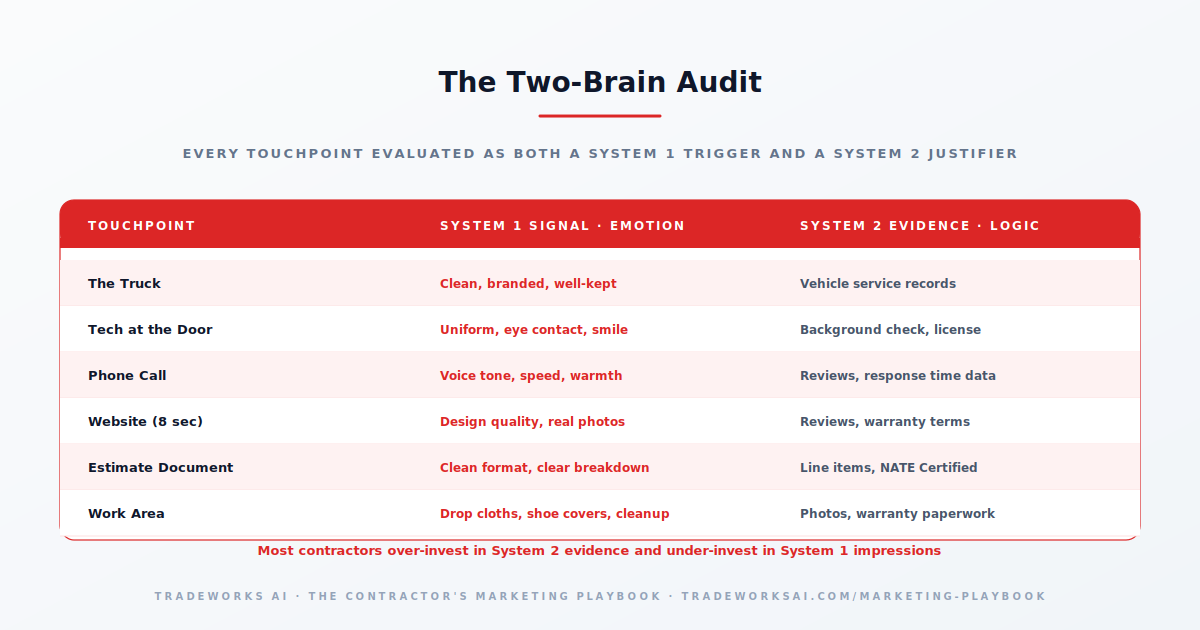
The Two-Brain Audit evaluates every contractor touchpoint through the dual-process lens. For each touchpoint, ask: Is this triggering System 1 (emotional, impression-based) or satisfying System 2 (rational, evidence-based)? Both are necessary. The mistake is investing heavily in one while ignoring the other.
The most common contractor mistake: investing in System 2 (certifications, credentials, licensing, detailed proposals) while underinvesting in System 1 (truck appearance, uniform quality, phone manner, website design, technician personality). The contractor with perfect credentials who shows up in a dirty truck with a tech in jeans and no name badge triggers System 1 doubt that no certification can overcome. The homeowner feels uneasy and rationalizes it as wanting another estimate.
The reverse mistake is less common but equally damaging: a contractor with excellent System 1 presence (great truck, professional tech, beautiful website) but weak System 2 evidence (no reviews, vague estimate, no visible licensing) leaves the homeowner’s System 2 without ammunition to justify the decision. The homeowner likes the contractor but cannot explain why to their spouse. The result: they want to think about it.
Two HVAC techs arrive at the same home on the same day for the same problem. Tech A: clean truck, pressed uniform, name badge, protective shoe covers at the door, introduces himself by name, explains what he is doing as he diagnoses. Tech B: unmarked van, jeans and a company t-shirt, walks straight to the unit without introduction, gives a verbal quote. Tech A charges $229. Tech B charges $89. Both are competent. Both will fix the problem correctly. The homeowner chooses Tech A at $229 and tells their spouse: he was licensed and insured, he gave me a written estimate, and the company has great reviews. Those are the System 2 reasons. The real reason: System 1 decided in the first 30 seconds at the door. The uniform, the eye contact, the shoe covers, the explanation. Tech A felt trustworthy. Tech B felt uncertain. The $140 price premium was earned in 30 seconds of System 1 impression, not in the quality of the repair.
Google Ads landing page: System 1 triggers (professional design, real photos, fast load, immediate confirmation of service) determine whether the visitor stays. System 2 justifiers (reviews, licensing, warranty) determine whether they call. Social media: System 1 dominates—personality, team photos, behind-the-scenes content builds liking and familiarity. System 2 content (educational posts, certifications, awards) builds authority. GBP profile: System 1 triggers (photos, response to reviews, overall impression). System 2 evidence (star rating, review count, license displayed). The estimate presentation: System 1 triggers (the tech’s demeanor, document quality, communication style). System 2 evidence (line items, warranty terms, financing options). Every channel, every touchpoint, every moment of contact—the two brains are operating simultaneously.
Both, but in a specific order. The emotional brain (System 1) makes the initial decision in seconds based on impressions: truck appearance, tech demeanor, website quality, voice on the phone. The rational brain (System 2) then assembles evidence (reviews, credentials, price) to justify the decision. Emotion decides. Logic defends.
A framework that evaluates every contractor touchpoint through Kahneman’s dual-process lens. Each touchpoint is categorized as a System 1 trigger (emotional impression that wins the decision) or a System 2 justifier (rational evidence that prevents regret). Both are necessary. Most contractors overinvest in System 2 and underinvest in System 1.
In most cases, System 1 said yes but System 2 did not receive enough evidence to justify the decision. The homeowner likes the contractor but cannot rationalize the price or explain the choice to their spouse. The fix: provide stronger System 2 evidence (written estimate, warranty documentation, reviews, financing) at the point of decision.
A contractor who triggers strong System 1 responses (professional appearance, confident communication, trustworthy impression) can charge premium prices because the homeowner’s emotional brain has already said yes. System 2 evidence (quality warranty, transparent pricing, credentials) then justifies the premium. The $229 tech and the $89 tech both fix the AC. The $229 tech wins on System 1 impression.
Tactics change every quarter. Psychology has not changed in 50,000 years. The Influence Audit grades your marketing across the 7 principles — Reciprocity, Commitment, Liking, Social Proof, Authority, Scarcity, and Unity — and identifies the one principle that, when activated, lifts every other channel you run.
Continue the Marketing & Psychology series with Part 3 of 15.
Continue the Marketing & Psychology series with Part 4 of 15.