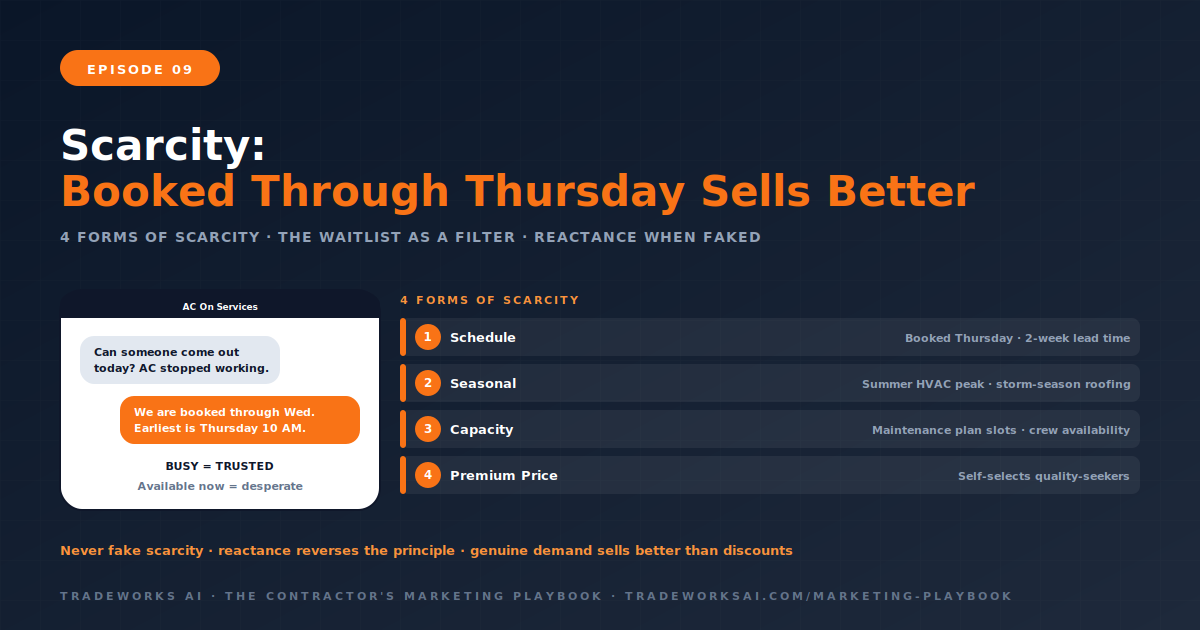
Marketing & Psychology · Part 9
Scarcity for Contractors: Why Being Booked Through Thursday Sells Better Than a Discount
Continue the Marketing & Psychology series with Part 9 of 15.
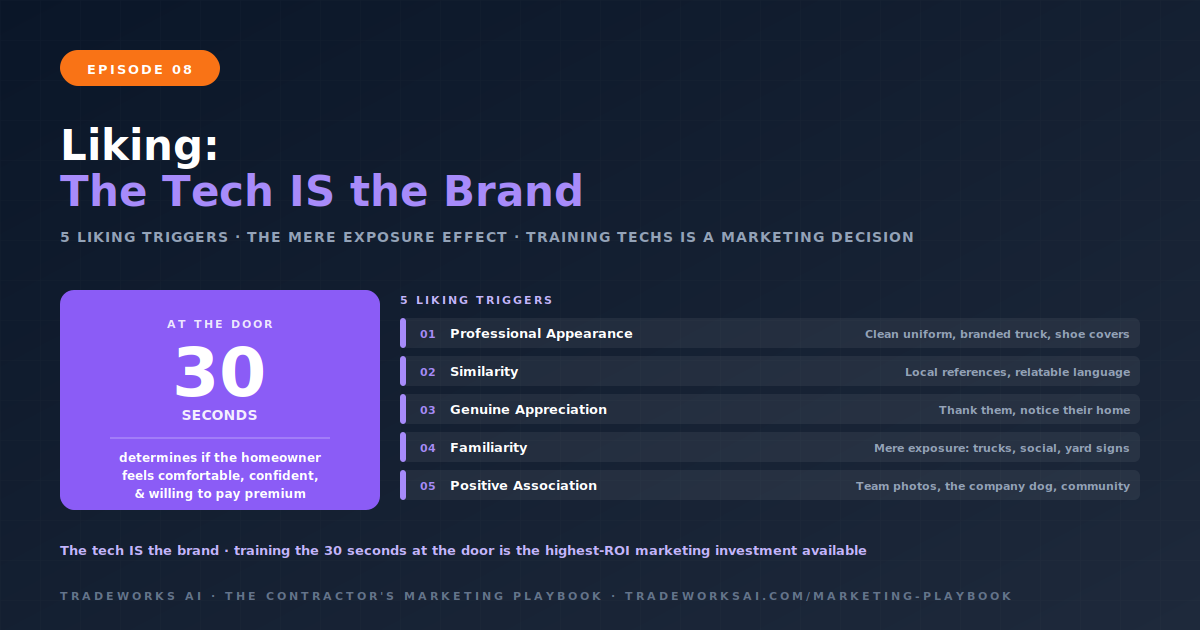
The Liking principle states that people prefer to say yes to people they know and like. For contractors, this means the homeowner’s impression of the technician IS their impression of the company. The tech at the door is the most important marketing moment in the business. Liking operates through 5 triggers: professional appearance (uniform, grooming, branded truck—System 1 signals from Episode 2), similarity (local references, shared experiences, relatable communication), genuine appreciation (thanking the homeowner, complimenting their home, acknowledging their patience), familiarity (the mere exposure effect—consistent social media posting, truck visibility, yard signs build recognition that makes the brand the obvious choice), and positive association (team photos, community involvement, the company dog—content that makes the brand human). Training technicians to be likable is not an HR decision. It is the most important marketing decision a contractor makes.
The homeowner opens the door. A technician stands on the porch. In the next 30 seconds, the homeowner forms an impression that will determine whether they feel comfortable, confident, and willing to pay a premium—or uncomfortable, skeptical, and price-sensitive. This is not an exaggeration. Episode 2 taught us that System 1 (the fast, emotional brain) processes impressions in milliseconds. The tech’s appearance, eye contact, smile, voice tone, and body language are processed before the first word of diagnosis. The homeowner’s impression of the technician becomes their impression of the company. There is no separation. The tech IS the brand. A brilliant marketing campaign, a beautiful website, and 5-star reviews are all rendered meaningless by a technician who makes the homeowner uncomfortable at the door.
The mere exposure effect is one of the most replicated findings in psychology: repeated exposure to a stimulus—a name, a face, a logo, a truck—increases liking and trust, even when the person cannot recall when or where they saw it. For contractors, this means showing up consistently across the homeowner’s environment is a form of marketing that operates below conscious awareness. The homeowner who has seen your truck in the neighborhood 12 times, your social media posts in their feed twice a week, your yard sign at the neighbor’s house, and your name on the Little League scoreboard does not consciously process each exposure. But when their AC dies and they search Google, your name feels familiar. Familiar feels safe. Safe feels trustworthy. That is the mere exposure effect converting visibility into liking without a single ad click.
This is why consistent social media posting matters even when engagement seems low. Each post is an exposure. Each exposure increases familiarity. Each familiarity increment increases liking. The contractor who posts 3 times a week for 12 months has created hundreds of exposures across thousands of local homeowners. When those homeowners eventually need a contractor, the familiar brand has a decisive advantage over the unfamiliar one—even if the unfamiliar contractor has better credentials.
The company that shares the team dog is more likable than the company that only posts service specials. This sounds trivial. It is not. Brand personality—the human qualities associated with the brand—is the most scalable application of the Liking principle. A company with a visible, relatable personality attracts homeowners who feel a connection before the service call. Team photos showing real employees. Behind-the-scenes content from job sites. The owner’s story. The new hire introduction. The Friday team lunch. The tech’s birthday celebration. Each piece of content humanizes the brand. The homeowner does not hire a company. They hire people. The more the brand feels like people they know and like, the more naturally the hiring decision follows.
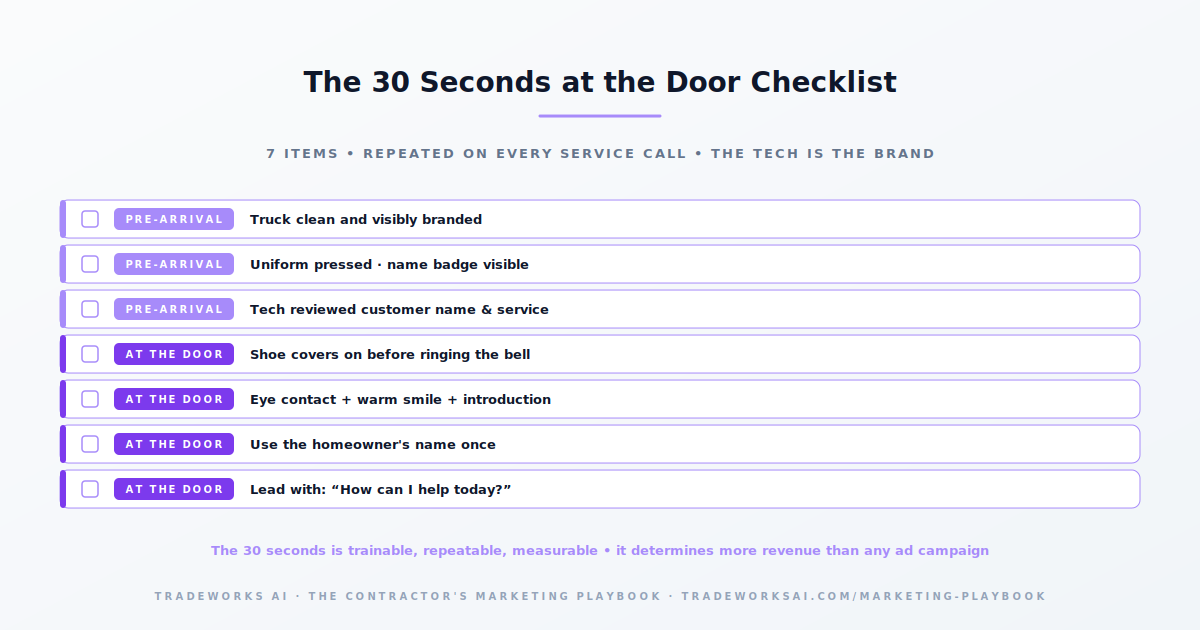
Most contractors invest in marketing (ads, website, SEO) and operations (tools, trucks, training on technical skills). Very few invest in training technicians on the human skills that determine whether the homeowner likes them—and by extension, the company. This is the most overlooked marketing investment in the industry. A $500 per month Google Ads budget increase may generate 3 additional leads. A $500 investment in technician communication training may increase the close rate on every lead by 10 to 20%. The math favors the training. The 30 seconds at the door—the introduction, the eye contact, the shoe covers, the name badge, the first words spoken—is a trainable, repeatable moment that determines more revenue than any ad campaign.
In the Trust Equation (Episode 3), Liking primarily builds Intimacy—the homeowner feels comfortable, understood, and connected. The likable tech creates emotional safety, which is the most neglected and most impactful numerator variable. In the Two Brains framework (Episode 2), Liking operates almost entirely through System 1—the fast, emotional brain. The homeowner does not consciously decide to like the tech. They feel it. The impression forms in seconds. And because System 1 decides while System 2 justifies, the likable tech wins the job and the homeowner explains it afterward with rational reasons.
The homeowner’s impression of the tech IS their impression of the company. A likable tech creates comfort, trust, and willingness to pay premium prices. An unlikable tech creates discomfort and price sensitivity—regardless of the company’s marketing, website, or credentials.
Repeated exposure to your brand (truck sightings, social media posts, yard signs, community sponsorships) increases familiarity, which increases liking and trust—even without direct interaction. When the homeowner eventually needs a contractor, the familiar brand feels like the obvious safe choice.
Share the human side: team photos, behind-the-scenes job site content, the owner’s story, employee introductions, company events, the team dog. Each piece humanizes the brand. The homeowner hires people, not companies—the more the brand feels like people they know and like, the easier the decision.
Yes. Training techs on the 30 seconds at the door (introduction, eye contact, shoe covers, communication style) increases close rates on every lead. A 10–20% close rate improvement on existing leads often produces more revenue than an equivalent investment in generating new leads.
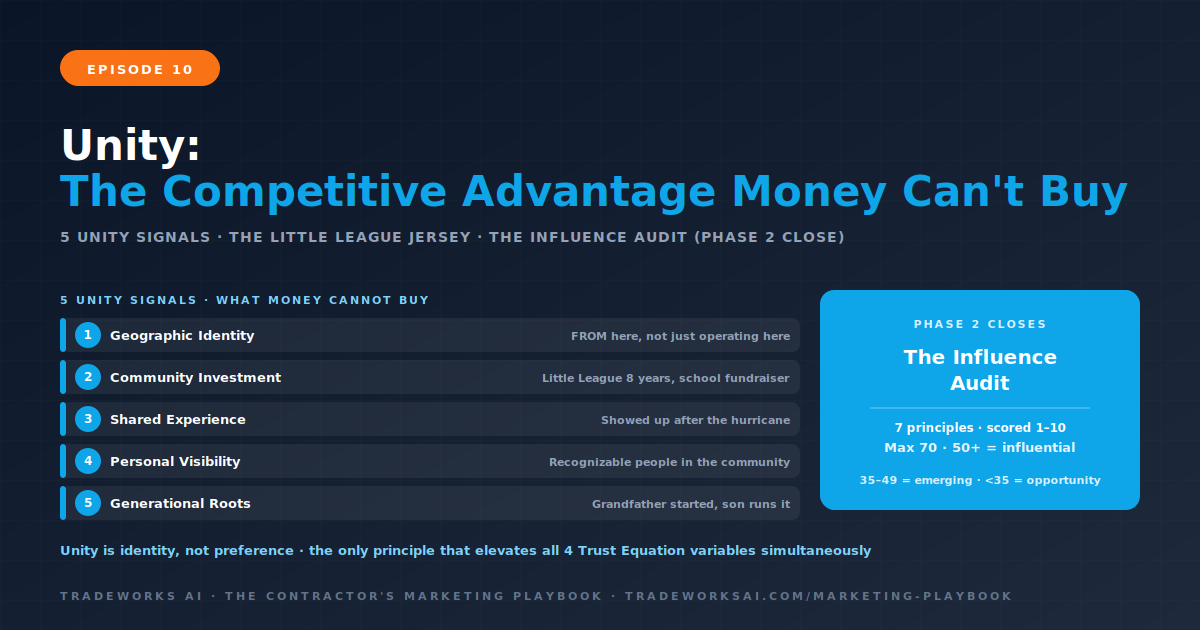
Tactics change every quarter. Psychology has not changed in 50,000 years. The Influence Audit grades your marketing across the 7 principles — Reciprocity, Commitment, Liking, Social Proof, Authority, Scarcity, and Unity — and identifies the one principle that, when activated, lifts every other channel you run.
Continue the Marketing & Psychology series with Part 9 of 15.
Continue the Marketing & Psychology series with Part 10 of 15.