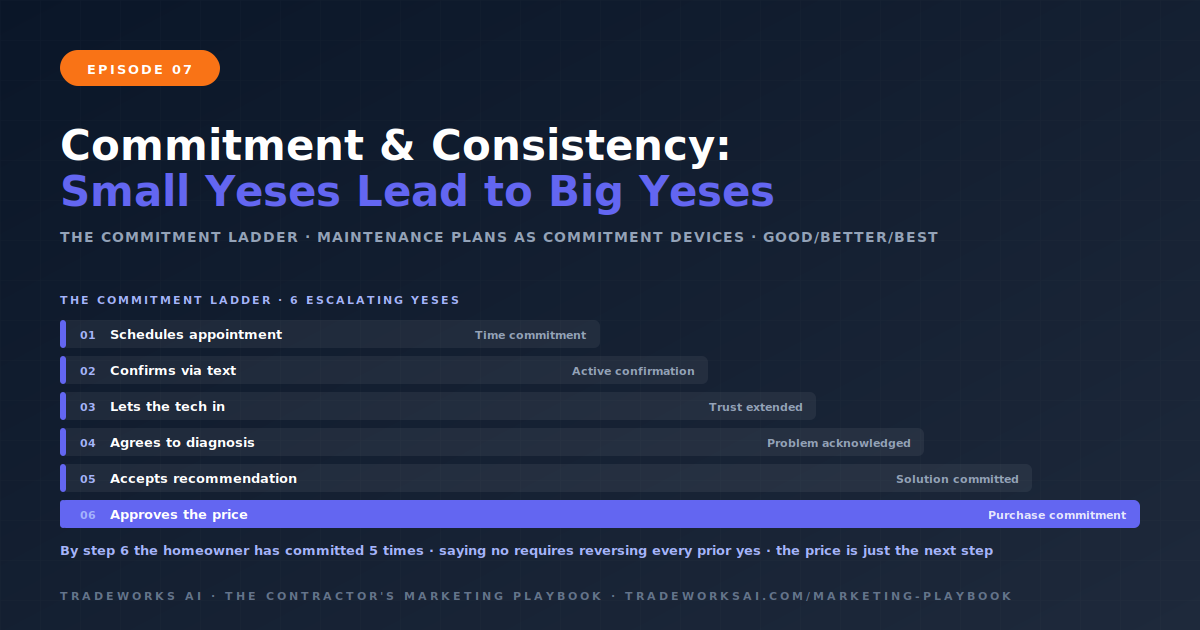
Marketing & Psychology · Part 7
Commitment and Consistency for Contractors: Why Small Yeses Lead to Big Yeses and How to Build the Commitment Ladder
Continue the Marketing & Psychology series with Part 7 of 15.
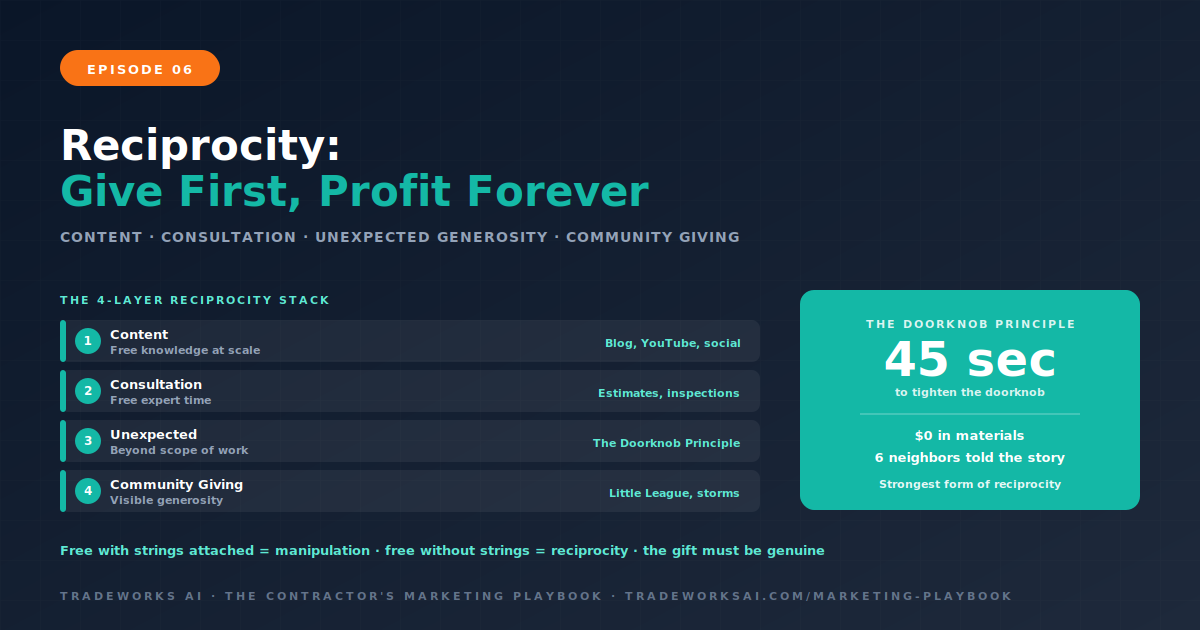
Reciprocity is the psychological principle that when someone gives us something of value, we feel an unconscious obligation to give back. For contractors, reciprocity operates through 4 layers: free content (blog articles, YouTube videos, social media tips—scalable, permanent, reaching thousands), free consultation (estimates, inspections, diagnostics—the homeowner receives expert time and knowledge before paying anything), unexpected generosity (the tech who tightens a loose doorknob outside the scope of work, who notices a potential safety issue and mentions it without upselling), and community giving (sponsoring the Little League team, donating to the school fundraiser, volunteering after a storm). Each layer creates a psychological debt the homeowner feels compelled to repay—through hiring, referral, or loyalty. The entire content library strategy is a reciprocity engine: every free article is a gift that builds obligation at scale.
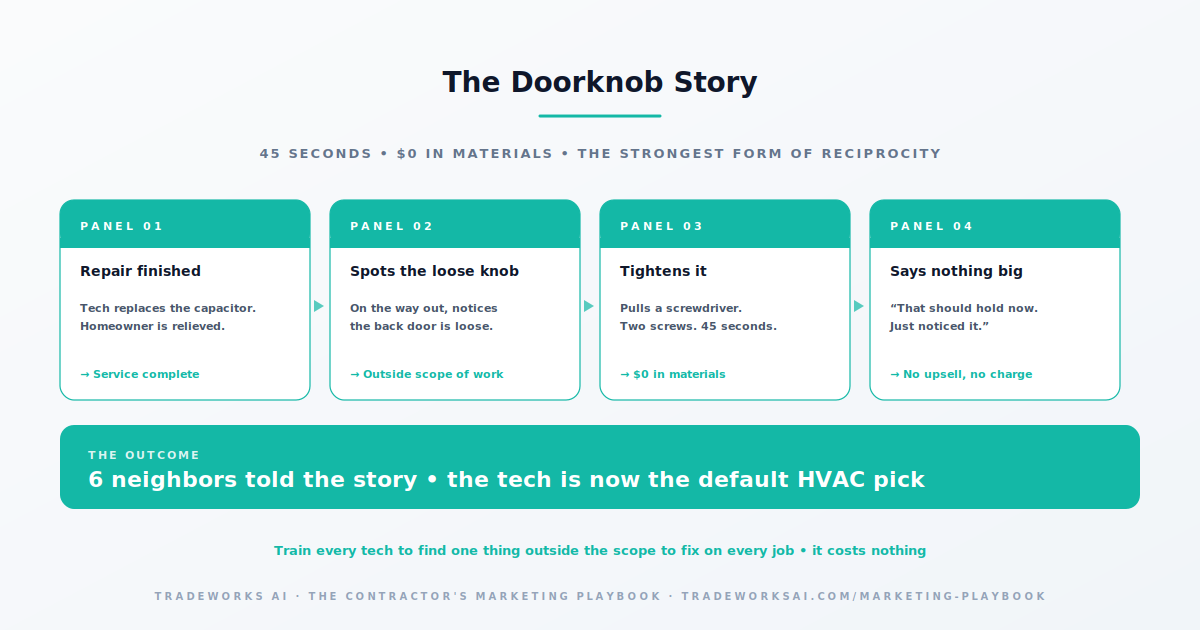
An HVAC tech finishes replacing a capacitor. The homeowner is relieved—the AC is working again. As the tech packs up, he notices the doorknob on the back door is loose. He pulls a screwdriver from his kit, tightens two screws, and says: that should hold now. No charge. Just noticed it while I was walking through. The homeowner did not ask for this. The tech was not obligated to do it. The doorknob fix took 45 seconds and cost the contractor nothing. But the psychological impact is enormous. The homeowner now feels a debt—not a financial debt, but an emotional one. Someone gave them something they did not ask for and did not have to give. Reciprocity is now active. The next time this homeowner needs HVAC service, they do not search Google. They call the tech who fixed the doorknob. When a neighbor asks for a recommendation, they do not say the company was fine. They tell the doorknob story.
Reciprocity is one of the most deeply wired principles in human psychology. Anthropologists have documented it in every known human culture. When someone gives us something—a gift, a favor, information, time—we experience an unconscious compulsion to repay. The obligation is not rational. It is automatic. We cannot easily dismiss it even when we know it exists. Cialdini’s research demonstrated that reciprocity operates even when the gift is small, even when it is unsolicited, and even when the giver is someone we do not particularly like. The principle is so powerful that it can override other decision factors including price. A homeowner who received a genuine, thorough free estimate from a contractor at $4,500 will often choose that contractor over a competitor at $3,800 who provided only a verbal quote—because the first contractor gave more during the evaluation process.
Every blog article, every YouTube video, every social media tip you publish is a gift. The homeowner receives valuable information—how to maintain their AC, when to replace their water heater, what to do during a power outage—for free. They did not ask for it. You were not obligated to share it. But the information was genuinely helpful, and the homeowner now associates your company with generosity and expertise simultaneously. This is where Reciprocity and Authority (Episode 5) compound: teaching builds authority (they see you as the expert) AND triggers reciprocity (they feel they owe you for the free education). The entire content library—hundreds of articles, dozens of videos—is a reciprocity engine running 24 hours a day. Every homeowner who learns something from your content carries a small, unconscious debt. When they eventually need a contractor, that debt activates. You are the first call.
Most contractors think of free estimates as a cost of doing business. They are actually one of the most powerful reciprocity tools available. A thorough, written estimate—where the tech takes time to diagnose, explain, document, and present options—is a gift of expertise. The homeowner received 30 to 60 minutes of professional time and a detailed document at no charge. The more thorough the estimate, the stronger the reciprocity. A verbal quote over the phone triggers minimal obligation. A detailed, written estimate with photos, options, and educational explanations triggers significant obligation. The estimate is not a price presentation. It is a gift that makes the homeowner want to repay you with the job.
Unexpected generosity is the most emotionally powerful form of reciprocity because it is unsolicited. The homeowner did not ask for the doorknob fix. They did not expect it. It appeared to cost the contractor nothing—but it demonstrated care that went beyond the transaction. The doorknob fix, the efficiency tip, the safety observation mentioned without an upsell—these are not random acts of kindness. They are strategic investments in the strongest form of reciprocity: the gift the recipient did not see coming. Training technicians to look for one small thing they can do outside the scope of work on every service call is one of the highest-ROI investments a contractor can make.
Reciprocity backfires when the giving feels transactional. If the homeowner senses that the free estimate, the doorknob fix, or the helpful YouTube video exists solely to manipulate them into buying, the reciprocity effect reverses. Instead of obligation, the homeowner feels manipulated. The free inspection that turns into a hard-sell presentation. The helpful social media post that is actually a disguised advertisement. The tech who fixes the doorknob but then immediately pitches a maintenance plan. Each of these destroys reciprocity by revealing self-orientation—the denominator from the Trust Equation (Episode 3). Genuine reciprocity requires genuine giving. The gift must be offered without a visible string attached. The obligation forms naturally. The moment you attach a string, the gift becomes a transaction and the reciprocity evaporates.
Free estimates trigger reciprocity—the homeowner receives professional expertise and time at no cost, creating an unconscious obligation to repay. The more thorough the estimate (written documentation, photos, options, educational explanations), the stronger the reciprocity effect. A detailed written estimate triggers significantly more obligation than a verbal phone quote.
Every blog article, YouTube video, and social media tip is a free gift of knowledge. The homeowner learns something valuable without paying, creating a small reciprocal debt. Content scales this to thousands of homeowners simultaneously. When they eventually need a contractor, the debt activates and your company is the first call.
Yes—when the giving feels transactional. If the homeowner senses the free estimate or helpful content exists solely to manipulate them into buying, the effect reverses to resentment. The free inspection that becomes a hard-sell presentation destroys reciprocity. Genuine giving with no visible strings creates obligation. Attached strings create distrust.
Unexpected, unrequested small acts of service beyond the scope of work. The tech who tightens a loose doorknob, mentions a safety concern without upselling, or adjusts a thermostat for efficiency. These take seconds, cost nothing, and create the strongest form of reciprocity because the homeowner did not expect or ask for them.
Tactics change every quarter. Psychology has not changed in 50,000 years. The Influence Audit grades your marketing across the 7 principles — Reciprocity, Commitment, Liking, Social Proof, Authority, Scarcity, and Unity — and identifies the one principle that, when activated, lifts every other channel you run.
Continue the Marketing & Psychology series with Part 7 of 15.
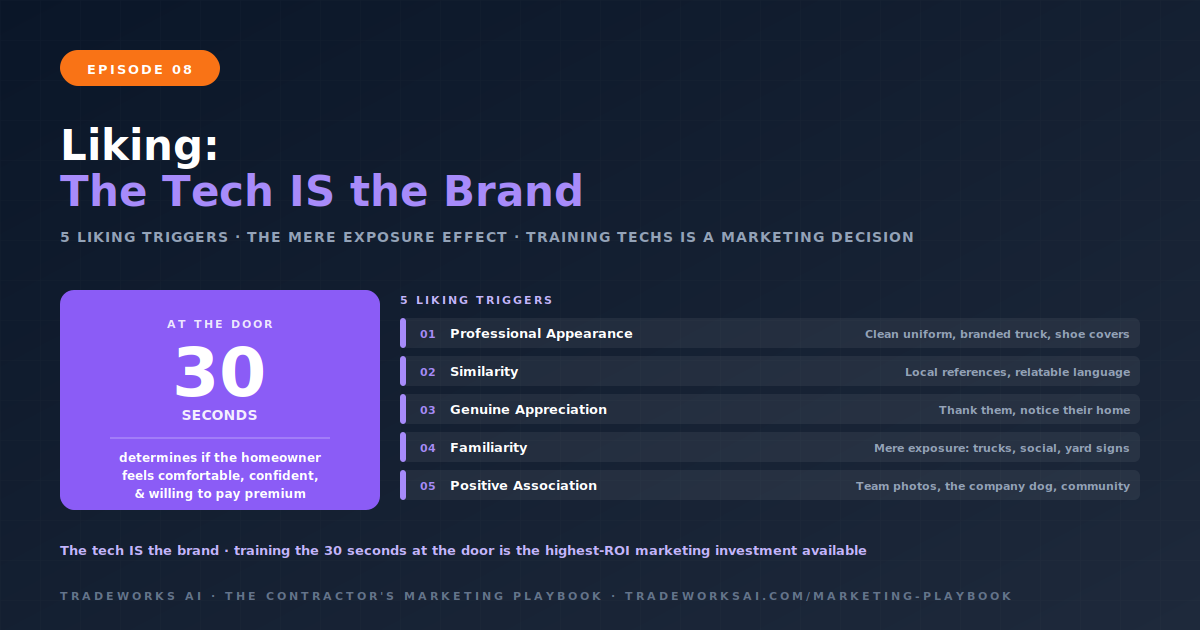
Continue the Marketing & Psychology series with Part 8 of 15.