Marketing & Psychology · Part 4
Social Proof for Contractors: Why Reviews Are Not a Tactic — They Are the Primary Decision Mechanism
Continue the Marketing & Psychology series with Part 4 of 15.
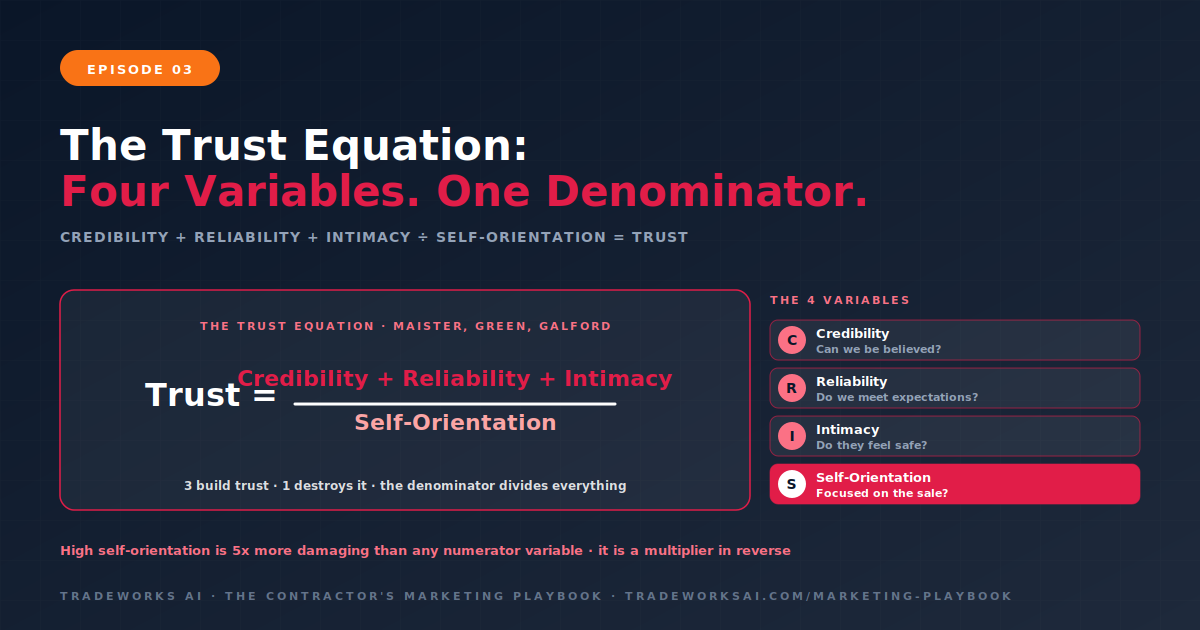
The Trust Equation, developed by David Maister, Charles Green, and Robert Galford, states: Trust = (Credibility + Reliability + Intimacy) / Self-Orientation. Three variables in the numerator build trust. One variable in the denominator destroys it. For contractors, Credibility means expertise and knowledge (certifications, technical explanations, educational content). Reliability means doing what you said you would do (showing up on time, calling when promised, completing on schedule). Intimacy means the homeowner feels safe and cared for (the tech who explains patiently, shows genuine concern, follows up after the job). Self-Orientation—the denominator—means the contractor appears focused on their own interests rather than the homeowner’s. The upselling tech, the pushy closer, the contractor who talks about themselves instead of the homeowner’s problem. High self-orientation divides everything in the numerator, destroying trust even when credibility, reliability, and intimacy are strong.
Trust = (Credibility + Reliability + Intimacy) / Self-Orientation. Four variables. Three build trust. One destroys it. The equation, published by Harvard professor David Maister and colleagues in The Trusted Advisor, has been validated across industries for over two decades. It works because it captures the actual mechanics of how human beings assess trustworthiness—not through conscious calculation, but through intuitive evaluation of these four dimensions simultaneously. For contractors, the equation is the diagnostic tool that explains every trust success and failure in the business.
Credibility is about words and expertise. Does the homeowner believe you know what you are talking about? For contractors, credibility is built through: technical knowledge demonstrated during the diagnosis (the tech who identifies the problem, explains it clearly, and names the parts), certifications and licensing displayed visibly (FL License #CAC123456, NATE Certified, EPA 608), years in business (Serving Tampa Since 2008), educational content that demonstrates expertise (YouTube videos, blog articles, social media posts that teach), and testimonials from other homeowners describing the contractor’s expertise. Credibility answers the System 2 question: are they qualified? It is the rational foundation of trust. But credibility alone is insufficient—a credible contractor who is unreliable or self-oriented will still lose trust.
Reliability is about actions and consistency. Does the contractor do what they said they would do? Reliability is built through: showing up at the time you promised (not within a 4-hour window—at the actual time), calling back when you said you would (a contractor who promises a callback in a few days and never calls has failed the reliability test before being hired), completing work on the timeline communicated, providing the estimate when promised, and following through on warranty commitments. Reliability is the most tangible trust variable because it is the easiest to evaluate—the homeowner simply compares what was promised to what was delivered. A series of small kept promises builds reliability faster than one large grand gesture. Reliability failures compound: every missed callback, late arrival, and broken commitment subtracts from the total.
Intimacy is about emotional connection and safety. Does the homeowner feel the contractor genuinely cares about them—not just the transaction? Intimacy is the most powerful numerator variable and the most neglected by contractors. It is built through: the tech who takes time to explain what is happening without jargon, who asks the homeowner how they are doing while the house is uncomfortably hot, who remembers the dog’s name on the follow-up visit, who notices a safety concern outside the scope of work and mentions it without turning it into an upsell. Intimacy makes the homeowner feel understood, not sold. Research on trust consistently shows that intimacy and low self-orientation are more impactful than credibility and reliability—yet most contractors invest almost exclusively in credibility and reliability while ignoring the emotional variables.
Self-Orientation is the denominator. It divides everything in the numerator. A contractor with high credibility (10), high reliability (10), and high intimacy (10) but high self-orientation (10) has a trust score of 3. The same contractor with low self-orientation (2) has a trust score of 15. Self-orientation is 5 times more impactful than any single numerator variable because it is a multiplier in reverse.
For contractors, high self-orientation looks like: the tech who recommends a full system replacement when a $200 repair would solve the problem, the sales closer who applies pressure tactics (this price is only good today), the contractor who talks about their own credentials and awards instead of the homeowner’s problem, the estimator who leads with price instead of diagnosis, and the follow-up call that is about selling a maintenance plan rather than checking whether the homeowner is satisfied. Every one of these behaviors signals to the homeowner’s brain: this person is focused on their own interests, not mine. The moment that signal registers, the numerator collapses—no amount of credibility, reliability, or intimacy can overcome the perception of self-interest.
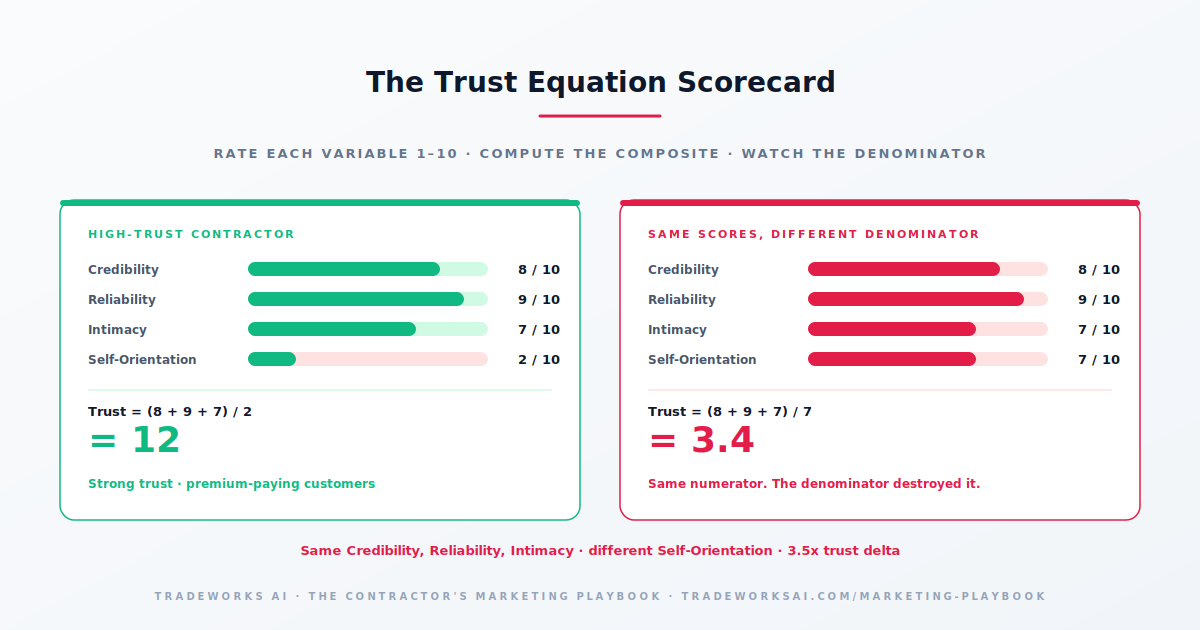
The Scorecard rates your business on each variable (1 to 10) and produces a composite Trust Score.
Trust Score = (C + R + I) / S. A contractor scoring 8, 9, 7 with self-orientation of 2: (24) / 2 = 12. A contractor scoring 8, 9, 7 with self-orientation of 7: (24) / 7 = 3.4. Same numerator. Different denominator. Dramatically different trust. The Scorecard becomes the series benchmark—referenced in every subsequent episode as principles from Phase 2 are applied to improve each variable.
Trust = (Credibility + Reliability + Intimacy) / Self-Orientation. Three variables build trust: expertise (credibility), consistency (reliability), and genuine care (intimacy). One variable—self-orientation (focus on your own interests)—destroys trust even when the other three are strong.
Self-orientation is the degree to which the contractor appears focused on their own interests rather than the homeowner’s. It is the denominator—it divides everything else. High self-orientation behaviors include unnecessary upselling, pressure tactics, leading with price instead of diagnosis, and prioritizing the sale over the homeowner’s actual need.
Intimacy means the homeowner feels safe and genuinely cared for. Build it through: explaining work without jargon, asking how the homeowner is doing during uncomfortable situations, remembering details on follow-up visits, noticing concerns beyond scope without turning them into upsells, and following up after the job to check satisfaction rather than sell.
Because self-orientation is not additive—it is divisive. It does not simply subtract from trust. It divides everything. A contractor with perfect credibility, reliability, and intimacy (score of 30) but high self-orientation (10) has a trust score of only 3. The same contractor with low self-orientation (2) scores 15. The denominator is the most powerful variable.
Tactics change every quarter. Psychology has not changed in 50,000 years. The Influence Audit grades your marketing across the 7 principles — Reciprocity, Commitment, Liking, Social Proof, Authority, Scarcity, and Unity — and identifies the one principle that, when activated, lifts every other channel you run.
Continue the Marketing & Psychology series with Part 4 of 15.

Continue the Marketing & Psychology series with Part 5 of 15.