Authority for contractors means the homeowner perceives you as an expert, not just a service provider. The expert commands a premium because people defer to credible expertise—92% of consumers trust recommendations from perceived authorities over other forms of advertising. Authority is not claimed by saying you are the best. It is signaled through behavior: the tech who diagnoses the problem, explains it in plain language, names the failing component, and recommends a course of action is perceived as an expert. The tech who walks in, checks the unit, and quotes a price is perceived as a vendor. The expert commands $229. The vendor competes at $89. The Authority Ladder has 5 levels: credentials (the baseline), diagnosis (in-home expertise), education (content that teaches), media (third-party recognition), and thought leadership (the contractor the industry and community look to).
The Expert and the Vendor
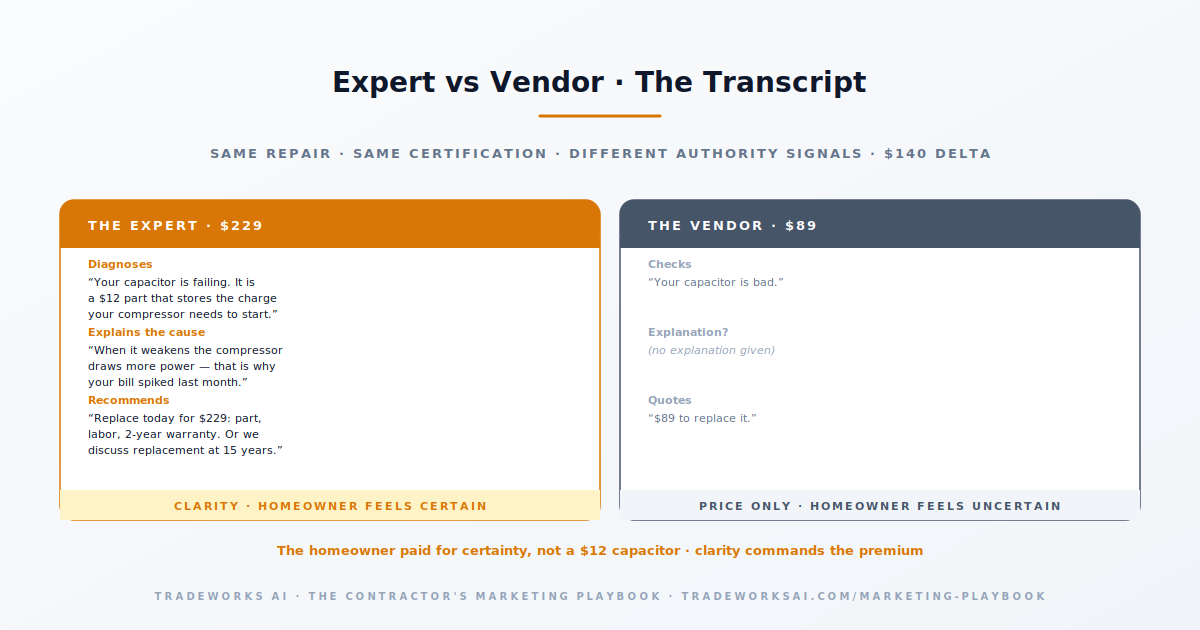
Two HVAC techs. Same certification. Same years of experience. Same ability to fix the AC. Tech A walks in, introduces himself, puts on shoe covers, opens the electrical panel, and says: your capacitor is failing. It is a $12 part that stores the electrical charge your compressor needs to start. When it weakens, the compressor works harder and draws more power—that is why your energy bill spiked last month. I can replace it today for $229, which includes the part, labor, and a 2-year warranty on the repair. Or, if the system is original to the house and you are planning to be here more than 3 years, I would recommend we discuss replacement options because at 15 years, you are approaching the end of the unit’s effective lifespan. Tech B walks in, checks the unit, and says: your capacitor is bad. $89 to replace it.
Both are competent. Both will fix the problem. The homeowner chooses Tech A at $229 and feels good about it. Why? Because Tech A demonstrated authority. He diagnosed, explained, educated, and recommended. The homeowner did not pay $229 for a $12 capacitor. They paid $229 for the certainty that comes from an expert’s guidance. Tech B provided a price. Tech A provided clarity. Clarity commands a premium.
Authority Is Signaled, Not Claimed
Most contractors try to claim authority: We are the best in Tampa. We have the highest quality. We are the most experienced. These claims are invisible to the homeowner’s brain because every competitor makes them. Authority is not what you say about yourself. It is what the homeowner concludes about you based on signals. The uniform, the shoe covers, the diagnosis, the explanation, the educational content on your website, the YouTube video explaining how a heat pump works, the blog article about whether to repair or replace a 15-year-old system—these are authority signals. They do not claim expertise. They demonstrate it.
The Authority Ladder: 5 Levels
Most contractors operate at Level 1 (credentials only). The contractors who command premium prices operate at Levels 2 and 3 consistently. Levels 4 and 5 create market dominance that makes price competition irrelevant.
Content Marketing Is the Most Scalable Authority Strategy
Level 2 (Diagnosis) happens one home at a time. The tech demonstrates expertise to one homeowner during one service call. It is powerful but limited by the number of service calls per day. Level 3 (Education) scales infinitely. A YouTube video explaining how a heat pump works reaches thousands of homeowners who have never met you. A blog article answering whether to repair or replace a 15-year-old AC ranks on Google and generates leads from homeowners who already perceive you as the expert before they call. Content marketing is not about creating content for the sake of it. It is about demonstrating the same expertise the Level 2 tech shows in the homeowner’s living room—but to an audience of thousands, permanently, for free.
The contractor who teaches becomes the authority. The YouTube video that explains the difference between SEER ratings, the blog post that walks through the insurance claims process for storm-damaged roofs, the TikTok that shows how to identify a failing water heater—these are not marketing expenses. They are authority investments that pay dividends every time a homeowner discovers them. In 2026, this content does double duty: it ranks in traditional search AND gets cited by AI search engines. Only 1.2% of local businesses get recommended by AI search. The businesses that do have documented, demonstrable expertise.
Authority in the Trust Equation
In Episode 3’s Trust Equation (Trust = [C + R + I] / S), authority primarily builds Credibility—the numerator variable that answers can we be believed? But authority also influences Intimacy when the expert takes time to educate (the homeowner feels understood and cared for), and reduces perceived Self-Orientation because the expert who teaches is perceived as generous rather than self-serving. An authority-first approach elevates three of the four Trust Equation variables simultaneously.
The Authority-Price Connection
Authority directly determines pricing power. Research shows perceived authority increases willingness to pay by up to 15% for identical products and services. In professional services, authority signals like credentials and demonstrated expertise allow 25 to 40% higher fees. For contractors, the connection is even more direct: the homeowner literally cannot evaluate the quality of the work until after it is done. They use authority signals as a proxy for quality. The expert who explains is perceived as higher quality than the vendor who only quotes—even when the actual repair is identical. This means investing in authority signals (diagnosis training, educational content, professional presentation) has a direct and measurable impact on average ticket price.
Through 5 levels: credentials (certifications, licensing), diagnosis (demonstrating expertise during service calls), education (blog articles, YouTube videos, social content that teaches), media (local news features, industry recognition), and thought leadership (workshops, speaking, becoming the default market expert). Most contractors stay at Level 1. Levels 2 and 3 command premiums.
Why does the expert charge more than the vendor?
The homeowner pays for certainty, not parts. The expert who diagnoses, explains, and recommends provides clarity about the problem and the solution. The vendor who quotes a price provides only a number. Clarity commands a premium because it resolves the homeowner’s uncertainty—the fundamental psychological state driving the entire hiring decision.
Is content marketing really authority building?
Yes. Content marketing is Level 3 of the Authority Ladder—scalable expertise. A YouTube video or blog article demonstrates the same knowledge the tech shows in the homeowner’s living room, but to thousands of homeowners permanently. The contractor who teaches becomes the perceived expert before the service call happens. In 2026, educational content also drives AI search citations.
How does authority connect to pricing?
Research shows authority signals increase willingness to pay by 15 to 40%. For contractors, authority is the primary proxy for quality because homeowners cannot evaluate the work before it is done. Stronger authority signals = higher perceived quality = higher acceptable price = larger average ticket.
Free Audit
Is Your Marketing Built on Tactics — or on Psychology?
Tactics change every quarter. Psychology has not changed in 50,000 years. The Influence Audit grades your marketing across the 7 principles — Reciprocity, Commitment, Liking, Social Proof, Authority, Scarcity, and Unity — and identifies the one principle that, when activated, lifts every other channel you run.