Business Operations · Part 1
How to Scale a Contractor Business: The 5-Stage Guide
Continue the Business Operations series with Part 1 of 12.

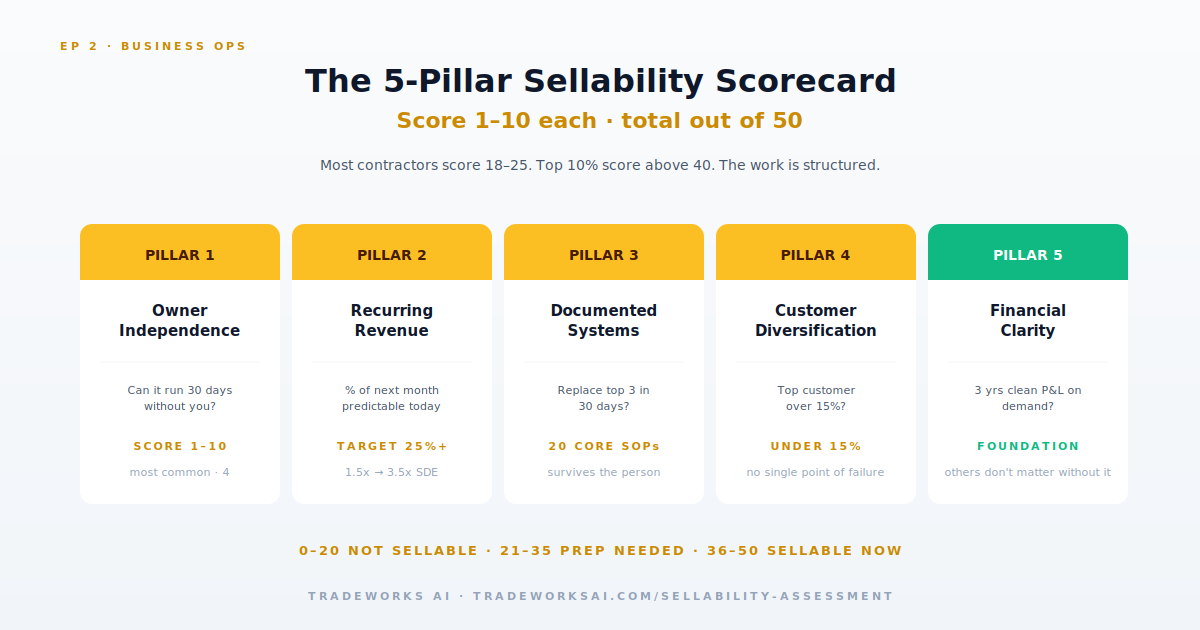
A contractor business is sellable when it scores 36 or higher out of 50 across five pillars: Owner Independence, Recurring Revenue, Documented Systems, Customer Diversification, and Financial Clarity. Score yourself 1–10 on each pillar — the total tells you where you stand. A score of 0–20 means the business is not sellable today. 21–35 means sellable with 12–18 months of preparation. 36–50 means sellable now. Most contractors score 18–25. The top 10% score above 40. And the dollar impact is dramatic: a $2 million revenue contractor business with a sellability score of 18 typically sells for around $600,000. The same $2 million business with a score of 42 sells for around $1.4 million. Same revenue. Same trade. $800,000 difference in life-changing money.
Score your business against the 5 pillars in 5 minutes → tradeworksai.com/sellability-assessment
The International Business Brokers Association (IBBA) tracks small business listings across the US and Canada. The data they publish quarterly tells a brutal story: only about 20% of small businesses that go to market actually sell. The other 80% sit on the market for 12 to 18 months, then get pulled when the owner gets tired of waiting.
In the contractor industry specifically, the rate is similar. Most contractors who list their business with a broker assume the business will sell because they’ve heard about a competitor selling for two times earnings. What they don’t hear about are the four other competitors who couldn’t find a buyer at any price.
The reason isn’t the market. Demand for contractor businesses has never been stronger — private equity has poured into HVAC, plumbing, and electrical roll-ups since 2020. The reason is the business itself. Most contractor businesses aren’t built to be sold. They’re built around the owner, and when the owner leaves, the value walks out the door.
The 5-Pillar Scorecard is the diagnostic that tells you whether your business has been built around you — or built to outlive you.
Every buyer who underwrites a contractor business acquisition runs through a version of this checklist. Whether it’s an individual buyer with SBA financing, a strategic acquirer rolling up multiple operations, or a private equity firm building a regional platform — they’re all looking for the same five things.
Score yourself honestly on each pillar from 1 to 10. The total of all five scores is your sellability number out of 50.
The single most important question a buyer asks: can the business run for 30 days without you?
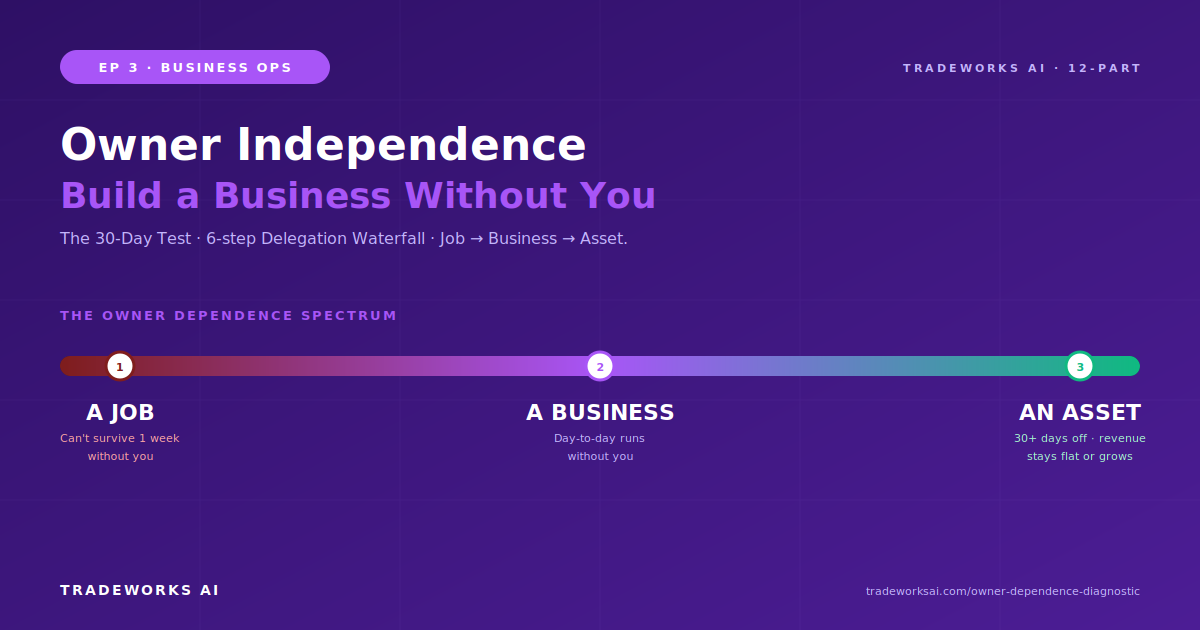
If the answer is no — if the phones go silent without you, if the techs don’t know what to do without your daily direction, if customers ask for you specifically — you don’t own a business. You own a job. And jobs aren’t sellable.
Score yourself:
1–3: The business cannot survive a week without you. You make every operational decision.
4–7: The business runs day-to-day without you, but strategic decisions, pricing, and major issues all come back to you.
8–10: A trained operations manager runs the business. You can disappear for 30+ days and revenue stays flat or grows.
The most common score in the contractor industry is 4. The score that makes a business sellable starts at 7.
What percentage of next month’s revenue is predictable today? Project work doesn’t count — a job booked for next month is not recurring revenue, it’s a backlog. Recurring revenue means contracts, maintenance plans, subscription-style services that auto-renew.
Why this matters more than any other pillar: project-based contractor businesses trade at roughly 1.5 times Seller’s Discretionary Earnings (SDE). Recurring-revenue-heavy contractor businesses trade at 3.0 to 3.5 times SDE. Same dollar of profit, double the valuation. The lever is recurring revenue.
Score yourself:
1–3: 0–10% of revenue is recurring. You start every month at zero.
4–7: 11–25% recurring. You have a maintenance plan program but it’s underdeveloped.
8–10: 26%+ recurring. Maintenance plans are the foundation; project work is the upside.
If your top three employees quit tomorrow morning, could you replace them in 30 days without revenue dropping?
Buyers ask this question because they’re not buying your knowledge — they’re buying your operation. If your operation lives in your head and a few key employees’ heads, the buyer is acquiring tribal knowledge that walks out the door at the first opportunity. That’s not an operation. That’s a hostage situation.
Score yourself:
1–3: Tribal knowledge runs the operation. No documented SOPs, no training materials, no playbook.
4–7: Some SOPs exist for the most common processes (intake, dispatch, payroll). Critical knowledge still in heads.
8–10: Comprehensive SOP library. New hires onboard from documentation. Senior employees can be replaced in 30 days.
Want to see exactly which pillar is dragging your score down? The free Sellability Assessment names your weakest pillar and gives you the 90-day fix → tradeworksai.com/sellability-assessment
Does any single customer represent more than 15% of your revenue? If yes, your business is worth less.
This is one of the most counterintuitive findings for contractor business owners. From inside the business, a big steady customer feels like stability. From a buyer’s perspective, that customer is a single point of failure. Buyers underwrite to the day that customer leaves — because in their experience, big customers leave when ownership changes hands. The longer the relationship, the more it’s tied to the existing owner, and the higher the perceived risk in the buyer’s due diligence model.
Score yourself:
1–3: Top customer is more than 25% of revenue. Severe concentration risk.
4–7: Top customer is 16–24%. Moderate concentration risk.
8–10: Top customer is under 15%. Diversified customer base. No single point of failure.
If you have a concentration problem, the fix is to actively grow the rest of the book — not to fire the big customer. Diversify upward, not downward.
Can you produce three years of clean profit-and-loss statements on demand? Are your books reviewed monthly by an actual bookkeeper or accountant? Do you know your gross margin by job type?
This is where the most deals die. A buyer signs a Letter of Intent at one valuation, then due diligence reveals that the books don’t reconcile, that personal expenses are mixed in with business expenses, that the gross margin numbers don’t match the bank deposits. The deal gets repriced down 20–40% — or it dies entirely.
Score yourself:
1–3: Cash-basis books, mixed personal/business, no monthly reconciliation. Tax-driven accounting only.
4–7: Monthly bookkeeper reviews. Some categorization, but not audit-ready.
8–10: Audit-ready or review-ready books. Three years of clean P&Ls. Gross margin tracked by job type.
Without this pillar, the other four don’t matter. A buyer can’t value what they can’t verify.
The 5 pillars don’t just affect whether the business sells — they affect what it sells for. The mechanism is the multiple.
When a contractor business sells, the price is typically calculated as Seller’s Discretionary Earnings (SDE) multiplied by a number called “the multiple.” SDE is the cash flow available to a single owner-operator after normalized operating expenses. The multiple varies based on perceived risk, growth, and quality of the business — and that’s where the 5 pillars come in.
Consider two contractor businesses, identical on the surface:
Same revenue. Same profit. Same trade. $800,000 difference in life-changing money. The difference is the score.
Business A is owner-dependent, has minimal recurring revenue, undocumented operations, customer concentration, and messy books. A buyer looks at it and sees risk — so the multiple drops. Business B has independence, recurring revenue, documented systems, diversified customers, and clean books. A buyer looks at it and sees an asset — so the multiple expands.
The five pillars compound. Improving any one of them increases the multiple. Improving four or five of them is the difference between selling for life-changing money and selling for what amounts to a salary buyout.
If you scored 0–20, the honest answer is that you don’t have a sellable business yet. You have a profitable job that can’t be transferred. The good news: this is the most common starting point. Most contractors who eventually sell start here. The work to move up is structured and predictable. Twelve to eighteen months of intentional building moves most businesses from 18 into the high 20s or low 30s.
A score in this range means the business will sell, but at a reduced multiple, with potentially long days on market, and likely with seller financing or earn-out structures. The fix is to identify the two weakest pillars and build them up over 12–18 months. Recurring Revenue and Documented Systems are usually the highest-leverage pillars to focus on, because both directly compound the multiple.
If you scored 36 or higher, the business is sellable today at a market multiple, with likely buyer interest, and with reasonable terms. Most contractor businesses in this range receive unsolicited acquisition interest at least once per year. If your score is in this range and you’re not getting unsolicited offers, the issue is visibility — not value. Get the business in front of qualified buyers, brokers, or strategic acquirers in your market.
Get your exact pillar-by-pillar score plus a personalized 90-day plan to improve your weakest pillar → tradeworksai.com/sellability-assessment
Three concrete actions move the needle. None require hiring anyone, paying for anything, or making major changes — they require an hour of focused work.
Block 30 minutes. Pull up the 5 pillars. Score 1–10 on each. Add them up. Resist the temptation to score yourself based on where you want to be — score where you actually are. The honest number is the only useful number.
Which pillar pulls your total score down the most? That’s your starting point. Don’t try to fix all five at once — that’s the most common mistake and it produces no real movement on any of them. Pick the lowest pillar and commit to a 90-day improvement plan.
For the weakest pillar, name the specific action that moves the score from your current number to the next band. If owner independence is the gap, the action might be “hire a part-time office helper to take over dispatch.” If recurring revenue is the gap, the action might be “launch a maintenance plan and convert 50 existing customers in 90 days.” Specificity is the marker of progress.
Five sellability-specific KPIs join the broader Contractor KPI Dashboard introduced in Part 4:
Owner Hours Per Week — the proxy for Pillar 1 (Owner Independence). Target: under 35 hours by Stage 4.
Recurring Revenue Percentage — monthly recurring revenue divided by total monthly revenue. Target: 25%+.
SOP Coverage Percentage — documented processes divided by core operational processes. Target: 80%+.
Top Customer Concentration — largest customer’s revenue divided by total revenue. Target: under 15%.
Months of Clean Financials — consecutive months of bookkeeper-reviewed P&Ls. Target: 36+ months for sale-readiness.
Most contractor businesses move from a sellability score in the high teens to a score above 36 over 12 to 18 months of focused work. The variable isn’t how hard you work — it’s how systematically you address the weakest pillars. Owners who try to fix all five pillars at once usually take 24+ months. Owners who fix one pillar at a time in 90-day sprints typically reach sellable territory in 12–18 months.
Multiples vary by trade and quality. As of 2026, the typical ranges for contractor businesses on Seller’s Discretionary Earnings (SDE) are: HVAC 1.5x–3.5x, plumbing 1.5x–3.5x, electrical 2.0x–4.0x, roofing 1.0x–3.0x, painting 1.0x–2.5x. Larger contractor businesses (over $5M revenue) trade on EBITDA multiples instead of SDE multiples, typically 4x–8x EBITDA. The 5-pillar score is the single biggest determinant of where in the range the multiple lands.
If your score is in the 36–50 range, selling now likely captures market value. If your score is in the 21–35 range, waiting 12–18 months to improve the weakest pillars typically increases the sale price by 40–100%. If your score is below 20, selling now generally produces a fire-sale outcome — the business is essentially being valued as a salary buyout for the next owner. The math almost always favors waiting and building.
Seller’s Discretionary Earnings (SDE) is used for businesses that will be operated by a single owner-operator after sale. SDE adds back the owner’s salary, owner’s benefits, and one-time non-recurring expenses to net income. EBITDA (Earnings Before Interest, Taxes, Depreciation, and Amortization) is used for businesses that will be operated by professional management. EBITDA does NOT add back owner’s salary because the next owner will pay a manager. Most contractor businesses under $3M revenue sell on SDE multiples; most contractor businesses over $5M revenue sell on EBITDA multiples.
Yes — but at a discount, with strict terms, and likely with significant seller involvement post-close. Owner-dependent businesses typically sell with structured earn-outs (a portion of the price paid only if revenue holds for 1–3 years), seller financing (you finance the buyer’s purchase), and consulting agreements (you stay involved for 6–12 months). The total cash at close is usually 40–60% of the headline price. Buyers have to pay this way because the risk of revenue collapse without the seller is real and quantifiable.
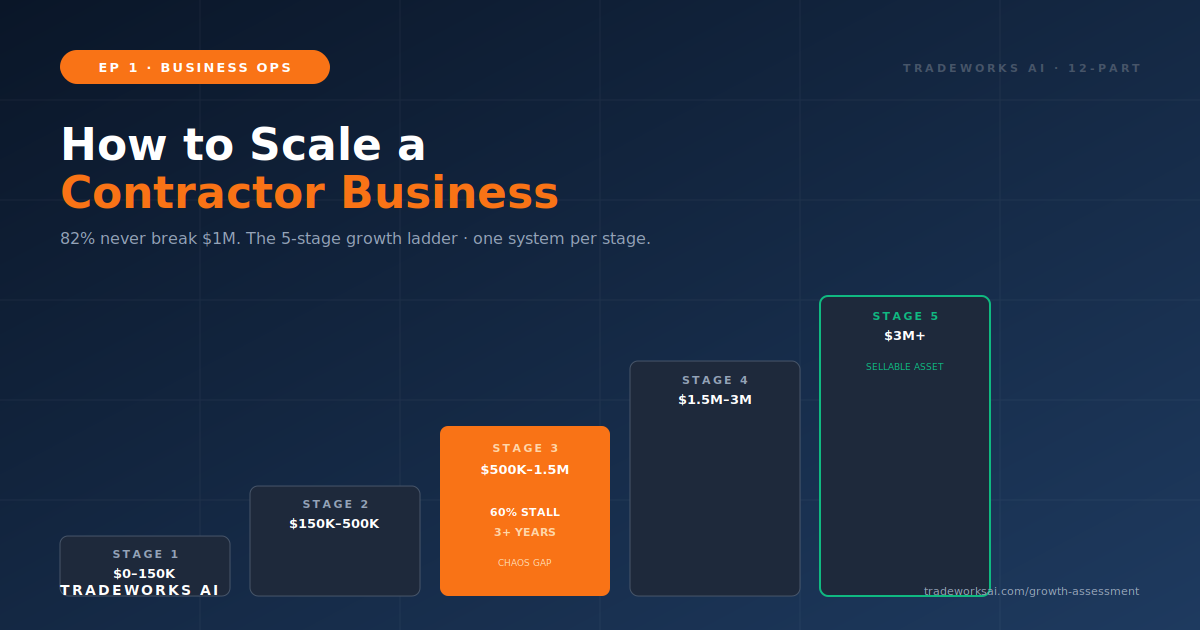
82% of contractor businesses never break $1M, and most don't know which operational system is missing. Our free audit grades your business against the 5 stages, names the chaos gap blocking you, and identifies the highest-leverage system to build next.
Continue the Business Operations series with Part 1 of 12.
Continue the Business Operations series with Part 3 of 12.