Business Operations · Part 11
Marketing ROI: Stop Wasting 60% of Your Budget
Continue the Business Operations series with Part 11 of 12.
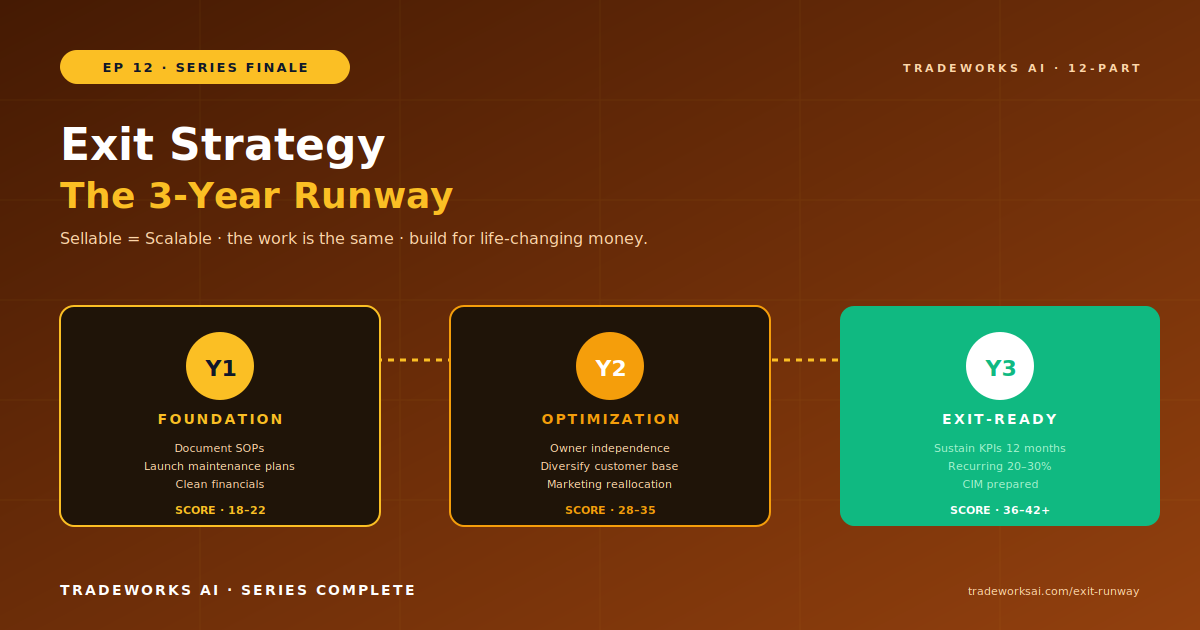
A contractor exit strategy is a structured 3-year plan that transforms a contractor business from owner-dependent and project-based into a sellable asset. The plan has three phases: Year 1 (Foundation) builds documented systems, launches recurring revenue, and establishes financial clarity. Year 2 (Optimization) achieves owner independence, diversifies the customer base, and optimizes marketing ROI. Year 3 (Exit-Ready) sustains performance, positions the business for sale, and prepares for due diligence. The framework applies whether you plan to sell, merge, pass the business to family, or simply build a business that runs without you.
The most important principle in exit planning is also the least intuitive: the work you do to make the business sellable is the same work you do to make the business scalable. They’re the same project. This is why exit strategy isn’t just for contractors planning to sell — it’s for every contractor who wants to build something bigger than a job.
Most contractors resist exit planning because they think it means preparing to leave. It doesn’t. The 5 Sellability Pillars from Part 2 — Owner Independence, Recurring Revenue, Documented Systems, Financial Clarity, and Customer Diversification — are also the 5 growth pillars. Every pillar that makes the business attractive to a buyer also makes the business easier to run, more profitable to operate, and more resilient to market shifts.
Documented systems (Part 8) make the business sellable AND enable delegation. Recurring revenue (Part 7) increases the valuation multiple AND stabilizes cash flow. Owner independence (Part 3) attracts buyers AND gives the owner their life back. Financial clarity (Part 4) satisfies due diligence AND enables better decisions. Customer diversification (Part 10) reduces buyer risk AND protects against revenue shocks.
The exit strategy IS the growth strategy. Building for exit makes the business better even if you never sell.
CTA #1: Download the free 3-Year Exit Runway Planner — month-by-month milestones, the Exit Readiness Checklist, and a due diligence preparation guide → tradeworksai.com/exit-runway
Before building the runway, understand the four ways a contractor business can change hands. Each has a different valuation range, timeline, and preparation requirement — but all four require the same foundational work.
[H3] 1. Strategic Sale (2.0–3.5x SDE)
A larger contractor or adjacent business acquires you for your customer base, territory, or capabilities. This is the most common exit for $1M–$5M contractors. The buyer wants systems, contracts, and a team that operates without the owner. Timeline: 6–12 months from listing to close. Preparation: 24–36 months of clean operations.
[H3] 2. Private Equity Roll-Up (3.0–4.5x SDE)
A PE firm acquires multiple contractor businesses in the same trade to build a regional platform. PE buyers pay the highest multiples but require the most operational maturity. They want recurring revenue above 20%, documented SOPs, and a management team that can run without the founder. Timeline: 3–6 months (PE moves fast once interested). Preparation: 36+ months.
[H3] 3. Management Buyout (1.5–2.5x SDE)
Your existing team — typically a general manager or operations lead — buys the business over time, usually through seller financing. Lower multiple but lower risk, faster close, and smoother transition. The buyer already knows the business. Timeline: 12–24 months structured payout. Preparation: 18–24 months of leadership development.
[H3] 4. Family Transition (Gradual Equity Transfer)
Ownership transfers to a family member over years, often through a combination of gifting, salary adjustments, and structured buy-in. Requires the same operational maturity as any other exit — family businesses fail when systems exist only in the founder’s head. Timeline: 3–7 years. Preparation: concurrent with operation.
All four types require the same preparation: the 3-Year Runway.
The runway is structured in three phases. Each phase builds on the previous one. Skipping phases doesn’t accelerate the timeline — it creates gaps that buyers discover during due diligence.
[H3] Year 1: Foundation (Months 1–12)
Year 1 is about building the infrastructure. The business becomes measurable, documented, and financially transparent.
Implement the 15-Metric KPI Dashboard (Part 4) and begin tracking monthly.
Document the first 20 SOPs using the 4-Step Framework (Part 8): customer-facing, field operations, office operations, and financial processes.
Launch a Maintenance Plan using the Blueprint from Part 7. Target: 50–100 agreements by month 12.
Restructure pricing using the Pricing Stack (Part 5): cost-plus floor, market-rate benchmark, value-based ceiling.
Make the first hire or restructure existing roles using the Decision Matrix (Part 6).
Establish clean bookkeeping with monthly P&L, balance sheet, and the 90-Day Cash Flow Forecast (Part 9).
Sellability Scorecard target: 18–22 out of 50.
[H3] Year 2: Optimization (Months 13–24)
Year 2 is about removing the owner from daily operations and making the business resilient.
Achieve owner independence using the Delegation Waterfall and 30-Day Test (Part 3). Target: 30 consecutive days away without revenue decline.
Diversify the customer base using the 15% Rule (Part 10): no single customer exceeds 15% of revenue.
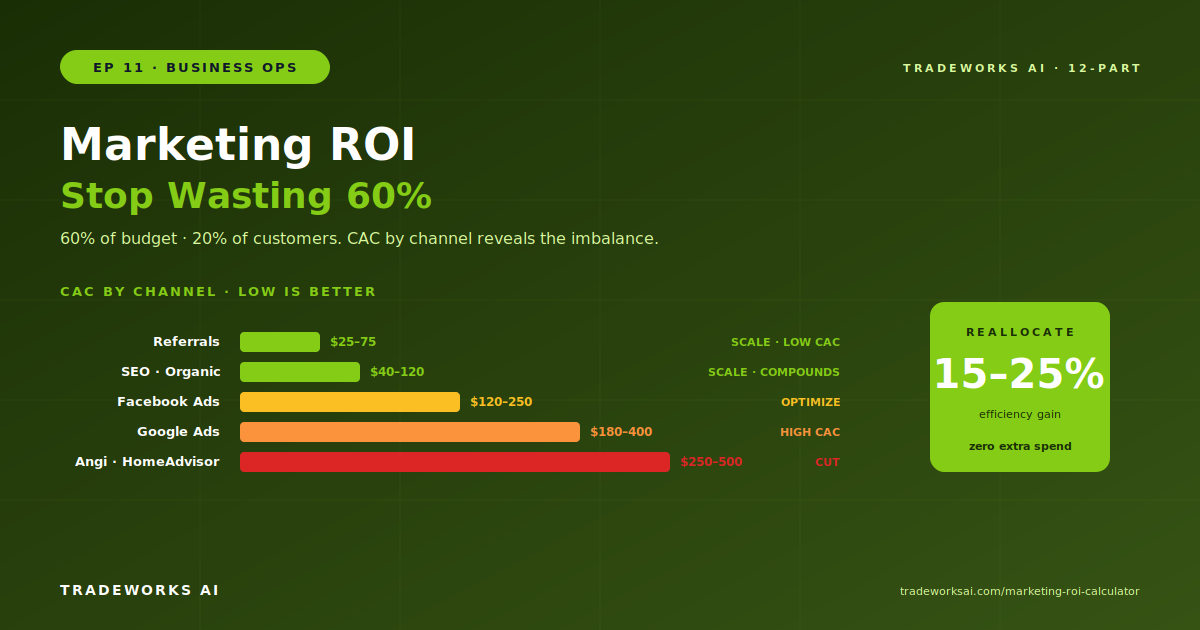
Optimize marketing spend using the CAC by Channel analysis (Part 11). Reallocate to highest-ROI channels.
Grow maintenance agreements to 150–250. Recurring revenue target: 15–25% of total.
Build a management layer: at least one person who can run daily operations without the owner.
12 consecutive months of clean financial records.
Sellability Scorecard target: 28–35 out of 50.
[H3] Year 3: Exit-Ready (Months 25–36)
Year 3 is about sustaining performance and positioning for maximum value.
Maintain all KPIs at target levels for 12 consecutive months. Consistency matters more than peaks.
24+ months of clean, GAAP-compliant financial records (buyers want 24–36 months).
Recurring revenue at 20–30% of total. Maintenance plan renewals above 80%.
Owner working fewer than 20 hours/week on operations. Management team handling day-to-day.
Customer concentration below 15% for any single account.
All 20 core SOPs current, tested, and used by staff without owner involvement.
Prepare the Confidential Information Memorandum (CIM) for potential buyers.
Sellability Scorecard target: 36–42+ out of 50.
CTA #2: The 3-Year Exit Runway Planner breaks each phase into monthly milestones with specific deliverables and KPI targets. Download free → tradeworksai.com/exit-runway
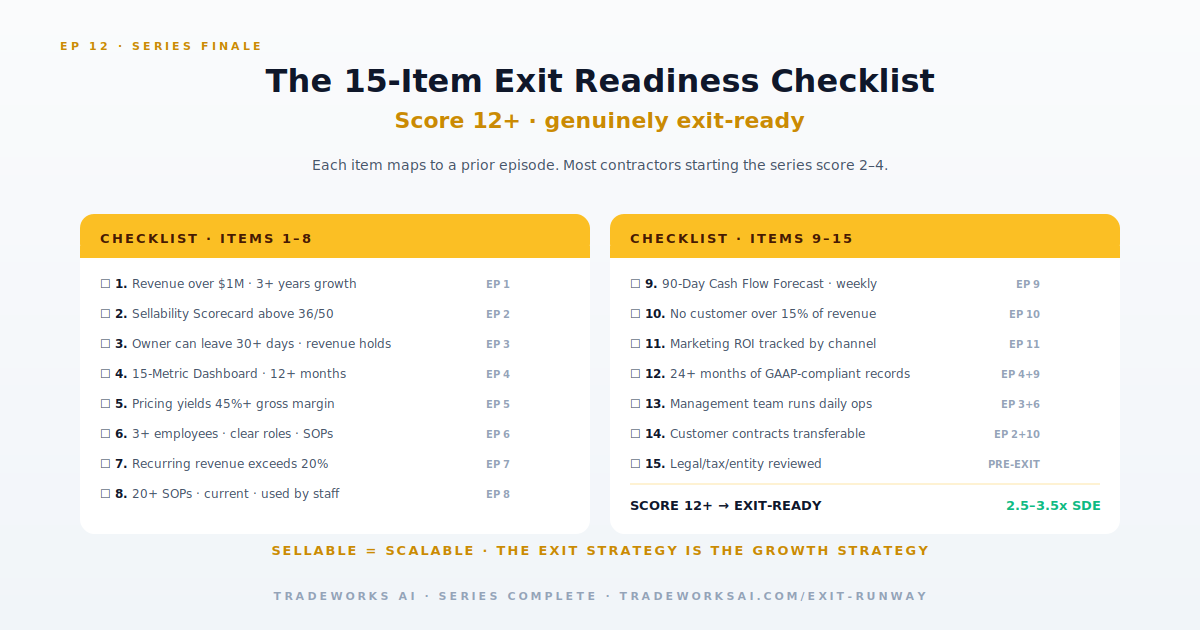
This checklist maps to every part in the Operations Playbook. A contractor scoring 12+ out of 15 is genuinely exit-ready. Most contractors starting the series score 2–4.
Due diligence is where most contractor sales collapse. The buyer’s team will examine every financial record, contract, employee agreement, customer list, and operational process. Contractors who built the runway survive it. Contractors who didn’t prepared get exposed.
Financial due diligence: 24–36 months of P&L, balance sheet, tax returns, AR/AP aging, revenue by customer. The KPI Dashboard (Part 4) and Cash Flow Forecast (Part 9) produce most of this automatically.
Operational due diligence: SOP documentation (Part 8), org chart, employee agreements, insurance certificates, license/certification records.
Customer due diligence: Revenue concentration analysis (Part 10), maintenance agreement terms and renewal rates (Part 7), customer acquisition cost by channel (Part 11).
Legal due diligence: Entity structure, pending litigation, contract assignability, non-compete agreements, intellectual property.
The contractors who have run the 3-Year Runway produce due diligence packages in days, not months. The systems already exist. The data is already clean. The documentation is already current.
Now. Regardless of whether you plan to sell in 3 years or 30 years. The Sellable = Scalable principle means every month of runway preparation makes the business better to run, not just better to sell.
A contractor who starts the runway at age 45 and sells at 55 has 7 years of a better-running business before the exit. A contractor who starts at 55 and tries to sell at 58 has a frantic scramble that produces a lower multiple. Owner Independence and Recurring Revenue can be accelerated with focused 90-day sprints, but Financial Clarity and Customer Diversification require time to demonstrate consistency.
CTA #3: The 3-Year Exit Runway Planner includes month-by-month milestones, the Exit Readiness Checklist, and a due diligence preparation guide → tradeworksai.com/exit-runway
This article closes the 12-part Contractor’s Operations Playbook. The series arc:
Together, these 12 parts form the operating system that separates $500K contractor businesses from $5M contractor businesses. The work is structured, predictable, and cumulative. Every part builds on the ones before it. The contractor who implements even half of these frameworks over 36 months will have a fundamentally different business — and a fundamentally different life — than the one who doesn’t.
No. The Sellable = Scalable principle means the work you do to prepare for exit is the same work that makes the business better to run. Documented systems, recurring revenue, financial clarity, owner independence, and customer diversification all improve the business regardless of whether a sale ever happens. The exit strategy IS the growth strategy.
Valuation = SDE × Multiple. SDE (Seller’s Discretionary Earnings) is calculated from the P&L (Part 4 FAQ). The multiple is determined by the 5-Pillar Sellability Score (Part 2). Typical ranges: 1.0–1.5x SDE for score 0–20, 1.5–2.5x for 21–35, 2.5–3.5x for 36–50. On $400K SDE, that’s $400K–$1.4M depending on score.
For businesses under $2M revenue: a business broker is standard. Commission: 8–12% of sale price. For businesses over $3M: an M&A advisor may produce better results. For PE roll-ups: the PE firm typically approaches you or your broker. Interview 3+ brokers. Ask for recent closed transactions in the trades. Avoid brokers who list 100+ businesses — yours will get lost.
Prepared businesses: 6–12 months from listing to close. Unprepared businesses: 18–36 months, often pulled from market without selling. The difference is the 3-Year Runway. Businesses that score 36+ on the Sellability Scorecard close faster because they survive due diligence without surprises.
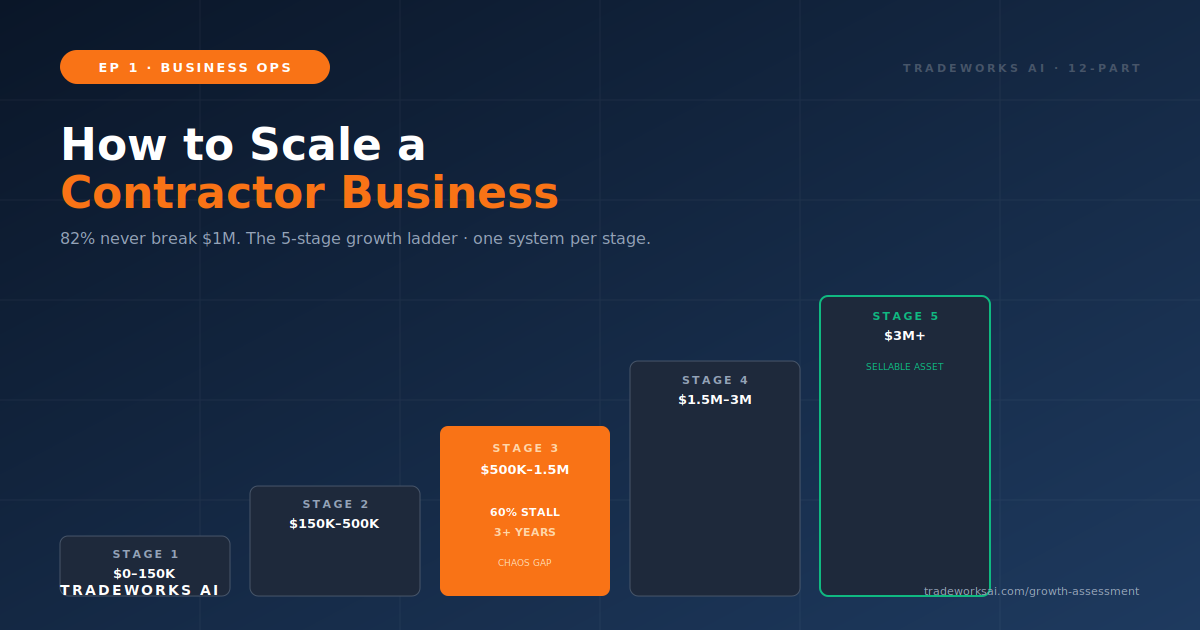
82% of contractor businesses never break $1M, and most don't know which operational system is missing. Our free audit grades your business against the 5 stages, names the chaos gap blocking you, and identifies the highest-leverage system to build next.
Continue the Business Operations series with Part 11 of 12.
Continue the Business Operations series with Part 1 of 12.