Business Operations · Part 9
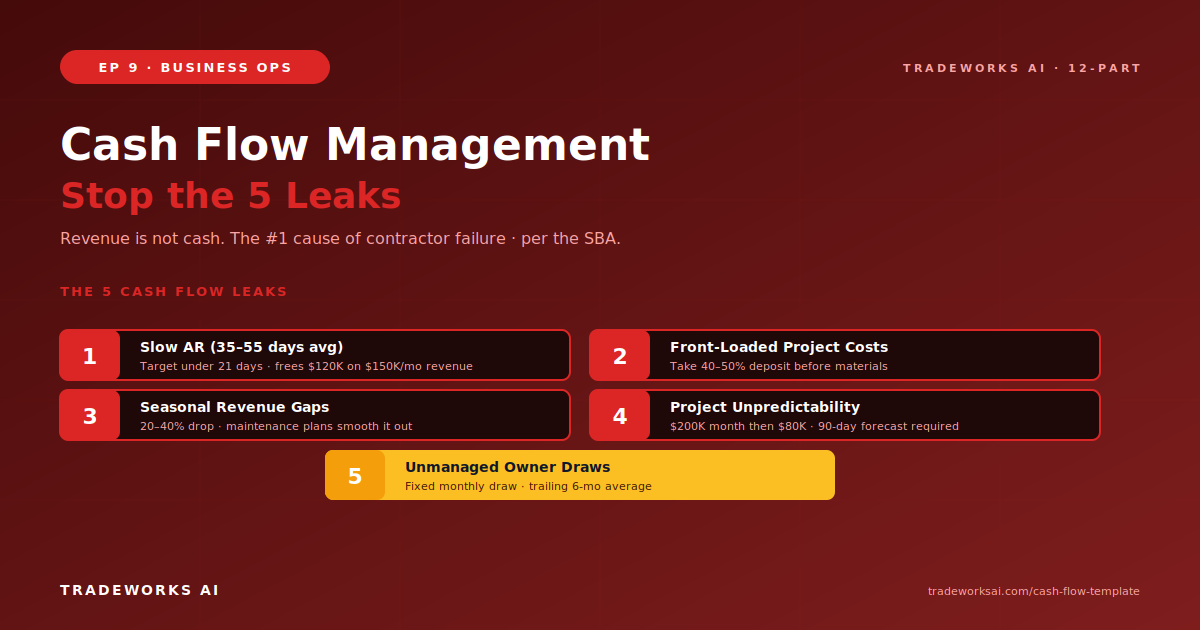
Cash Flow: Stop the 5 Leaks Killing Your Profit
Continue the Business Operations series with Part 9 of 12.
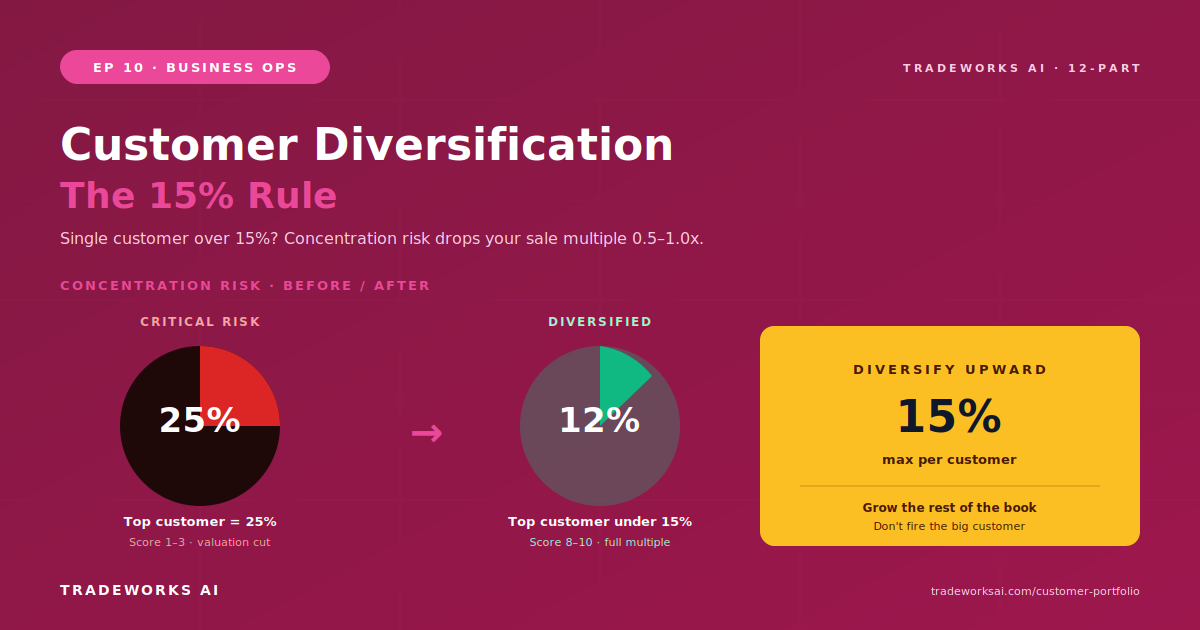
Customer diversification means no single customer represents more than 15% of total revenue. The diagnostic from Part 2’s Sellability Scorecard (Pillar 4): does any customer exceed 15%? If yes, the business carries concentration risk — a structural vulnerability that reduces sale value, increases cash flow volatility, and creates a single point of failure. From inside the business, a large steady customer feels like stability. From a buyer’s perspective, that customer is the biggest risk in the portfolio. Buyers underwrite to the day that customer leaves — because in their experience, large customers leave when ownership changes. The fix is not firing the big customer. It’s growing the rest of the book until no single customer exceeds 15%. This is called diversifying upward.
Download the free Customer Portfolio Analyzer — calculates concentration risk and identifies diversification targets → tradeworksai.com/customer-portfolio
Customer concentration is the most counterintuitive risk in contractor businesses. The contractor with a $400K commercial account feels secure — that’s reliable revenue, long-term relationship, steady work. But if that $400K represents 25% of total revenue, the business is structurally fragile.
Three ways concentration damages the business:
Sellability: a buyer applies a discount to the valuation because the concentrated customer represents transfer risk. If the customer leaves post-sale, 25% of revenue disappears. Buyers price that risk into the multiple — typically 0.5-1.0x SDE reduction.
Cash flow: if the concentrated customer pays late or reduces scope, cash flow takes a disproportionate hit. A 60-day payment delay on $400K annual = $66K in delayed cash. Part 9’s Cash Flow Gap widens dramatically.
Negotiating power: the concentrated customer knows they’re important. They negotiate harder, demand priority, and expect discounts. The contractor can’t say no because losing the customer is existential.
No single customer should represent more than 15% of total annual revenue. This is the threshold that buyers use in due diligence. The scoring from Part 2:
Top customer > 25% of revenue = Score 1-3 (severe concentration risk)
Top customer 16-24% = Score 4-7 (moderate concentration risk)
Top customer < 15% = Score 8-10 (diversified, low risk)
The 15% rule also applies to the top 3 customers combined. If your top 3 customers represent more than 40% of revenue, concentration risk exists even if no single customer exceeds 15%.
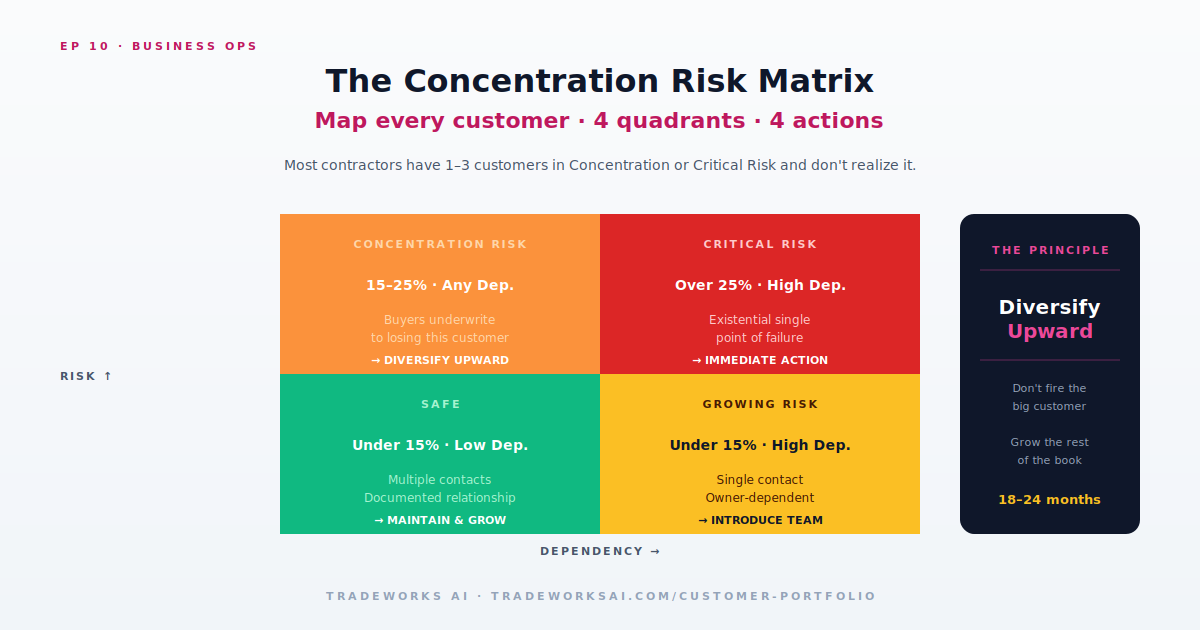
The matrix maps every customer by revenue contribution and relationship dependency.
Most contractors have 1-3 customers in the Concentration Risk or Critical Risk quadrant and don’t realize it because the revenue feels like stability.
The Portfolio Analyzer maps every customer into the matrix automatically → tradeworksai.com/customer-portfolio
The fix for concentration is NOT firing the big customer or reducing their scope. That’s diversifying downward — shrinking the business to fix a ratio. The fix is diversifying upward: growing the rest of the customer base until the big customer’s percentage naturally drops below 15%.
Example: a contractor with $1.6M total revenue and a $400K customer (25% concentration). To get below 15%, total revenue needs to reach $2.67M ($400K / 0.15). That’s $1.07M in growth needed — achievable over 18-24 months with the right strategy. The $400K customer stays. The rest of the book grows around them.
Strategy 1: Maintenance plan expansion (Part 7). 200 residential plan customers at $750/year total value = $150K in diversified recurring revenue. Each plan customer is < 0.05% of revenue — maximum diversification.
Strategy 2: New commercial accounts. Target 10-15 new commercial customers at $30K-$80K each. Each new account reduces concentration by spreading revenue across more relationships.
Strategy 3: Service area expansion. Enter an adjacent market (neighboring city/county) to access an entirely new customer pool. Requires marketing investment but produces structurally diversified revenue.
Pull customer revenue report from FSM tool for trailing 12 months.
Calculate each customer’s % of total revenue.
Map every customer into the Concentration Risk Matrix.
Identify customers in Concentration Risk and Critical Risk quadrants.
Set target: reduce top customer from X% to below 15% within 18-24 months.
Launch maintenance plan sprint (Part 7’s 100-Customer Sprint) targeting residential customers — maximum diversification per enrollment.
Identify 10 prospective commercial accounts through networking, GBP, and referrals.
Begin outbound to commercial prospects with case studies from existing commercial work.
For any customer in the Growing Risk quadrant (high dependency), introduce your team to the customer contact.
Transition primary relationship from owner to service manager or account manager.
Document the customer relationship in CRM: contact history, preferences, service history, renewal dates.
The relationship should survive the owner leaving. If it can’t, it’s a sellability blocker.
The Portfolio Analyzer runs the full analysis + maps the Diversification Sprint → tradeworksai.com/customer-portfolio
Top Customer Concentration (Metric 11) — largest customer revenue / total revenue. Target: under 15%.
Top 3 Customer Concentration — combined top 3 / total. Target: under 40%.
Customer Count Growth — trailing 12-month new customer count. Target: 15-25% annual growth.
Revenue Per Customer — total revenue / total customers. Monitor for over-reliance on a few large accounts.
Best customer ≠ safest customer. The quality of the relationship doesn’t reduce the structural risk. If they represent 25% of revenue and they leave (retirement, sale, budget cut, new vendor), 25% of revenue disappears regardless of how good the relationship was. Diversify upward while keeping the relationship strong.
18-24 months to move from 25% concentration to under 15%. The math: if your concentrated customer is $400K and total revenue is $1.6M, you need to grow total revenue to $2.67M. At 15-20% annual growth, that’s 18-24 months. The Sprint starts the process in 90 days; the math completes over 2 years.
No. Never turn down profitable work. Diversification is about growing the REST of the book, not shrinking the concentrated account. The customer stays. The base grows around them. If the customer naturally reduces scope, that accelerates diversification — but you don’t engineer it.
82% of contractor businesses never break $1M, and most don't know which operational system is missing. Our free audit grades your business against the 5 stages, names the chaos gap blocking you, and identifies the highest-leverage system to build next.
Continue the Business Operations series with Part 9 of 12.
Continue the Business Operations series with Part 11 of 12.