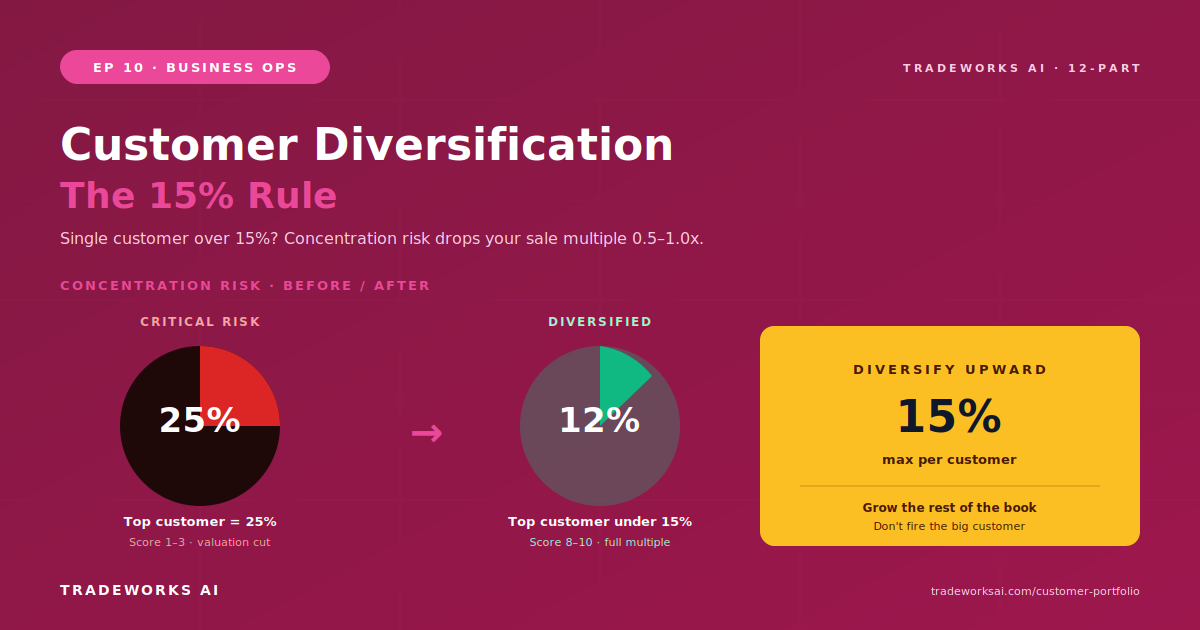
Business Operations · Part 10
Customer Diversification: The 15% Rule
Continue the Business Operations series with Part 10 of 12.
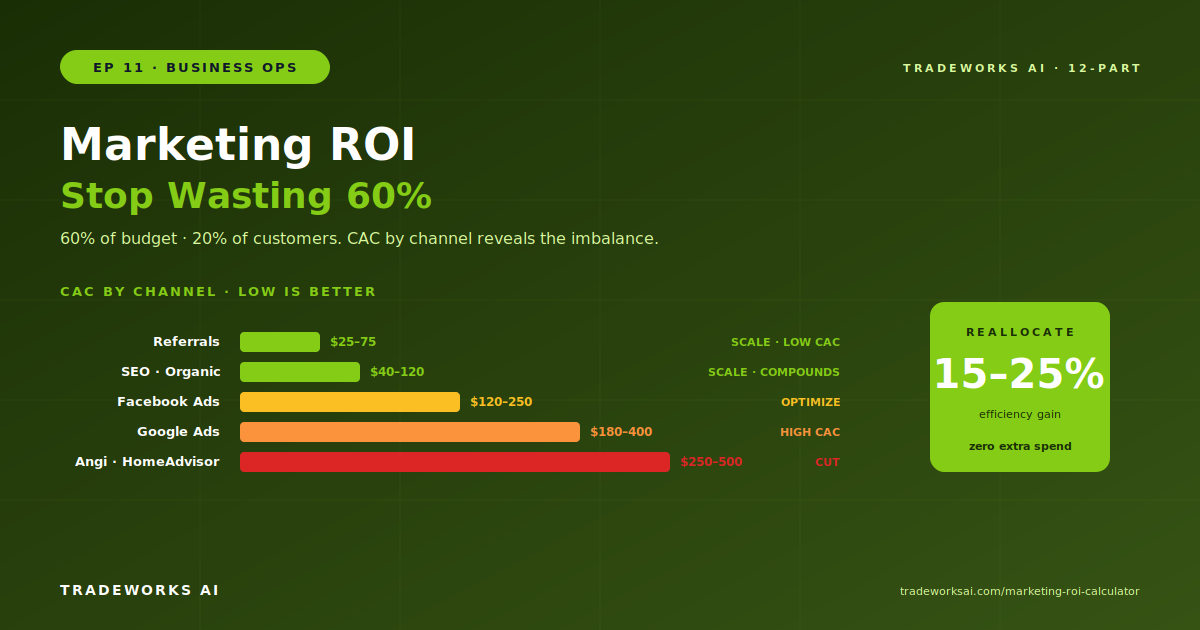
Marketing ROI for contractors comes down to one metric: Customer Acquisition Cost (CAC) by channel. Total marketing spend per channel divided by new customers from that channel. Most contractors spend 60% of their marketing budget on the channel that produces 20% of new customers — and don’t know it because they’ve never calculated CAC by channel. The fix is a 90-Day Reallocation Sprint: measure CAC across all channels, identify the imbalance, reallocate 20% of the highest-CAC channel’s budget to the lowest-CAC channel, and measure for 90 days. The typical result: 15–25% improvement in marketing efficiency with zero increase in total budget. Marketing budget benchmarks for contractors: 5–8% of revenue for established businesses (Stage 3+), 8–12% for growth-phase businesses (Stage 2). Channels ranked by typical CAC: referrals ($25–75), SEO/organic ($40–$120), Facebook Ads ($120–$250), Google Ads ($180–$400), Angi/HomeAdvisor ($250–$500).
Download the free Marketing ROI Calculator — plug in spend and customers by channel, get CAC and reallocation recommendations → tradeworksai.com/marketing-roi-calculator
The 60/20 Problem is the most common marketing inefficiency in contractor businesses: 60% of the marketing budget goes to the channel that produces 20% of new customers. The inverse is also true — the channel producing 40–50% of customers often receives only 10–15% of the budget.
Why this happens: contractors allocate marketing budget based on visibility (Google Ads feels active), sales pressure (Angi reps call weekly), or habit (always done it this way) rather than measured cost per acquisition. Without CAC by channel, the allocation is a guess. And guessing at $5,000–$15,000/month in marketing spend is expensive.
The discovery moment: when a contractor calculates CAC by channel for the first time, they almost always find that referrals and SEO produce customers at 3–5x lower cost than paid platforms — but receive a fraction of the marketing investment (time, money, or both).
Formula: Total Channel Spend / New Customers from Channel = CAC for Channel.
Calculate for every channel the business uses. Include both hard costs (ad spend, platform fees) and soft costs (time spent, content creation, networking events valued at hourly rate).
The benchmarks vary by trade and market. HVAC Google Ads CAC is typically $200–$350 in competitive Florida markets. Plumbing referral CAC is typically $30–$60. The point is not the absolute number — it’s the relative difference between channels.
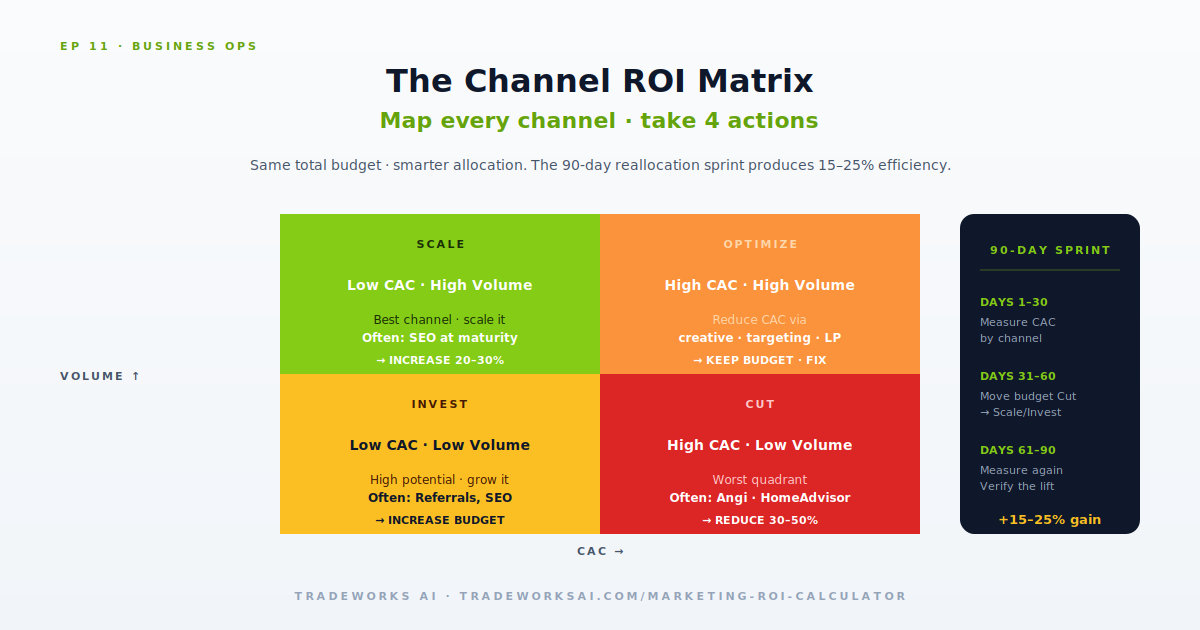
Map every channel on a 2×2 matrix: X-axis = CAC (low to high), Y-axis = volume (low to high).
Most contractors have 1–2 channels in the Cut quadrant (often Angi and overspent Google Ads) and 1–2 in the Invest quadrant (often referrals and SEO) that are underinvested.
The ROI Calculator maps every channel into the matrix and recommends reallocation → tradeworksai.com/marketing-roi-calculator
Calculate CAC by channel for trailing 6 months.
Map each channel into the ROI Matrix.
Identify Cut channels and Scale/Invest channels.
Set up attribution tracking: unique phone numbers per channel (CallRail), UTM tags on all URLs, CRM source field populated on every new lead.
Reduce Cut channel budgets by 30–50%.
Increase Scale/Invest channel budgets by the same dollar amount.
Do NOT change total marketing budget — only the allocation.
Launch or expand referral program (if Referrals are in Invest quadrant).
Increase SEO/content investment if organic is in Invest quadrant.
Recalculate CAC by channel after 60 days of new allocation.
Compare to baseline. The typical result: 15–25% improvement in overall marketing efficiency.
If a reallocated channel’s CAC hasn’t improved, restore partial budget and investigate (targeting, creative, landing page).
Set quarterly CAC review cadence going forward.
Below 5% of revenue: underinvesting. The business is likely growing on referrals alone, which is fragile. Above 12%: overinvesting relative to stage, or CAC is too high on primary channels.
Marketing ROI is impossible without attribution. Three tools solve this:
1. CallRail or similar call tracking: unique phone number per channel. Google Ads calls to one number, Facebook to another, GBP to a third. Cost: $45–$145/month.
2. UTM tags on every URL: utm_source, utm_medium, utm_campaign on every link in every ad, email, and social post. Free.
3. CRM source field: every new lead in the CRM gets a “How did you hear about us?” field populated at intake. The office helper (Part 6) asks on every call. Free.
Without these three, the contractor is guessing. With them, every customer is attributed to the channel that produced them — and CAC by channel becomes calculable.
The ROI Calculator includes attribution setup guides for CallRail, UTM tags, and CRM source tracking → tradeworksai.com/marketing-roi-calculator
CAC by Channel (Metric 6) — recalculated quarterly. Target: declining trend on every channel.
Marketing Budget as % of Revenue — target 5–8% for Stage 3+.
New Customer Count by Channel — monthly. Shows volume shifts as budget reallocates.
Blended CAC — total marketing spend / total new customers. Target: declining quarter over quarter.
Not necessarily. If Angi produces customers at a CAC within your target range, keep it. If CAC is $400+ and volume is low, it belongs in the Cut quadrant. Reduce budget, don’t necessarily cancel — test at a lower spend level for 90 days before fully cutting.
Google Ads budget should be sized to the target CAC and desired volume. If target CAC is $250 and you want 20 new customers/month from Google, budget = $5,000/month. If actual CAC comes in at $350, either optimize (landing page, targeting, ad copy) or reduce volume target.
Yes — but on a 6–12 month timeline. SEO produces customers at $40–$120 CAC once ranking, which is 2–5x more efficient than paid channels. The investment is upfront (content creation, GBP optimization, website improvements) with delayed return. Contractors at Stage 3+ should allocate 20–30% of marketing budget to SEO/content.
Simple structure: $50–$100 credit to the referring customer for each new customer who books service. Announce the program on every invoice, every follow-up email, and every maintenance plan renewal. Track referral source in CRM. Most contractors who formalize a referral program see 20–40% increase in referral volume within 6 months.
82% of contractor businesses never break $1M, and most don't know which operational system is missing. Our free audit grades your business against the 5 stages, names the chaos gap blocking you, and identifies the highest-leverage system to build next.
Continue the Business Operations series with Part 10 of 12.

Continue the Business Operations series with Part 12 of 12.