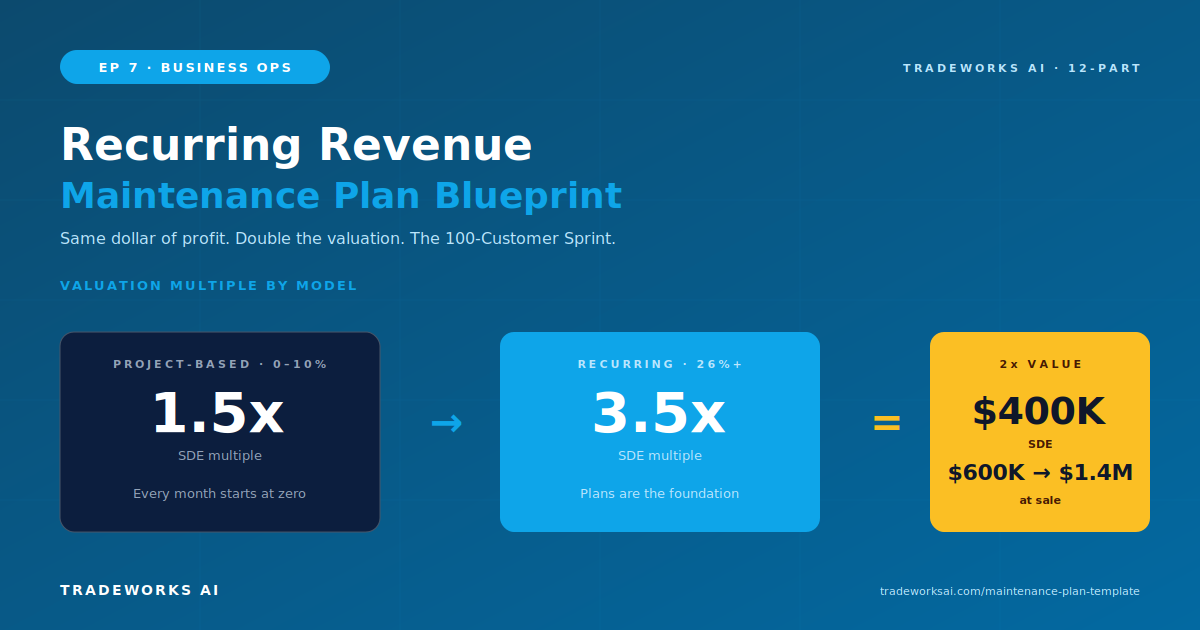
Business Operations · Part 7
Recurring Revenue: The Maintenance Plan Blueprint
Continue the Business Operations series with Part 7 of 12.
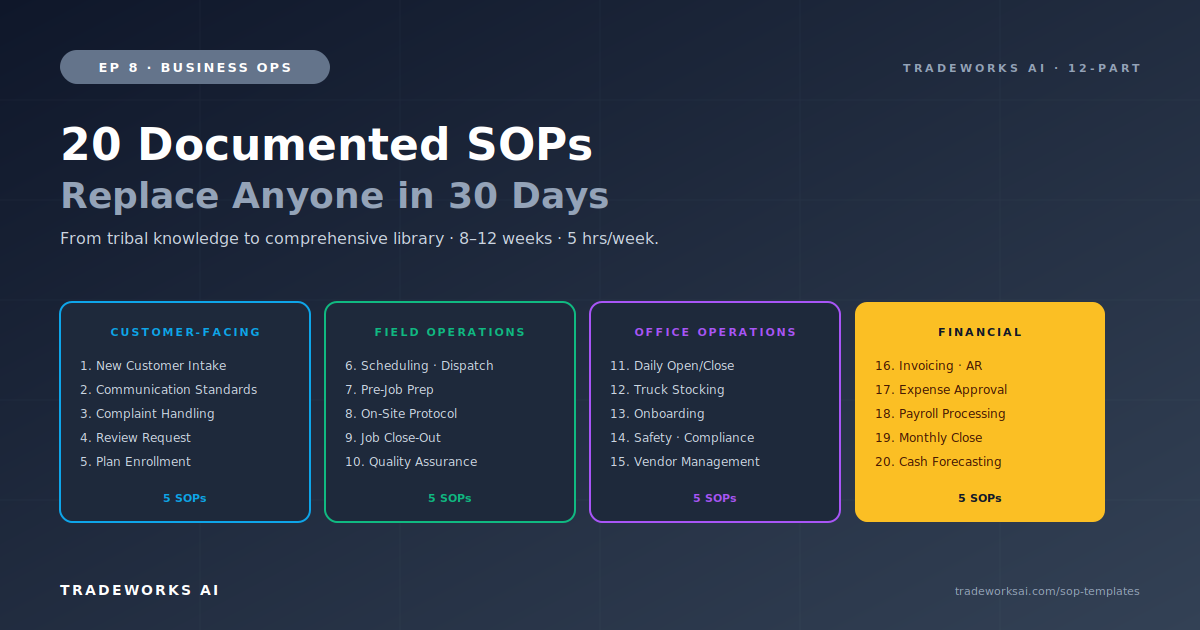
Standard operating procedures (SOPs) are the documented, repeatable processes that allow a contractor business to operate consistently regardless of who is performing the work. The diagnostic from Part 2’s Sellability Scorecard: if your top three employees quit tomorrow morning, could you replace them in 30 days without revenue dropping? If the answer is no, the operation runs on tribal knowledge — information that lives in people’s heads and walks out the door when they leave. Moving from tribal knowledge to a comprehensive SOP library is a 6–12 month project that follows a specific maturity spectrum: tribal knowledge (score 1–3), some SOPs for common processes (score 4–7), comprehensive library with new hires onboarding from documentation (score 8–10). The 20 core SOPs every contractor needs fall into four categories: customer-facing (5), field operations (5), office operations (5), and financial (5).
Download the free SOP Template Library — 20 pre-built templates with recording guides and documentation standards → tradeworksai.com/sop-templates
In Part 3, we introduced the Delegation Waterfall — the 6 delegations that move an owner from Position 1 (Job) to Position 3 (Asset). Every delegation requires an SOP. Delegation 1 (customer intake) requires an intake script SOP. Delegation 2 (dispatch) requires a scheduling SOP. Delegation 3 (technical decisions) requires the Decision Authority Matrix. Without SOPs, delegation fails because the new person has no reference for “how we do things here.”
In Part 6, we identified 5 Core SOPs to document before the first hire. Part 8 expands that to the full 20 that a Stage 3+ contractor business needs to operate consistently. In Part 7, we built the Maintenance Plan Blueprint — which requires fulfillment SOPs (visit scheduling, quality checks, follow-up) to work at scale. SOPs are the connective tissue.
The business case: a contractor business with comprehensive SOPs can replace any employee in 30 days. A contractor business without them is hostage to its best people. When the lead technician leaves, two years of accumulated knowledge walks out the door and the owner is back on the truck.
Every contractor business sits on a three-position spectrum of documentation maturity.
No documented processes. Everything lives in the owner’s head and a few key employees’ heads. New hires learn by shadowing. When someone leaves, knowledge is lost. This is normal at Stage 1 and early Stage 2 — and it’s the number one reason contractors stall at Stage 3. The operation can’t scale beyond what the owner personally oversees.
The most common processes are documented — customer intake, dispatch, basic job procedures. Critical knowledge still lives in heads, especially technical decision-making and customer relationship management. New hires get partial onboarding from documentation but still rely heavily on shadowing senior staff. This is where most Stage 3 contractors live.
Every core process is documented, recorded, and version-controlled. New hires onboard from the SOP library with minimal shadowing required. Any employee can be replaced in 30 days without revenue impact. The documentation survives the person. This is the standard for Stage 4+ and the requirement for sellability.
The SOP Template Library includes all 20 templates with Loom recording guides and Notion documentation standards → tradeworksai.com/sop-templates
Organized by category. Each SOP should exist as both a video recording (Loom, 3–8 minutes) and a written document (Notion, Google Docs, or Trainual).
SOP 1: New Customer Intake — phone script, information capture, expectation setting, appointment booking
SOP 2: Customer Communication Standards — appointment confirmations, on-my-way notifications, post-service follow-up timing and content
SOP 3: Complaint and Escalation Handling — when to resolve on-site, when to escalate, documentation requirements, follow-up timeline
SOP 4: Review Request Process — when to ask, how to ask, which platforms, response templates for positive and negative reviews
SOP 5: Maintenance Plan Enrollment — presentation script, enrollment process, billing setup, welcome communication
SOP 6: Job Scheduling and Dispatch — routing logic, priority rules, scheduling conflicts, technician assignment criteria
SOP 7: Pre-Job Preparation — truck stock verification, customer file review, site-specific requirements, safety checklist
SOP 8: On-Site Service Protocol — arrival procedures, diagnostic process, customer communication during service, upsell/cross-sell presentation
SOP 9: Job Close-Out — payment collection, invoice generation, before/after photos, customer sign-off, system update
SOP 10: Quality Assurance — post-job inspection criteria, callback standards, warranty documentation, customer satisfaction check
SOP 11: Daily Office Opening and Closing — system checks, voicemail review, schedule confirmation, end-of-day reconciliation
SOP 12: Truck Stocking and Inventory — standard parts list by truck, reorder triggers, vendor contacts, emergency procurement process
SOP 13: Employee Onboarding — first-day checklist, tool/equipment issuance, SOP library orientation, 30-day milestone plan
SOP 14: Safety and Compliance — OSHA requirements, PPE standards, incident reporting, annual safety training schedule
SOP 15: Vendor and Supplier Management — approved vendor list, payment terms, quality standards, dispute resolution
SOP 16: Invoicing and Accounts Receivable — invoice timing, payment methods accepted, follow-up schedule for unpaid invoices, collections process
SOP 17: Expense Approval and Processing — approval thresholds, receipt documentation, category coding, reimbursement timeline
SOP 18: Payroll Processing — timesheet collection, overtime rules, pay schedule, tax withholding, direct deposit setup
SOP 19: Monthly Financial Close — bookkeeper reconciliation process, P&L review, bank statement verification, owner review meeting
SOP 20: Cash Flow Forecasting — 90-day projection process (Part 9), AR aging review, recurring revenue tracking, expense planning
Creating SOPs doesn’t require a consultant or a project manager. It requires a camera, a documentation tool, and a systematic approach. The 4-step framework:
The owner or the best performer records themselves doing the process on Loom (screen + camera for office tasks, camera-only for field tasks). Length: 3–8 minutes per SOP. Don’t script it — just do the process and narrate what you’re doing. Raw recording is better than no recording.
Transcribe the key steps into a written document in Notion, Google Docs, or Trainual. Use numbered steps, not paragraphs. Include screenshots for software-based processes. Link the Loom recording at the top of the document for context.
Have someone who has NEVER done the process follow the SOP without additional guidance. Watch where they get stuck or confused. Every question they ask reveals a gap in the documentation. Fill the gaps.
After the SOP has been used 5–10 times, review and update. Processes evolve. Tools change. The SOP should version-control (v1.0, v1.1, v2.0). Set a quarterly review cadence for all 20 SOPs.
Total time investment to create all 20 SOPs: 40–60 hours over 8–12 weeks. That’s 5 hours per week for 8–12 weeks. Most owners can create 2–3 SOPs per week.
For most Stage 2–3 contractors: Loom (free) + Notion (free) is sufficient. At Stage 4+: consider Trainual for structured training with completion tracking and quizzes.
Weeks 1–3: Customer-Facing SOPs (1–5). Priority because they directly impact customer experience.
Weeks 4–6: Field Operations SOPs (6–10). Priority because they standardize service delivery.
Weeks 7–9: Office Operations SOPs (11–15). Priority because they enable the office to run without the owner.
Weeks 10–12: Financial SOPs (16–20). Priority because they enable financial clarity (Pillar 5) and cash flow management (Part 9).
Create 2–3 SOPs per week. Record on Monday, document on Tuesday, test on Wednesday. By Week 12, the full 20-SOP library is built, tested, and ready for onboarding.
The SOP Template Library includes all 20 pre-built templates, Loom recording guides, and a 12-week sprint tracker → tradeworksai.com/sop-templates
SOP Coverage Percentage — documented SOPs / total core processes (20). Target: 80%+ (16 of 20).
New Hire Onboarding Time — days from hire to independent operation. Target: under 30 days with SOPs (vs 60–90 without).
Replace-in-30-Days Score — self-assessment: could you replace your top 3 employees in 30 days? Binary yes/no. Target: yes.
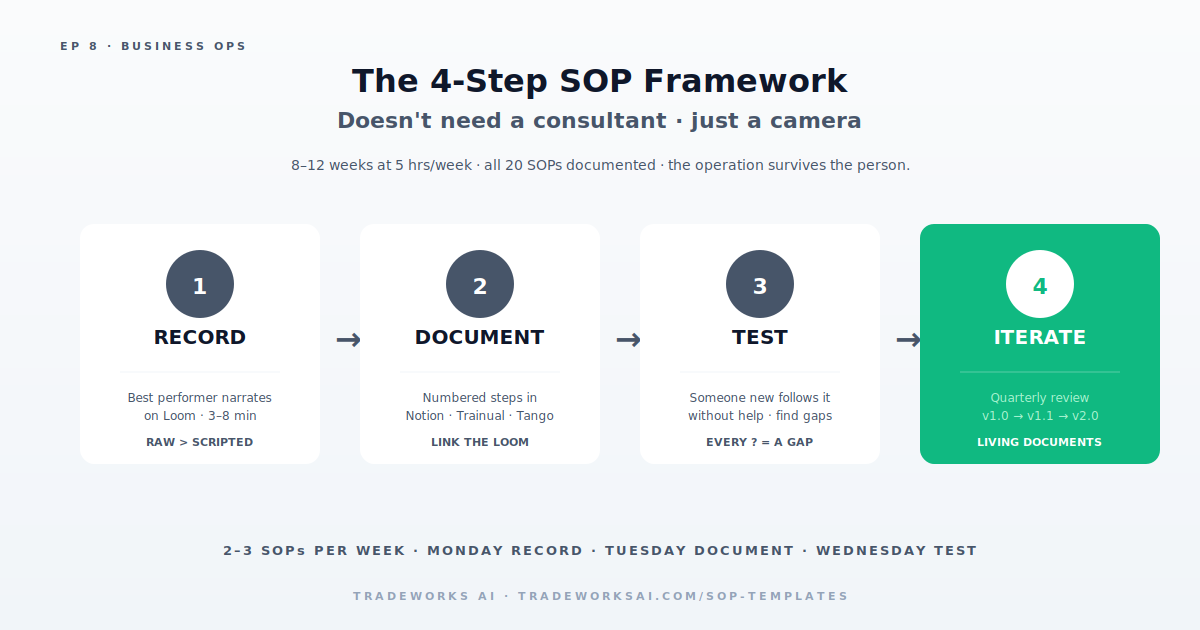
8–12 weeks at 5 hours per week. Most owners create 2–3 SOPs per week using the Record → Document → Test → Iterate framework. The first 5 (Customer-Facing) take the longest because they establish the format and style. SOPs 6–20 go faster.
The best performer of each process should record the SOP — which might be the owner, a senior technician, or the office manager. The owner creates SOPs for processes only they do (financial decisions, strategic planning). For field operations, the best technician records. For office operations, the office manager records. The owner reviews all SOPs for accuracy and completeness.
SOPs are living documents. Set a quarterly review: first Monday of every quarter, review 5 SOPs (rotating through all 20 over the year). Update the written document and re-record the Loom if the process has materially changed. Version-control: v1.0, v1.1, v2.0. The quarterly review takes 2–3 hours.
Yes — directly. Buyers in due diligence specifically ask for process documentation. A business with comprehensive SOPs scores 8–10 on Pillar 3 (Documented Systems) of the Sellability Scorecard. A business without them scores 1–3. The difference impacts the sale multiple by 0.5–1.0x SDE — which on $400K SDE is $200K–$400K in sale price.
82% of contractor businesses never break $1M, and most don't know which operational system is missing. Our free audit grades your business against the 5 stages, names the chaos gap blocking you, and identifies the highest-leverage system to build next.
Continue the Business Operations series with Part 7 of 12.
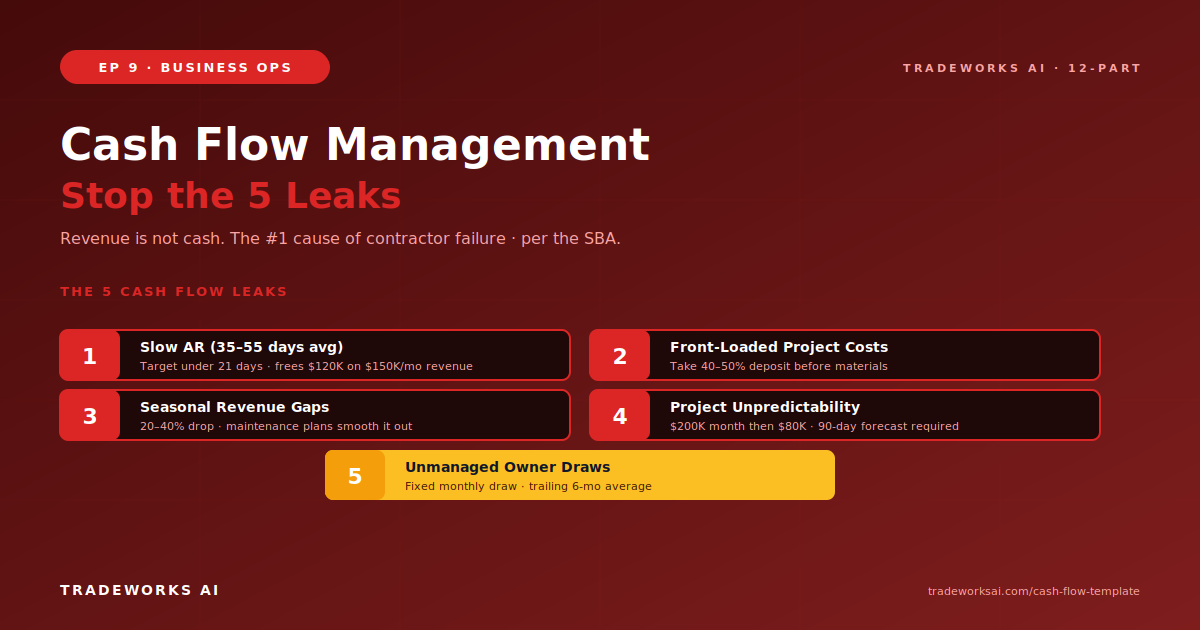
Continue the Business Operations series with Part 9 of 12.