Marketing & Psychology · Part 10
Unity for Contractors: The Competitive Advantage Money Cannot Buy
Continue the Marketing & Psychology series with Part 10 of 15.
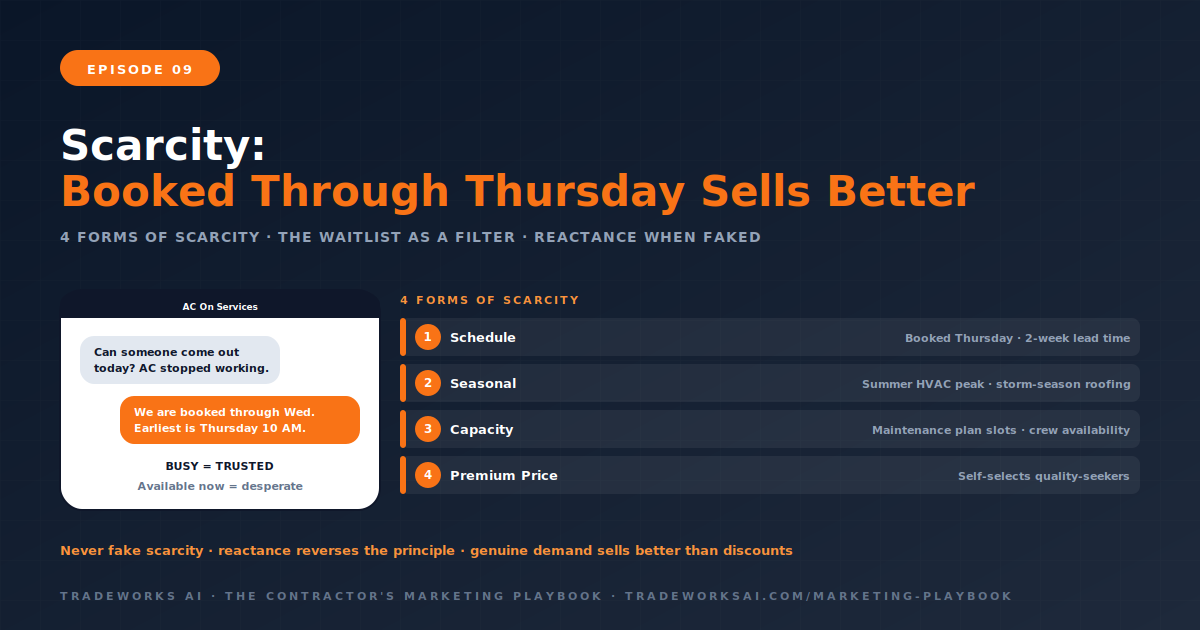
Scarcity for contractors means that people value things more when they are rare or diminishing in availability. A contractor who says we can get you on the schedule Thursday is perceived as more desirable than a contractor who says we can come right now—because availability signals demand, and demand signals quality. The $229 HVAC contractor with a 3-week waitlist does not need to claim to be the best. The waitlist IS the claim. Available anytime signals the opposite: if no one else is hiring them, why should I? Scarcity operates through 4 forms for contractors: schedule scarcity (busy is good), seasonal urgency (natural demand peaks), capacity limits (maintenance plan slots, crew availability), and premium positioning (the contractor who charges more attracts quality-seeking customers). Never fake scarcity. Fake urgency triggers reactance—the homeowner resists more strongly than if no scarcity was claimed.
A homeowner calls two HVAC contractors in July. Contractor A says: we are booked through Thursday, but I can get you on the schedule Friday morning. Contractor B says: we can have someone there in an hour. Most contractors assume B wins because speed is valued. But for non-emergency situations, A is often perceived as more desirable. Why? Because Contractor A is busy. Busy means in demand. In demand means other homeowners chose them. Other homeowners choosing them is social proof (Episode 4). A contractor nobody else is using feels risky. A contractor everyone is trying to book feels safe. Scarcity and social proof reinforce each other: the harder something is to get, the more valuable it appears.
This does not apply to genuine emergencies—a homeowner with a flooded kitchen needs someone now. But for non-emergency repairs, installations, estimates, and maintenance, a short wait communicates quality more effectively than immediate availability. The homeowner who waits until Friday has a higher perceived value of the service than the homeowner who got same-hour dispatch—and they are less likely to negotiate on price because the scarcity has already established the contractor’s value.
A waitlist does three things simultaneously. First, it signals quality through social proof—if there is a wait, other homeowners have chosen this contractor, which validates the homeowner’s own choice. Second, it self-selects for quality-seeking customers. Price-shoppers will not wait. They move to the next available contractor. Quality-seekers will wait because they understand that the best providers are in demand. The waitlist filters out the customers you least want and retains the customers you most want. Third, it increases perceived value. Cialdini’s research demonstrates that when access to something is limited, people assign it higher value—even when the thing itself has not changed. The same HVAC repair perceived as a $229 service when scheduled for Friday feels like a $300 value when there was a waitlist to get on the schedule.
The most important rule: never manufacture false scarcity. This price is only good today when the price will be the same tomorrow. Only 3 spots left this month when there is no actual capacity limit. Limited time offer that runs perpetually. False scarcity triggers a psychological response called reactance—when people feel their freedom of choice is being manipulated, they resist the influence attempt more strongly than if no influence had been attempted at all. Reactance does not just neutralize the scarcity effect. It reverses it. The homeowner who detects fake urgency becomes actively hostile to the sale. They feel manipulated. The Trust Equation’s denominator (Self-Orientation) spikes. Trust collapses.
Genuine scarcity is honest about constraints. We are booked through Thursday because we genuinely are. Maintenance plan slots are limited because we can only service a certain number of households per tech per day. Summer demand peaks because every homeowner in Tampa needs their AC serviced in June. The constraint is real. The homeowner recognizes it as real. The scarcity effect activates because the homeowner trusts it.
Scarcity and Authority (Episode 5) compound powerfully. An expert who is in demand is perceived as more expert because of the demand. The logic in the homeowner’s brain: if this many people are trying to hire them, they must be very good. The expert’s waitlist validates their authority. The authority justifies the waitlist. This is the cycle that creates market dominance without advertising—the contractor who is perceived as the best becomes the busiest, and being the busiest reinforces the perception of being the best. Breaking into this cycle from the outside (as a new competitor) is extremely difficult, which is why established contractors with genuine scarcity have a structural advantage that compounds over time.
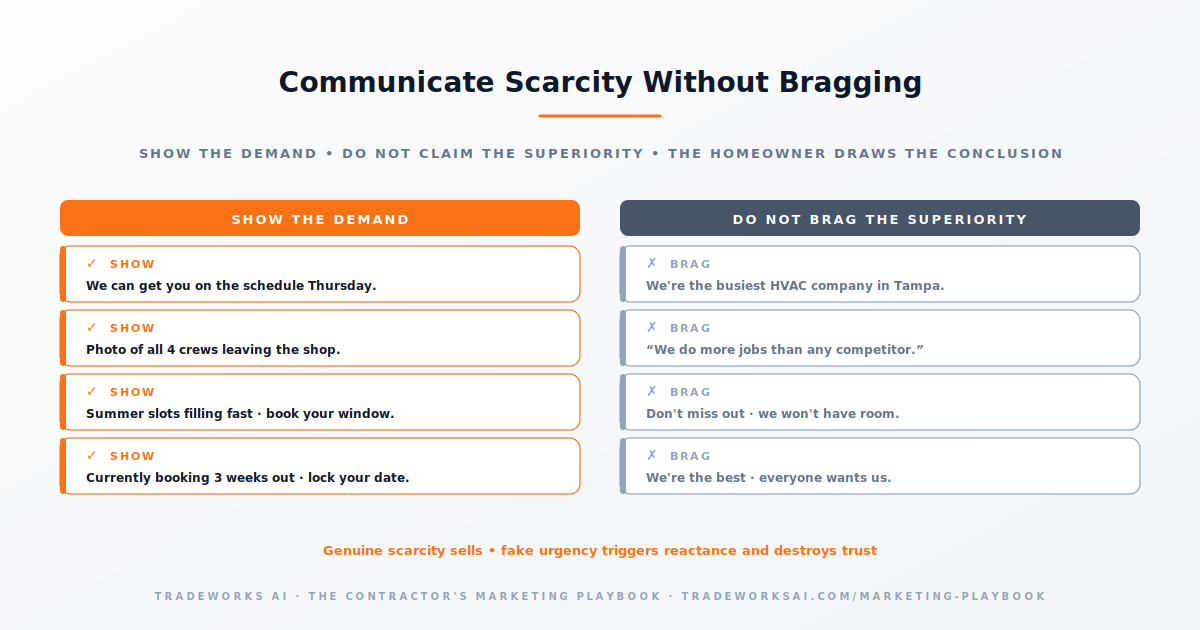
The contractor who says we are the busiest company in Tampa is bragging. The contractor who says we are currently booking installations 3 weeks out—if you would like to get on the schedule, I would recommend we lock in your date today is communicating scarcity through behavior, not claims. The difference matters. Social media posts that say busy week—all 4 crews out today with a photo of trucks leaving the shop communicate scarcity through proof. Google Business Profile updates that say summer tune-up slots filling fast—book your window at [link] communicate scarcity through actionable urgency. The principle: show the demand, do not claim the superiority. The homeowner draws the conclusion themselves.
Scarcity signals quality through social proof: if many homeowners chose this contractor, they must be good. A busy schedule also self-selects for quality-seeking customers—price-shoppers move to the next available option, while quality-seekers wait.
Yes—when it is true. Communicating genuine schedule scarcity (we can get you on the schedule Thursday) signals demand and increases perceived value. The homeowner who waits perceives higher value and is less likely to negotiate on price.
When homeowners detect fake scarcity (this price is only good today when it will be the same tomorrow), they resist the influence more strongly than if no scarcity was claimed. Fake urgency creates hostility and destroys trust. The Self-Orientation denominator in the Trust Equation spikes. Only use genuine scarcity.
Show the demand, do not claim the superiority. Busy week—all 4 crews out today with a truck photo. Summer slots filling fast with a booking link. Currently booking 3 weeks out—I recommend we lock in your date. The homeowner draws the quality conclusion themselves.
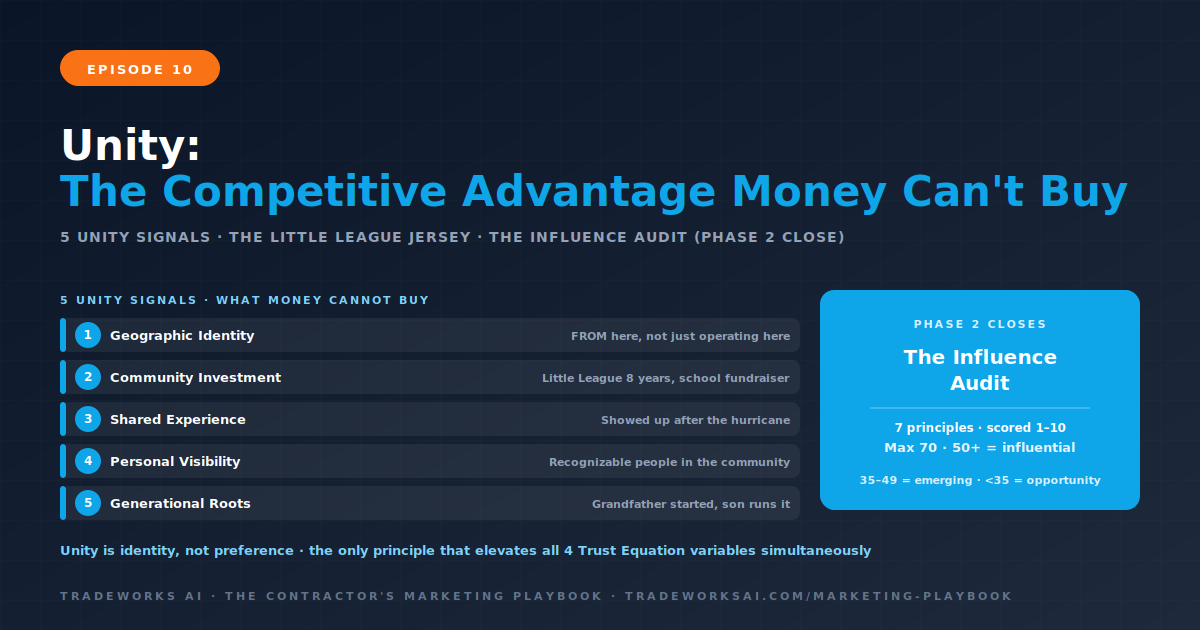
Tactics change every quarter. Psychology has not changed in 50,000 years. The Influence Audit grades your marketing across the 7 principles — Reciprocity, Commitment, Liking, Social Proof, Authority, Scarcity, and Unity — and identifies the one principle that, when activated, lifts every other channel you run.
Continue the Marketing & Psychology series with Part 10 of 15.
Continue the Marketing & Psychology series with Part 11 of 15.