Marketing & Psychology · Part 15
The Influential Brand: All 7 Principles in Concert — The Complete Psychology of Why They Choose You (Series Finale)
Continue the Marketing & Psychology series with Part 15 of 15.
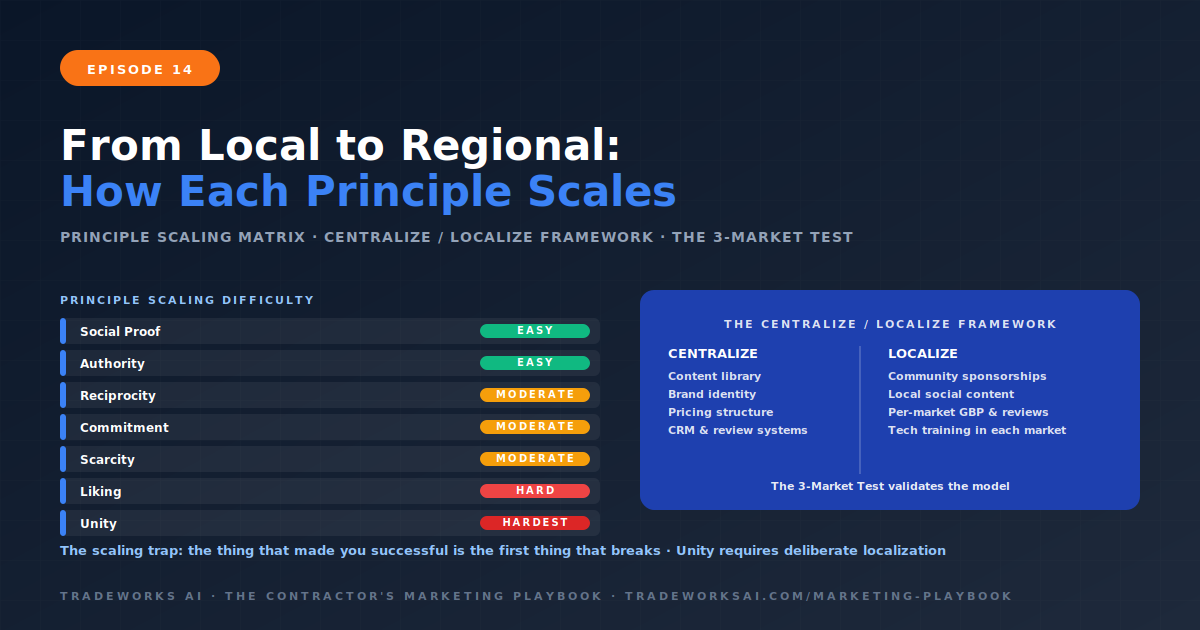
Scaling a contractor business from local to regional requires understanding that each influence principle scales differently. Authority scales through content—one YouTube video reaches the entire region. Social Proof compounds—more jobs produce more reviews which produce more trust across a wider area. Scarcity scales naturally—growth creates genuine demand signals. Reciprocity scales through content and systems—free estimates and the review engine work in any market. Commitment scales through CRM and maintenance plan systems that replicate across locations. Liking requires human replication—every new technician must be trained on the 30 seconds at the door. Unity is the hardest to scale because it is built on genuine local identity. The contractor who was from Riverview cannot claim to be from Brandon and Clearwater and Lakeland simultaneously. Unity requires localization: separate community investments, local references, and neighborhood-specific presence in every new market.
Most contractors who successfully grow from a single-market operation to a multi-market regional company lose something in the process. The personal touch that built the original reputation gets diluted. The owner who used to answer the phone and show up on job sites is now managing operations and rarely interacts with customers. The community connections that created Unity get stretched thin. The technician quality that drove Liking becomes inconsistent as hiring accelerates to fill demand. The contractor grows revenue but erodes the principles that created the revenue in the first place. This is the scaling trap: the thing that made you successful is the first thing that breaks when you scale. The Principle Scaling Matrix prevents this by identifying which principles scale naturally, which require systems, and which require deliberate localization.
Unity is the hardest principle to scale because it is built on genuine local identity. The contractor who was from Riverview—who coached Little League, attended neighborhood cookouts, and was recognized at the grocery store—cannot replicate that identity in Brandon, Clearwater, and Lakeland simultaneously. Attempting to claim we are local everywhere feels like exactly what national franchises do—and homeowners detect the inauthenticity. The solution is localization: each new market gets its own Unity investment. A local community manager or team lead who lives in that market. Separate community sponsorships specific to that neighborhood. Social media content referencing that specific community. A dedicated GBP for that service area with local reviews. The umbrella brand provides Authority and Social Proof (the reputation of the larger company). Unity is rebuilt from the ground up in each market by someone who genuinely lives there.
The framework prevents the scaling trap: the centralized elements maintain consistency and efficiency while the localized elements preserve the genuine community connection that created the original success. The contractor who scales well does both simultaneously—they do not sacrifice localization for efficiency or efficiency for localization.
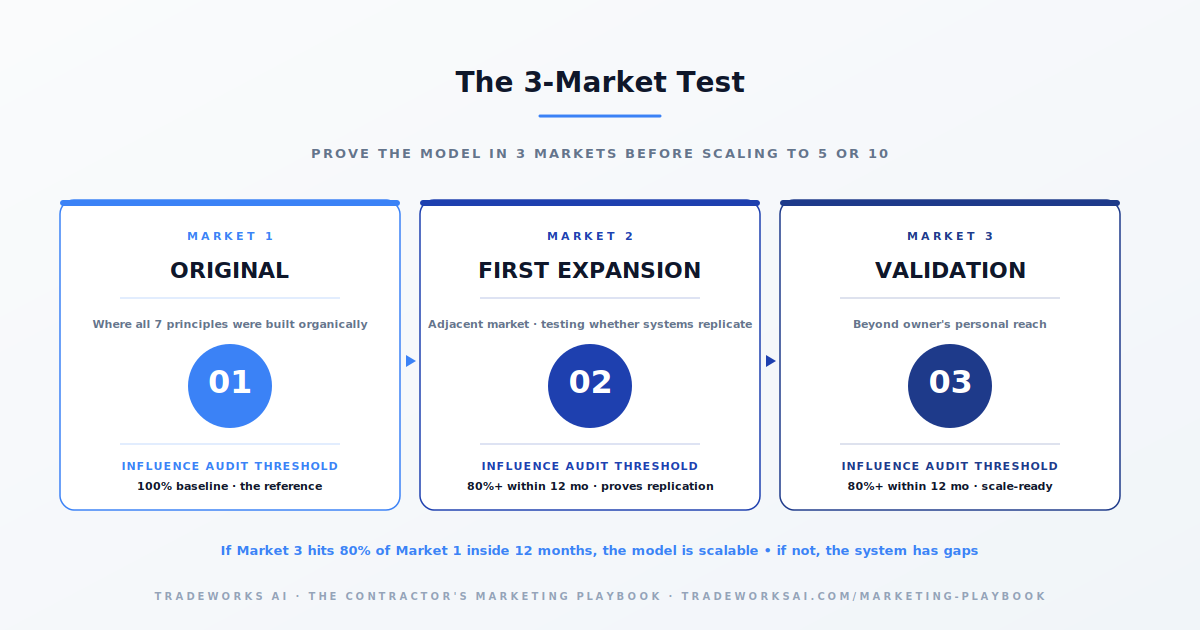
Before scaling to 5 or 10 markets, every contractor should prove the model in 3 markets. Market 1 is the original—the market where all 7 principles were built organically. Market 2 is the first expansion—the adjacent market where you test whether systems can replicate the principles. Market 3 is the validation—the market that proves the model works beyond the owner’s personal reach. If Market 3 achieves an Influence Audit score within 80% of Market 1 within 12 months, the model is scalable. If it does not, the scaling system has gaps—usually in Liking (tech training) or Unity (localization).
Unity. It is built on genuine local identity—community sponsorships, neighborhood references, personal visibility. Claiming to be local everywhere feels inauthentic. Each new market requires its own Unity investment built by someone who genuinely lives there.
Social Proof (reviews compound with volume) and Authority (content is geography-independent). One YouTube video reaches the entire region. 500 reviews across 3 markets is more powerful than 200 in 1.
Through the Centralize/Localize Framework. Centralize systems that scale (content, CRM, pricing structure, review automation). Localize elements that require genuine community presence (sponsorships, social content, GBP, tech training, Unity signals).
Prove the model in 3 markets before scaling further. Market 1: original. Market 2: first expansion (test replication). Market 3: validation (proves the model works beyond the owner’s personal reach). If Market 3 achieves 80% of Market 1’s Influence Audit score within 12 months, the model is scalable.
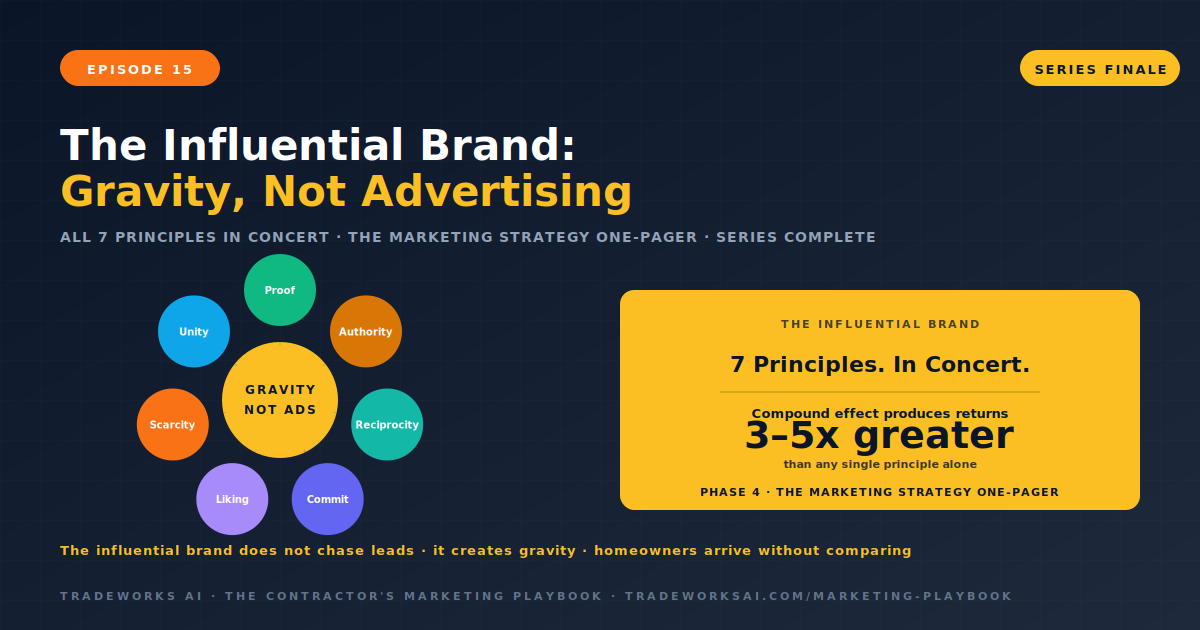
Tactics change every quarter. Psychology has not changed in 50,000 years. The Influence Audit grades your marketing across the 7 principles — Reciprocity, Commitment, Liking, Social Proof, Authority, Scarcity, and Unity — and identifies the one principle that, when activated, lifts every other channel you run.
Continue the Marketing & Psychology series with Part 15 of 15.
Continue the Marketing & Psychology series with Part 1 of 15.