
Business Operations · Part 2
Is Your Contractor Business Sellable? 5-Pillar Scorecard
Continue the Business Operations series with Part 2 of 12.
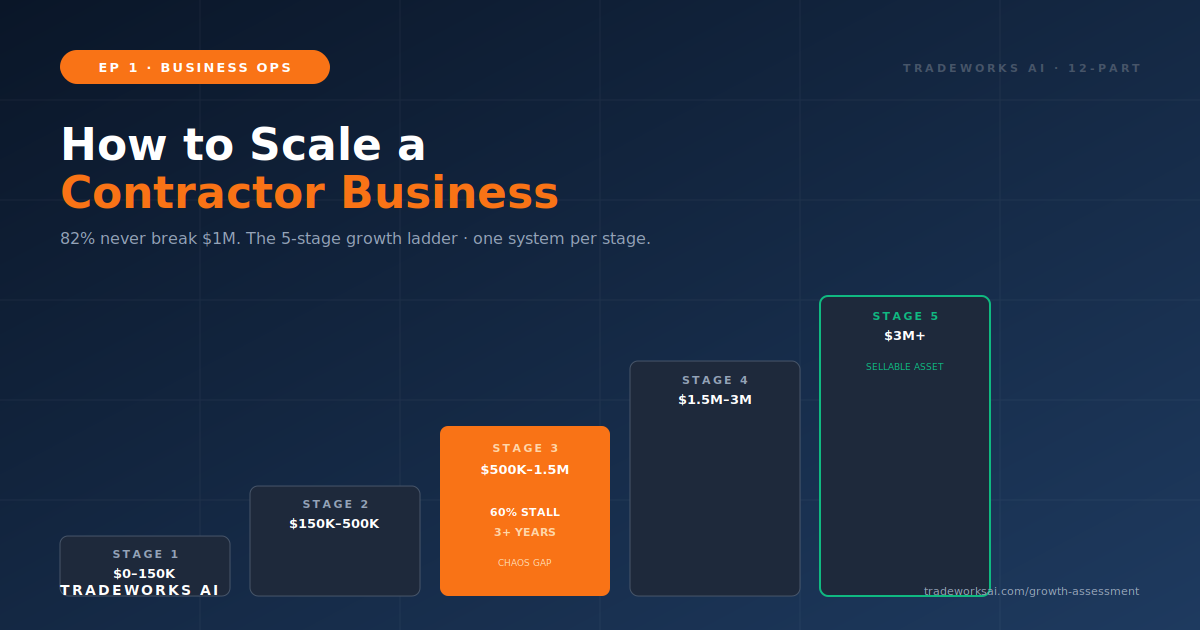
To scale a contractor business, you have to identify which of five revenue stages you’re in — and build the specific operational system that gets you to the next one. Stage 1 ($0–$150K) requires clean books and a real CRM. Stage 2 ($150K–$500K) requires documented SOPs and a dispatch process. Stage 3 ($500K–$1.5M) requires KPI tracking. Stage 4 ($1.5M–$3M) requires recurring revenue and financial reporting. Stage 5 ($3M+) requires exit-ready financials. Most contractors stall because they try to use Stage 2 systems at Stage 3 — the systems don’t scale, but the volume does.
The data is unforgiving: 82% of contractor businesses never exceed $1 million in revenue. The reason isn’t skill, work ethic, or market — it’s that running the work and running the business are two completely different jobs, and nobody teaches the second one. This guide walks through every stage, the operational system that unlocks it, and the chaos gap that traps most contractors between stages.
Want to identify your exact stage in under 5 minutes? Take the free Growth Assessment → tradeworksai.com/growth-assessment
The trades have a scaling problem. According to IBIS World industry data, 82% of contractor businesses across HVAC, plumbing, electrical, roofing, and adjacent home services never exceed $1 million in annual revenue. The SBA reports a 50% five-year failure rate across small contractor businesses — well above the cross-industry average.
Most owners assume the bottleneck is leads, marketing, or pricing. The 2025 ServiceTitan State of the Trades report found something different: the most-cited bottleneck among contractors trying to scale is “I can’t find good people.” But that framing misses the real cause. Good technicians don’t want to work in chaos. If a business can’t attract or retain good people, the issue is rarely the labor market — it’s the operation.
Contractor businesses don’t scale by getting better at the trade. They scale by getting better at running the business. And the business looks completely different at every revenue stage.
Every contractor business that crosses $3 million in revenue passes through the same five stages. Each stage has a different operational reality, a different team structure, and a different critical system that must be built to reach the next stage. Skipping a stage isn’t possible — the systems compound.
In Stage 1, the owner is the business. They’re the technician, the salesperson, the dispatcher, the bookkeeper, the marketing department, and the customer service team. They answer the phone, they do the work, they invoice the customer, and they deposit the check. Team size: one, plus an occasional part-time helper.
The critical system to build at Stage 1 is clean books and a real customer relationship management (CRM) tool. Not a spreadsheet — a CRM. QuickBooks Online for the books. Housecall Pro, ServiceTitan Go, or Jobber for customer history and scheduling. Without these foundations, every subsequent stage becomes harder. The owner who tries to scale on a spreadsheet will hit a wall around $200K.
The exit ticket from Stage 1 isn’t hitting a revenue threshold — it’s when the owner is consistently turning away work because there isn’t time to do all of it. That’s the signal to hire. Hiring before that point creates a labor cost without revenue support.
Stage 2 begins with the first technician hire. The owner is still on the truck most days but is starting to delegate. Team size: two to three people, including possibly an office helper or virtual assistant for dispatch.
The critical system at Stage 2 is the first set of standard operating procedures (SOPs) and a documented dispatch process. The moment a contractor business has a second technician, it cannot run on tribal knowledge. Five core SOPs cover most operational ground: new customer intake, job scheduling, truck stocking, end-of-day reporting, and customer follow-up. Loom for the recordings, Notion for the documentation. Total cost: under $50/month.
The exit ticket from Stage 2 is when the technician can run a full day without calling the owner for help on operational decisions. Technical questions are fine. Operational questions like “where am I going next” should not be the owner’s problem after Stage 2.
Stage 3 is the most common stalling stage in the contractor industry. Approximately 60% of contractor businesses that reach $500K in revenue remain there for three or more years. The reason is structural: the systems that worked at Stage 2 break at Stage 3.
At Stage 3, the team grows to four to seven technicians plus office support. The owner should be off the truck — if they’re still installing, the business has a Stage 2 owner running a Stage 3 operation. Volume is now too high to manage by feel. Every job needs to follow the same workflow regardless of which technician is on it. The critical system is documented processes plus key performance indicator (KPI) tracking.
The KPIs that matter at Stage 3 include revenue per technician, gross margin per job, customer acquisition cost by channel, first-time fix rate, and same-day response rate. Without these, the owner can’t see where the business is leaking margin. With them, the path to Stage 4 becomes obvious.
The exit ticket from Stage 3 is when the office runs scheduling and dispatch without the owner touching the calendar. If the owner still controls the schedule, they’re still the bottleneck.
Where are you stalling? The Growth Assessment names the exact system blocking your next stage. Take it free → tradeworksai.com/growth-assessment
Stage 4 is the transition from a contractor business to a contractor company. The owner has hired an operations manager who runs the day-to-day. Team size: 12 to 18 people, including 8 to 12 technicians, the ops manager, and 2 to 3 office staff.
The critical system at Stage 4 is recurring revenue plus structured financial reporting. Maintenance plans are no longer optional — they’re a strategic asset. A monthly profit and loss (P&L) review with an actual bookkeeper or accountant becomes mandatory. The owner should know the gross margin by job type (service call, install, maintenance, emergency), the customer acquisition cost by channel, and the cash flow forecast for the next 90 days.
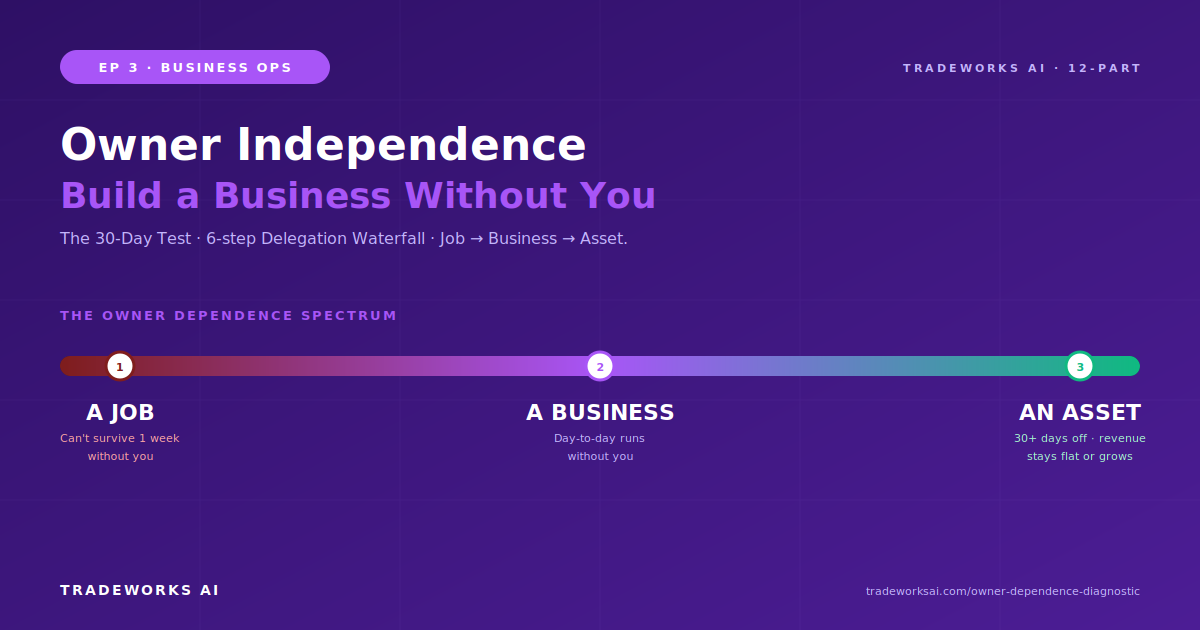
The exit ticket from Stage 4 is when the owner can take 30 days off and revenue stays flat or grows. This is the test John Warrillow describes in Built to Sell as the indicator of true business independence — and the threshold at which the business starts to behave like an asset rather than a job.
Stage 5 is when the contractor business becomes a sellable asset. The owner functions as a CEO. Team size: 25 to 40 plus, including ops manager, service manager, controller or financial leader, dispatchers, technicians, install crews, and office staff. The owner’s time is allocated to strategy, capital allocation, leadership development, and acquisitions — not daily operations.
The critical system at Stage 5 is exit-ready financials and buyer-grade documentation. This means three years of clean P&L statements available on demand, audited or review-ready books, comprehensive SOPs for every function, customer concentration under 15%, and recurring revenue at 30% or more. Without these, the business cannot survive due diligence.
The exit ticket from Stage 5 is an unsolicited acquisition offer. When private equity, strategic buyers, or larger contractor consolidators reach out without prompting, the business has crossed into asset territory.
Between every stage on the staircase is a chaos gap. The chaos gap is the operational period where the systems that worked at the current stage have stopped working, but the systems for the next stage haven’t been built yet. The most common chaos gap sits between Stage 2 and Stage 3 — the gap that traps 60% of contractor businesses for three or more years.
Three patterns define every chaos gap regardless of which stages flank it:
No documented systems — the operation runs on tribal knowledge that lives in the owner’s head and a few key employees’.
Cash flow instability — revenue is unpredictable month to month because there’s no recurring revenue base and AR collection is reactive.
The owner is still on every job — if not physically, then virtually, through constant phone calls and text messages.
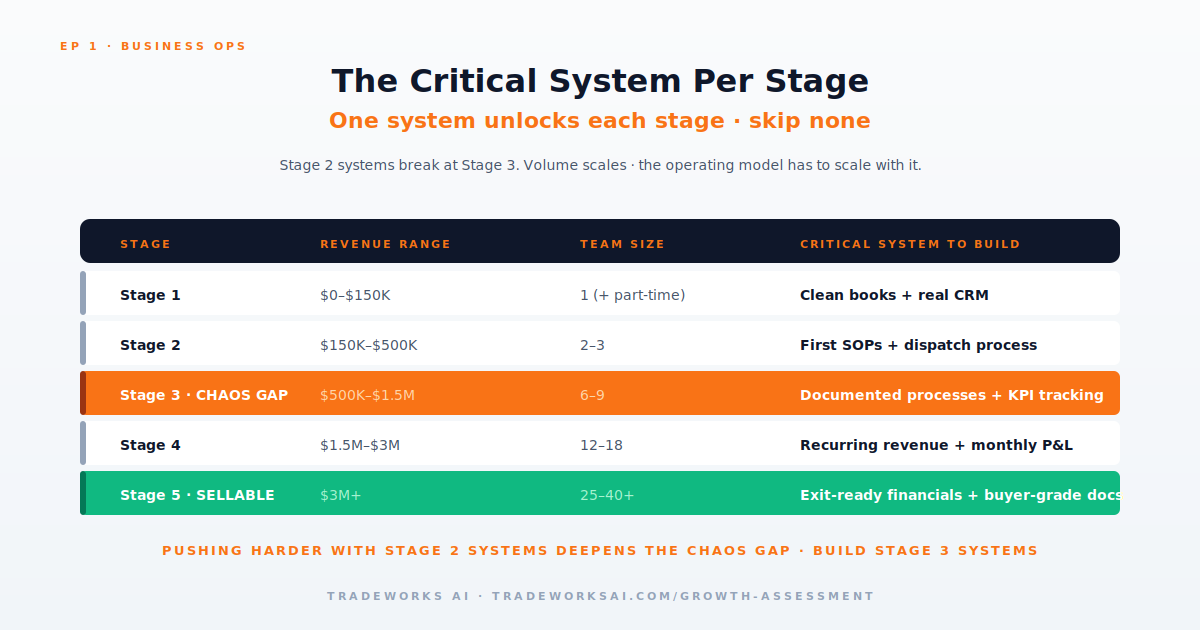
The fix for every chaos gap is the same: build the critical system for the next stage. Pushing harder with the systems of the current stage doesn’t close the gap — it deepens it. The systems aren’t broken. They’re just outgrown.
This table summarizes the operational unlock for each revenue stage. Most contractor businesses benefit from saving or printing this section for reference.
Without these systems, the business stalls. With them, the business scales. None of these are about marketing or lead generation — because operations are what unlock every stage. Marketing without operations just brings more chaos into a business that can’t handle the volume it already has.
There’s one question that separates contractors who scale from contractors who stall:
“What’s the one system you’d need to build to jump to the next stage?”
Owners who can answer that question with specificity — “I need to document my five core SOPs and hire a part-time office helper for dispatch” — are out of the chaos gap. Owners who can’t answer it specifically are still in it.
If the answer is vague (“I need more leads” or “I need better people”), the owner is still trying to push harder with the systems of the current stage. Specificity is the marker of progress.
Three concrete actions complete the diagnostic and produce a starting point. None of these require hiring anyone, buying software, or making major changes — they require a notepad and 30 minutes of honest reflection.
Pull the actual revenue figure from the last 12 months — not a projection, not an estimate, not the best month annualized. The honest number. Most contractors are off by 15–20% in their head versus what the books show. The real number is the only number that matters for stage identification.
Match revenue and team size to the table above. If revenue and team size don’t align (e.g., $400K revenue with five technicians), the smaller indicator wins — the business is functioning at the lower stage even if the revenue is higher, and the operational gaps will show in margin compression.
From the cheat sheet, identify the critical system for the next stage. Write it down. That’s the focus for the next 90 days. Not three systems — one. Most contractors fail to scale because they try to build everything at once and finish nothing.
Skip the manual diagnostic. The free Growth Assessment runs all three steps in 5 minutes and produces a personalized action plan → tradeworksai.com/growth-assessment
Operational visibility is the prerequisite for scaling. The four foundational KPIs introduced in this guide form the baseline that the full Contractor KPI Dashboard — published in Part 4 of this series — builds out to fifteen total metrics:
Annual Revenue — the trailing 12-month total, recalculated monthly.
Monthly Revenue Trend — the rolling 6-month chart showing growth direction.
Team Size — total headcount including subcontractors counted as full-time equivalents.
Revenue Per Employee — annual revenue divided by FTE count. Healthy contractor businesses run $130K–$200K revenue per employee depending on trade and market.
These four metrics alone produce more clarity than most contractor business owners have ever had. They don’t replace the full dashboard — they’re the starting point that proves the dashboard’s value.
On average, contractors who actively work on Stage 3 systems (documented processes, KPI tracking, dispatch independence) move from $500K to $1.5M in 24 to 36 months. Contractors who don’t build those systems remain at $500K–$700K for three or more years. The variable isn’t market or trade — it’s whether the operational systems for Stage 3 actually get built.
The SBA reports that the leading cause of contractor business failure is cash flow mismanagement, not lack of revenue. A contractor business with $1M in annual revenue and 60-day average accounts receivable can run out of cash even while booking jobs. This is why financial clarity — monthly bookkeeping, gross margin tracking, and cash flow forecasting — becomes critical at Stage 3.
The exit ticket from Stage 1 (Solo Operator) is when the owner is consistently turning away work because there isn’t time to do all of it. Hiring before that point creates a labor cost without revenue support. Hiring after that point delays Stage 2 unnecessarily. The signal isn’t a revenue threshold — it’s saying “no” to qualified work multiple times in a month.
The chaos gap is the operational period between revenue stages where the systems of the current stage have stopped working but the systems for the next stage haven’t been built yet. The most common chaos gap sits between Stage 2 and Stage 3 — the period where 60% of contractor businesses stall for three or more years. The fix is to build the critical system for the next stage, not to push harder with the systems of the current stage.
A part-time office helper or virtual assistant for dispatch and intake costs $20–$25/hour at 15–20 hours per week — approximately $400–$500/week. The math: if that role frees five hours of the owner’s time at $150/hour billable rate, the owner nets $250–$350/week. The hire pays for itself within the first 30 days for most Stage 2 contractors.
82% of contractor businesses never break $1M, and most don't know which operational system is missing. Our free audit grades your business against the 5 stages, names the chaos gap blocking you, and identifies the highest-leverage system to build next.
Continue the Business Operations series with Part 2 of 12.
Continue the Business Operations series with Part 3 of 12.