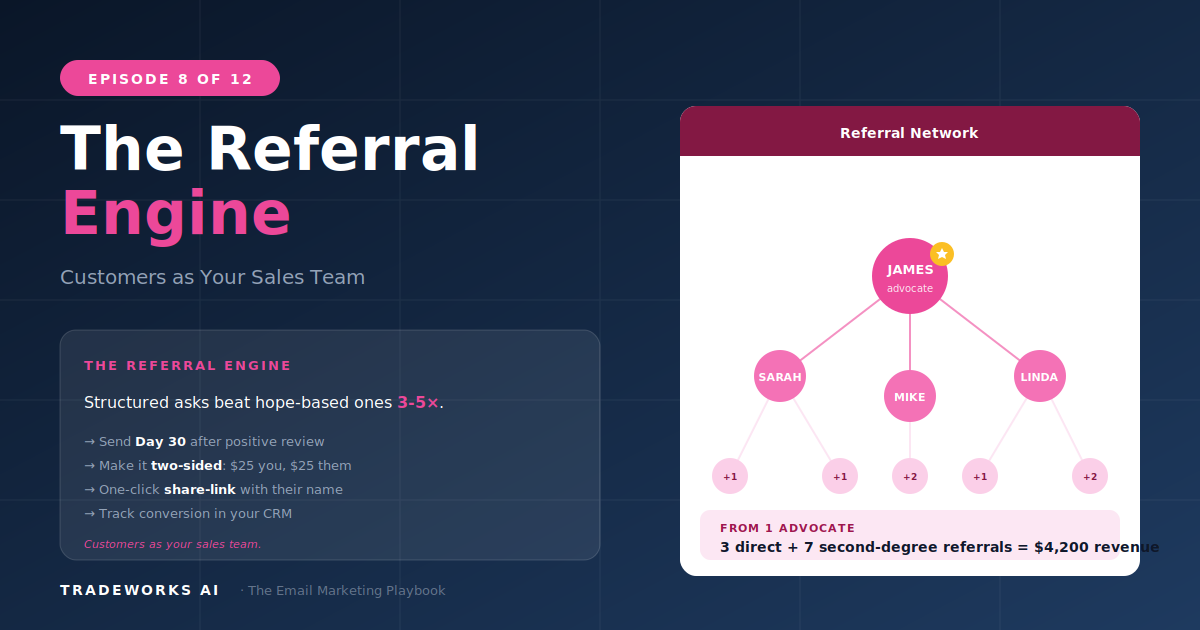
Email Marketing · Part 8
The Referral Engine
2-email post-service sequence with dual-sided incentives.
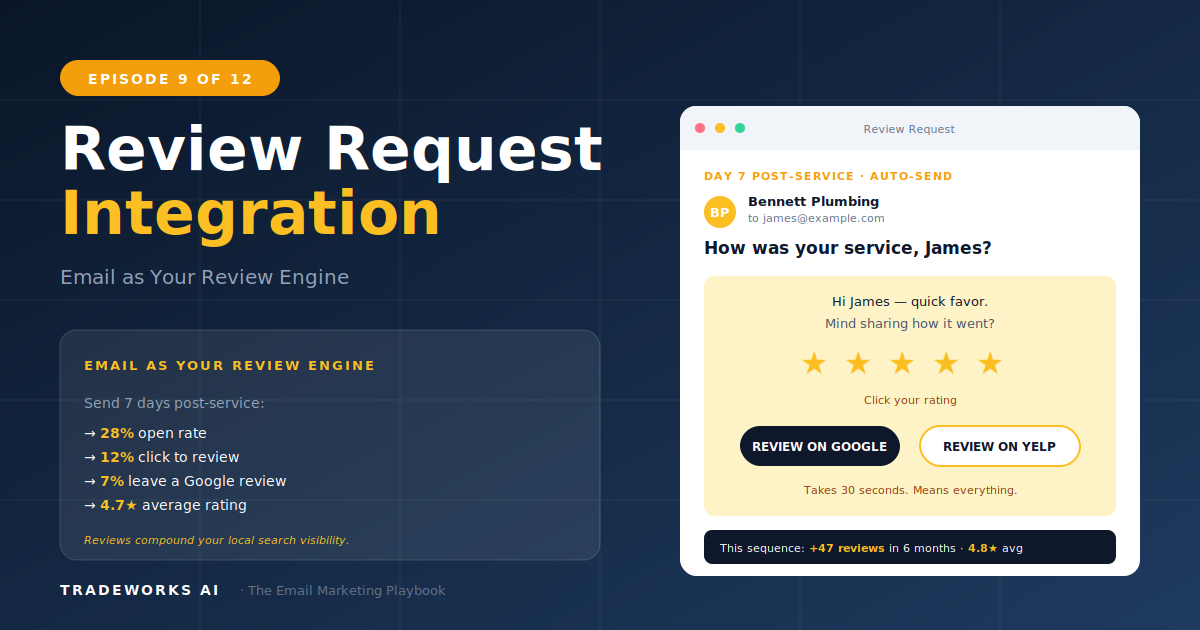
The most effective review generation system for home service contractors is a two-email automated sequence that sends 3 to 5 days after job completion, incorporating a satisfaction gate that intercepts unhappy customers before they reach a public review platform. Contractors running this system generate 15–30 new Google reviews per month from a customer base completing 80–150 jobs monthly, maintaining a 4.7–4.9 average star rating.
The key to the system is not asking more customers for reviews. It is asking the right customers at the right time through the right channel with the right amount of friction removed.
For contractors following this email playbook, the review request system feeds directly into your Google Business Profile visibility (see our Map Pack ranking guide), your referral engine (Part 8), and the social proof content used in reactivation, seasonal, and maintenance plan campaigns.
The 3 to 5-day window is optimal because the customer has lived with the completed service long enough to form a genuine opinion but the experience is still recent enough to motivate action. Day 1 is too early: the customer has not yet confirmed everything works correctly. Day 14 is too late: the emotional connection has faded and review completion rates drop by 40–60%.
The satisfaction gate is the most important component of the review system and the one most contractors skip. It is a routing mechanism that directs happy customers to your public review profiles and routes unhappy customers to a private feedback channel where you can resolve the issue before it becomes a 1-star review.
This is not review manipulation. You are not preventing anyone from leaving a negative review. You are giving unhappy customers a faster, more direct path to resolution — which is what most dissatisfied customers actually want.
Subject lines:
Body: Brief, warm reference to the completed service. Mention the technician by name. Present the satisfaction gate. For the happy path, the click-through lands on your Google Business Profile with a brief prompt: "Mentioning [technician name], [specific service], or [your city] in the review helps other homeowners find a contractor they can trust." That guidance produces review content with relevant search terms naturally.
Trigger: Sent only to customers who opened Email 1 but did not click the review link. Customers who already reviewed (tracked via click-through) or who clicked the unhappy path do not receive this.
Body: Two to three sentences. "We sent a note a few days ago asking about your experience. If you have 30 seconds, a Google review helps other [city] homeowners find a contractor they can trust." Final review ask. No third email.
Google is the priority platform for contractors. Allocation strategy:
Reviews that include specific keywords, service descriptions, and location references carry more weight in Google's local algorithm:
Every review, positive or negative, receives a response within 24–48 hours.
A 20–25% conversion rate (customers who receive the review email and complete a review) is achievable with the two-email sequence and satisfaction gate. Without the system, most contractors get 2–5% organically.
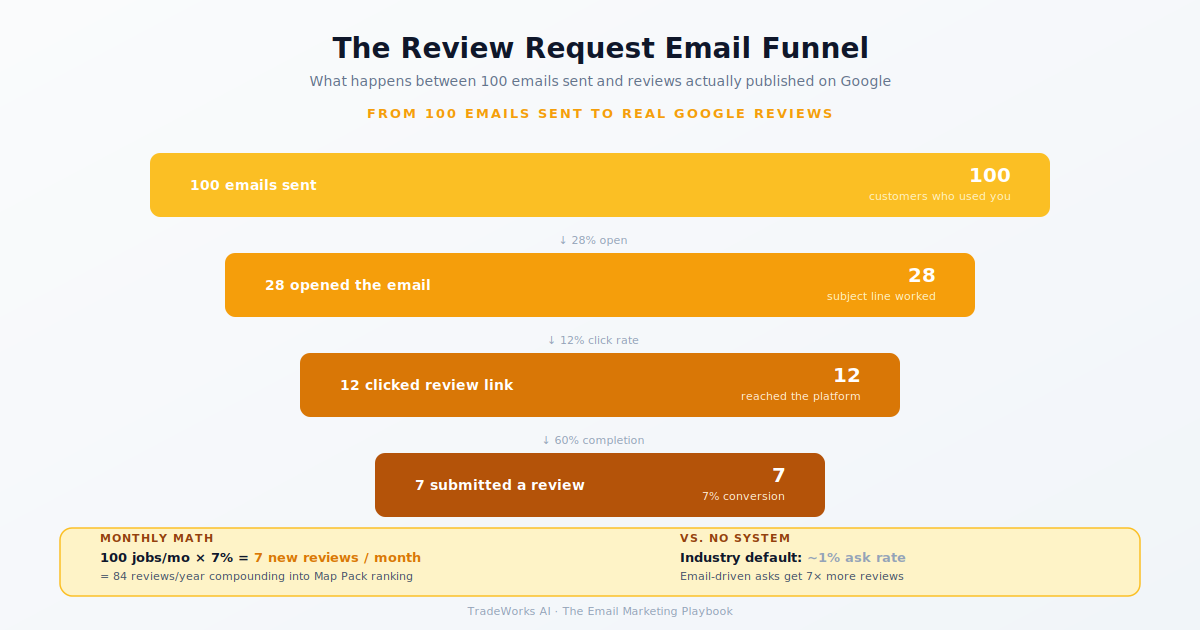
Reviews are not luck. They are the output of a system. The 2-email sequence, the satisfaction gate, and platform-specific review allocation produce 15–30 new Google reviews per month. That review velocity translates directly to Map Pack rank, AI citation eligibility, and conversion. Read Part 10 next: how email and ads work together to close more jobs.
Yes. Google prohibits selectively soliciting positive reviews (only asking happy customers). The satisfaction gate asks all customers for feedback and routes based on their response. The FTC's 2024 guidance on review solicitation supports this approach as long as all customers are asked and no incentive is offered for positive reviews specifically.
No. Google, Yelp, and the FTC prohibit incentivized reviews. Do not offer discounts, gift cards, or service credits in exchange for reviews. The ask itself, delivered at the right time with minimal friction, is sufficient. Incentivized reviews also tend to be generic and low-quality, which hurts your credibility.
These platforms are effective but add $200–500/month. The two-email sequence built in ActiveCampaign achieves 80–90% of the same result at no additional cost. Consider dedicated review platforms when you scale past 200 jobs per month.
Flag the review through Google's 'Report review' function with evidence. Google's removal process takes 3–14 days. Do not respond publicly accusing the reviewer of being fake. If the review stays, a professional response noting you have no record of the reviewer is appropriate.
There is no fixed number, as it varies by market competitiveness. In most mid-size markets, contractors with 150+ reviews at 4.5 stars or above consistently appear in the Local Pack. More important than total count is recency and velocity.
Both work; SMS has a higher open rate but lower review-completion rate because the customer often does not have their email open and ready to authenticate to Google. Use SMS for the initial nudge ('Check your inbox for a quick review request') and email for the actual ask with the satisfaction-gate buttons.
Without automation and a satisfaction gate, contractors get 2-5% review conversion. Our free audit reviews your current request setup and shows what's possible at 20-25%.
2-email post-service sequence with dual-sided incentives.
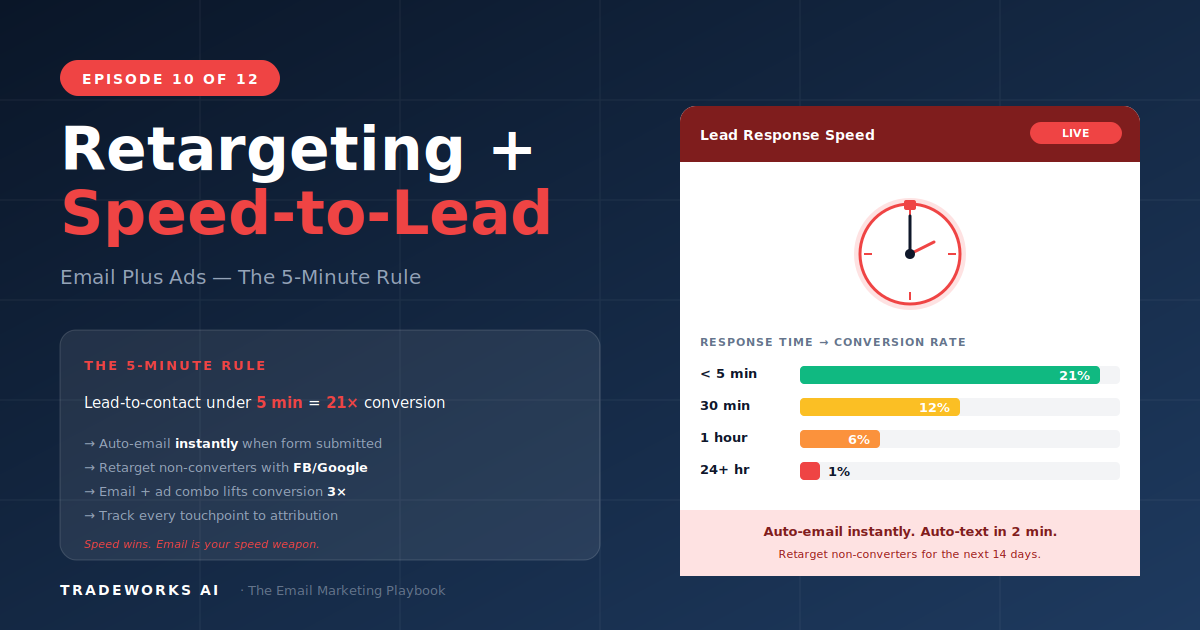
5-minute response automation plus retargeting custom audiences.