Email Marketing · Part 2
Email Foundation: List + Segments
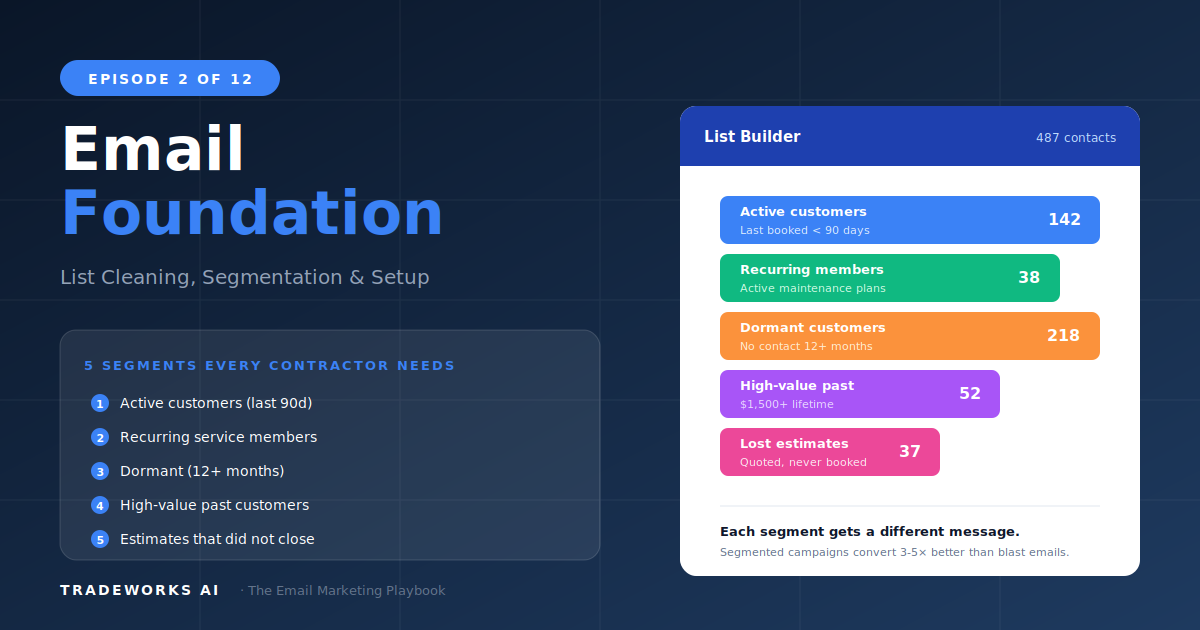
List cleaning, the 5 segments every contractor needs, and platform setup.
Every contractor with an FSM (Jobber, Housecall Pro, ServiceTitan) has between 200 and 2,000 past customers sitting in their CRM doing absolutely nothing. No emails. No follow-up. No reactivation campaigns. Just names in a database collecting dust. Those names are worth between $30,000 and $200,000 in the next twelve months based on dormant customer reactivation rates of 15–25%, average customer lifetime values of $1,500–4,500 for recurring service businesses, and email marketing ROI averaging $36 returned per $1 spent.
Email is the cheapest, highest-ROI marketing channel a contractor can operate, yet 51% of home service contractors have never sent a marketing email to their customer list. This article introduces the Re-Revenue Framework — four revenue pillars (Reactivate, Retain, Recur, Refer) that turn an existing customer list into a measurable revenue engine — and presents the math that shows why email marketing produces 3–8x more revenue per dollar than Google Ads, Facebook Ads, or any other paid acquisition channel for contractors who already have a customer base.
Every contractor we audit at TradeWorks AI follows the same pattern. They have an FSM. The FSM has a customer database. The database has 200 to 2,000 past customers with names, phone numbers, email addresses, service history, and payment records. And the contractor has done nothing with it.
No reactivation campaign for dormant customers. No seasonal maintenance reminders. No referral requests. No educational content. The database sits there while the contractor spends $3,000–10,000 per month on Google Ads and LSAs to acquire new customers who cost 5–10x more than reactivating an existing one.
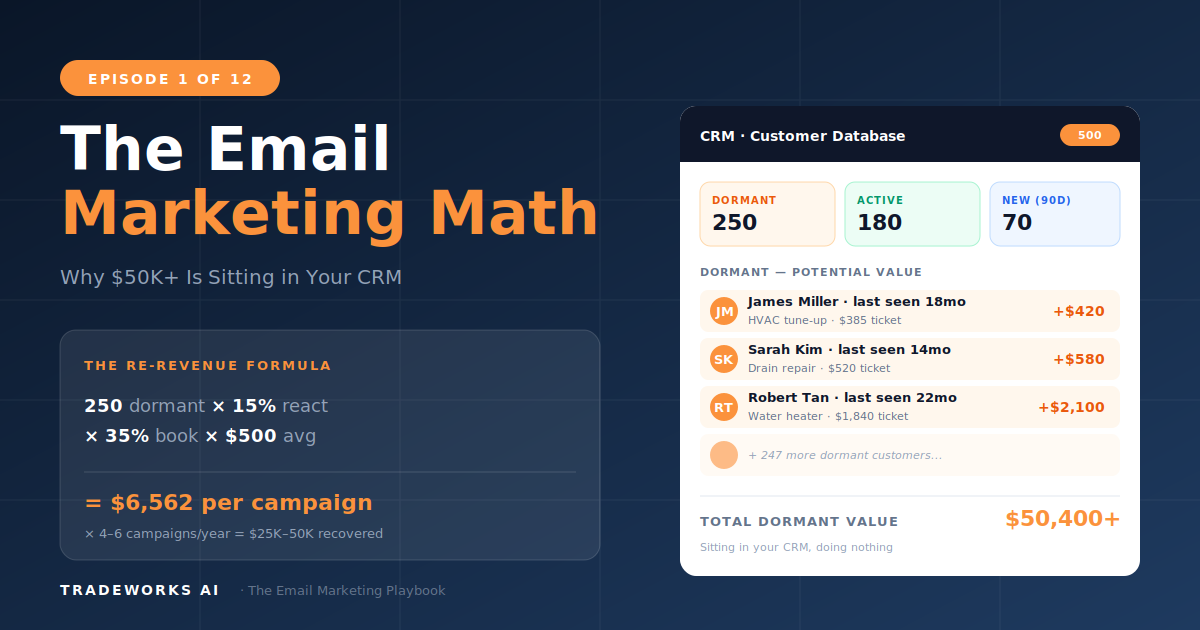
The math on what that database is worth:
Conservative math: 250 dormant customers × 15% reactivation × 35% booking × $500 average ticket = $6,562 from one email campaign. Run 4–6 campaigns per year and the number reaches $25,000–$50,000 in recovered revenue that was sitting in the database doing nothing.
That is before factoring in retention campaigns, recurring service revenue, and referral generation — the other three pillars of the Re-Revenue Framework.
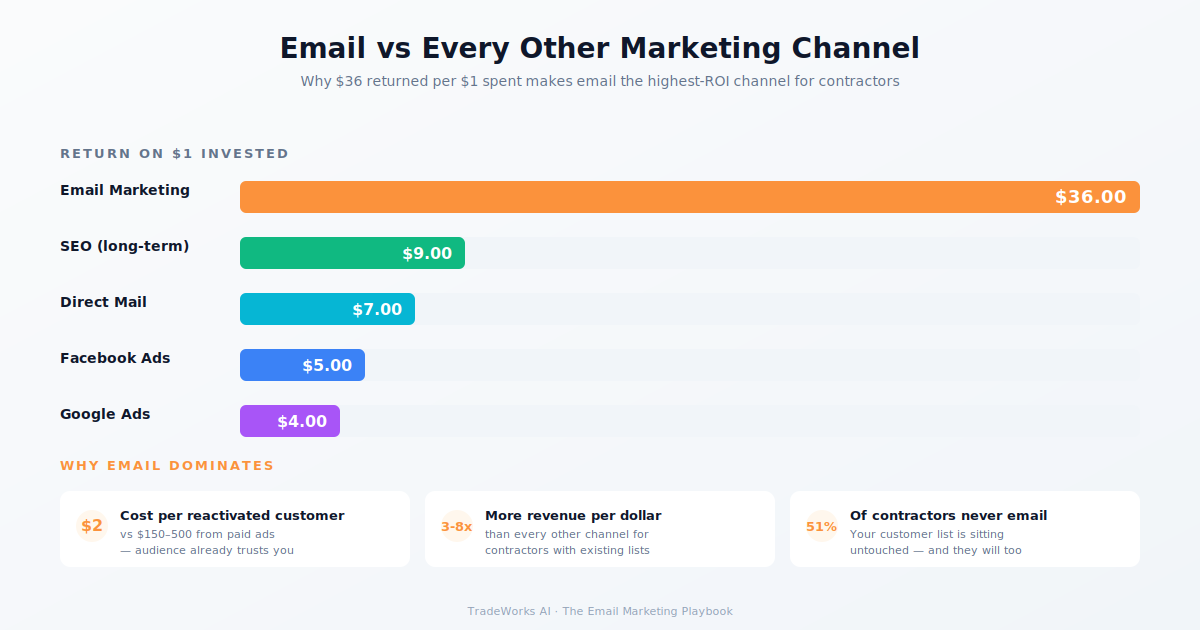
Contractors have heard they should be on social media, running Google Ads, doing SEO. All of those matter. But email outperforms every one of them on a per-dollar basis for businesses with existing customer lists.
Email wins because the audience already knows you. They were your customer. They paid you money. They trusted you in their home. The cost to reach them again is nearly zero compared to the cost of acquiring a new customer through any paid channel. A new customer from Google Ads costs $150–500 to acquire. A reactivated customer from email costs $2–5 to reach. The economics are not close.
Three characteristics of contractor businesses make email particularly powerful:
The Re-Revenue Framework is the operating model for contractor email marketing. Four pillars, each generating revenue from a different angle. Together they turn the customer database into a compound revenue engine.
Bring dormant customers back. The customer who used you 18 months ago and has not called since. They did not leave because they were unhappy — they left because they forgot, moved on, or did not have a need. A well-timed email with a relevant offer brings 15–25% of them back. (See Part 5 for the complete reactivation playbook.)
Keep active customers engaged so they do not become dormant. The customer who called last month should hear from you this month — not with a sales pitch, but with value. Educational content about maintaining their systems. Seasonal tips. Behind-the-scenes of your business.
Convert one-time customers into recurring revenue through maintenance plans, service agreements, and scheduled service programs. Email is the enrollment mechanism and the retention mechanism for these programs. (See Part 7.)
Turn satisfied customers into referral sources. A structured referral request email program produces 3–5x more referrals than hope-based strategies. (See Part 8.)
The compounding effect: a customer reactivated through email does not just produce one job. They re-enter your active customer base. They receive retention emails. They enroll in maintenance plans. They refer others. A single reactivation email produces 3–5 years of subsequent revenue.
If the math is this compelling, why do most contractors not do it? Five reasons:
This series teaches contractors how to extract the revenue in their customer list. Not how to be a marketing expert. Just how to use the customers you already have to generate measurable revenue with minimal effort. The full part list is in the table of contents below this section.
Your customer list is not a database. It is a revenue engine you have not turned on. The Re-Revenue Framework gives you the model: Reactivate dormant customers. Retain active ones. Convert to recurring revenue. Generate referrals. Four pillars, each producing measurable revenue from the customers you already have.
The math is clear: $36 returned per $1 spent. $2–5 per reactivated customer vs $150–500 per new customer. 15–25% of dormant customers respond to well-executed campaigns. Read Part 2 next: building the foundation before your first campaign sends.
As few as 100. The Re-Revenue Framework works at any scale. A solo contractor with 100 past customers running one reactivation campaign can recover $2,000–5,000. Larger databases produce proportionally larger returns. Start where you are.
Most major FSMs (Jobber, Housecall Pro, ServiceTitan) include basic email marketing functionality. You can start there. As your email program matures, dedicated platforms like Mailchimp (free up to 500 contacts) or ActiveCampaign provide more sophisticated automation. Part 4 covers the tool comparison.
A reactivation campaign targeting customers who have not booked in 12+ months. It is the fastest path to measurable revenue and proves the channel works before you invest more effort. Part 5 covers the complete reactivation campaign.
Monthly is the minimum cadence for retention. Bi-weekly for active seasonal campaigns. The sweet spot for most contractors is 2–4 emails per month during peak seasons and 1–2 per month during off-seasons.
Typical unsubscribe rates for contractor emails are 0.3–0.8% per campaign — substantially lower than retail/ecommerce because the relationship is personal. The customers who unsubscribe were unlikely to book again anyway. Do not let a 0.5% unsubscribe rate prevent you from reaching the other 99.5%.
Yes. Email produces $36 per dollar spent vs $3–8 for social and paid ads. Email reaches customers in a format they check daily. SMS complements email but does not replace it. Social media drives awareness; email drives revenue from existing customers.
Most contractors have $30K-$75K of dormant revenue hiding in their FSM. Our free audit quantifies what your list is worth and identifies the highest-impact campaign to recover it first.
List cleaning, the 5 segments every contractor needs, and platform setup.
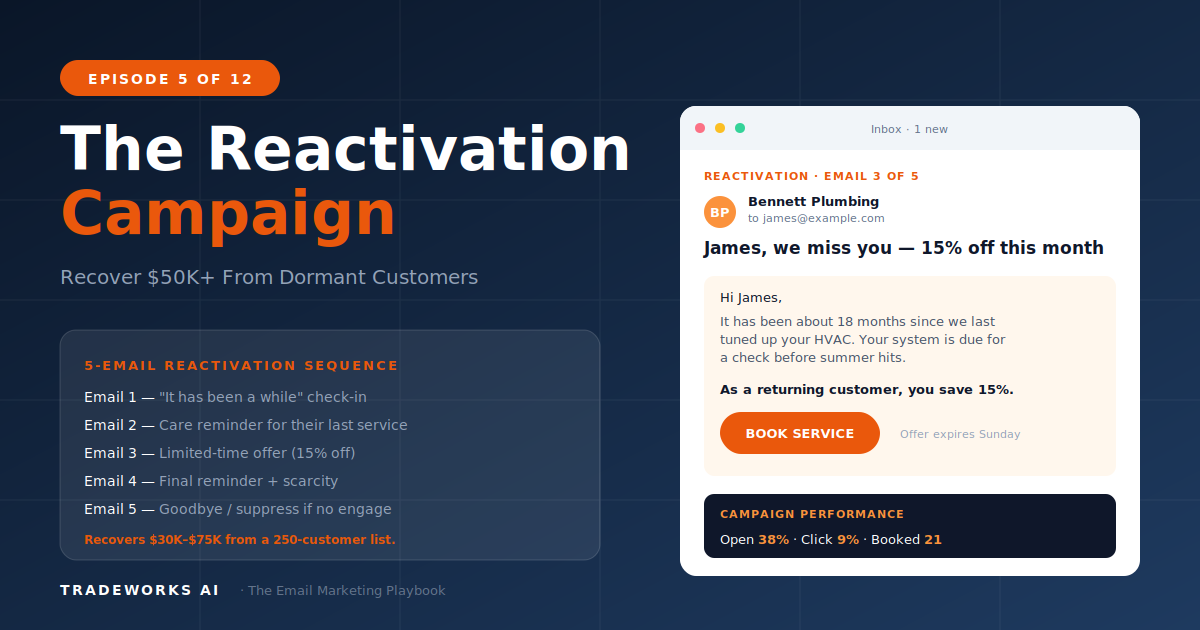
5-email sequence that recovers $30K-$75K from dormant customers.