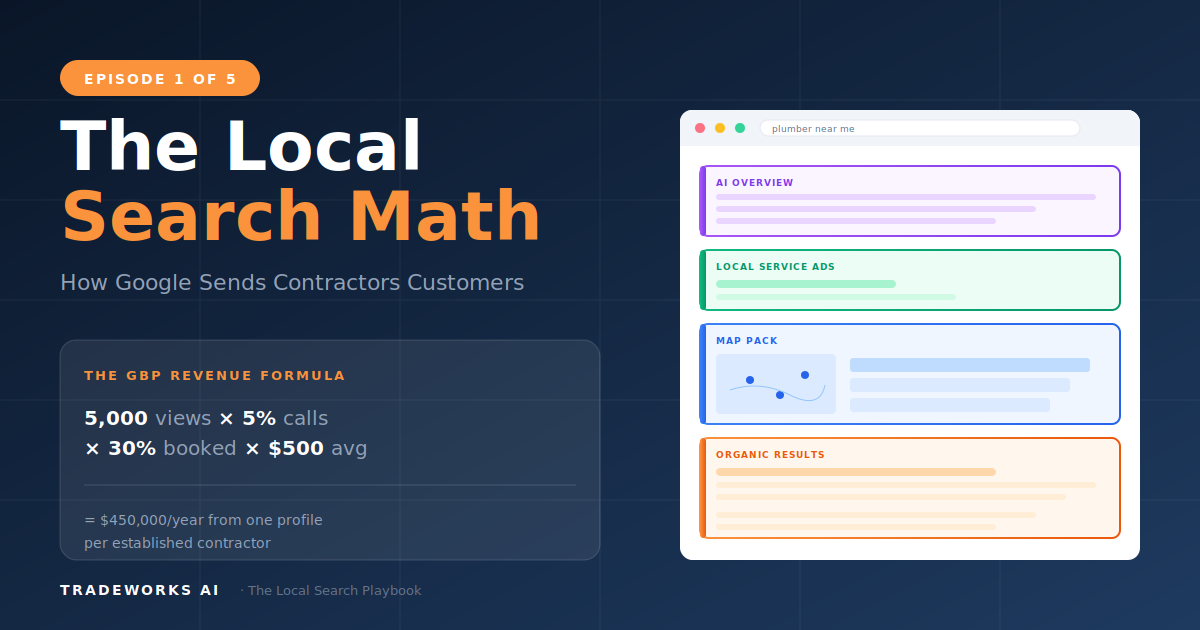
Local Search · Part 1
How Google Actually Sends Contractors Customers
The math behind Google leads, the GBP revenue formula, and the 5-Layer Local Search Stack.
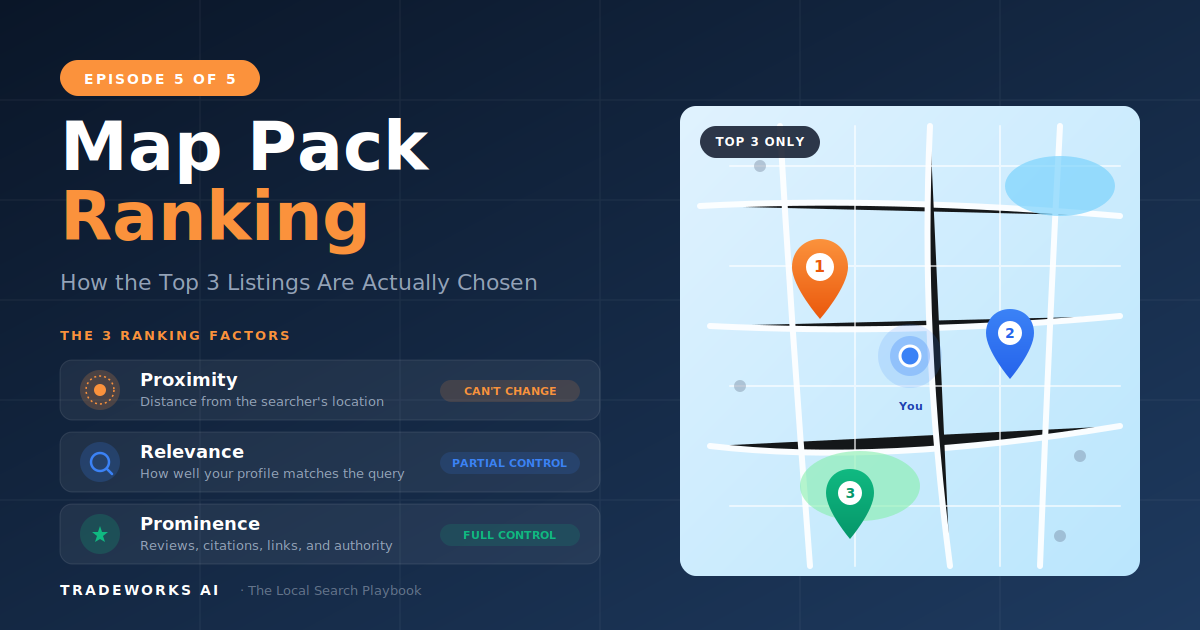
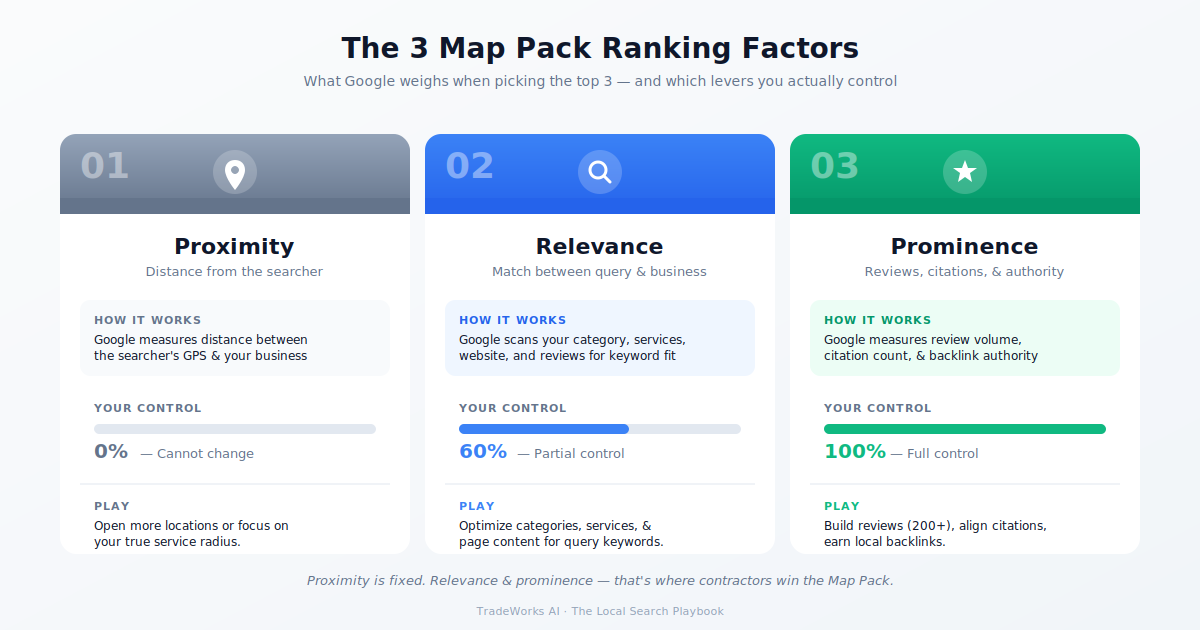
Google Map Pack ranking is determined by three factors: proximity (how close the business is to the searcher, roughly 25–35% of ranking weight), relevance (how well the business matches the query through categories, services, and content, roughly 20–25%), and prominence (how well-known and trusted the business is through reviews, citations, links, and overall web presence, roughly 40–50%).
Contractors cannot control proximity — it is the searcher's location. Contractors directly control relevance through GBP category selection, services, and website content. Contractors build prominence through reviews, citation consistency, link authority, and engagement signals over time.
The Map Pack now appears in only 39% of local searches (down from 78% in 2023), but when it appears, it remains the highest-converting organic local surface. This article breaks down each ranking factor with specific weight estimates from industry testing, the 8 tactical levers contractors actually control, the 5 most common Map Pack myths, and the ranking factor changes in 2026 that shifted weight toward engagement signals and AI-source alignment.
Google officially names three factors for local search ranking: relevance, distance, and prominence. The industry uses "proximity" instead of "distance" and inverts the order by practical importance. The factors are not weighted equally, and the weights have shifted in 2026.
How close the business is to the searcher at the moment of search. This is the factor you cannot control and the one that matters most for "near me" queries.
When a homeowner searches "plumber near me" from their kitchen, Google calculates the distance from their GPS location to every plumber GBP in the area. Closer businesses rank higher, all other factors being equal.
What this means tactically: you cannot move your business to be closer to every searcher. But you can extend your effective proximity through multiple service area signals, city pages on your website, and GBP service area definitions. A contractor with one address and no service area signals is limited to a tight radius. A contractor who defines a 30-mile service area and has city pages for communities within that radius competes for a wider geography.
Proximity weight increases for "near me" and emergency queries. Proximity weight decreases for branded queries and "best in city" queries where the searcher is willing to travel.
How well the business matches what the searcher is looking for. Relevance is determined by your GBP primary and secondary categories, your services list, your business description, and the content on your website.
A homeowner searches "tankless water heater installation Tampa." Google evaluates which plumber GBPs have water heater installation as a listed service, which have plumber as a category, and which have website content about tankless water heaters in Tampa.
What this means tactically: the GBP optimization from Part 2 directly drives relevance. The website content from Part 4 extends relevance into long-tail queries.
Relevance is the most underoptimized factor for contractors. Most have their primary category set and nothing else. Adding 5–9 secondary categories, listing 15–25 services, and building service-specific landing pages can move relevance from average to top-tier in 2–4 weeks.
How well-known and trusted the business is on the web. Prominence is the factor where the most effort produces the most impact because it encompasses multiple sub-signals you directly control.
Prominence sub-signals:
Prominence weight has increased in 2026 as Google relies more on behavioral and engagement signals to differentiate between businesses in the same proximity and relevance tier.
Within the three ranking factors, there are exactly 8 levers contractors can directly influence. Arranged by impact:
Three specific changes in 2026 shifted Map Pack ranking dynamics.
Google now weights click-through rate, call volume, and direction requests more heavily than in prior years. Profiles that generate high engagement rank better even with slightly fewer reviews than competitors. This rewards businesses that customers actually contact, not just businesses with the most reviews.
The gap between active and dormant profiles widened in 2026. Posting weekly, uploading photos monthly, and responding to reviews within 48 hours became baseline requirements rather than competitive advantages. Contractors not doing these things are falling behind faster.
Businesses that appear in AI Overviews for local queries are showing correlated improvement in Map Pack positioning. The causation is debated, but the correlation is measurable. Strong AI Overview presence (through FAQ content and schema markup from Part 4) appears to reinforce Map Pack ranking signals.
The Map Pack is organic. You cannot buy placement. Local Service Ads (LSAs) appear above the Map Pack and are paid, but the Map Pack itself is algorithm-driven. Any service promising paid Map Pack placement is either selling LSAs (legitimate) or running a scam (not).
Review volume matters, but it is not the only prominence signal. A contractor with 500 reviews and no GBP activity, thin website, and inconsistent NAP can rank below a competitor with 200 reviews and strong signals across all other levers. Volume is necessary but not sufficient.
Service-area businesses (SABs) can rank in areas they do not physically occupy. Your GBP service area definition, your city pages, and your customer review locations all extend your effective proximity. A contractor based in Tampa can rank in Clearwater if the other signals are strong.
Adding keywords to your GBP business name ("Tampa Best Plumber - Smith Plumbing") does provide a short-term ranking boost for some queries. But it violates Google TOS and results in suspension. The risk far outweighs the temporary benefit. Your business name should be your legal DBA.
Rankings fluctuate by the hour based on searcher location, query variation, time of day, and competitive activity. A contractor might rank 1st from one neighborhood and 5th from another for the same query. Local rank tracking tools (Local Falcon, BrightLocal Local Search Grid) show this variation visually. Do not judge your ranking from a single search at a single location.
Standard Google search from your office shows you one data point. Real Map Pack tracking requires tools that check ranking from multiple locations across your service area.
Check rank from at least 9 geographic points across your service area (3×3 grid minimum). Monthly tracking reveals trends. Weekly tracking reveals algorithm response to optimization changes.
Map Pack ranking is not one optimization — it is the cumulative result of all 8 levers operating together. Review volume alone does not win. GBP completeness alone does not win. The contractor who operates all 8 levers at a high level consistently outranks competitors who optimize one or two.
The Map Pack now appears in only 39% of local searches, but when it does appear, it captures the highest-converting organic local traffic. Optimizing for the Map Pack while simultaneously building the Content Authority Layer (Part 4) and AI Source Coverage ensures visibility across all surfaces.
Depends on starting position and competition. GBP completeness improvements (categories, services, description) can show impact in 2–4 weeks. Review volume gains take 60–90 days to produce ranking movement. Link building and content depth take 3–6 months. Full 8-lever optimization typically shows measurable improvement within 90 days.
Yes, if you are a service-area business. Define your service area in GBP, build city-specific landing pages with genuine local content, accumulate reviews from customers in that area, and maintain NAP consistency. Proximity still matters — closer competitors have an advantage — but strong relevance and prominence signals can overcome moderate proximity disadvantage.
GBP completeness (Lever 3) first because it is the fastest to fix and enables all other optimizations. Then review volume and velocity (Lever 1) because it is the highest-impact prominence signal. Then NAP consistency (Lever 5) because it removes friction across all other signals.
No. Manufactured search behavior violates Google guidelines and can trigger penalties. Behavioral signals improve naturally when your GBP is optimized (better CTR from better photos and descriptions), your service is strong (more calls and direction requests), and your website serves user intent. Optimize the inputs, not the metrics.
Use Local Falcon or BrightLocal Local Search Grid to map your rank across geographic points. If you rank well near your office but poorly 10 miles away, proximity is the limiting factor. The fix is stronger relevance and prominence signals in those distant areas — city pages, reviews from those neighborhoods, and service area definition.
Yes. When the Map Pack appears (39% of local searches), it remains the highest-converting organic surface. And Map Pack optimization (GBP, reviews, citations, content) directly feeds AI Overview visibility and AI tool recommendations. The same optimization serves multiple surfaces simultaneously.
Map Pack ranking is the cumulative result of 8 tactical levers operating together. Most contractors optimize 2 or 3 and wonder why they're stuck on page two. Our free audit grades you on every lever and shows the highest-impact fixes for your market.
The math behind Google leads, the GBP revenue formula, and the 5-Layer Local Search Stack.
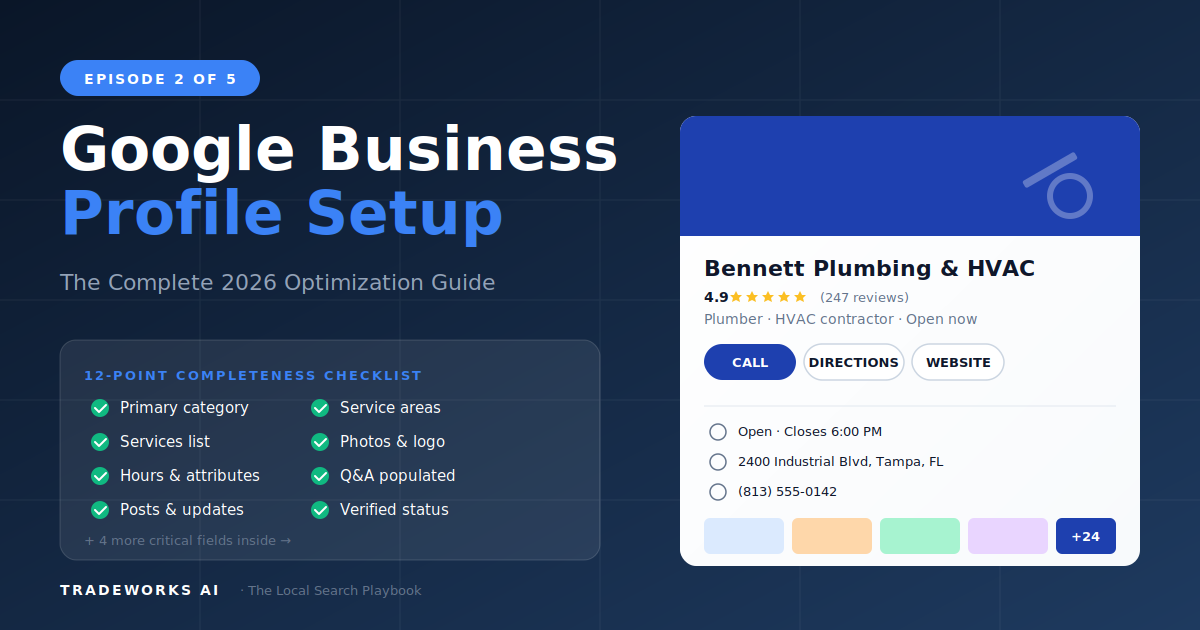
The 12-point completeness checklist and every GBP field that drives Map Pack visibility.