Local Search · Part 2
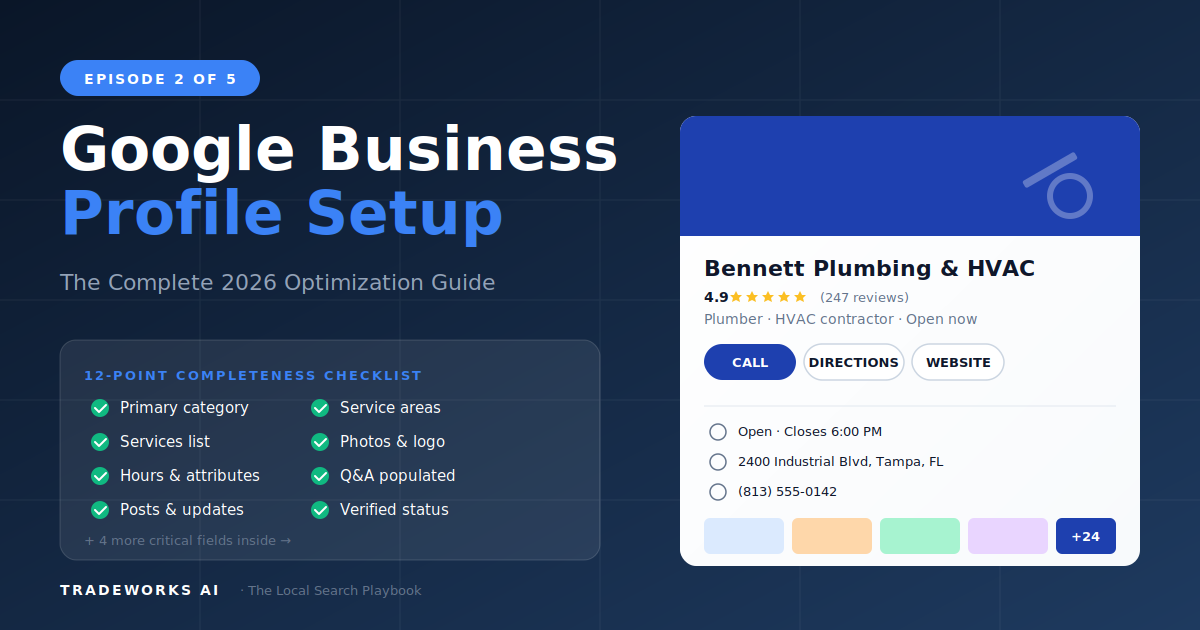
Google Business Profile Setup for Contractors
The 12-point completeness checklist and every GBP field that drives Map Pack visibility.
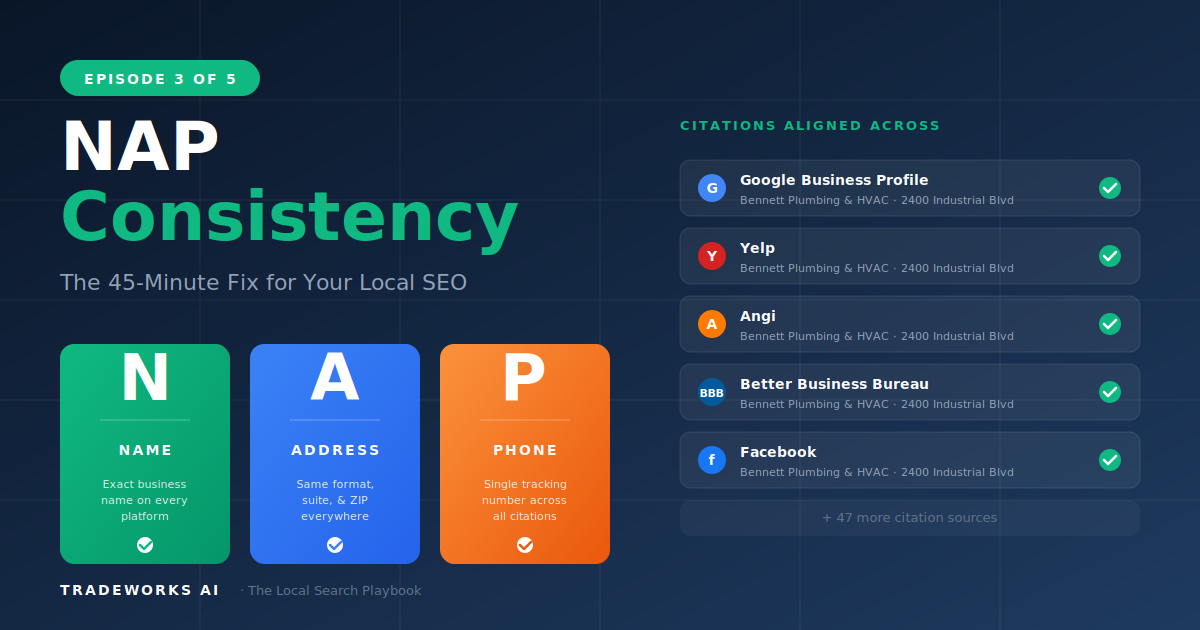
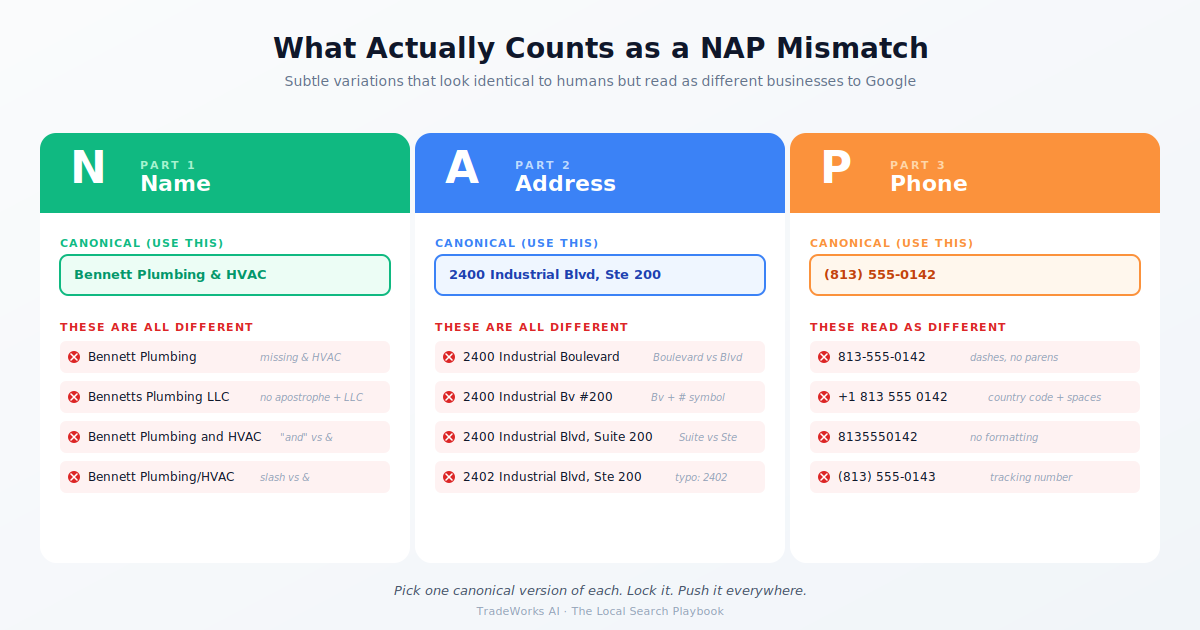
NAP stands for Name, Address, and Phone number — the three data points that must be identical across every online listing, directory, and platform where your business appears. A single inconsistency — a suite number present on Google but missing on Yelp, a phone number with dashes on your website but parentheses on BBB, a business name with "LLC" on some listings and without on others — creates entity confusion in search algorithms.
Google, ChatGPT, Gemini, and Perplexity all cross-reference your NAP data across the web to verify that your business exists, operates at its stated location, and is the entity it claims to be. Inconsistent NAP data degrades trust signals across every layer of the Local Search Stack.
The fix takes roughly 45 minutes: a citation audit using free or low-cost tools, identification of the top 25 citation sources that matter for contractors, correction of inconsistencies at the source, and submission to data aggregators that propagate fixes across hundreds of secondary directories.
NAP consistency is not a ranking factor on its own — it is an entity verification signal that enables every other ranking factor to work properly. Think of it as the plumbing behind the wall: nobody notices when it works, but everything breaks when it does not.
When Google encounters your business name, address, and phone number across multiple sources and they all match, it gains confidence that your business is real, operates where it claims, and should be trusted with visibility. When those data points conflict, Google loses confidence and hedges — showing competitors with cleaner data instead.
In 2026, the stakes are higher because NAP data feeds AI systems too. ChatGPT and Gemini cross-reference your listings when generating contractor recommendations. Conflicting data creates uncertainty in AI recommendation logic. The AI defaults to recommending the competitor whose entity data is clean across all sources.
Most contractors do not create NAP inconsistencies on purpose. They accumulate over time through five common patterns:
The average contractor has 50–80 online listings. Even a 10% inconsistency rate means 5–8 conflicting data points degrading entity trust across the web.
The audit identifies every inconsistency across your listings and prioritizes fixes. It takes roughly 45 minutes with the right tools.
Write down the exact version of your business name, address, and phone number that appears on your Google Business Profile. This is your canonical NAP — the single correct version that every other listing must match.
Be specific about formatting. If your GBP says "123 Main Street Suite 100," every listing should say "123 Main Street Suite 100" — not "123 Main St Ste 100," not "123 Main Street #100."
Use a citation scanning tool to find every listing across the web. Three options:
Most inconsistencies propagate from four data aggregators that feed hundreds of secondary directories. Fix the aggregators first and the fixes cascade downstream.
Submit corrections to all four aggregators. Propagation takes 4–8 weeks for full distribution to secondary directories.
While aggregator fixes propagate, manually correct the top-tier directories that matter most for contractor visibility. These directories have their own databases and may not update from aggregator corrections alone.
Not all directories matter equally. These 25 sources cover roughly 90% of citation value for home service contractors in 2026.
Thumbtack, HomeAdvisor (Angi network), Houzz, YellowPages.com, Superpages.com, Manta.com, MapQuest, Foursquare.
CitySearch, DexKnows, Local.com, Brownbook, Hotfrog, EZLocal, ShowMeLocal, Merchant Circle, 2FindLocal.
Tier 3 directories have lower individual value but collectively reinforce entity trust signals. Fix them after Tier 1 and 2 are clean.
Manual fixing works for the initial audit. Ongoing consistency requires either regular manual audits (quarterly) or automated tools that monitor and correct continuously.
In 2026, NAP consistency has a new dimension: AI entity verification.
When ChatGPT generates a contractor recommendation, it cross-references multiple data sources. If your business name appears differently on Angi than on Google than on your website, the AI treats these as potentially different entities. The recommendation confidence drops.
When Gemini checks Facebook and Nextdoor for neighborhood recommendations, it matches the business entity against what it finds on Google. Mismatched phone numbers or address variations create entity confusion that reduces recommendation probability.
Clean NAP across all sources creates what AI researchers call high entity resolution confidence — the AI is certain that all references point to one real business. That certainty translates directly to recommendation eligibility.
NAP consistency is the invisible foundation of the Local Search Stack. It costs nothing to fix beyond labor. The 45-minute audit identifies every inconsistency. The data aggregator submissions start the fix cascading across hundreds of directories. The ongoing monitoring ensures consistency holds.
The contractors with clean NAP data across all 25 top-tier sources have higher Map Pack visibility, stronger AI recommendation eligibility, and better conversion because customers never encounter conflicting information.
Run a citation scan using BrightLocal, Whitespark, or the free Moz Local Check. The scan compares your listings against your canonical NAP (the version on your Google Business Profile) and flags every mismatch. Most contractors find 5–15 inconsistencies on the first scan.
4–8 weeks for full propagation from the four major data aggregators to secondary directories. Tier 1 directories (Google, Bing, Apple, Facebook, Yelp) should be fixed directly — do not wait for aggregator propagation on critical sources.
Not directly as a standalone ranking factor. NAP consistency is an entity verification signal that enables other ranking factors (reviews, proximity, relevance) to function properly. Think of it as removing a penalty rather than adding a boost. Clean NAP removes friction. Dirty NAP adds friction that limits every other optimization.
Depends on scale and budget. Single-location contractors can fix NAP manually in 45 minutes and monitor quarterly for zero cost. Multi-location contractors or those who want real-time sync benefit from Yext or BrightLocal automation. The 45-minute manual approach works for most contractors at Stage 1–3.
Duplicate listings are a specific form of NAP inconsistency. If Google finds two GBP profiles for the same business, it may suppress both or merge them incorrectly. Claim and remove duplicates through the Google Business Profile dashboard. On other platforms, contact support to merge or delete duplicate listings.
Quarterly for manual audits. Monthly if using automated monitoring tools. Immediately after any business change (address move, phone number change, name change, new location). Data aggregators and scrapers continuously create and update listings — consistency is not a one-time fix.
Most contractors have 5–15 NAP inconsistencies they can't see — quietly degrading Map Pack rank and AI recommendation eligibility. Our free audit scans your top citation sources, surfaces every mismatch, and gives you a prioritized fix list.
The 12-point completeness checklist and every GBP field that drives Map Pack visibility.
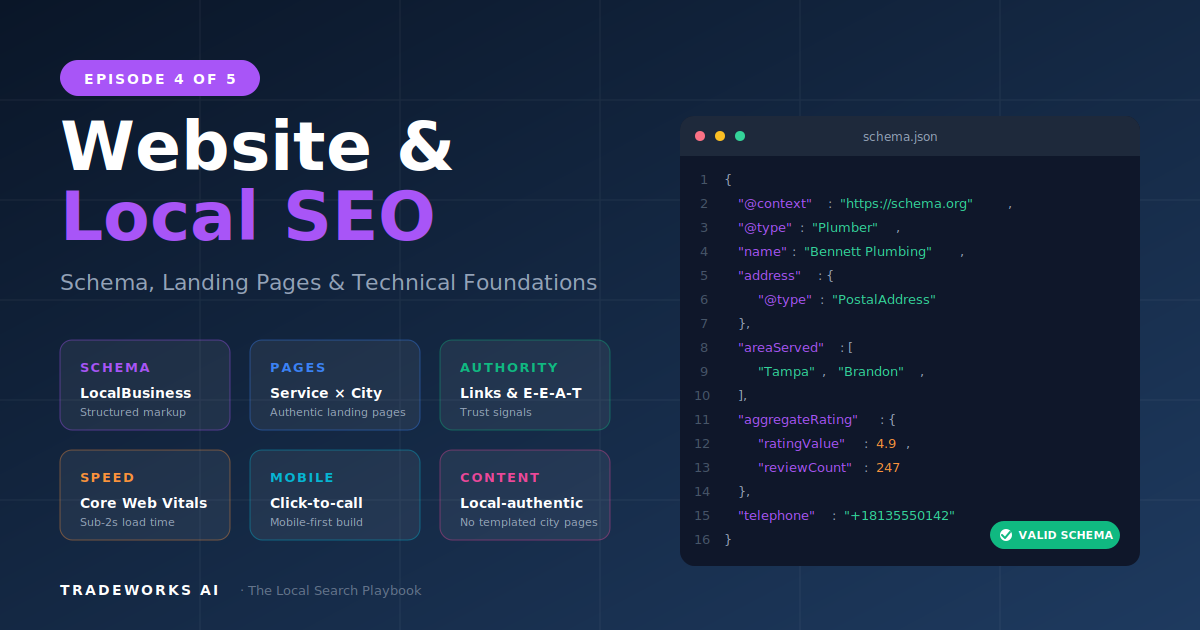
Schema, service pages, city pages, and the FAQ content strategy that wins AI Overview citations.