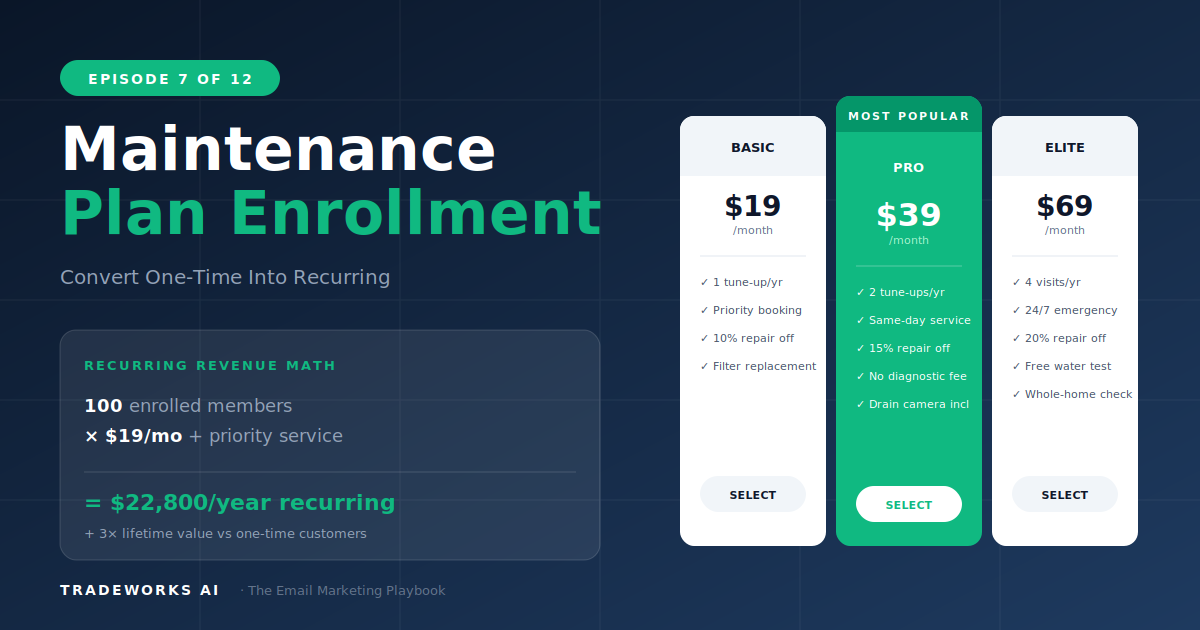
Email Marketing · Part 7
Maintenance Plan Enrollment
3-email post-service sequence that converts one-time to recurring.
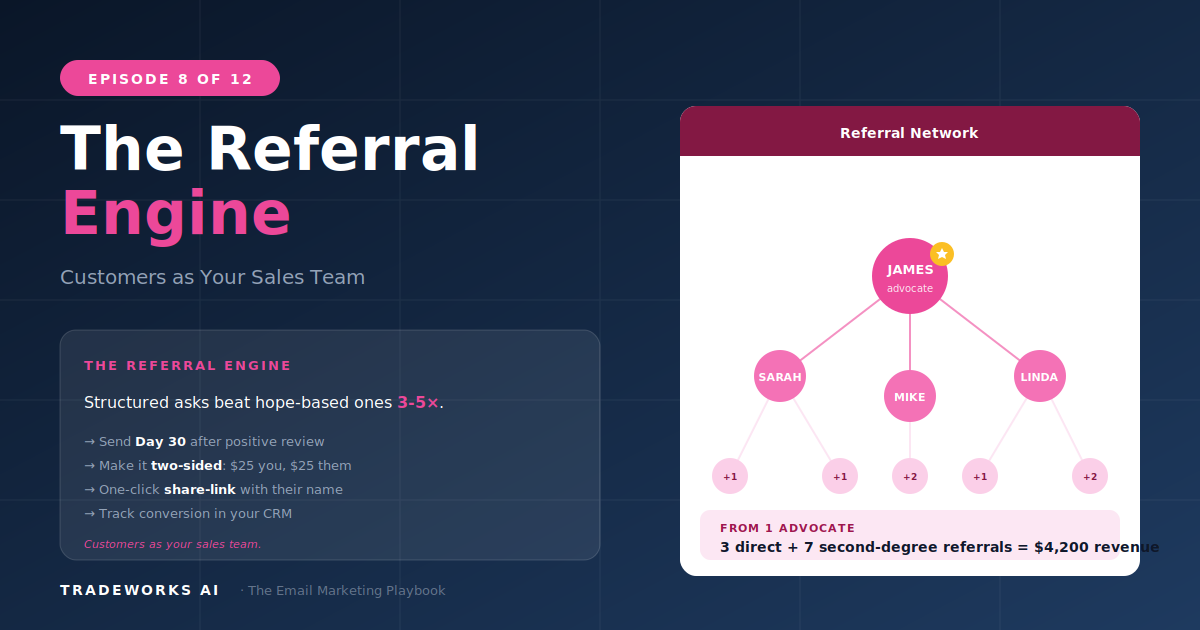
A referred customer costs zero to acquire, converts at 2–4 times the rate of a paid lead, and has a 37% higher retention rate than a customer acquired through advertising. For home service contractors, referrals are consistently the highest-quality lead source available, yet most contractors treat referrals as something that happens passively rather than something they engineer.
A structured referral campaign built on a two-email post-service sequence with dual-sided incentives generates 8–15 referrals per 100 satisfied customers, producing $15,000–45,000 in annual referred revenue for a typical contractor with 1,500 active customers.
Referred customers arrive pre-sold. They already trust you because someone they trust recommended you. They do not price-shop as aggressively. They decide faster. They spend more. And they are more likely to become referral sources themselves, creating a compounding growth loop.
Despite these advantages, most contractors' referral strategy is hoping satisfied customers mention them to neighbors. Hope is not a strategy. A structured referral engine turns this passive channel into a predictable, measurable revenue source.
The single biggest factor in referral campaign success is timing. Ask too early and the customer has not yet experienced the full value of your service. Ask too late and the emotional peak has passed.
In the Welcome Sequence (Part 3), the referral ask lives in Email 4 at Day 14 for new customers.
Deliberately shorter than reactivation (5 emails) or seasonal (4 emails) campaigns. Referral asks work best when they are direct, easy, and infrequent. Overasking erodes the relationship.
Subject lines:
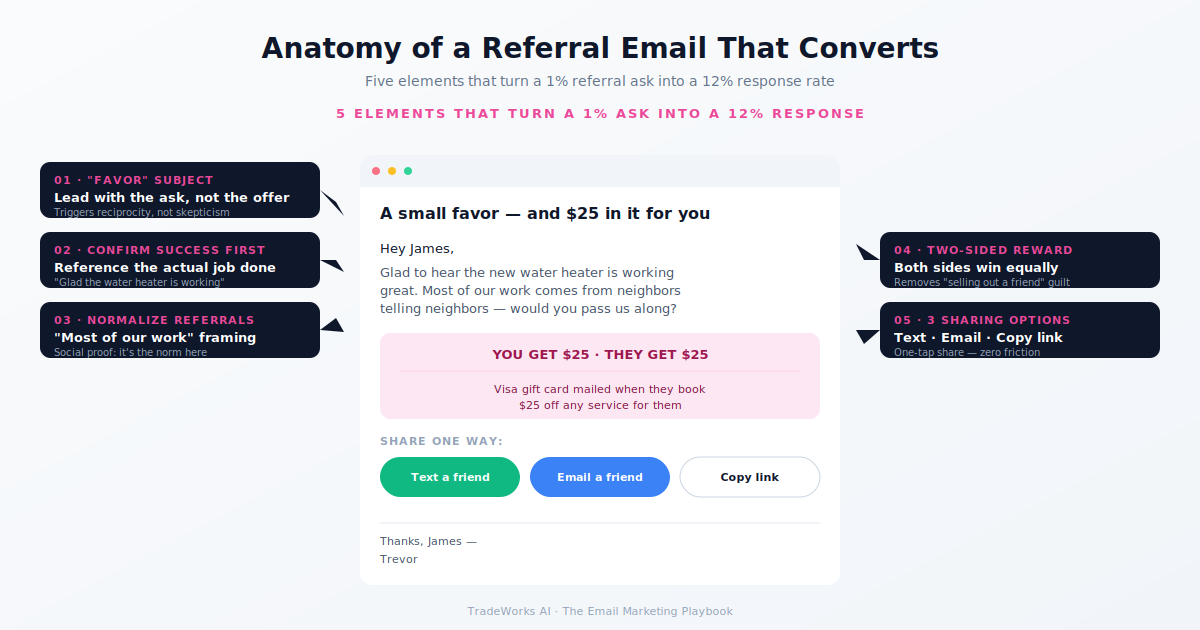
Body: Brief thank-you for their recent service. Then: "If you know a friend, neighbor, or family member who could use a reliable [trade] in [city], we would love the introduction. And we will make it worth your time." Introduce the dual-sided incentive: "You receive a $[XX] credit on your next service. Your referral receives $[XX] off their first appointment."
Referral mechanism (ranked by conversion rate):
Trigger: Only sent to customers who opened Email 1 but did not reply, click, or forward.
Body: Keep this short. Two to three sentences max. "Just a quick follow-up on my note last week. If anyone comes to mind who could use a trusted [trade] in [city], reply with their name and we will take care of the rest."
This email is the last referral ask for this service event. Do not send a third.
The psychology of dual-sided incentives consistently outperforms one-sided incentives by 25–40%.
Maintenance plan members (Part 7) are your highest-value referral sources because they have an ongoing relationship, high satisfaction, and skin in the game.
For plan members, add a quarterly referral nudge on top of the post-service sequence:
Subject: "Your referral scorecard, [First Name]"
Body: Show their referral history: how many people they have referred, total credits earned, credits available. If they have never referred, the scorecard shows zeros, which creates a gentle nudge without being pushy.
The confirmation email is critical. Customers who receive prompt confirmation of their referral reward are 60% more likely to refer again.
Hope is not a referral strategy. The referral engine turns satisfied customers into a predictable, low-cost lead generation channel. $15,000–45,000 in annual referred revenue from a 2-email automation that runs once configured. Read Part 9 next: how email becomes your review generation engine.
8–15 referrals per 100 satisfied customers who receive the referral sequence. This rate improves over time as customers see others participating and as your service quality builds word-of-mouth momentum.
No. Each ask deserves its own moment. The review request goes at Day 3–5 post-service. The referral ask goes at Day 7. Combining them dilutes both. Customers who are asked to do two things often do neither.
Credit the referrer anyway. The referral reflects their intent and effort. If the existing contact is dormant, treat the referral as a reactivation trigger. If the contact is active, send a thank-you to the referrer and note the duplicate.
Commercial referrals work best through relationship-based outreach rather than automated email. Adjust the incentive: instead of service credits, offer a free quarterly inspection or a priority response time upgrade.
Yes, but sparingly. Annual referral contests can spike referral activity. Keep leaderboards private to avoid making non-participants feel pressured. Public leaderboards work for commercial accounts but feel awkward for residential homeowners.
Standard dual-sided service credits are legal in all 50 states for contractor referral programs. Some states regulate referral fees for licensed services (real estate, insurance) but not standard home service contracting. Check your state's contractor licensing rules and your state attorney general guidance for any specific restrictions.
Hope is not a referral strategy. Our free audit benchmarks your current referral acquisition rate and shows what a structured email engine could produce for your customer base.
3-email post-service sequence that converts one-time to recurring.
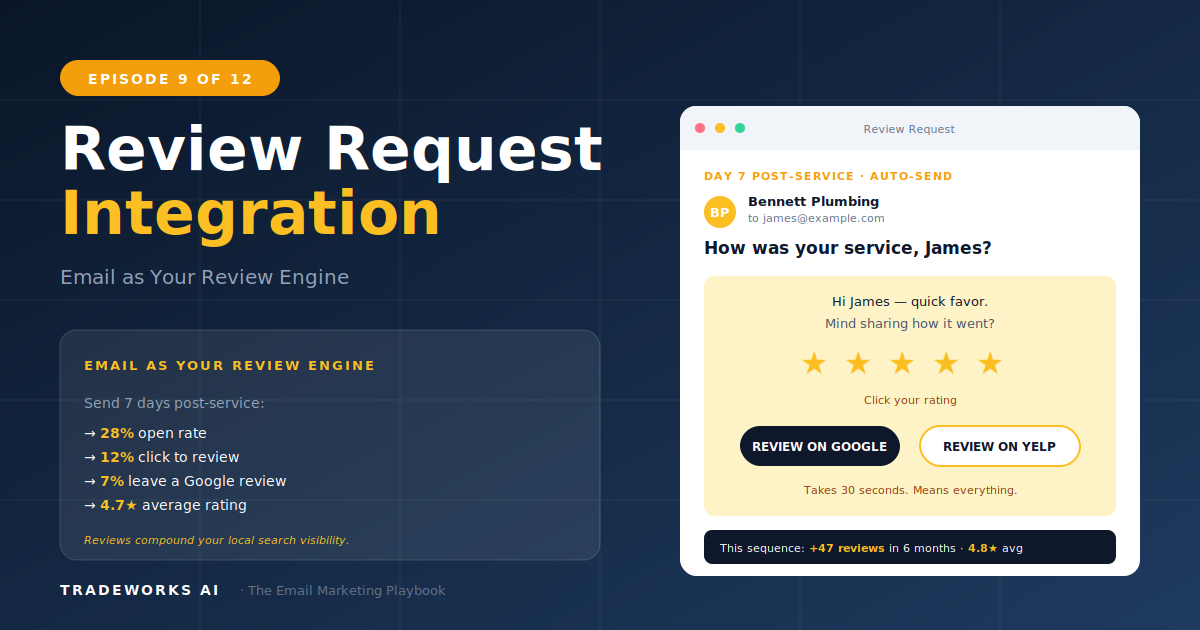
2-email sequence with the satisfaction gate that builds 4.8-star reputation.