Business Operations · Part 6
First Hire: Who, When, and How to Onboard
Continue the Business Operations series with Part 6 of 12.
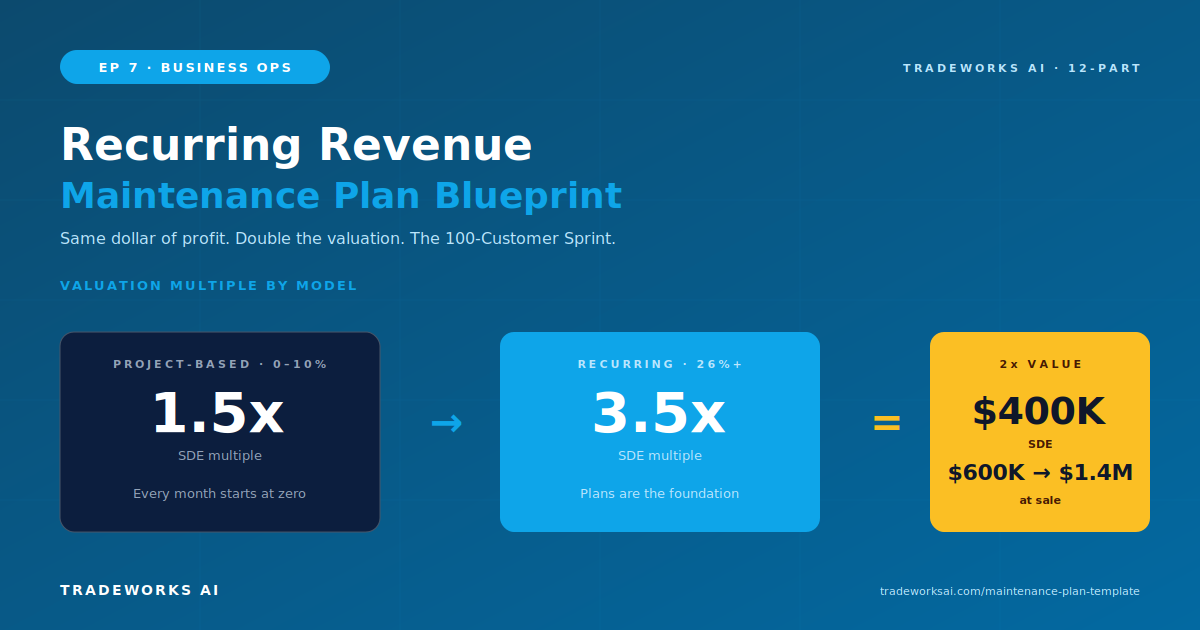
Recurring revenue for contractors comes in three forms: maintenance plans (scheduled preventive service at a fixed annual or monthly price), service agreements (priority service and discounted rates for enrolled customers), and subscription services (ongoing monitoring, filter delivery, or water quality testing). The multiplier impact is dramatic: project-based contractor businesses trade at roughly 1.5 times Seller’s Discretionary Earnings (SDE), while recurring-revenue-heavy businesses trade at 3.0 to 3.5 times SDE. Same dollar of profit, double the valuation. Most contractors operate at 0–10% recurring revenue. The target is 25%+. The path from 0% to 25% is a 90-day sprint to convert the first 100 existing customers to a maintenance plan.
Download the free Maintenance Plan Template — pricing calculator, enrollment script, and marketing materials → tradeworksai.com/maintenance-plan-template
In Part 2, we introduced Sellability Pillar 2: Recurring Revenue. The diagnostic question: what percentage of next month’s revenue is predictable today? Recurring revenue changes three things simultaneously:
Valuation multiple: project-based at 1.5x SDE, recurring-revenue at 3.0–3.5x SDE. On $400K SDE, that’s the difference between a $600K sale and a $1.4M sale.
Cash flow predictability: 200 maintenance plan customers at $30/month = $6,000 guaranteed monthly revenue before answering a single call. That’s $72,000/year regardless of weather or seasonality.
Customer lifetime value: a plan customer stays 3–5x longer than a one-time service customer, generating emergency calls, replacements, and referrals for years.
Every contractor business sits on a spectrum from fully project-based to fully recurring.
Position 1 (0–10% recurring): Fully project-based. Every month starts at zero. Valued at 1.0–1.5x SDE.
Position 2 (11–25% recurring): Hybrid model. Maintenance plan exists but underdeveloped. Valued at 1.5–2.5x SDE.
Position 3 (26%+ recurring): Recurring-revenue-forward. Plans are the foundation; project work is upside. Valued at 2.5–3.5x SDE.
Most contractors are at Position 1. The goal is Position 3. The path goes through the Maintenance Plan Blueprint.
The most common form. Customer pays fixed annual or monthly fee for scheduled preventive maintenance. Example HVAC: $199/year or $18.99/month. Includes 2 tune-ups, priority scheduling, 15% repair discount, no overtime charges. Gross margin: 65–78%. Generates 2.5–3.5 additional service calls per customer per year at full margin.
Lighter-touch for trades where scheduled maintenance is less common. Customer pays for priority access and discounted rates. Example plumbing: $149/year for priority scheduling, 10% discount, free annual inspection, waived diagnostic fees.
Product-delivery or monitoring-based. Examples: HVAC filter delivery ($15–$25/month), water quality monitoring ($29/month), pest control recurring treatments ($35–$50/month). Highest margin and lowest fulfillment cost but requires delivery/monitoring systems. Best for Stage 3+.
The Maintenance Plan Template includes pricing for all three types → tradeworksai.com/maintenance-plan-template
Building a plan program follows five components:
Good-Better-Best structure (Part 5). Good ($149–$199/year): 1 visit, priority, 10% discount. Better ($249–$349/year): 2 visits, same-day, 15% discount, no overtime. Best ($399–$499/year): 2 visits, same-day, 20% discount, no overtime, no diagnostic fees, parts warranty. 55–65% choose Better. Price Good at break-even to anchor Better and Best.
Enrollment at two moments: during service call (technician presents after repair) and during follow-up (office calls 24–48 hours post-service). Technician script: “We just fixed [problem]. The maintenance plan would have caught this before it became an emergency. Here are three options.” Target attach rate: 15–25% of service calls.
Auto-recurring billing via ServiceTitan membership module, Housecall Pro service plans, or Stripe Billing. Monthly billing ($18.99/month) produces higher lifetime value — monthly churn 8–12% vs annual 15–20%. 60–70% of customers choose monthly when offered.
Automated dispatch of maintenance visits from CRM/FSM tool. Customer receives 7-day reminder, 24-hour confirmation, 24-hour follow-up. Fulfillment failure (missed visits) is #1 cause of cancellation.
Annual renewal call from owner, birthday/anniversary emails, exclusive promotions, refer-a-friend incentive ($25 credit). Target retention: 85–90% annual. Below 80% = fulfillment or pricing problem.
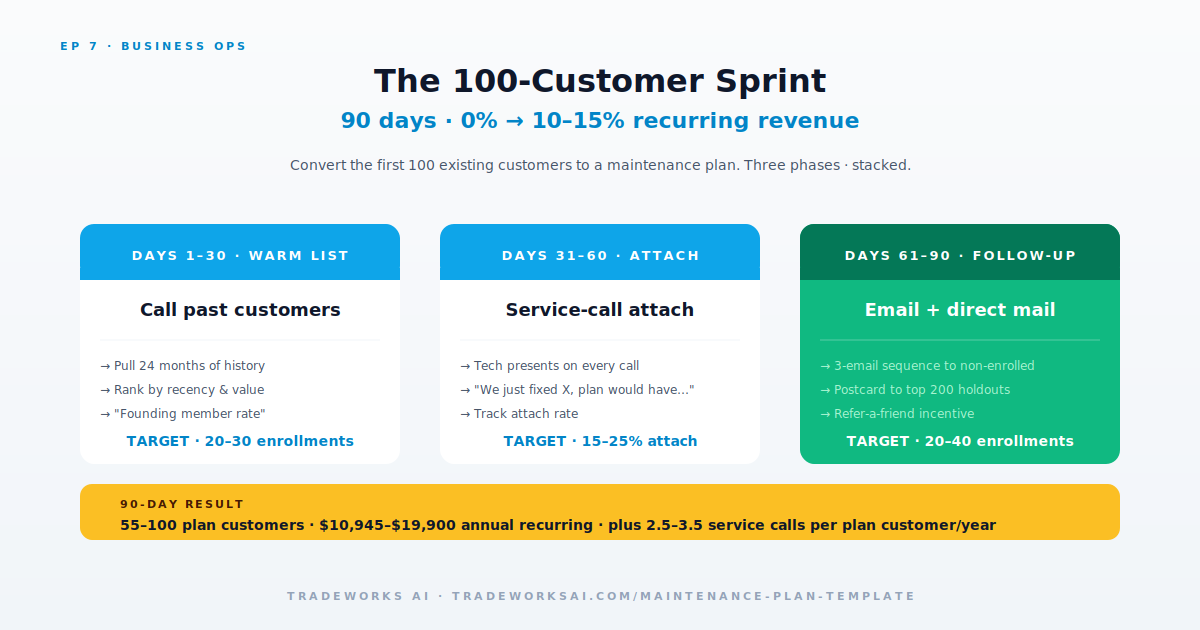
A 90-day campaign to convert the first 100 existing customers to a maintenance plan.
Pull every customer from last 24 months with a service call but no plan.
Rank by recency and job value. Call the top 100.
Script: “We’re launching a maintenance plan. As a past customer, you’re eligible for the founding member rate.”
Target: 20–30 enrollments in 30 days.
Technicians present plan on every service call.
Track attach rate. Target: 15–25% = 15–30 enrollments/month.
3-email sequence to non-enrolled warm list.
Direct mail postcard to top 200 non-enrolled.
Target: 20–40 additional enrollments.
Total 90-day target: 55–100 plan customers. At $199/year average: $10,945–$19,900 in new annual recurring revenue. Plus each plan customer generates 2.5–3.5 additional service calls per year.
The template includes enrollment scripts, email sequences, direct mail, and the 90-day sprint tracker → tradeworksai.com/maintenance-plan-template
Recurring Revenue % (Metric 10) — target 25%+.
Attach Rate — new enrollments / completed service calls. Target 15–25%.
Plan Retention Rate — renewed / eligible. Target 85–90% annual.
Revenue Per Plan Customer — total revenue from plan customers / plan count. Benchmark $450–$750/year.
The attach rate is 15–25% — 75–85% will decline. The business case requires enough customers to move recurring revenue above 25%, not every customer. On 1,000 service calls/year at 20% attach: 200 plan customers × $199 = $39,800 annual recurring.
Offer both. Monthly produces higher lifetime value (8–12% annual churn vs 15–20%). Annual produces better upfront cash flow. 60–70% of customers choose monthly.
Buyers want 12–18 months of stable recurring with documented retention. Starting today produces sellability impact in 12–18 months. Compounds: 100 customers Year 1, 170–200 Year 2, 250–300 Year 3.
CRM/FSM tool with membership module (ServiceTitan, Housecall Pro, Jobber), billing tool for auto-recurring (often built-in, or Stripe Billing), email tool for retention (Mailchimp, ActiveCampaign). Additional cost: $0–$100/month if already using FSM tool.
82% of contractor businesses never break $1M, and most don't know which operational system is missing. Our free audit grades your business against the 5 stages, names the chaos gap blocking you, and identifies the highest-leverage system to build next.
Continue the Business Operations series with Part 6 of 12.
Continue the Business Operations series with Part 8 of 12.