
Business Operations · Part 2
Is Your Contractor Business Sellable? 5-Pillar Scorecard
Continue the Business Operations series with Part 2 of 12.
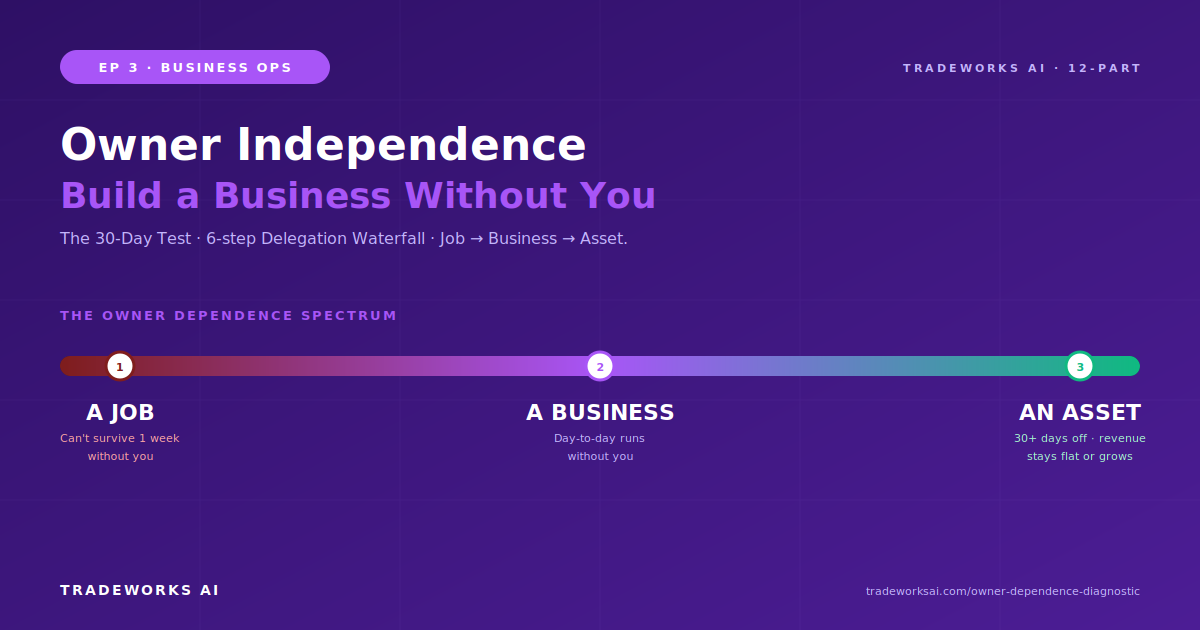
Owner independence is the single biggest determinant of whether a contractor business is sellable, scalable, or stuck. The diagnostic is simple: can your business run for 30 days without you — no calls, no texts, no decisions routed back? If yes, you own a business. If no, you own a job. Most contractors fall on a spectrum between three positions: a job (cannot survive a week without you), a business (runs day-to-day without you but strategic decisions still route through), and an asset (operations manager runs everything; you choose your involvement). Moving from Job to Business is a 12–18 month transformation built on five core delegations: customer intake, dispatch, technical decisions, financial decisions, and customer relationships. Moving from Business to Asset adds a sixth: leadership development. Each delegation is its own operational system.
Find your exact position on the Owner Dependence Spectrum in 5 minutes → tradeworksai.com/owner-dependence-diagnostic
In Part 2 of this series, we introduced the 5-Pillar Sellability Scorecard — the framework buyers use to value contractor businesses. Pillar 1, Owner Independence, is the highest-leverage pillar of the five. Every other pillar partially depends on it.
If you’re the bottleneck for every operational decision (Pillar 1 score 1–3), you don’t have time to build documented systems (Pillar 3). You can’t consistently deliver maintenance plans without dropping the ball, so recurring revenue (Pillar 2) stalls. Customer relationships are tied to you personally, so customer concentration (Pillar 4) gets worse. You don’t have the bandwidth to clean up financial reporting (Pillar 5). Owner dependence is upstream of everything.
Move owner independence from a 3 to a 7, and the other four pillars become possible. Move it from a 7 to a 9, and the business becomes a sellable asset. The work to do this is structured — not easy, but predictable.
Every contractor business sits on a three-position spectrum. The position determines what the business actually is — regardless of revenue, regardless of trade.
If the business cannot operate for one week without you — phones go silent, customers complain, technicians sit idle, decisions wait — you don’t own a business. You own a job that pays you better than W-2 employment but offers no transferable value.
Job-stage indicators: you answer the phone for new customers. You make pricing decisions on most quotes. You handle customer escalations personally. You write checks, sign payroll, review every invoice. You can’t take a vacation longer than 7 days without the business suffering. Most Stage 1 and Stage 2 contractor businesses operate from this position. That’s normal at $0–$500K. It becomes a problem when revenue grows but the operating model doesn’t change.
If the business runs day-to-day operations without you — dispatch happens, technicians know what to do, the office handles routine customer calls — but every strategic decision (pricing changes, new hires, capital expenditures, customer escalations beyond a threshold) still routes through you, you own a business.
Business-stage indicators: you take 14 days off and operations continue. You don’t answer routine customer calls. Technicians make day-to-day technical decisions independently. But you’re still required for hiring, firing, pricing strategy, vendor selection, and major customer issues. Most Stage 3 contractor businesses operate here. It’s healthy — but it’s not where buyers pay top multiples.
If the business runs strategic and operational decisions without you — ops manager handles hiring, service manager handles customer escalations, controller manages capital decisions — you own an asset.
Asset-stage indicators: 30+ days off and revenue stays flat or grows. You spend time on strategy, capital allocation, leadership development, and acquisitions. The business has named successors for your role. Buyers see this and pay 3.0–3.5x SDE or higher. Stage 4 and Stage 5 contractor businesses operate here. Only position from which the business can be sold for life-changing money.
Take the Owner Dependence Diagnostic — plus the 90-day plan to move up one notch → tradeworksai.com/owner-dependence-diagnostic
The cleanest diagnostic for Owner Independence is the 30-Day Test. Three rules:
Rule 1: For 30 consecutive days, you don’t go to the office, don’t visit job sites, don’t take phone calls from customers, employees, or vendors. Email check once daily, no replies before the 30 days end.
Rule 2: At the end of 30 days, revenue, gross margin, and customer satisfaction are within 5 percent of the prior 30-day window.
Rule 3: At the end of 30 days, no major operational decision is waiting for you. No fires, no firings, no escalations sitting in a queue.
If you’d pass the 30-Day Test, you’re at Position 3 (Asset). If you’d pass with the help of texted check-ins, you’re at Position 2 (Business). If the test would result in measurable revenue loss, customer complaints, or operational chaos, you’re at Position 1 (Job).
Most contractors haven’t taken 30 consecutive days off in the last five years. That’s the data point. The test isn’t about taking the time off — it’s about whether the business could survive it. You don’t have to actually go away to know the answer.
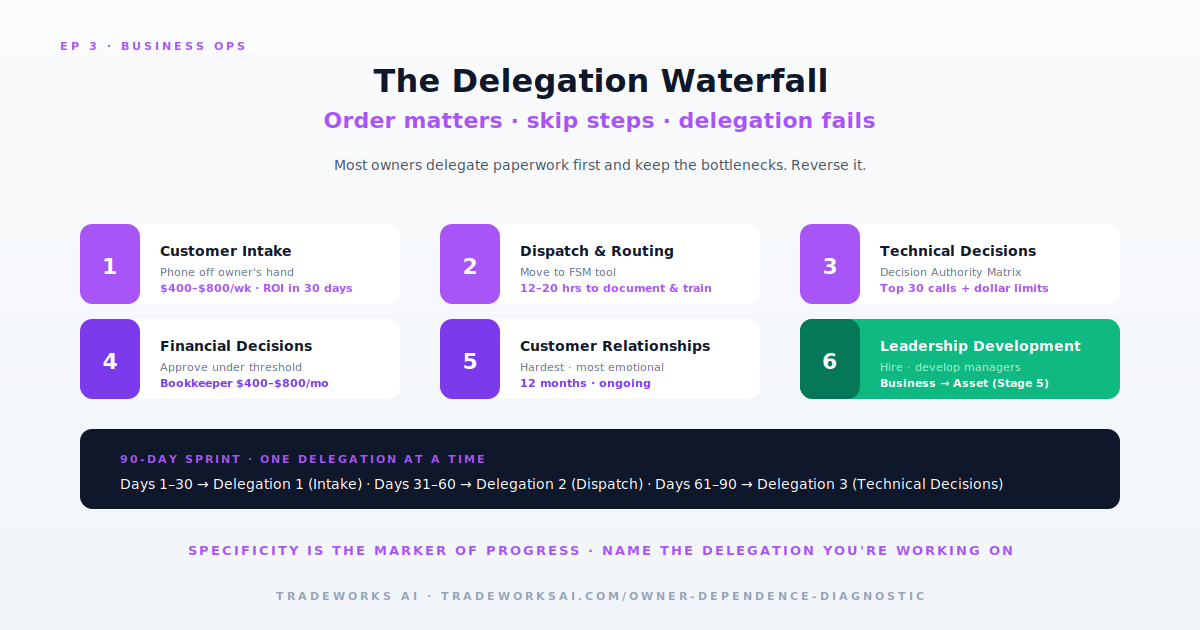
Moving up the spectrum requires delegating in a specific order. Most contractors fail at delegation because they delegate the wrong things first. The Delegation Waterfall is the sequence that actually works.
Take the phone out of the owner’s hand. Every inbound customer call routes to a trained intake person — part-time office helper, virtual assistant, or answering service following your script. The owner stops being the receptionist.
Cost: $400–$800/week for part-time helper or VA. Time investment: 8–12 hours to record intake training. Impact: most contractors recover 5–10 hours per week immediately. The math: at $150/hour billable rate, the time recovered pays for the helper within the first 30 days.
Dispatch is the operational backbone. As long as the owner is dispatching, the owner is the operational bottleneck. Move dispatch to the trained intake person or operations coordinator. Use a dispatch tool (Housecall Pro, ServiceTitan, Jobber, FieldEdge) — not a spreadsheet, not a paper calendar, not text messages.
Cost: software included in CRM/FSM tool. Time investment: 12–20 hours to document and train. Impact: removes the most-cited reason owners can’t leave — the perception that “nobody else can dispatch as well as I can.”
Most contractors are bottlenecks on standard technical decisions because the technicians ask before doing. Build a Decision Authority Matrix: explicit authority on the top 30 most common technical decisions, with dollar limits and clear criteria. Anything above threshold escalates; anything below is the technician’s call.
Cost: zero. Time investment: 8–16 hours to build with input from senior techs. Impact: technicians make decisions faster, customers experience faster service, owner stops being the bottleneck for routine technical questions.
Pay invoices, approve standard expenses, process payroll without owner sign-off on every line item. Set thresholds: bookkeeper or controller can approve recurring expenses up to $X without owner approval, can process payroll without exception, routes only outliers to owner.
Cost: bookkeeper $400–$800/month. Time investment: 4–8 hours to document approval thresholds. Impact: removes the daily drain of approving routine financial transactions.
Hardest delegation because it’s emotional. Most owners built the customer base personally and feel that customers want to deal with them specifically. Reframe: customers want their problems solved. They prefer the owner only because they don’t trust anyone else to solve their problem. Train your team well enough that the customer trusts them. Then introduce the team to the customer in person, in writing, in service delivery. Within 12 months, customers stop asking for the owner.
Cost: zero. Time investment: ongoing through training and process. Impact: removes the customer-relationship dependency that is the single biggest blocker to selling.
The final delegation is hiring and developing leaders — not just technicians or office staff, but managers who can run functions of the business. Operations manager. Service manager. Sales manager. Controller. Each leader hired and developed by the owner removes another dimension of dependence.
Cost: $80K–$150K/year per leader (loaded). Time investment: 12–18 months to hire, onboard, and develop. Impact: this is the move that converts a Position 2 (Business) into a Position 3 (Asset).
Don’t try all six delegations at once. Pick one, work it for 90 days, then move to the next. The order matters — each delegation builds on the previous.
Hire the part-time helper or VA. Record intake training. Document the script. Stop answering customer calls personally by Day 30. Track: number of calls handled by you vs. helper. Goal: helper handles 80%+ of new customer calls by Day 30.
Move dispatch to the helper or dedicated dispatcher. Document dispatch logic. Train. Stop dispatching personally by Day 60. Track: number of dispatch decisions made by you. Goal: under 5 per week by Day 60.
Build the Decision Authority Matrix with senior technicians. Communicate to the team. Enforce by deflecting routine technical questions back to the technician’s authority. Track: number of technical questions escalated to you. Goal: 50% reduction by Day 90.
Want a personalized 90-day plan based on your starting position? The Owner Dependence Diagnostic identifies your weakest delegation and gives you the exact next step → tradeworksai.com/owner-dependence-diagnostic
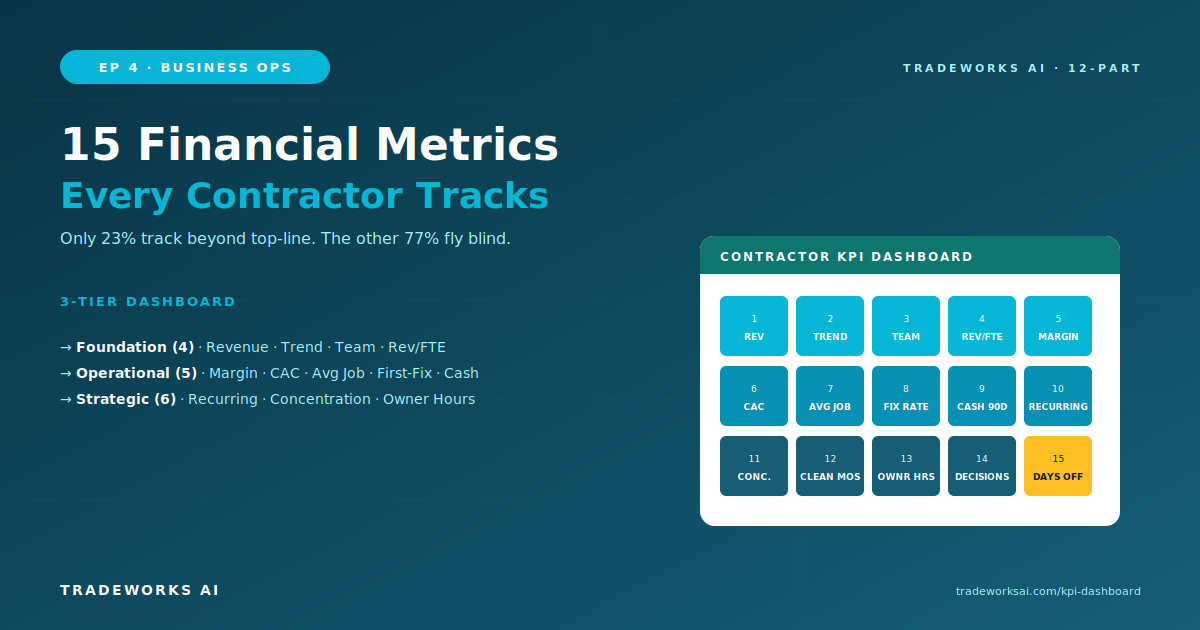
Three KPIs measure progress on owner independence. Join the broader Contractor KPI Dashboard introduced in Part 4:
Owner Hours Per Week — self-tracked time spent on the business. Target: under 35 hours by Stage 4. Single most honest indicator.
Decisions Routed to Owner — weekly count of operational, technical, financial, and customer decisions that required owner involvement. Target: under 10/week by Stage 4.
Days Off in Trailing 12 Months — actual days fully disconnected (not “working from the lake”). Target: 30+ at Stage 4.
Most contractors who actively work the Delegation Waterfall move from Position 1 (Job) to Position 2 (Business) in 9 to 12 months. Moving from Position 2 (Business) to Position 3 (Asset) typically takes another 12 to 18 months because it requires hiring leaders. Total transition from Job to Asset: 24 to 30 months for contractors who commit consistently.
Customer intake — inbound calls. The phone is the most-cited bottleneck and the easiest to delegate because it requires the least judgment. A trained part-time helper or VA following a script handles 80%+ of new customer calls without dropping quality. Cost $400–$800/week. Time recovered: 5–10 hours/week. ROI positive within 30 days.
When the owner is the bottleneck, the owner is also the relationship manager. Customers tied to the owner personally tend to be larger, longer-tenured, and more demanding. They get more attention because they bring more revenue and demand more of the owner’s time. Smaller customers churn or get under-served. Result: the customer base concentrates on a small number of large, owner-dependent relationships — which is exactly the structure that destroys sale value (Pillar 4 in Part 2).
Yes — at a discount, with seller financing, with an earn-out, and likely with a 6–12 month consulting agreement. Total cash at close on owner-dependent businesses: typically 40–60% of headline price. The buyer has to structure it this way because revenue collapse risk without the seller is real and quantifiable. If you’re planning to sell within 12 months, the highest-leverage work is reducing owner dependence — not finding a buyer.
Most common reason delegation fails: order. Most owners try to delegate the things they hate doing (paperwork, payroll) and keep the things they enjoy (customer relationships, technical decisions). The Delegation Waterfall reverses this: it requires delegating the operational core (intake, dispatch, technical decisions) first — the things that make you the bottleneck — and keeping the strategic work the owner is best positioned to do. Try the Waterfall in order. The order is the system.
82% of contractor businesses never break $1M, and most don't know which operational system is missing. Our free audit grades your business against the 5 stages, names the chaos gap blocking you, and identifies the highest-leverage system to build next.
Continue the Business Operations series with Part 2 of 12.
Continue the Business Operations series with Part 4 of 12.