Marketing & Psychology · Part 2
The Two Brains: Why Homeowners Decide with Emotion and Explain with Logic
Continue the Marketing & Psychology series with Part 2 of 15.
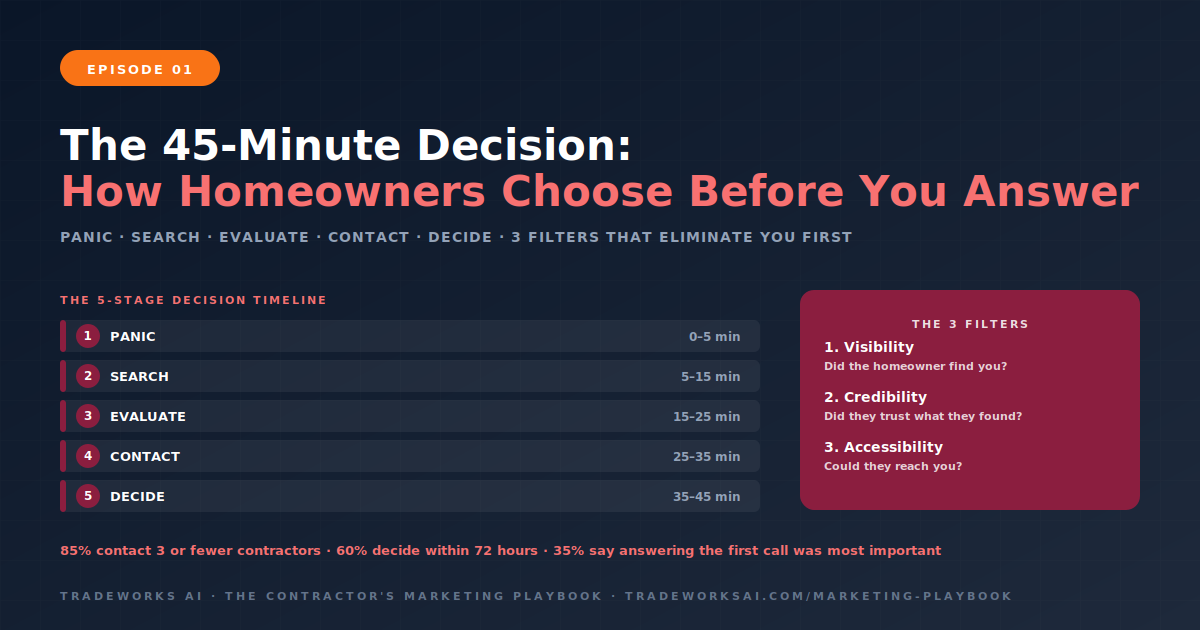
Homeowners choose a contractor through a rapid, high-stakes decision process driven more by psychology than by price comparison. 85% of homeowners contact 3 or fewer contractors. 60% make a hiring decision within 72 hours. 35% say the most important factor was simply answering the initial call—40% rarely or never hire a contractor who did not answer the first call. The 45-Minute Decision Map traces this process through 5 stages (panic, search, evaluate, contact, decide) and 3 filters that eliminate contractors before a conversation ever happens: Visibility (did the homeowner find you?), Credibility (did they trust what they found?), and Accessibility (could they reach you?). Fail any single filter and you are eliminated before you can compete on price, quality, or experience. Marketing does not start with ads. It starts with understanding how the human brain makes decisions under uncertainty.
A homeowner’s AC dies at 2:14 PM on a Saturday in July in Tampa. The house is 89 degrees and climbing. Two children are cranky. The dog is panting. The homeowner does not open a spreadsheet to methodically compare HVAC contractors by certification, years of experience, and warranty terms. The homeowner picks up their phone. What happens in the next 45 minutes determines which contractor gets paid $3,500 today. Not which contractor is the best. Not which contractor has the most experience. Which contractor the homeowner finds, trusts, and reaches. This is the moment that defines everything in contractor marketing. Not the ad. Not the logo. Not the website redesign. The 45 minutes between when a homeowner realizes they need help and when they commit to hiring someone.
The homeowner’s decision process unfolds in 5 stages. Each stage has a dominant psychology and a specific marketing implication.
At each stage of the decision map, one of three filters can eliminate a contractor before any human interaction occurs.
If the homeowner does not find you during the Search stage, nothing else matters. Your landing pages, your reviews, your certifications, your 30 years of experience—all invisible. Visibility means appearing in the Google Map Pack, in Local Service Ads, in the organic results, or in the homeowner’s prior memory. The contractor who is not visible is not considered. This is not about being the best result. It is about being a result at all. The 45-minute window does not include time for page-two research. If you are not on page one, you are not in the decision.
The homeowner finds 3 to 5 options in 10 minutes. They do not schedule consultations with all 5. They eliminate 60 to 70% based on credibility proxies—signals that take seconds to evaluate. The most powerful credibility proxies in 2026: review count and rating (62% of homeowners say reviews are very or extremely important in their decision), professional photos versus no photos or stock photos, website quality (8 to 15 seconds to form an impression), licensing and insurance badges visible, and Google Guaranteed badge for LSA contractors. The homeowner is not conducting a thorough investigation. They are scanning for reasons to eliminate you. One missing signal—no reviews, a poor website, no licensing badge—is enough. 48% of homeowners say finding a trustworthy contractor is a challenge. The contractors who make trust visible do not have this problem.
The homeowner passes Visibility and Credibility. They are ready to call. The phone rings. No answer. 26% of all contractor calls go unanswered. 40% of homeowners say they rarely or never hire a contractor who did not answer the first call. Less than 1 in 6 unanswered calls result in a voicemail callback request. The homeowner hangs up and calls the next contractor on their list. In the 45-minute window, the homeowner is not waiting for callbacks. They are moving to the next option. Accessibility means answering the phone, responding to online requests within minutes (not hours), and providing certainty on the first contact: we can come today, here is what it will cost approximately, we are on our way.
The contractor with the most experience, the best certifications, and the highest quality work can lose every time to a contractor who is more visible, more credible-looking online, and more accessible by phone. This is not unfair. This is how human decision-making works under stress. The homeowner is not choosing the best contractor. They are choosing the first acceptable contractor. This is called satisficing—a decision strategy where the brain stops evaluating once it finds an option that meets the minimum acceptable criteria. Under stress, the threshold for acceptable drops and the speed of the decision increases. The 45-Minute Decision Map is a satisficing process, not an optimization process.
Most contractor marketing focuses on messaging—what to say in the ad, what to write on the website, how to position the brand. The 45-Minute Decision Map reveals that the majority of hiring decisions are determined before any messaging is evaluated. The homeowner eliminates contractors through filters, not comparisons. If you pass all three filters—you are visible, you appear credible, you are accessible—you are in the final 2 to 3 options. At that point, messaging, price, and experience matter. But most contractors never reach that point because they fail a filter they did not know existed.
The Marketing Playbook that follows this episode teaches you how to win at each filter and then convert at each stage. Social Proof (Episode 4) builds credibility. Authority (Episode 5) elevates your perceived expertise. Reciprocity (Episode 6) creates goodwill before the emergency. Every principle in this series maps back to the 45-Minute Decision Map.
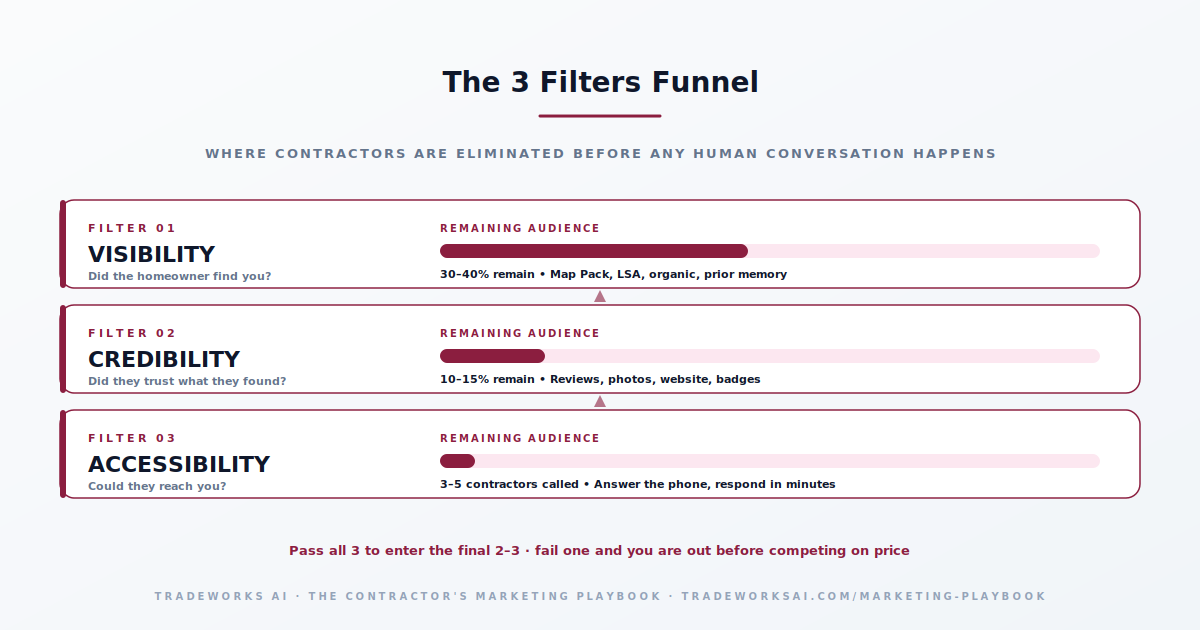
85% of homeowners contact 3 or fewer contractors. 60% decide within 72 hours. The decision process follows 5 stages (panic, search, evaluate, contact, decide) filtered by visibility, credibility, and accessibility. Answering the phone is the single most impactful factor—35% of homeowners say it is the most important.
In an emergency decision, homeowners move to the next contractor immediately. Less than 1 in 6 unanswered calls result in a voicemail callback. The 45-minute decision window does not include time for waiting. The homeowner calls the next visible, credible, accessible option.
Answering the initial call. 35% of homeowners say it is the single most important factor, and 40% rarely or never hire a contractor who did not answer the first call. Beyond answering, the next most important factors are online reviews (62% say very/extremely important) and response speed.
For emergency services (HVAC, plumbing, electrical), the decision often happens within 45 minutes to a few hours. For planned projects (roofing, renovation), 60% of homeowners still decide within 72 hours of beginning their search. The window is shorter than most contractors assume.
Tactics change every quarter. Psychology has not changed in 50,000 years. The Influence Audit grades your marketing across the 7 principles — Reciprocity, Commitment, Liking, Social Proof, Authority, Scarcity, and Unity — and identifies the one principle that, when activated, lifts every other channel you run.
Continue the Marketing & Psychology series with Part 2 of 15.
Continue the Marketing & Psychology series with Part 3 of 15.