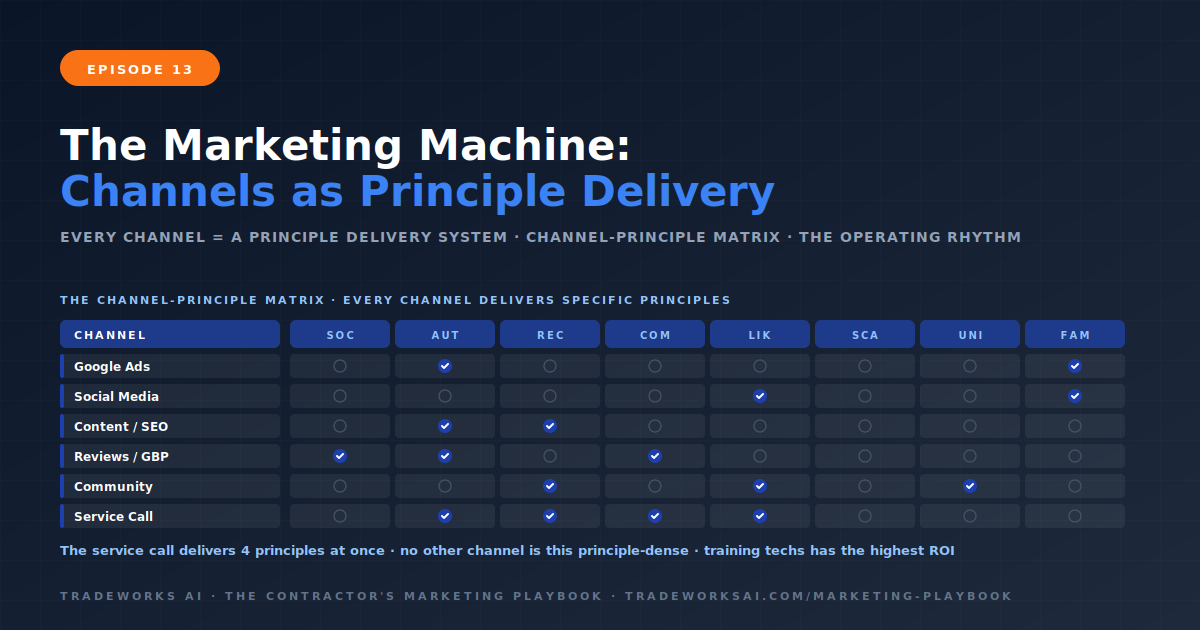
Marketing & Psychology · Part 13
The Contractor Marketing Machine: Every Channel Reframed as a Principle Delivery System
Continue the Marketing & Psychology series with Part 13 of 15.
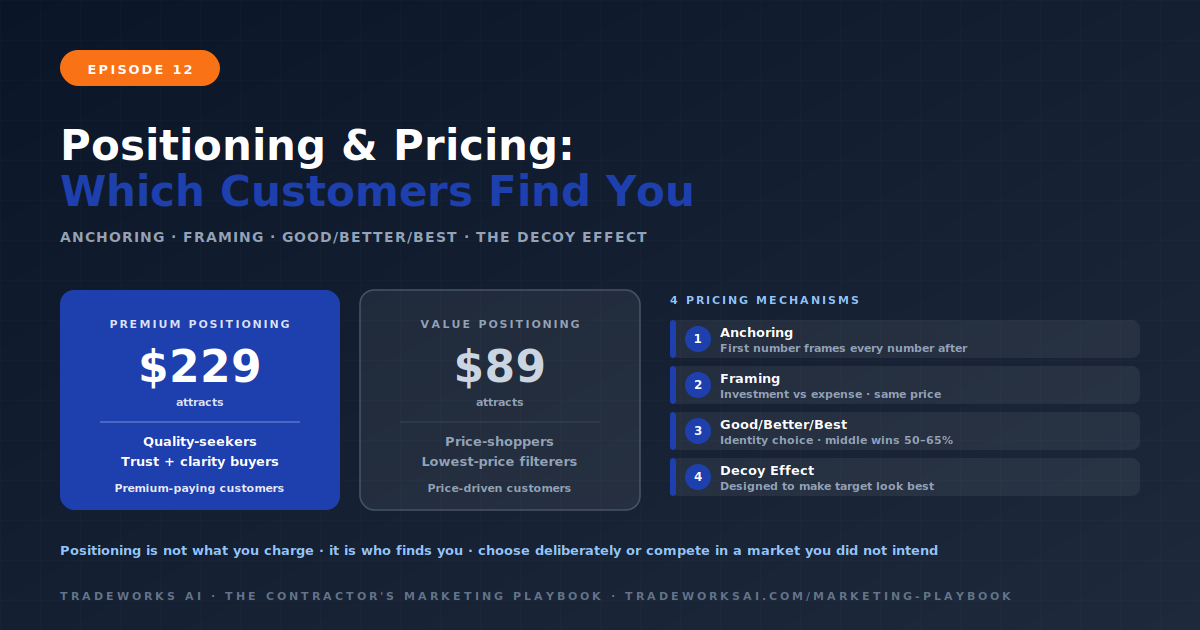
Positioning and pricing for contractors is not about choosing what to charge. It is about choosing which customers find you. The $229 contractor attracts homeowners who value expertise, clarity, and trust. The $89 contractor attracts homeowners who filter by lowest price. Both are valid markets. But the contractor who does not choose deliberately ends up competing in the market they did not intend. Pricing psychology operates through 4 mechanisms: anchoring (the first number frames everything after), framing (same repair positioned as investment vs expense), Good/Better/Best (identity commitment from Episode 7—the homeowner chooses who they are, not just what they pay), and the decoy effect (the option designed to make the target option look best). The Positioning and Pricing Worksheet defines your market position deliberately.
Positioning Is Not Price. Positioning Is Who Finds You.
Most contractors set their prices based on costs plus margin or competitive matching—they look at what competitors charge and price similarly. This is pricing without positioning. It lets the market define you rather than you defining the market. Positioning is the deliberate decision about which customers you want to attract and which you are willing to lose. The $229 HVAC contractor from Episode 5 made a positioning choice: expert diagnosis, thorough education, written estimate with options, 2-year warranty included. This package attracts quality-seeking homeowners willing to pay for certainty. The $89 contractor made a different positioning choice (intentionally or not): fast, minimal interaction, verbal quote. This attracts price-driven homeowners. Neither is wrong. But the contractor who charges $229 and markets like the $89 contractor—or vice versa—creates confusion that loses both audiences.
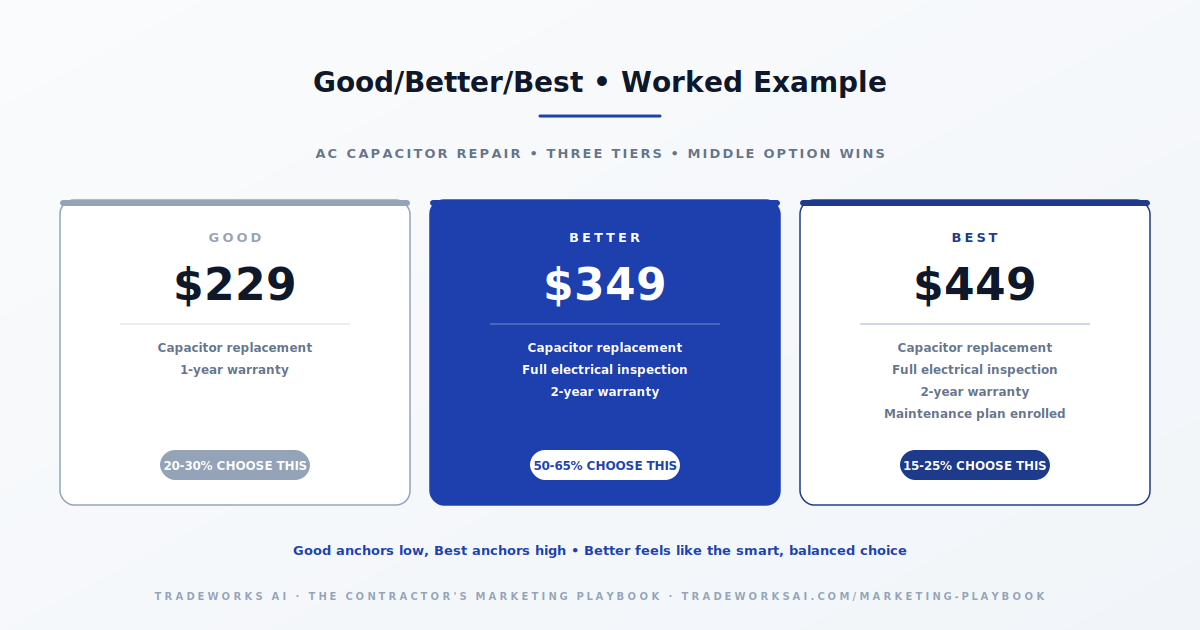
Good/Better/Best is the most important pricing structure for contractors because it activates multiple principles simultaneously. From Episode 7 (Commitment), the homeowner who chooses Better commits to an identity as a quality buyer. From Episode 5 (Authority), the written tiered estimate with clear explanations demonstrates expertise. From Episode 9 (Scarcity), the Best tier with maintenance plan enrollment creates a capacity-limited premium option. The structure transforms the conversation from is this price acceptable? to which level of service reflects my priorities? The homeowner is no longer evaluating a number. They are choosing an identity.
The middle option captures 50 to 65% of decisions in tiered pricing. This is not accidental. The Good option serves as a downward anchor (this is the minimum—do I really want the minimum?). The Best option serves as an upward anchor (this is the premium—it validates that the middle is reasonable). The Better option feels like the smart choice—more than the minimum, less than the maximum. The homeowner choosing Better feels they made a thoughtful, balanced decision.
The estimate is the anchor-setting moment. The first number the homeowner hears frames everything. If the tech leads with the repair price ($229), that is the anchor. Any additional service feels like an upsell on top of $229. If the tech instead starts with the full system context (a replacement would run $8,000 to $14,000—but that is not what we are looking at today), then presents the repair at $229, the homeowner processes $229 against the $8,000 anchor. The repair feels like relief, not expense. This is not manipulation. The $8,000 replacement is a real number. The context is genuine. Anchoring simply ensures the homeowner has the full picture before evaluating the repair price.
The Worksheet forces the positioning decision to be deliberate. Most contractors drift into a market position through pricing reactions rather than choosing it. The Worksheet defines the target customer, the market position, the pricing structure, the anchor strategy, and the framing language—ensuring every element of the price presentation aligns with the intended position.
The first number the homeowner hears frames their evaluation of all subsequent prices. Leading with a system replacement cost ($8,000–14,000) before presenting a repair ($229) makes the repair feel like relief. Leading with the repair price first makes additional services feel like upsells.
It transforms the decision from yes/no on a single price to which level reflects my priorities. The middle option captures 50–65% of decisions because Good feels minimal and Best feels premium. Better feels smart. The homeowner also commits to an identity (quality buyer) that carries forward.
Your price, marketing, and brand presentation attract a specific type of customer. Premium positioning ($229 with diagnosis, education, warranty) attracts quality-seekers. Value positioning ($89, fast, minimal) attracts price-shoppers. The contractor who does not choose deliberately competes in a market they did not intend.
An option designed to be less attractive than the target option, making the target look better by comparison. In Good/Better/Best, the Good option often serves as the decoy—its limited scope makes Better look like clearly superior value.
Tactics change every quarter. Psychology has not changed in 50,000 years. The Influence Audit grades your marketing across the 7 principles — Reciprocity, Commitment, Liking, Social Proof, Authority, Scarcity, and Unity — and identifies the one principle that, when activated, lifts every other channel you run.
Continue the Marketing & Psychology series with Part 13 of 15.
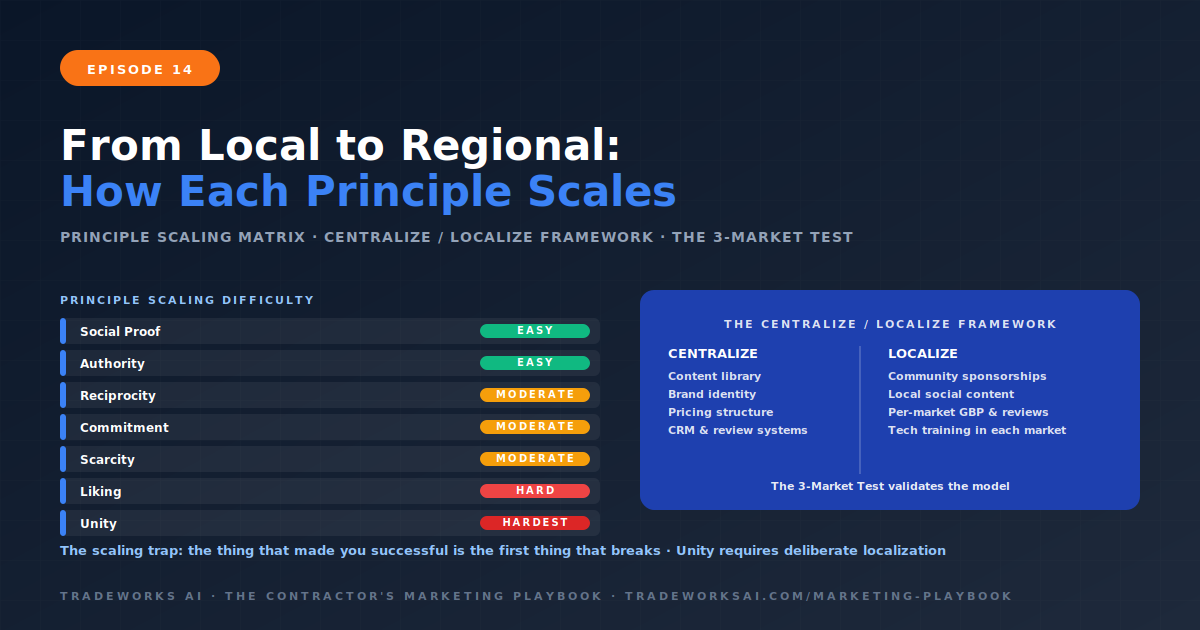
Continue the Marketing & Psychology series with Part 14 of 15.