
Business Operations · Part 5
Pricing Strategy: Stop Leaving $50K On the Table
Continue the Business Operations series with Part 5 of 12.
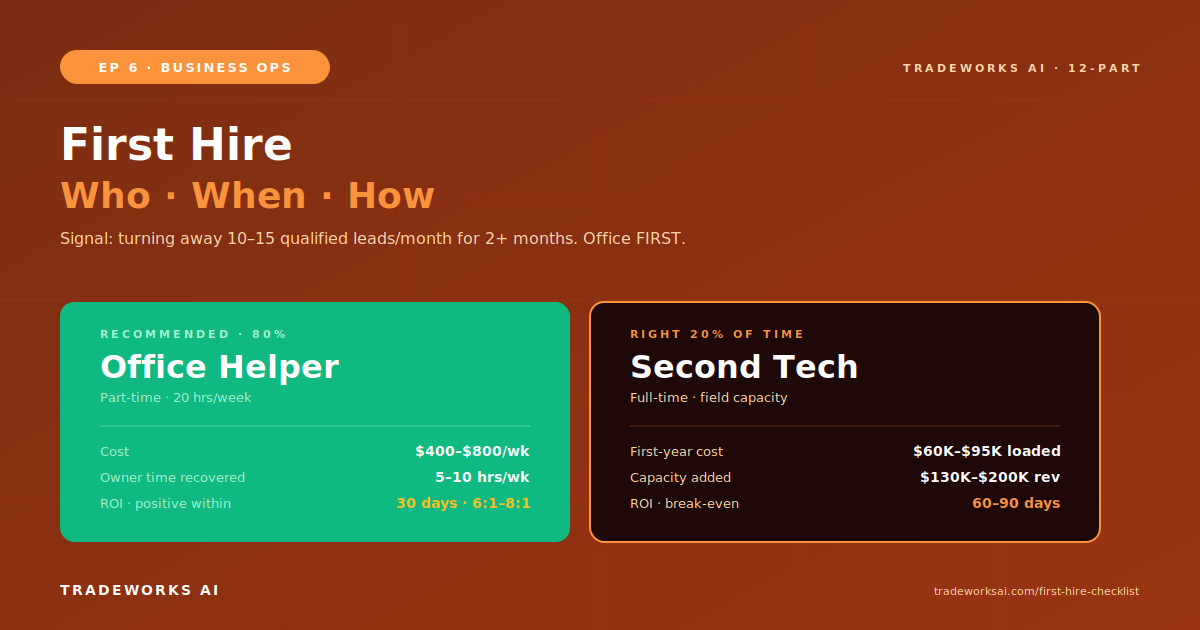
The signal to make your first hire as a contractor isn’t a revenue number — it’s when you’re consistently turning away qualified work because there isn’t time to do it all. For most contractors, that signal appears between $100K and $200K in annual revenue. The first hire should almost always be a part-time office helper or virtual assistant, not a second technician. The counterintuitive reason: the office helper frees the owner’s time for billable work (Delegation 1 from the Delegation Waterfall in Part 3), while a second technician adds capacity but also adds management overhead the owner isn’t ready for. The office helper costs $400–$800 per week, recovers 5–10 hours of the owner’s time at $150+/hour billable rate, and produces positive ROI within 30 days. The second technician comes after the office helper has proven the dispatch process works without the owner.
Download the free First Hire Checklist — hiring timeline, interview questions, onboarding plan, and ROI calculator → tradeworksai.com/first-hire-checklist
In Part 1, we introduced the exit ticket from Stage 1 (Solo Operator): when you’re consistently turning away work because there isn’t time to do all of it. That’s the hiring signal. Not a revenue target. Not a calendar date. The signal is saying “no” to qualified work multiple times in a single month.
Hiring before the signal creates a labor cost without revenue support. The new hire sits idle on slow days, and the owner pays wages without the demand to justify them. Hiring after the signal — waiting too long once you’re consistently turning away work — delays growth and burns out the owner.
The quantitative proxy: track the number of qualified leads you decline or fail to respond to each month. When that number exceeds 10–15 per month for two consecutive months, the demand exists to support a hire. Below that, the demand doesn’t justify the cost.
Most contractors assume the first hire should be a second technician — another set of hands to run more jobs. The logic seems sound: more capacity, more revenue.
It’s the wrong hire 80% of the time. Here’s why.
A second technician adds capacity but also adds management overhead: who dispatches them? Who answers the phone while you’re both in the field? Who handles intake, scheduling, invoicing, follow-up? If the answer to all of those is still “you,” then the second technician doesn’t free you — they add more work to your plate on top of the field work you’re already doing.
The first hire should be a part-time office helper or virtual assistant whose primary job is Delegation 1 from Part 3’s Waterfall: customer intake (answering the phone). The secondary job is Delegation 2: dispatch and routing.
If the owner’s primary bottleneck is time spent on phone calls, scheduling, invoicing, and admin, the office helper is the right first hire. If the owner’s bottleneck is genuinely physical capacity — they have more jobs than they can run but the admin is under control — then the technician is the right first hire. For most solo-operator contractors, the bottleneck is admin even if it doesn’t feel that way.
Not sure which hire to make first? The First Hire Checklist walks through the Decision Matrix with your specific numbers → tradeworksai.com/first-hire-checklist
The first hire feels expensive to a solo operator who has never had payroll. Here’s the actual math.
The math works because the owner’s time is worth more on the truck than on the phone. Every hour the owner spends answering calls, dispatching, and invoicing is an hour not spent generating $150–$200 in billable revenue. The office helper costs $20–$25 per hour to recover that $150–$200 per hour of owner revenue. The ROI is 6:1 to 8:1.
The technician hire is a bigger bet — higher cost, longer break-even, more management required. It’s the right hire when demand justifies capacity expansion, not when the owner is drowning in admin.
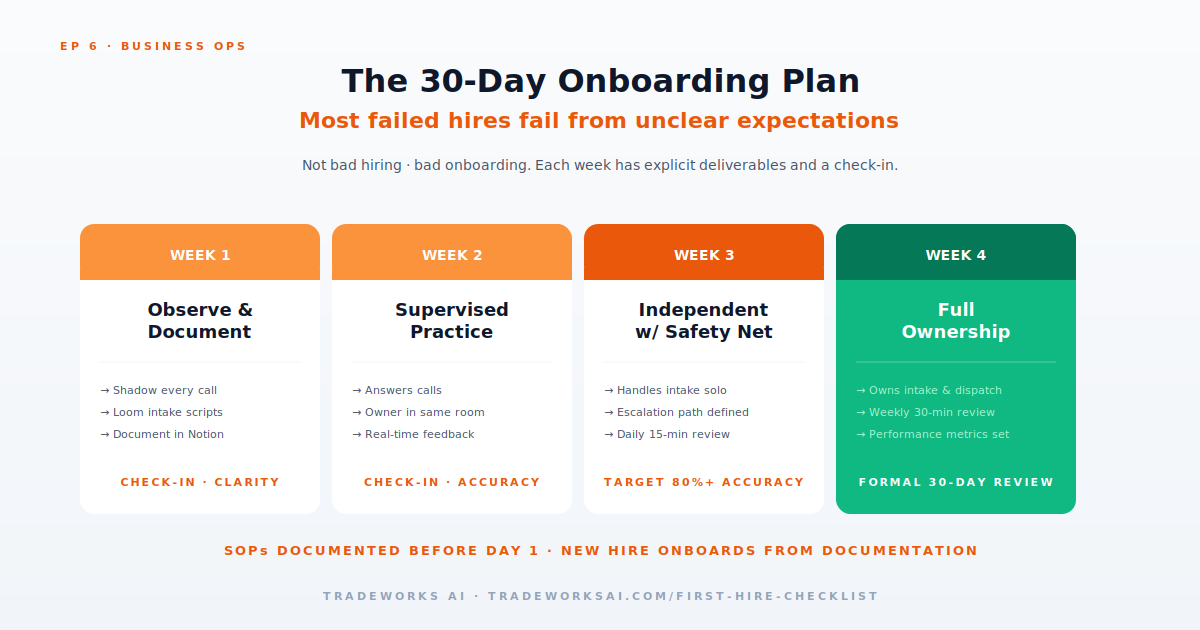
The first 30 days determine whether the hire succeeds. Most failed first hires fail because of unclear expectations and inadequate training, not bad hiring. The 30-Day Onboarding Plan removes ambiguity.
New hire shadows the owner on every call, dispatch decision, and customer interaction
Owner records intake scripts on Loom (3–5 common call types)
New hire creates written documentation of observed processes in Notion or Google Docs
End of Week 1 check-in: “What’s clear? What’s unclear?”
New hire answers calls with owner listening (not on the line — in the room)
New hire dispatches from the tool with owner reviewing end of day
Owner provides real-time feedback after each call and each dispatch decision
End of Week 2 check-in: review accuracy rate on calls and dispatch
New hire handles intake and dispatch independently
Escalation path defined: what gets handled alone, what gets routed to owner
Owner reviews dispatch log daily (15 minutes) but doesn’t intervene unless asked
End of Week 3: accuracy should be 80%+ on standard calls
New hire owns intake and dispatch fully
Owner’s review drops to weekly (30 minutes)
Performance metrics established: calls handled, dispatch accuracy, customer satisfaction
End of Week 4: formal 30-day review with documented expectations for Month 2
From Part 1 (Stage 2): document these five SOPs before the first hire starts. The new hire onboards from documentation, not tribal knowledge.
SOP 1: New Customer Intake — how to answer the phone, capture customer info, set expectations, and book the appointment.
SOP 2: Job Scheduling and Dispatch — how to route jobs, assign technicians (when applicable), and handle scheduling conflicts.
SOP 3: Truck Stocking — standard parts list, reorder process, vendor contacts.
SOP 4: End-of-Day Reporting — how to close out jobs in the system, reconcile payments, and flag incomplete work.
SOP 5: Customer Follow-Up — post-service check-in call/text within 24 hours, review request trigger.
Record each SOP on Loom (screen + voice). Document in Notion or Google Docs. Total investment: 8–12 hours. Total cost: under $50/month for tools. This is the operational foundation that makes the first hire successful.
Hiring a friend or family member without clear role definition and performance expectations. Personal relationships and employment relationships require different boundaries.
Hiring before the demand signal (turning away 10–15 qualified leads per month for 2+ months). Premature hiring creates cost without revenue support.
Hiring a technician when the bottleneck is admin. The technician adds capacity the owner can’t manage because the owner is still drowning in phone calls.
Failing to document SOPs before the hire starts. The new hire onboards from tribal knowledge, develops their own shortcuts, and becomes impossible to replace.
Not setting a 30-day review checkpoint. Problems compound silently without structured feedback.
The First Hire Checklist includes the Decision Matrix, ROI calculator, 30-day onboarding timeline, 5 SOP templates, and interview question bank → tradeworksai.com/first-hire-checklist
The first hire unlocks capacity for the second and third. The sequence:
Hire #1 (office helper): takes intake and dispatch off the owner’s plate. Owner goes back to full-time billable work.
Hire #2 (first technician): now that intake and dispatch are handled, adding a technician is operationally feasible. The office helper dispatches both the owner and the new tech.
Hire #3 (second technician or operations coordinator): depends on demand. If demand supports 3 trucks, hire a tech. If the office helper is overwhelmed, upgrade to a full-time operations coordinator.
The signal for each subsequent hire is the same: the current team is consistently turning away qualified work. Don’t hire speculatively. Hire in response to proven demand.
$20–$25/hour for a part-time office helper (20 hours/week). $18–$22/hour for a virtual assistant. In the Tampa Bay market specifically, $22–$25/hour attracts reliable part-time candidates with customer service experience. The total weekly cost of $400–$500 produces $750–$2,000 in recovered owner billing time, making it positive-ROI within 30 days.
For an office helper handling intake and dispatch, W-2 is strongly recommended. The IRS classification test for 1099 requires that the worker controls how, when, and where they work. An office helper following your scripts, using your tools, and working your schedule is a W-2 employee by definition. Misclassifying creates significant legal and tax liability. Consult a payroll provider (Gusto, ADP Run) for proper classification.
If the 30-day review reveals performance below 80% accuracy on standard calls and dispatch, address the gap with specific retraining on the documented SOPs. If the 60-day mark shows no improvement, replace the hire. The SOPs and Loom recordings make replacement fast — the next hire onboards from the same materials. The documentation survives the person.
Yes, as a bridge. Answering services cost $200–$500/month and handle basic intake. They can’t dispatch, can’t handle customer relationships, and can’t grow into an operations role. Use an answering service when you need phone coverage now but aren’t ready to commit to a part-time hire. Transition to the office helper when the demand signal is clear.
82% of contractor businesses never break $1M, and most don't know which operational system is missing. Our free audit grades your business against the 5 stages, names the chaos gap blocking you, and identifies the highest-leverage system to build next.
Continue the Business Operations series with Part 5 of 12.
Continue the Business Operations series with Part 7 of 12.