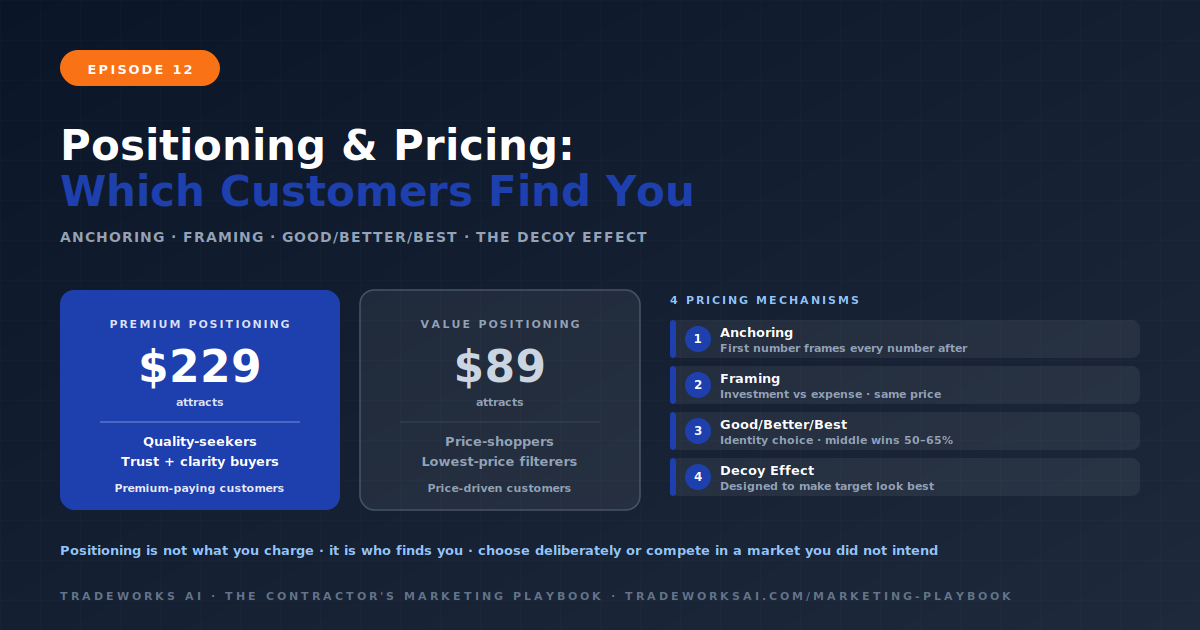
Marketing & Psychology · Part 12
Positioning and Pricing for Contractors: Anchoring, Framing, and Choosing Which Customers Find You
Continue the Marketing & Psychology series with Part 12 of 15.
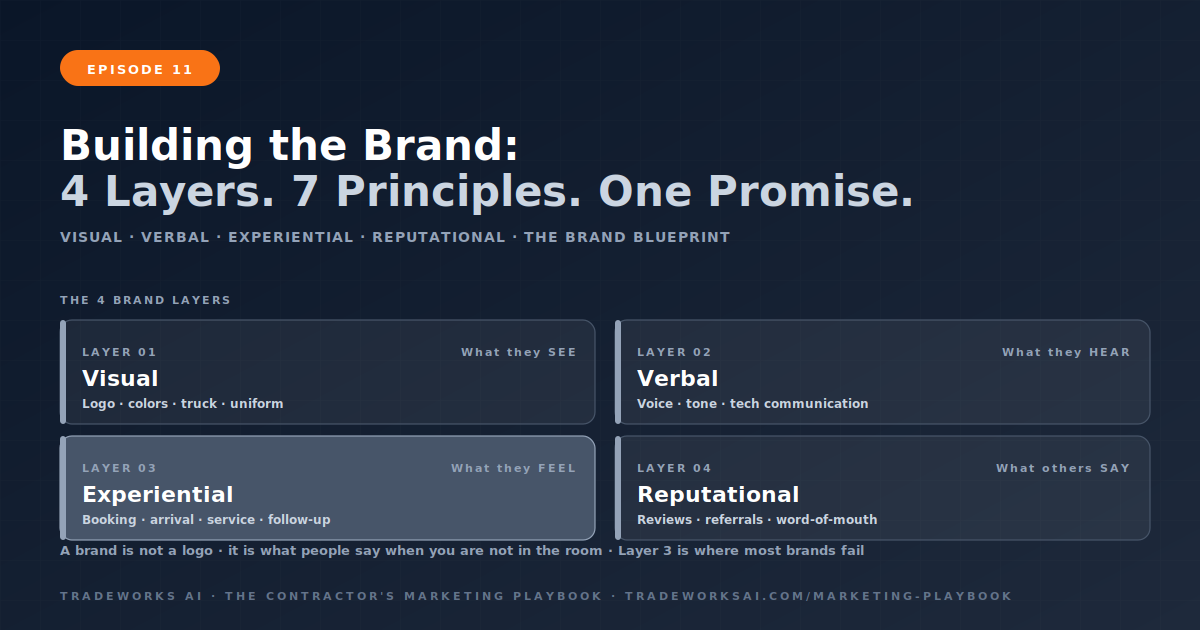
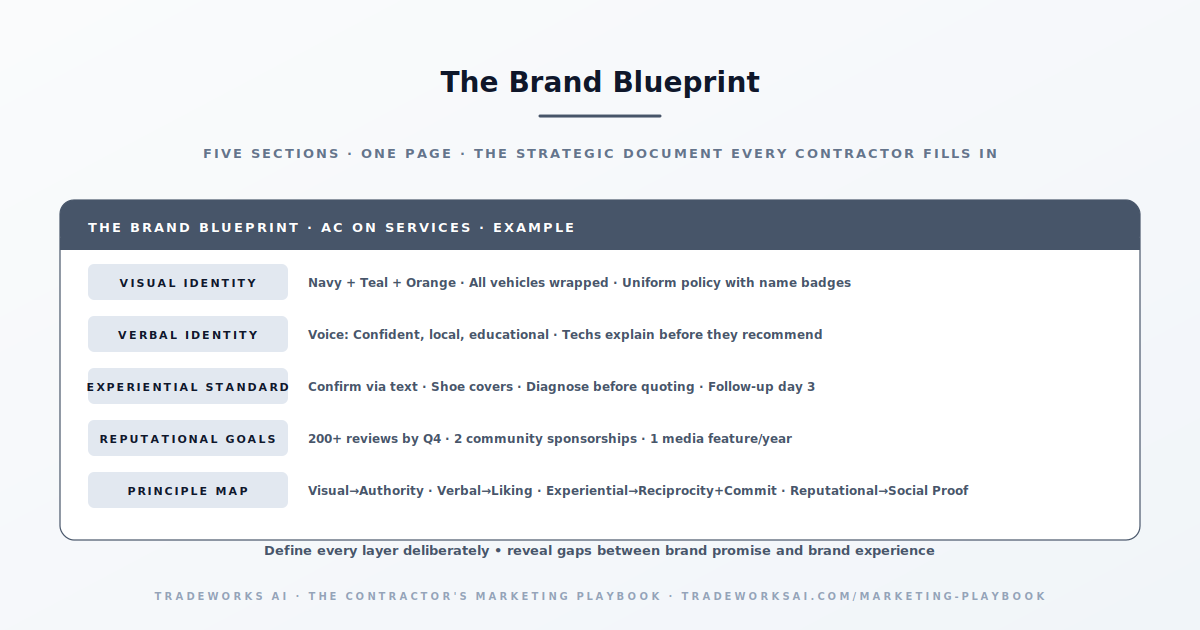
A contractor brand is not a logo, color scheme, or tagline. It is what people say about you when you are not in the room. A strong contractor brand has 4 layers: visual (logo, colors, uniforms, truck wraps, website design), verbal (voice, tone, messaging, how the tech speaks), experiential (what it feels like to be your customer—the estimate process, the service call, the follow-up), and reputational (what others say—reviews, referrals, word-of-mouth). Each layer maps to the 7 influence principles from Phase 2. The Brand Blueprint defines all 4 layers, connecting each to the principle it activates.
Most contractors think their brand is their logo. These are brand elements but not the brand. Your brand is the total impression across every touchpoint: the website visited at 11 PM, the phone voice the next morning, the truck in the driveway, the tech on the porch, the diagnosis, the estimate, the follow-up call, the review. The brand is what the homeowner says to their neighbor. If the answer includes a feeling—they were professional, they explained everything, I trusted them—that is a brand. If it is just a name with no feeling, that is a transaction.
Most contractors invest heavily in Layer 1 (visual) and underinvest in Layers 2–4. A beautiful truck wrap attached to a tech who makes the homeowner uncomfortable is a brand failure. The visual promise was broken by the experiential reality.
The experiential layer—what it actually feels like to be your customer—is the most important and most neglected brand layer. A homeowner does not experience your logo. They experience your tech, your process, your communication, your follow-through. This is where every Phase 2 principle activates or breaks in real time. If the experiential layer is weak, no visual branding compensates. Training technicians (Episode 8) is a brand decision, not HR.
In the Trust Equation, Reliability answers: do we meet expectations? Brand consistency IS reliability at scale. When every touchpoint delivers the same quality, Reliability rises. Inconsistency—beautiful website followed by disorganized service call—drops Reliability and erodes Trust Score. The brand is the promise. The experience is the delivery.
Not your logo. It is what people say about you when not in the room. 4 layers: visual, verbal, experiential, reputational. All must align.
The experiential layer—what it feels like to be your customer. Where every principle activates or breaks. Visual branding cannot compensate for weak experience.
One-page strategic document defining all 4 layers with standards, examples, and principle connections. Reveals gaps between promise and delivery.
Each layer activates specific principles. Visual: Authority, Scarcity. Verbal: Liking, Authority. Experiential: Reciprocity, Commitment, Liking. Reputational: Social Proof, Unity.
Tactics change every quarter. Psychology has not changed in 50,000 years. The Influence Audit grades your marketing across the 7 principles — Reciprocity, Commitment, Liking, Social Proof, Authority, Scarcity, and Unity — and identifies the one principle that, when activated, lifts every other channel you run.
Continue the Marketing & Psychology series with Part 12 of 15.
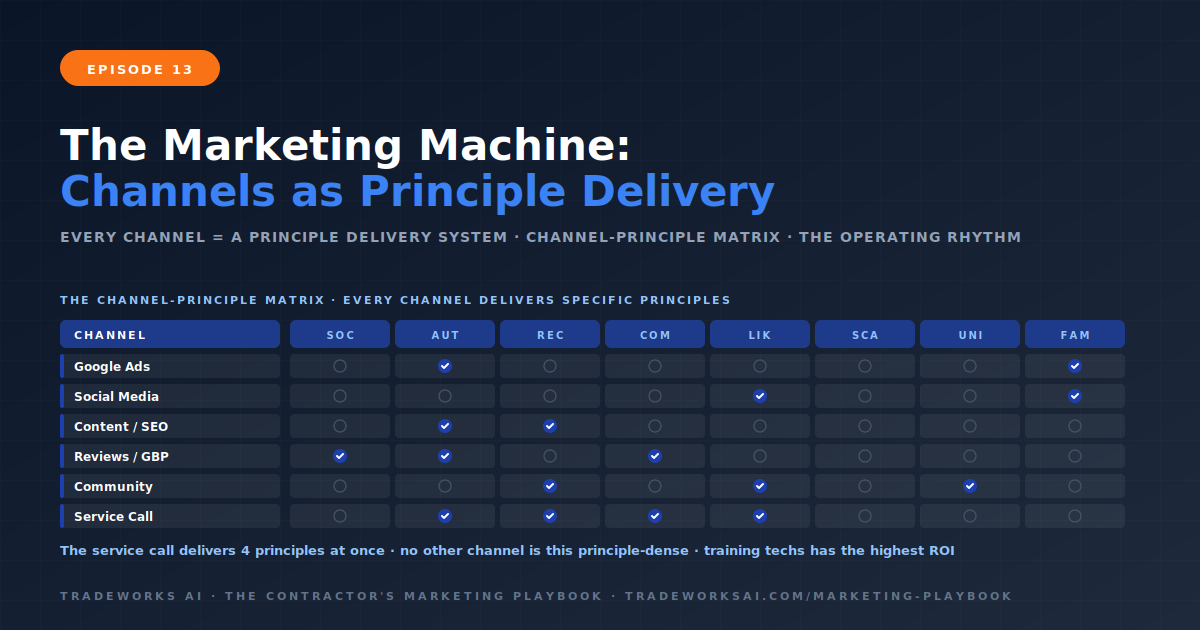
Continue the Marketing & Psychology series with Part 13 of 15.