AI for Real Estate · Part 1
AI for Real Estate Agents in 2026: What It Actually Does, What It Doesn’t, and How to Start
Continue the AI for Real Estate series with Part 1 of 7.
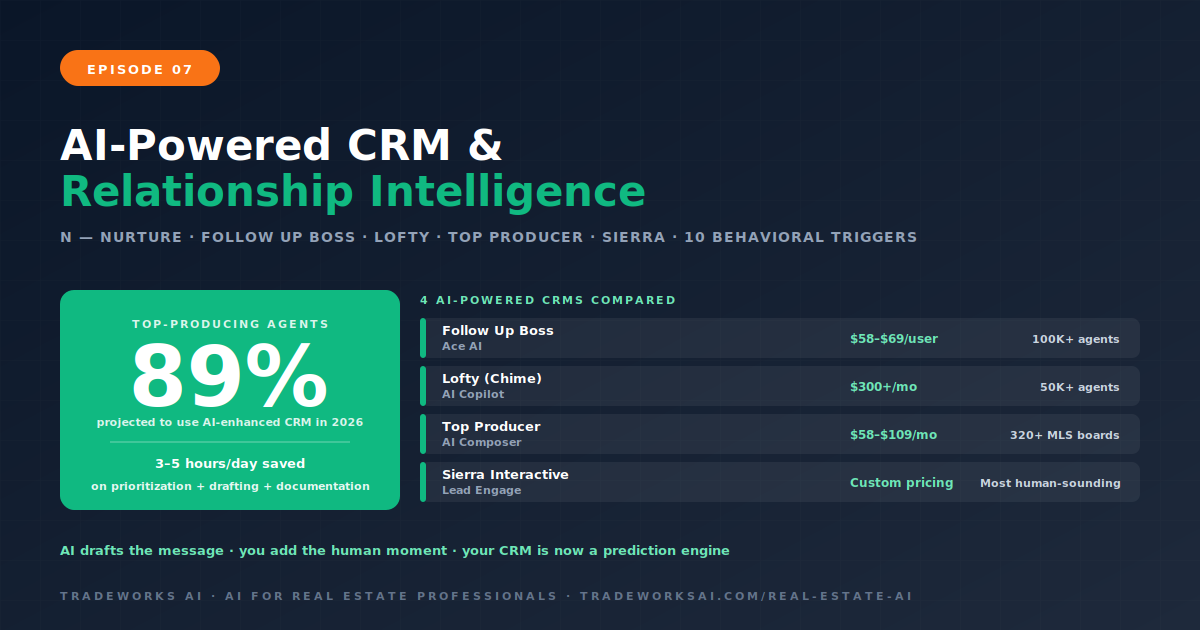
Nearly 89% of top-producing real estate agents are projected to use AI-enhanced CRM systems in 2026. McKinsey estimates that generative AI could generate $110 billion to $180 billion or more in additional value for the real estate industry, with the largest share coming from automated client engagement and lead qualification — both CRM-driven functions. The transformation is fundamental: your CRM is no longer a database where you store contacts and log activities. It is an intelligence layer that watches what every contact does, predicts who is ready to transact, drafts personalized follow-up in your voice, summarizes your calls so you never lose context, and tells you exactly who to contact each day and what to say. This episode covers the NURTURE layer of the AGENT Framework — the AI capabilities that maintain relationships at scale without sacrificing the personal touch that earns referrals.
In 2020, a CRM stored contacts and logged activities. In 2023, CRMs added basic automation — drip campaigns and task reminders. In 2026, the leading CRMs watch behavioral signals across every channel (website visits, email opens, listing views, search frequency, social engagement), score each contact by conversion probability, draft personalized follow-up based on the contact’s specific behavior, summarize phone calls and conversations for instant context, and tell agents exactly who to contact each day with specific talking points. The agent who used to spend 45 minutes each morning deciding who to call now opens their CRM and sees a prioritized list of contacts ranked by AI-detected intent signals, with suggested messages ready to send. The 45 minutes of decision-making becomes 5 minutes of review and action.
| Platform | AI Core Feature | Best For | Price | Key Differentiator |
|---|---|---|---|---|
| Follow Up Boss | Ace AI: predictive lead prioritization, call summaries, suggested texts/emails | Solo agents + teams with diverse lead sources | $58–$69/user/mo | 250+ integrations, AI built into existing workflow, 100K+ agents |
| Lofty (formerly Chime) | AI Copilot: voice commands, Smart Plans, behavioral auto-routing | Teams wanting maximum AI automation | $300+/mo | 33+ lead gen methods, deepest AI automation, 50K+ agents |
| Top Producer | AI Composer: drafts follow-up in your voice, Market Snapshot, Smart Targeting | Agents with large databases + seller focus | $58–$109/mo | MLS integration (320+ boards), best for long-term nurture |
| Sierra Interactive | Lead Engage: 24/7 AI text qualification, conversational AI | Teams prioritizing local SEO + lead volume | Custom pricing | Most human-sounding conversational AI |
| BoldTrail (kvCORE) | AI utilities, agent performance tracking, brokerage management | Brokerages wanting all-in-one + accountability | $499+/mo (brokerage) | Complete brokerage operations platform |
Follow Up Boss serves over 100,000 agents and differentiates through its approach to AI: rather than requiring agents to learn a new interface or toggle between tools, FUB embeds AI directly into the workflows agents already use. Ace AI provides predictive lead prioritization through Smart Lists that surface the contacts most likely to convert based on recent activity — website visits, email opens, property saves, and search patterns. AI-powered call transcripts mean that after every phone conversation, the agent has a searchable summary of what was discussed, eliminating the need for manual notes and ensuring no follow-up commitment is forgotten.
The suggested texts and emails are where FUB AI creates daily time savings. Instead of drafting a follow-up from scratch, the agent sees an AI-generated suggestion based on the contact’s specific activity and conversation history. A contact who just viewed three homes in Westchase on the website receives a different suggestion than one who has been inactive for 60 days. The agent reviews, personalizes with a sentence or two, and sends. The AI handles the heavy lifting of drafting; the agent handles the personal touch that makes it feel human.
Because FUB has integrated calling and texting directly in the CRM, the AI has access to the actual contents of calls and text conversations — not just metadata. This gives FUB AI a deeper understanding of each contact’s context than CRMs that rely on external communication tools.
Lofty, serving more than 50,000 agents, takes AI automation further than any competing platform. The AI Copilot allows agents to give voice instructions — describe a task in plain language and the system executes it. Smart Plans automatically route leads based on source, behavior, and engagement signals without manual configuration. The AI follows up via text, responds to replies, moves leads through the pipeline automatically, and can even trigger direct mail sequences based on digital behavior.
Lofty’s behavioral monitoring is the platform’s unique strength for relationship intelligence. Beyond responding to inbound inquiries, the AI watches what contacts do across the entire platform: which listings they view, how often they search, what price ranges they browse, whether they are returning after a period of inactivity. These behavioral signals surface intent that explicit communication does not reveal. A contact who never replies to emails but has been searching listings every night for the past week is a hot lead that manual tracking would miss entirely.
The tradeoff: Lofty’s depth of features comes with complexity. Teams should evaluate whether the breadth of automation aligns with their actual workflow before committing. For teams that can fully adopt the platform, Lofty provides the most comprehensive AI-powered CRM experience available in 2026.
Top Producer takes a different strategic approach: rather than optimizing for speed-to-lead on new inquiries (FUB’s strength) or maximum automation depth (Lofty’s strength), Top Producer optimizes for extracting value from large existing databases over long nurture cycles. The AI Composer drafts follow-up emails and texts in the agent’s voice, learning tone and style from previous communications. Market Snapshot delivers hyperlocal market reports automatically to contacts in the database, keeping agents relevant during the 6 to 18 month nurture periods that characterize most real estate relationships.
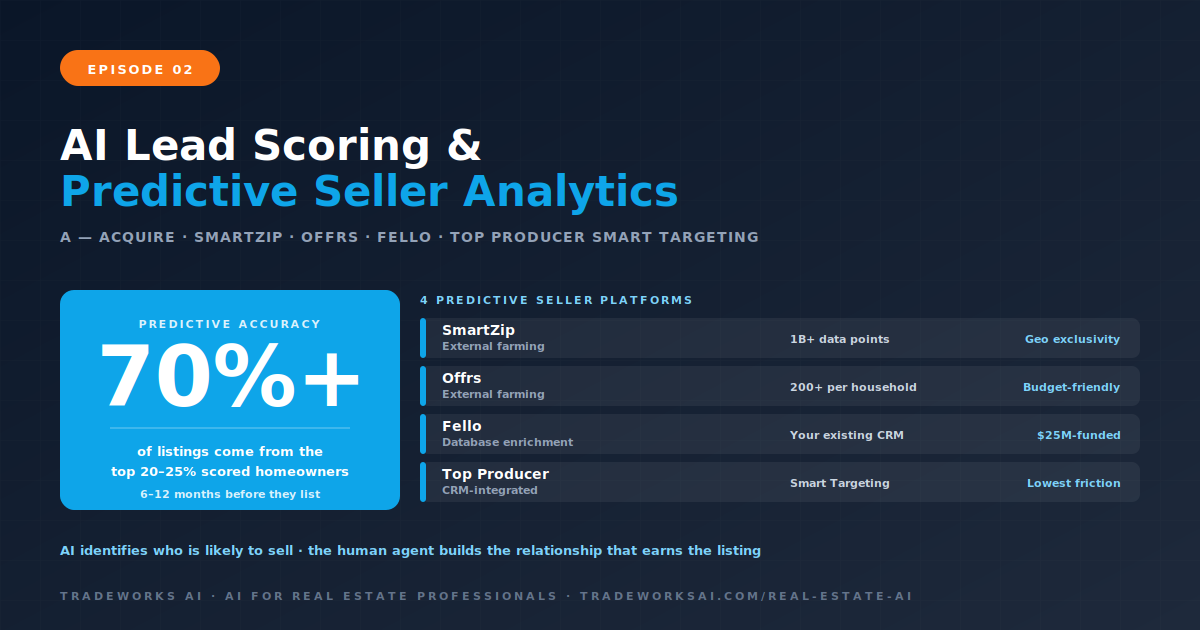
Smart Targeting, covered in Episode 2, identifies the top 20% of likely sellers in a farm area using proprietary AI. Integration with 320 or more MLS boards keeps listing data current across the CRM. For experienced agents managing databases of 500 or more contacts who want AI to help them stay consistent over long nurture cycles — particularly those targeting seller leads — Top Producer is the strongest choice.
The most valuable AI CRM feature for daily productivity is AI-generated follow-up suggestions. FUB, Lofty, and Top Producer all offer some version of this: the AI drafts a text or email based on the contact’s activity and history, and the agent reviews and sends. The quality of these suggestions depends on how well the AI understands the agent’s voice.
Voice calibration takes 15 to 30 minutes of initial setup. Review 10 to 15 AI-generated suggestions and edit each one to match your natural communication style. The AI learns from your edits. After two weeks of consistent editing, the suggestions become increasingly accurate to your voice. By week four, most agents report that AI suggestions require minimal editing — a personalized sentence or two added to an already well-drafted message. The time savings compound: 5 minutes of editing per contact versus 15 minutes of drafting from scratch, across 20 to 30 contacts per day, saves 3 to 5 hours daily.
Every AI-powered CRM in 2026 offers some form of smart list or prioritized action system. FUB’s Smart Lists filter contacts by recent activity: website visits, email opens, property saves, and text engagement. Lofty’s Smart Tasks surface the highest-priority contacts based on behavioral analysis. Top Producer’s Follow-Up Coach tells agents who to contact each day and provides conversation starters. The common principle: the AI eliminates decision fatigue. Instead of staring at a database of 1,000 contacts wondering who to call, the agent opens the CRM and sees 15 prioritized contacts with specific reasons for each one and suggested talking points. Decision-making time drops from 45 minutes to 5 minutes. The agent spends the saved 40 minutes actually talking to people.
Follow Up Boss at $58 to $69 per user per month. The Smart List prioritization and 250 or more integrations mean every lead gets worked regardless of source. AI is built into the existing workflow, not a separate tool. The learning curve is the shortest of any AI-powered CRM.
Lofty for teams wanting maximum AI automation depth, or FUB for teams with diverse lead sources wanting integration flexibility. Lofty provides deeper automation but at higher cost and complexity. FUB provides broader integration with a simpler interface. The choice depends on whether the team values automation depth or integration breadth.
Yes, after voice calibration. The AI learns from your edits over approximately two weeks of consistent use. By week four, most agents report suggestions require only minor personalization. The key is actively editing the first 10 to 15 suggestions rather than accepting generic defaults. The AI adapts to your voice faster than most agents expect.
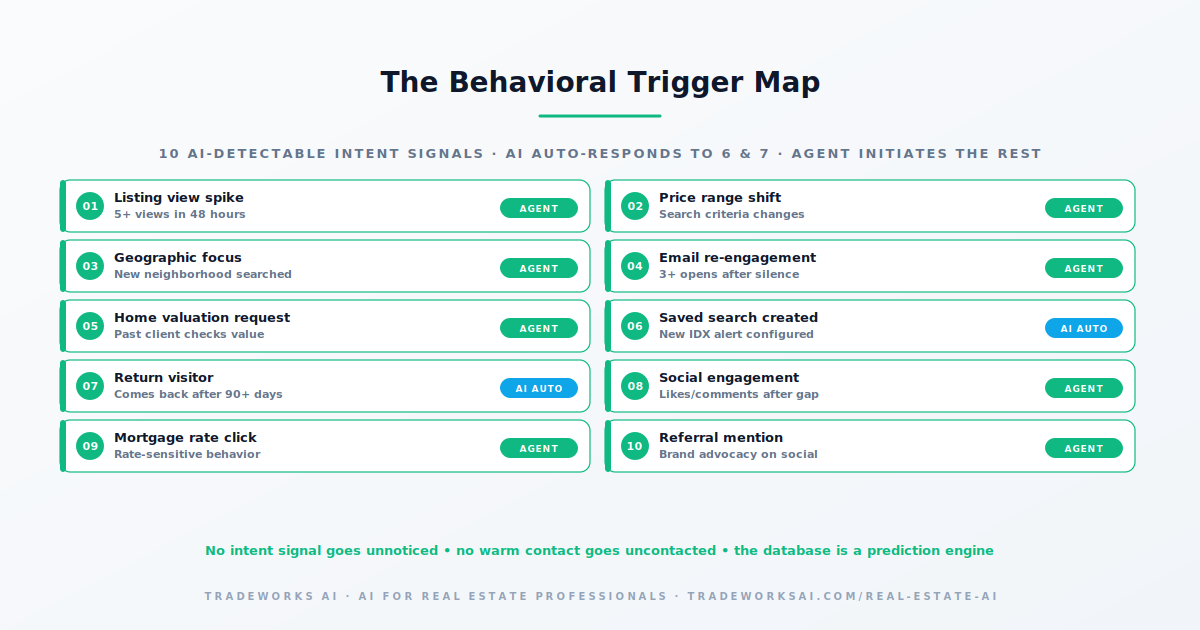
Listing view spikes (resumed active search) and home valuation requests (potential seller) are the two highest-value triggers. A past client who checks their home value through Homebot or your website is signaling potential selling intent. A cold lead who suddenly views five listings in 48 hours has restarted their search. Both require immediate, personal follow-up.
Agents using fully configured AI CRM features report saving 3 to 5 hours per day on lead prioritization, follow-up drafting, call documentation, and decision-making about who to contact. The time comes primarily from eliminating the daily “who should I call?” deliberation and the per-contact drafting time. This translates to 15 to 25 additional hours per week spent on actual client-facing activities rather than administrative CRM work.
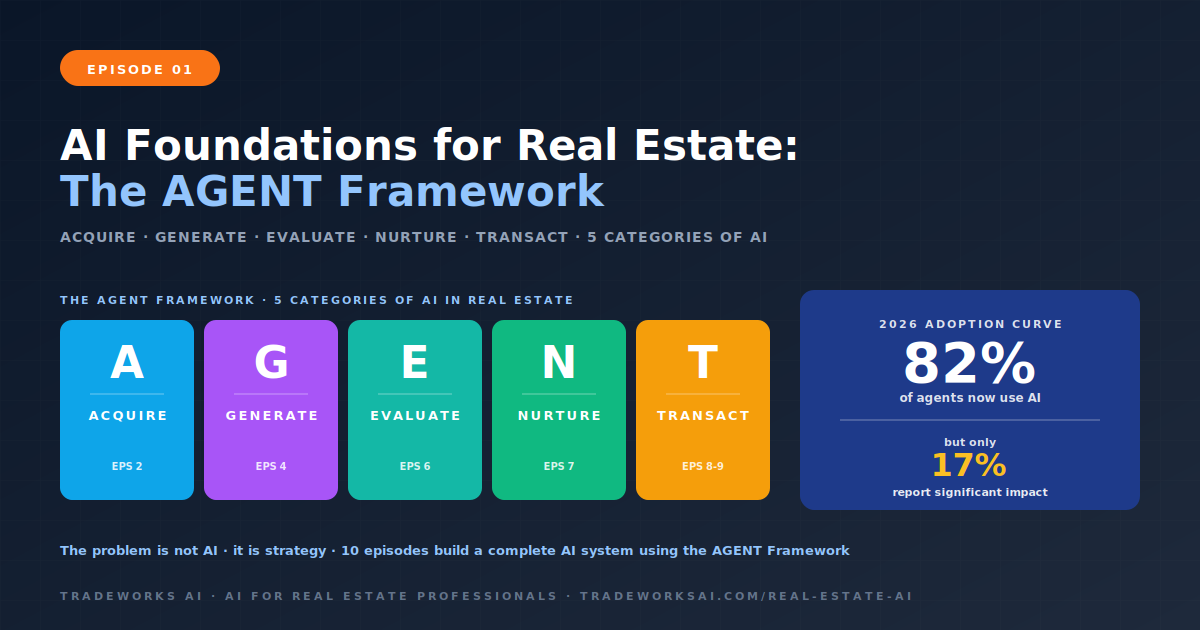
82% of agents use AI. Only 17% report significant impact. The difference is not the tools — it is the strategy. The AI Readiness Assessment grades your business across 6 dimensions and maps the AGENT categories to the right stack for your stage.
Continue the AI for Real Estate series with Part 1 of 7.
Continue the AI for Real Estate series with Part 2 of 7.